The book, as slides to post and to present: horizontal PDFs, every slide with its speaker notes. Drawn from data like the rest of this site, so a slide is corrected by changing a line and rendering again.
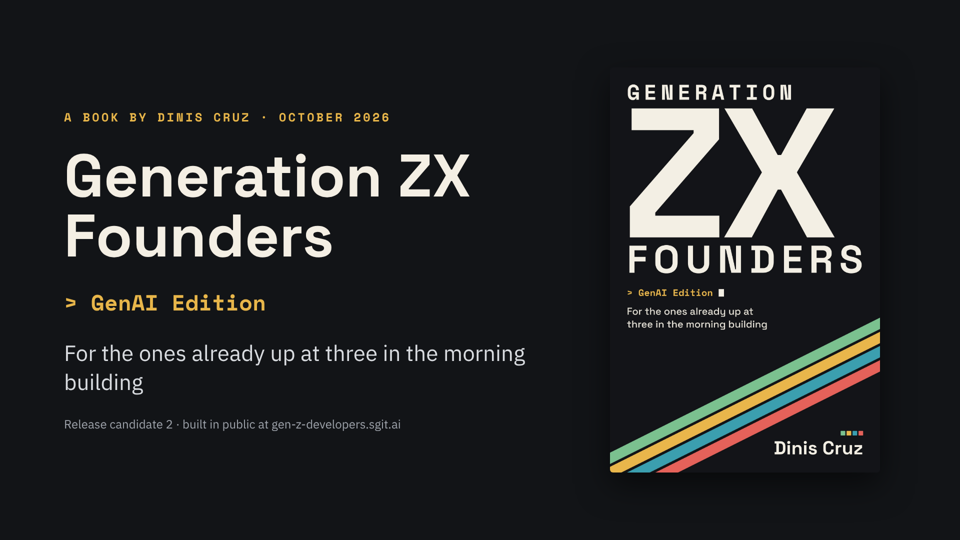
Generation ZX Founders (GenAI Edition): the book in twelve slides
A horizontal deck about the book, to post and to present: who it is for, what is in it, the infographics, how it is made in public, the storyboards, the three cover proposals, and where to read it. Every number is the release candidate's and the site's own; every quoted line is Dinis's, from the book and the articles. Made at Dinis's request of 19 October 2026, and retitled before release for decisions 017, 019 and 020.
Download the PDF12 slides, 16:9, 1.8 MB · made 2026-10-20 · release candidate 2
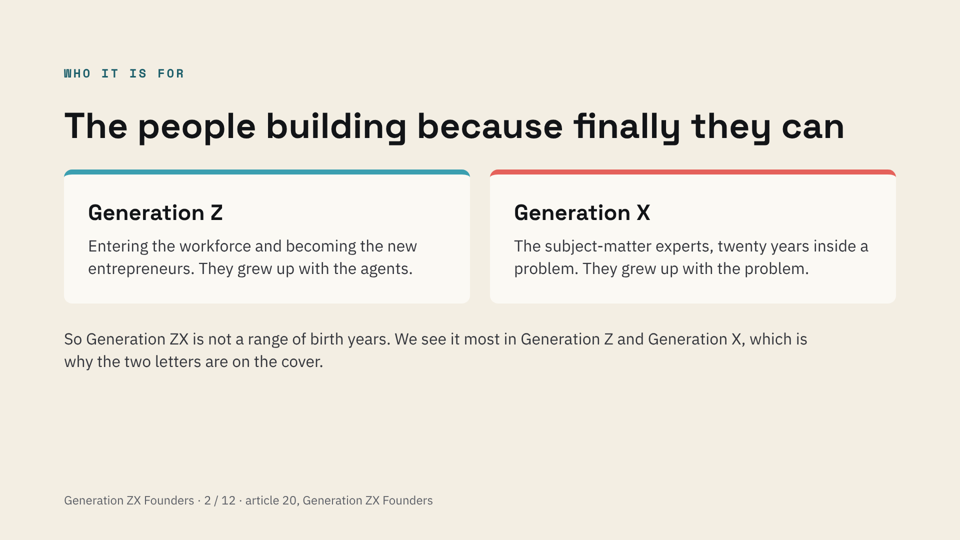
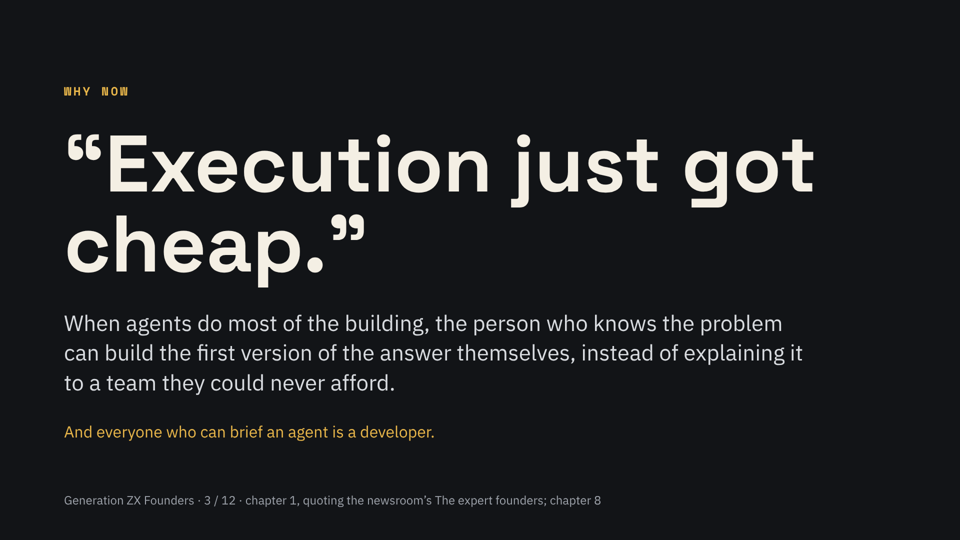
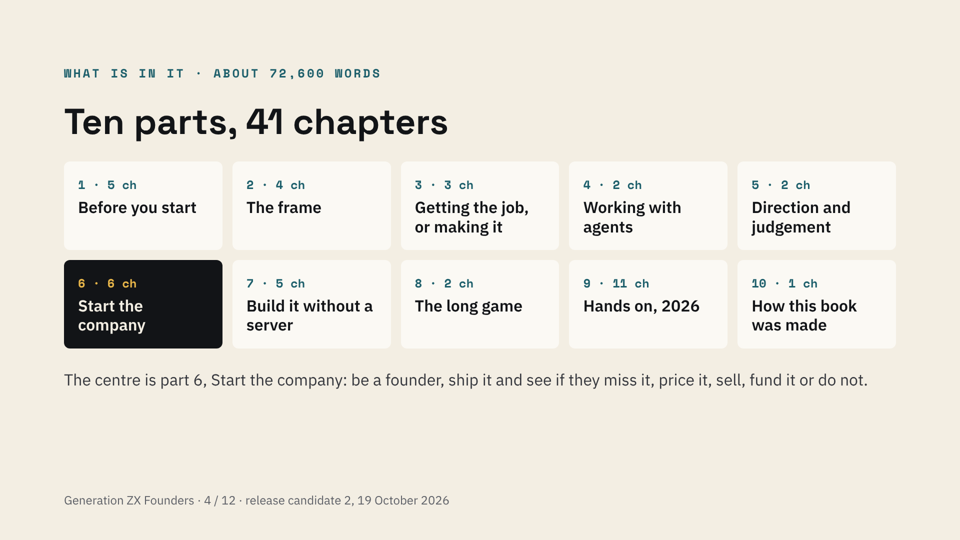
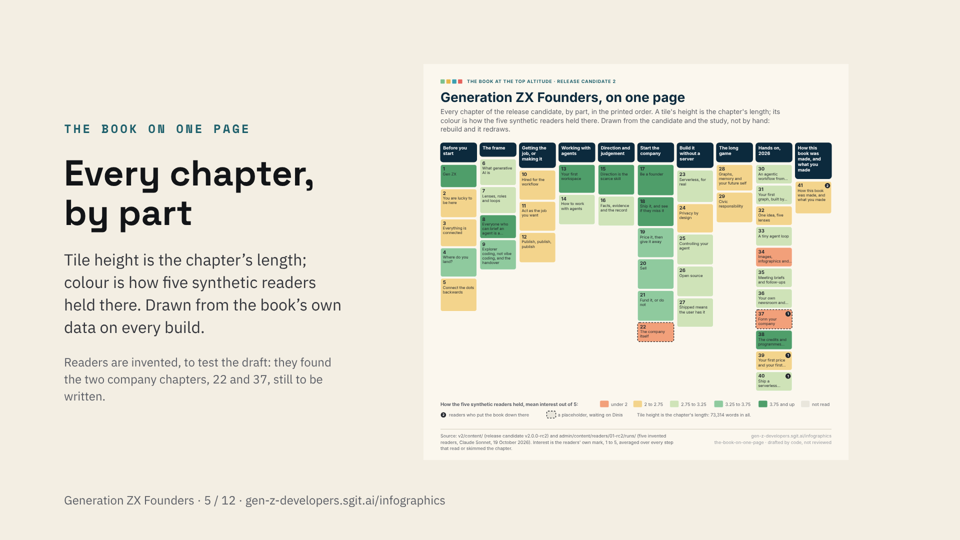
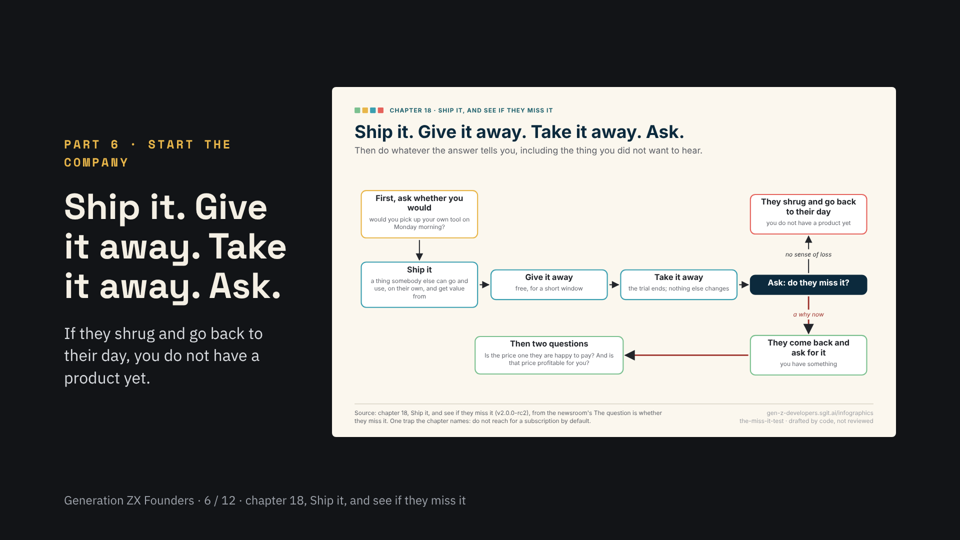
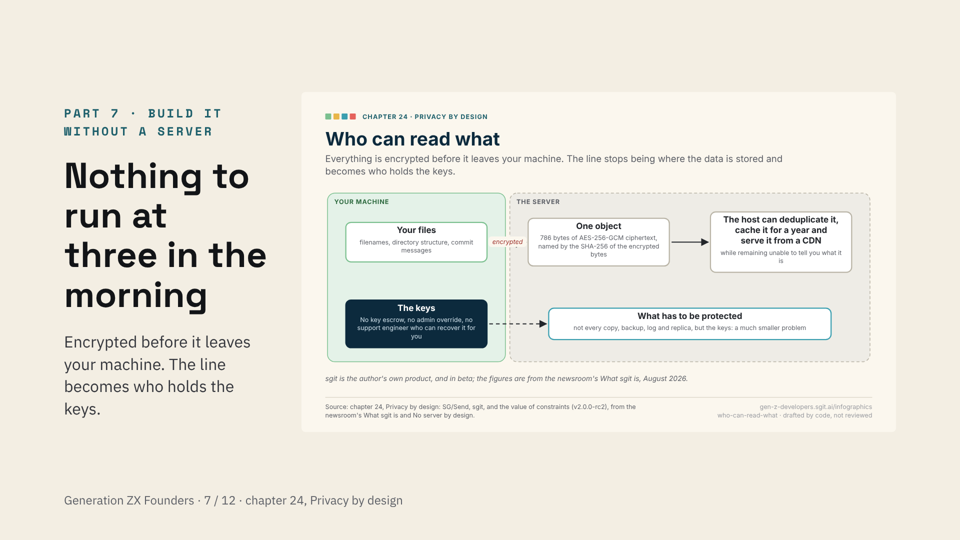
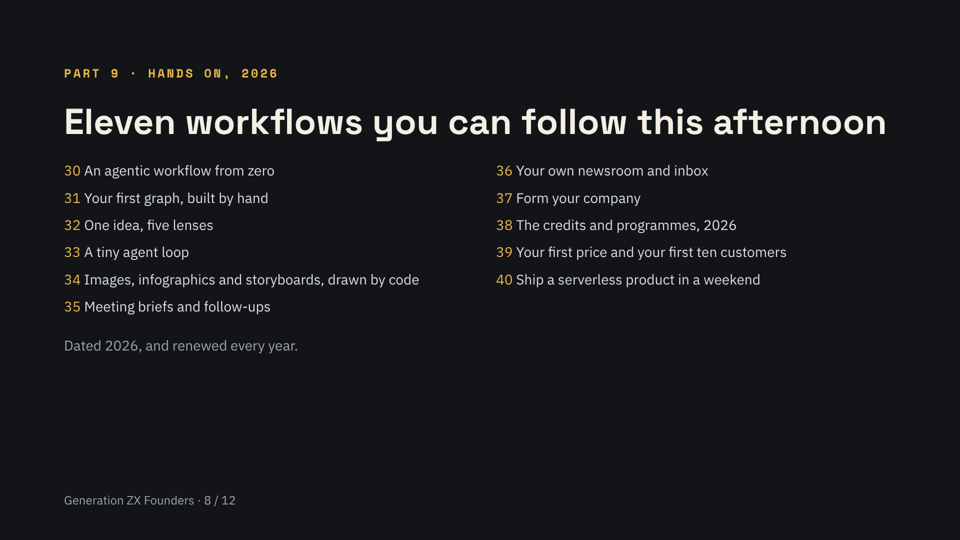
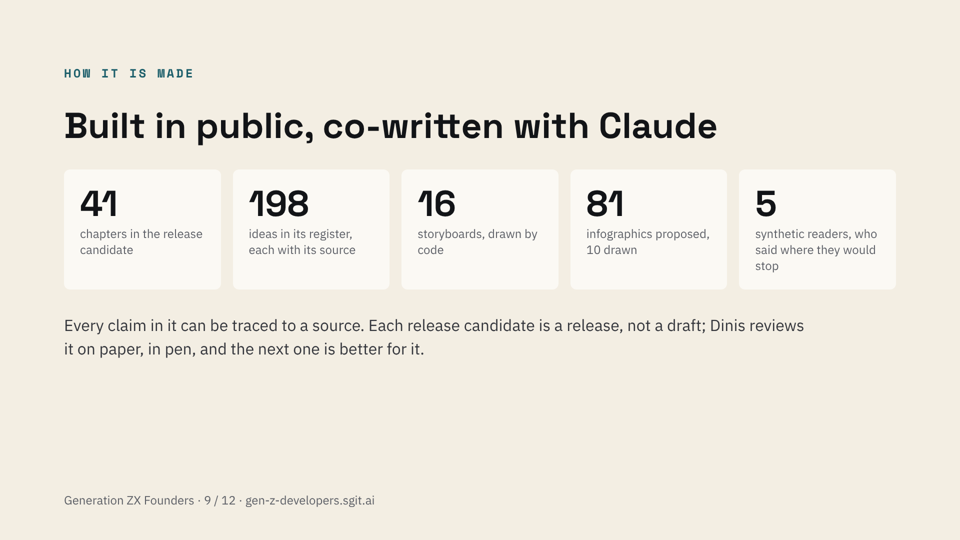
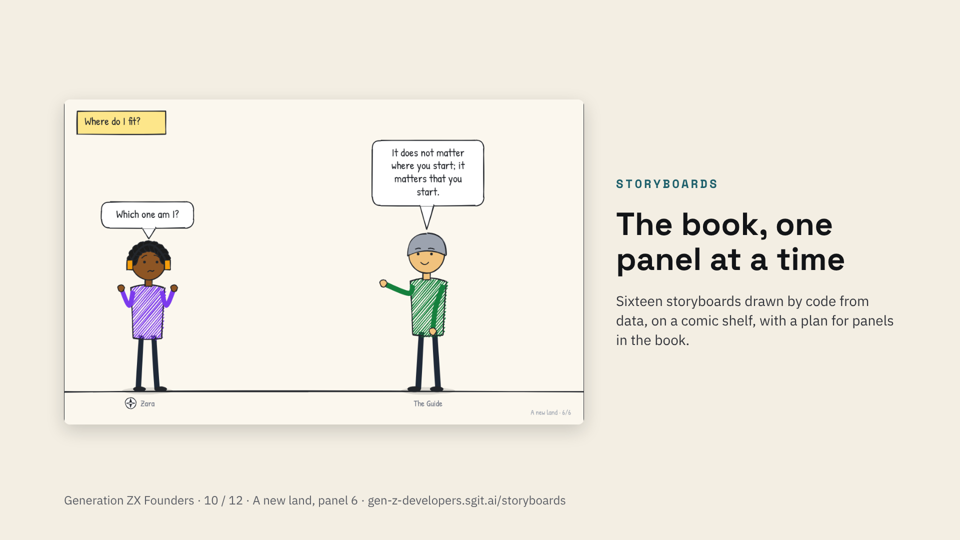
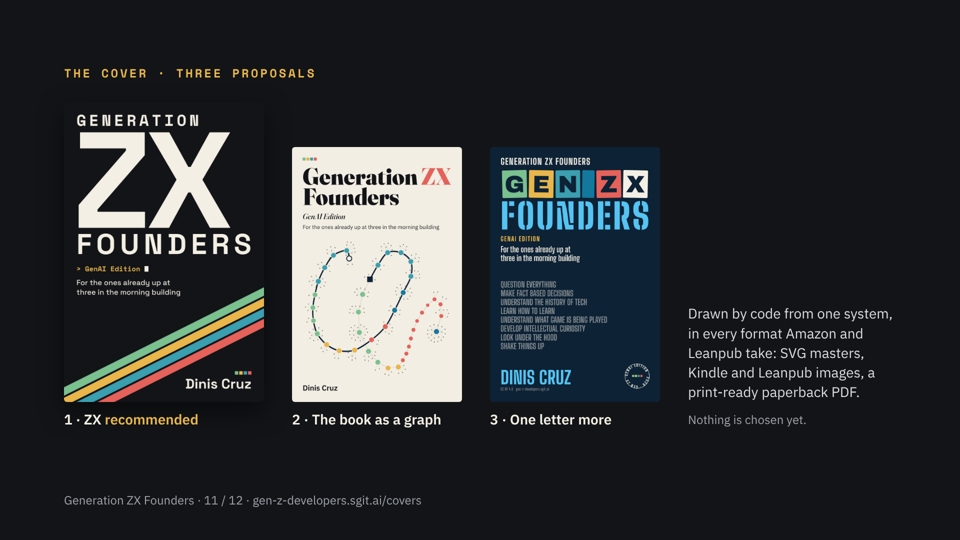
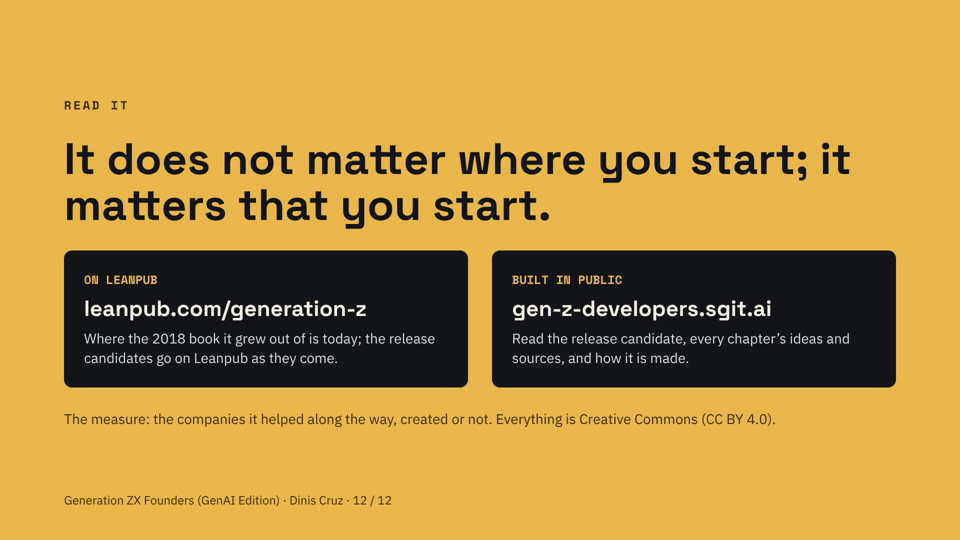
1. Generation ZX FoundersGeneration ZX Founders (GenAI Edition) is a new book that grew out of Generation Z Developers (2018). The cover shown is the one the art director recommended of three proposals; nothing is chosen yet.2. The people building because finally they canThe book is named for the reader by the word they use for themselves, founder (decision 019). A millennial who builds at three in the morning is one of them too.3. “Execution just got cheap.”The three words are from the newsroom article The expert founders, quoted in chapter 1. Chapter 8 is titled Everyone who can brief an agent is a developer.4. Ten parts, 41 chaptersCounts are from the release candidate's own data. Part 10's full title is How this book was made, and what you made.5. Every chapter, by partThis is the top altitude of the infographics plan: the whole book on one page. The colour comes from the synthetic readers' study of release candidate 2; the print version would be coloured by part.6. Ship it. Give it away. Take it away. Ask.The test readers valued most. The chapter's next step is the price: is it one they are happy to pay, and is it profitable for you.7. Nothing to run at three in the morningPart 7's promise, in its own words: build it so that there is nothing to run at three in the morning. This picture is drawn for the reader who does not code.8. Eleven workflows you can follow this afternoonThe practical part, dated 2026 and renewed every year, inside the book. Chapter 37, Form your company, waits on Dinis's notes on the UK, Portugal, Lithuania and the EU.9. Built in public, co-written with ClaudeThe agents in roles: an editor, a reviewer, a publisher, a journalist, a librarian, a storyboards agent and an illustrator, each with a folder of issues, briefs and debriefs. Dinis decides, and the decisions are recorded on the site; decision 016 made every release candidate a release.10. The book, one panel at a timeFrom the storyboard A new land: explorers, then villagers, then town planners, as the population grows; the last panel's line is the one Dinis wants as a theme across the book. The storyboards agent keeps the boards and proposed where panels could go in the book, for Dinis to decide.11. coversThree designs, reviewed by an art-director agent, which ranked ZX first: it is the one that stops a scroll at a thumbnail. The choice is Dinis's.12. It does not matter where you start; it matters that you start.Decision 020: the book measures itself by the companies it helped along the way, created or not. Decision 016: each release candidate is released on Leanpub and sold, now; how it reaches the 2018 book's readers on Leanpub is the publisher's question.
How a deck is made
The data.admin/content/decks/<slug>/deck.json (the title, the order, the fonts) and one slides/<id>.htm per slide (a fragment, not a page of this site): one <section> on a 1920 by 1080 canvas, every style inline, the speaker notes in its <aside>. Images are named by their path here: the covers, the infographics, a storyboard panel.
The drawing.python3 admin/build/deck_pdf.py, after the site build, renders the PDF and the slide images with Chromium; both are committed, as the book's PDF is. The build checks every slide, image and page.
The same files are in the subset the Slides artifact type reads, so a deck can be published there for comments and presenting, and back.