What exists

Before proposing anything new: every picture the 2018 book has, the newsroom's figures in the articles the second edition draws on, and the storyboard panels that already work as infographics.

The 2018 book: 31 images

Looked at one by one. Most are screenshots of 2018 tools; the few real infographics are someone else's (a Radical Candor quadrant, sixteen personality types, the Big Five, Wikipedia's licence table), and three figures the text links were never generated. The recommendation is for the working copy and the next candidate; v1/ is frozen and does not change. 2 keep, 6 redraw, 3 replace, 13 drop, 7 kept as the 2018 record.

ImageKind, whereWhat it is, whoseDoWhy
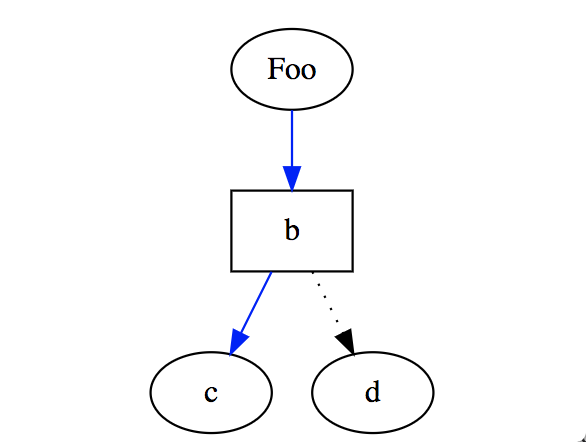
A Graphviz drawing: Foo points to b, b to c and, dotted, to d.diagram
2.mvp-for-gen-z-dev/content/dot-language.md
A Graphviz drawing: Foo points to b, b to c and, dotted, to d.
the author's rendering
keep
ch. 31
Small, clean and the author's own; a DOT example still teaches graphs in four lines. Chapter 31 (your first graph, built by hand) is where it would go, redrawn at print size if kept.
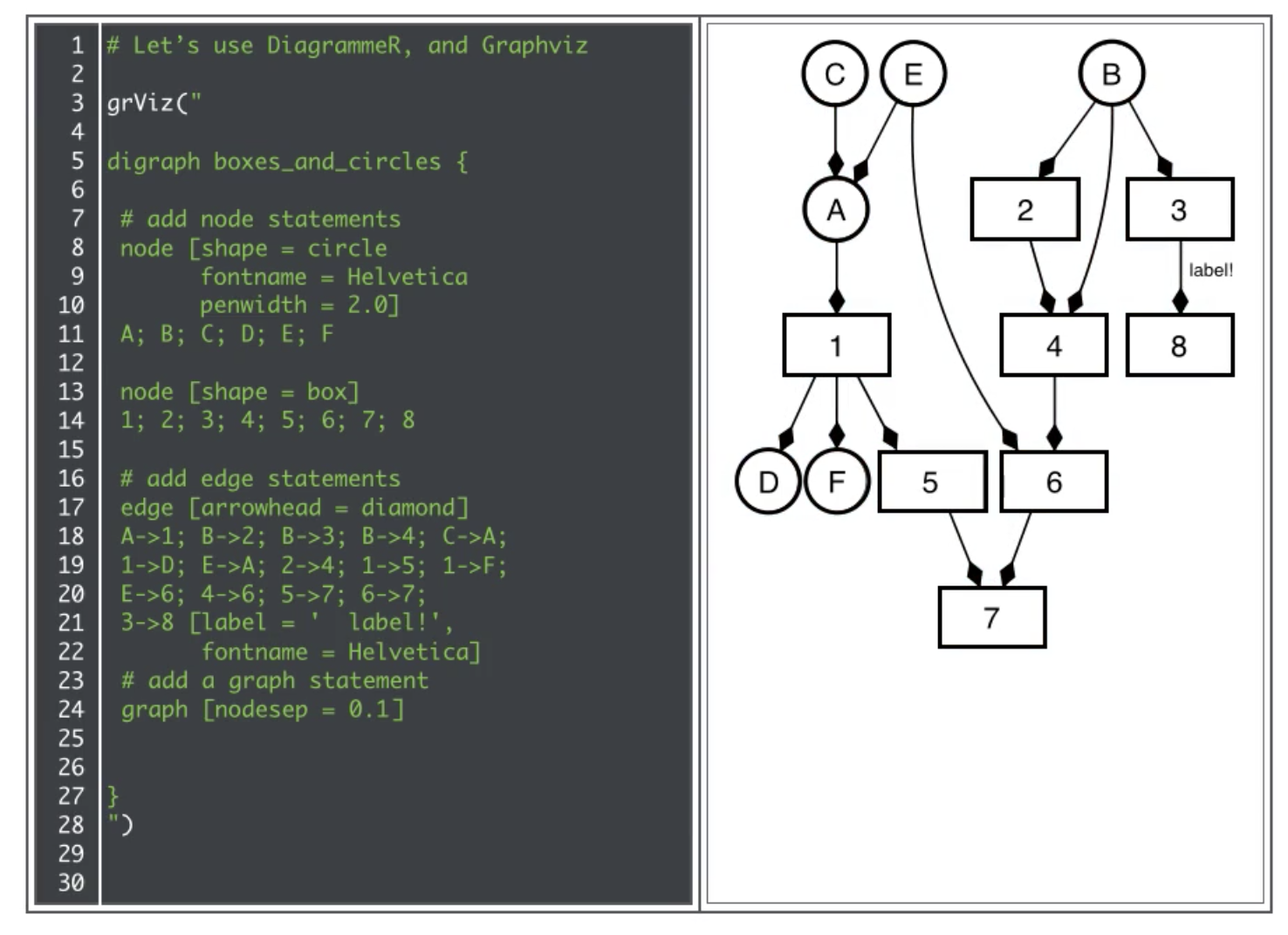
Graphviz source on the left (boxes and circles, edges, a label) and the graph it renders on the right.screenshot
2.mvp-for-gen-z-dev/content/dot-language.md
Graphviz source on the left (boxes and circles, edges, a label) and the graph it renders on the right.
the author's screenshot
keep
ch. 31
Code beside its picture is the whole lesson of chapter 31; worth keeping or redrawing at print size.
never generatedmissing
1.introduction/stem-tech-stack.md
Gen X's tech stack, linked and never generated from PlantUML.
the author's
redraw
· drawn
Drawn by code from the 2018 lists: stem-tech-stack.
never generatedmissing
1.introduction/stem-tech-stack.md
Gen Y's tech stack, linked and never generated.
the author's
redraw
· drawn
Drawn by code: stem-tech-stack.
never generatedmissing
1.introduction/stem-tech-stack.md
Gen Z's tech stack, linked and never generated.
the author's
redraw
· drawn
Drawn by code: stem-tech-stack.
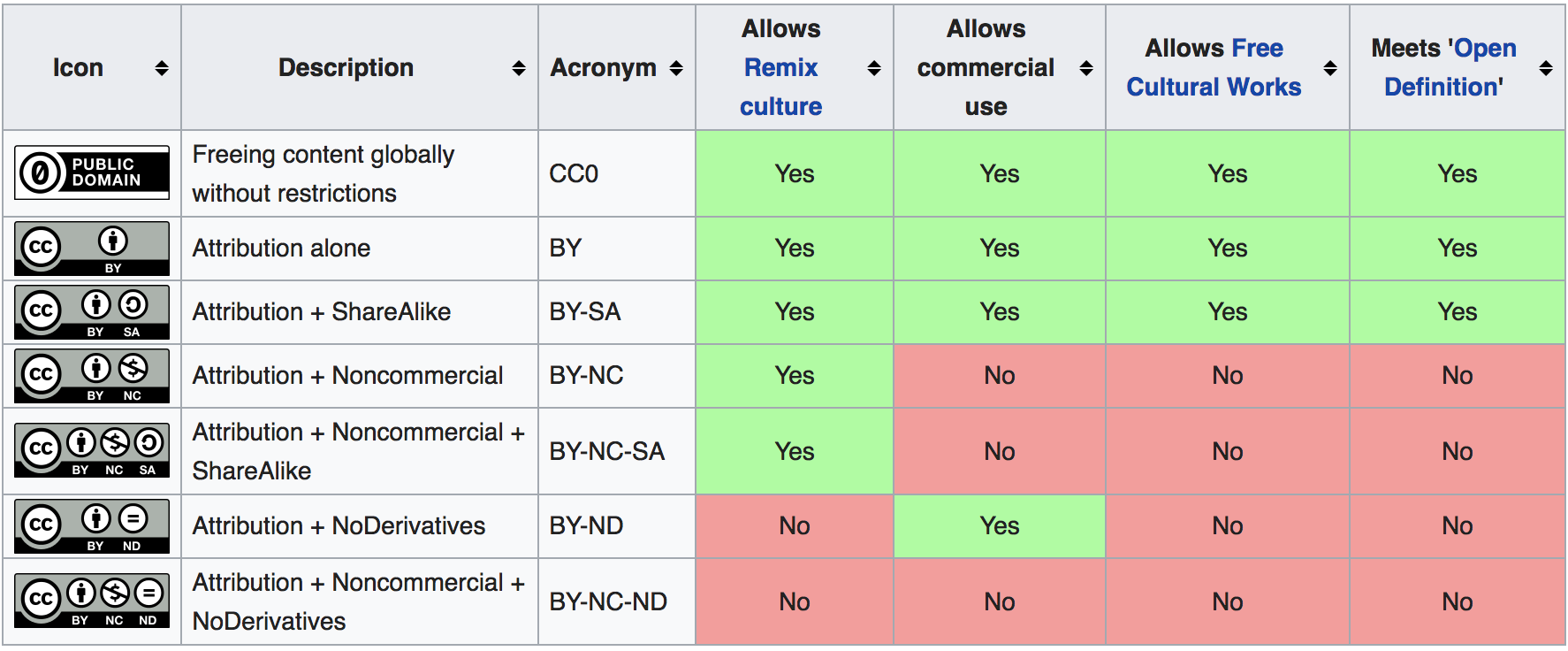
Wikipedia's table of the Creative Commons licences (CC0, BY, BY-SA, BY-NC, BY-NC-SA, BY-ND, BY-NC-ND) against remix, commercial use, free cultural works and the open definition.table
2.mvp-for-gen-z-dev/content/creative-commons.md
Wikipedia's table of the Creative Commons licences (CC0, BY, BY-SA, BY-NC, BY-NC-SA, BY-ND, BY-NC-ND) against remix, commercial use, free cultural works and the open definition.
Wikipedia (CC BY-SA)
redraw
ch. 26
Licences matter more in 2026, when everything an agent writes needs one; the facts can be drawn again by code as a small table with this book's palette, and the redraw credits Wikipedia. The book itself is CC BY 4.0 (decision 001): say so on the same page.
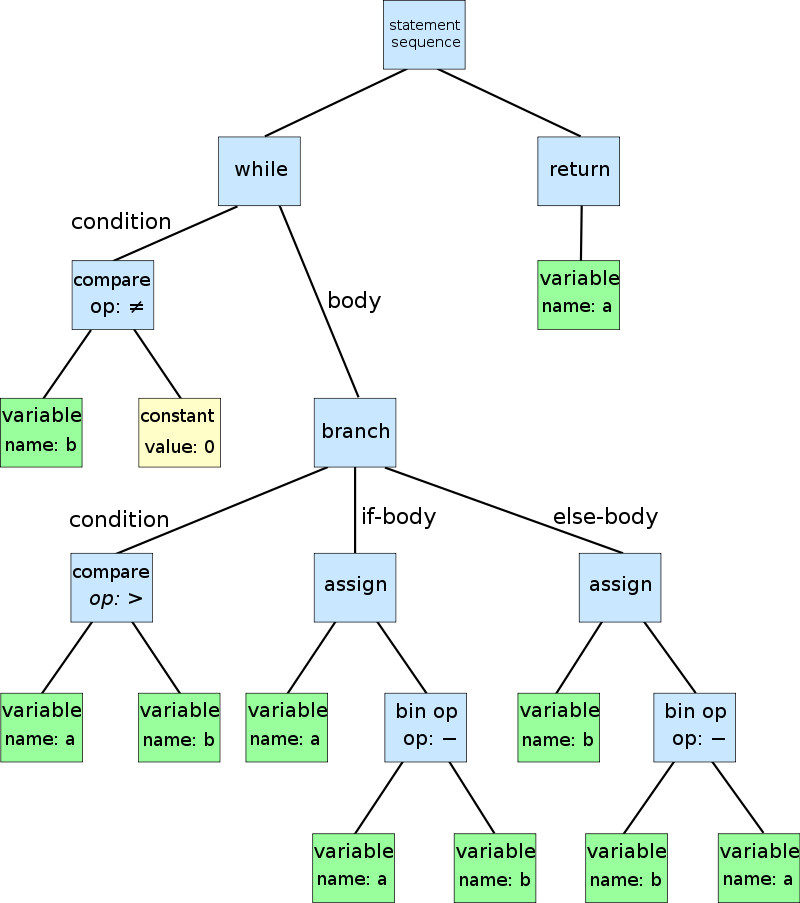
The abstract syntax tree of Euclid's algorithm: statement sequence, while, compare, branch, assign, variables and constants.diagram
3.technologies/content/AST.md
The abstract syntax tree of Euclid's algorithm: statement sequence, while, compare, branch, assign, variables and constants.
Wikimedia Commons (licence to check)
redraw
ch. 3 · drawn
The 2026 point, code is already a graph, is chapter 3's (code-is-a-layered-graph); a tree drawn by code from a three-line example of the book's own is clearer than a borrowed one.
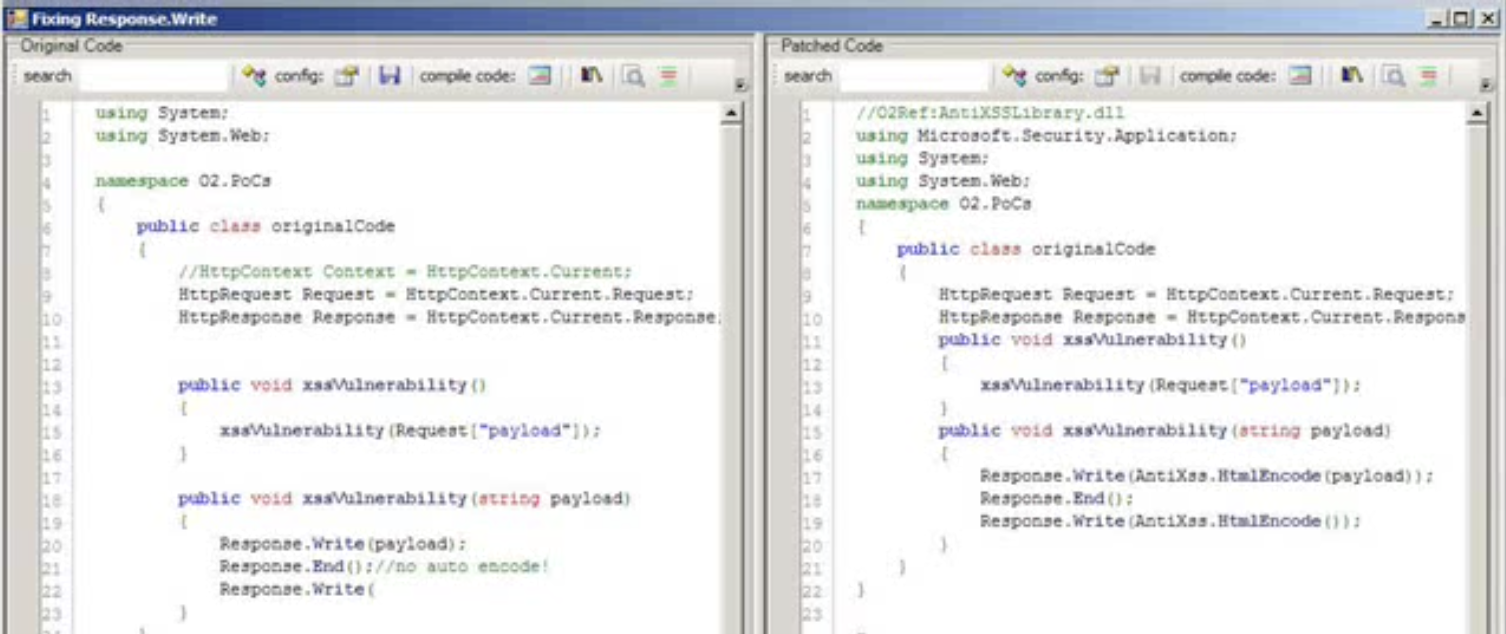
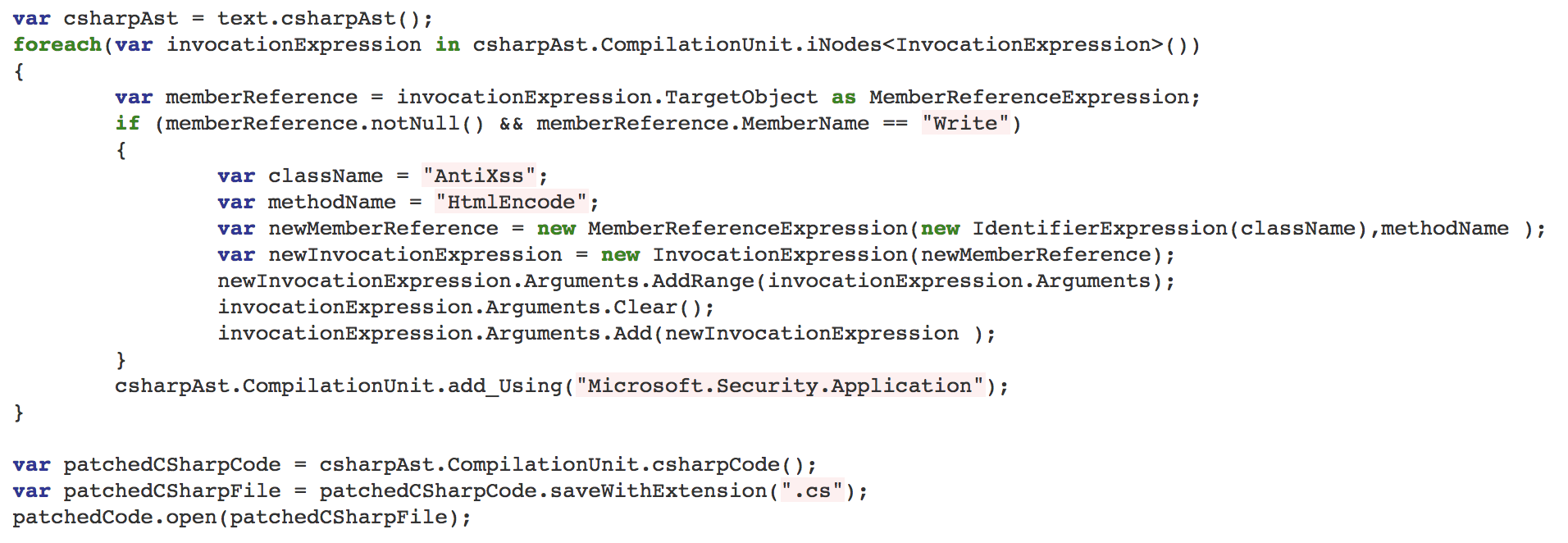
Two C# files side by side: the original code with Response.Write, and the patched one that encodes the payload.screenshot
3.technologies/content/AST.md
Two C# files side by side: the original code with Response.Write, and the patched one that encodes the payload.
the author's screenshot
redraw
A security fix made by rewriting the tree is still a strong before-and-after; as code on a screenshot it cannot be read in print. Redraw as a two-column comparison if chapter 3 or 25 keeps the story.
A tree whose leaves are open-source logos: openSUSE, CakePHP, git, Ruby, PHP, Joomla, Drupal, MySQL, MongoDB, WordPress, Linux, Python and others.illustration
2.mvp-for-gen-z-dev/content/open-source.md
A tree whose leaves are open-source logos: openSUSE, CakePHP, git, Ruby, PHP, Joomla, Drupal, MySQL, MongoDB, WordPress, Linux, Python and others.
trademarks of their owners; source of the drawing not recorded
replace
ch. 26
The point (a whole ecosystem grew from open code) carries without logos. For chapter 26 the fork-next-door-triangle and who-pays-for-open-source proposals say what the 2026 chapter argues; drop the tree.
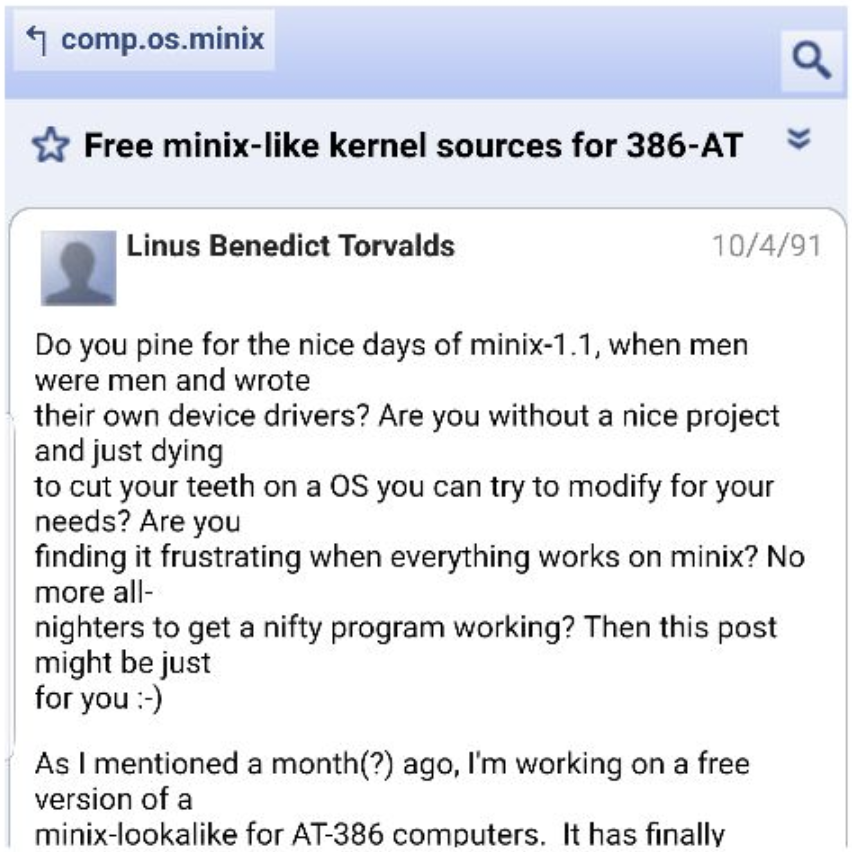
Linus Torvalds's post to comp.os.minix of 25 August 1991 announcing a free kernel for 386 machines, as shown in Google Groups.screenshot
2.mvp-for-gen-z-dev/draft/linux.md
Linus Torvalds's post to comp.os.minix of 25 August 1991 announcing a free kernel for 386 machines, as shown in Google Groups.
Linus Torvalds's public post
replace
ch. 26
Named as text in the draft, never placed. The words are the history; set them as a quote in chapter 26 rather than as a screenshot of a Groups page.
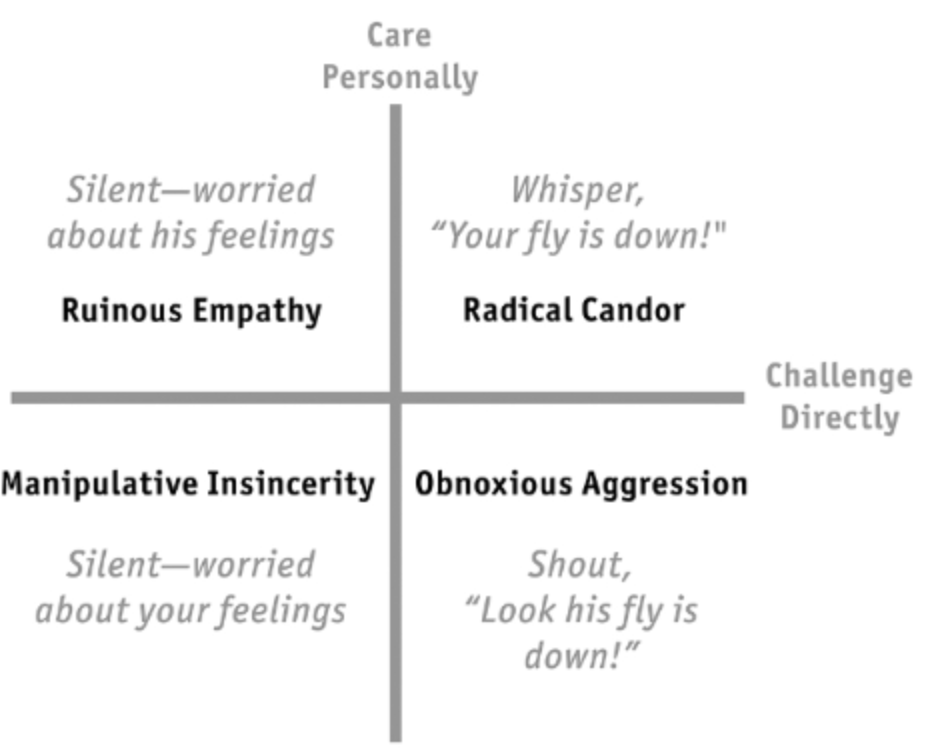
The Radical Candor two by two: care personally against challenge directly, with ruinous empathy, radical candor, manipulative insincerity and obnoxious aggression.infographic
4.life-patterns/content/being-criticized-is-a-privilege.md
The Radical Candor two by two: care personally against challenge directly, with ruinous empathy, radical candor, manipulative insincerity and obnoxious aggression.
Kim Scott's framework; drawing third party
replace
The only true infographic in the 2018 book, and not the book's. The release candidate does not carry the chapter; if a chapter on feedback returns, draw the quadrant by code with Kim Scott credited, or link hers.
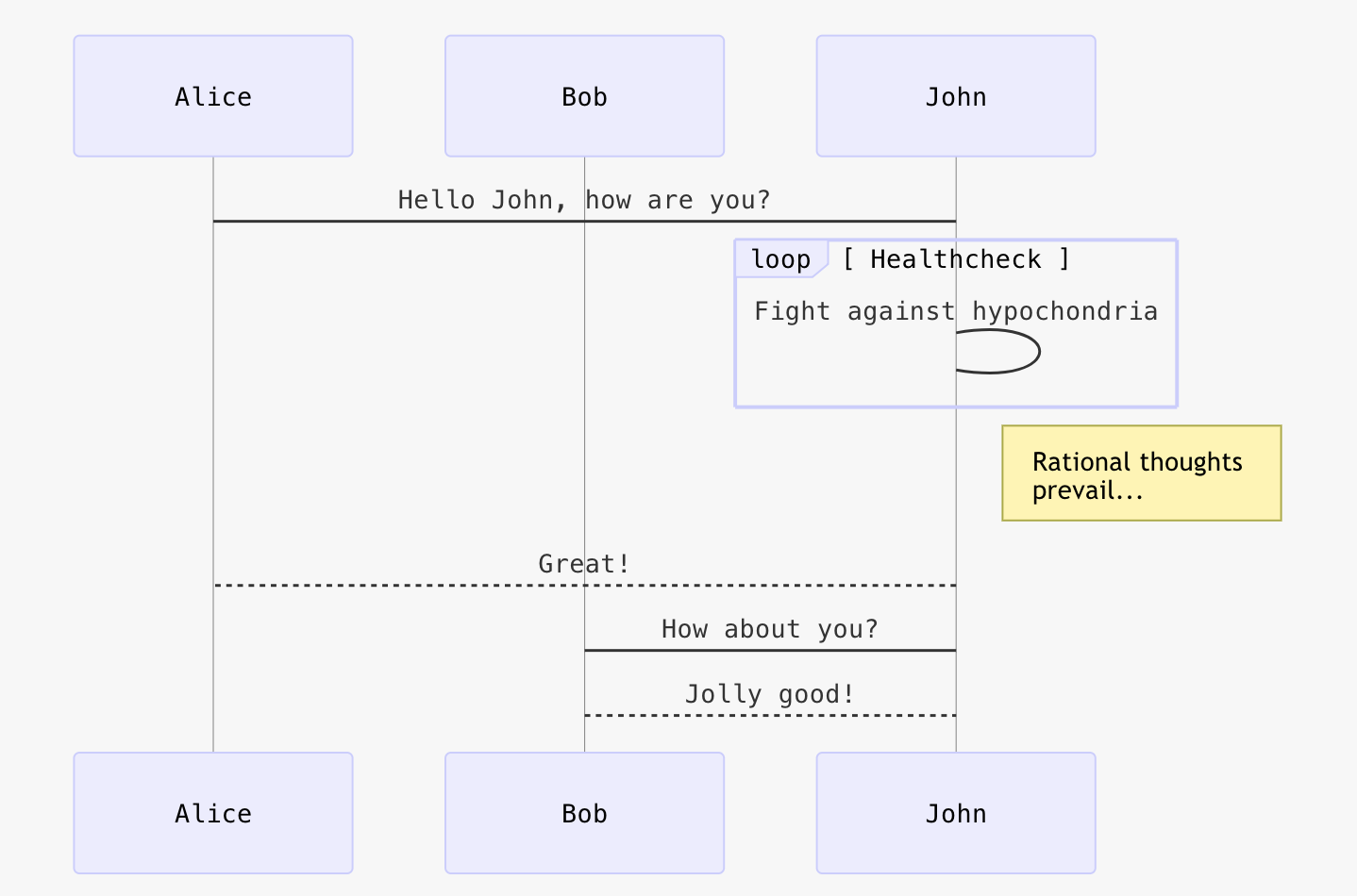
A sequence diagram: Alice, Bob and John, a 'loop Healthcheck' box and a 'Rational thoughts prevail' note.diagram
2.mvp-for-gen-z-dev/content/dot-language.md
A sequence diagram: Alice, Bob and John, a 'loop Healthcheck' box and a 'Rational thoughts prevail' note.
the author's rendering of the PlantUML documentation's example
drop
ch. 31
The PlantUML documentation's example, not the book's; diagrams-as-code is better shown with the book's own process (read-comment-decide-loop is one).
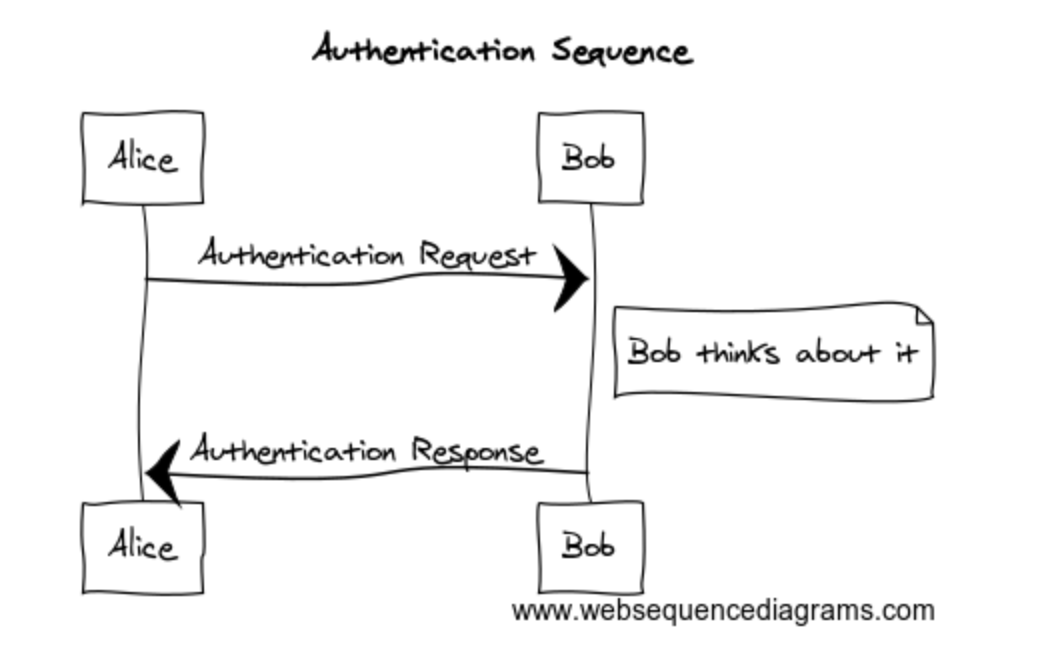
An 'Authentication Sequence' between Alice and Bob in websequencediagrams.com's sketched style, with the site's address on it.diagram
2.mvp-for-gen-z-dev/content/dot-language.md
An 'Authentication Sequence' between Alice and Bob in websequencediagrams.com's sketched style, with the site's address on it.
websequencediagrams.com's rendering
drop
Third-party rendering with its address on the image.
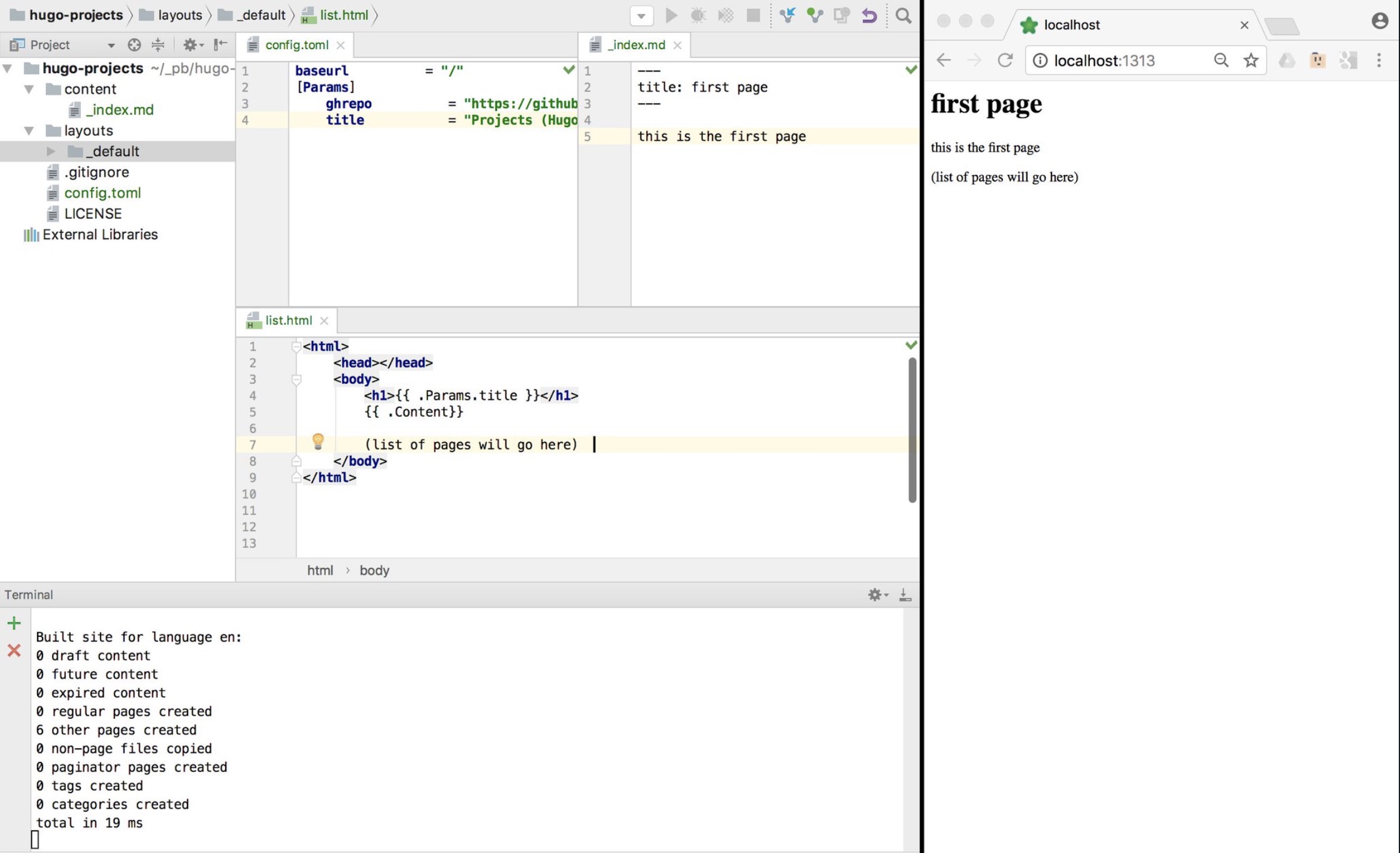
An IDE and a browser side by side: a Hugo site's files, a template, and the page it renders, with the build output.screenshot
2.mvp-for-gen-z-dev/content/hugo.md
An IDE and a browser side by side: a Hugo site's files, a template, and the page it renders, with the build output.
the author's screenshot
drop
ch. 36
Tooling of 2018. Publishing in 2026 is chapter 12 (your own newsroom) and 36 (your own newsroom and inbox), which have their own proposals (newsroom-in-five-steps, voice-memo-to-checked-site).
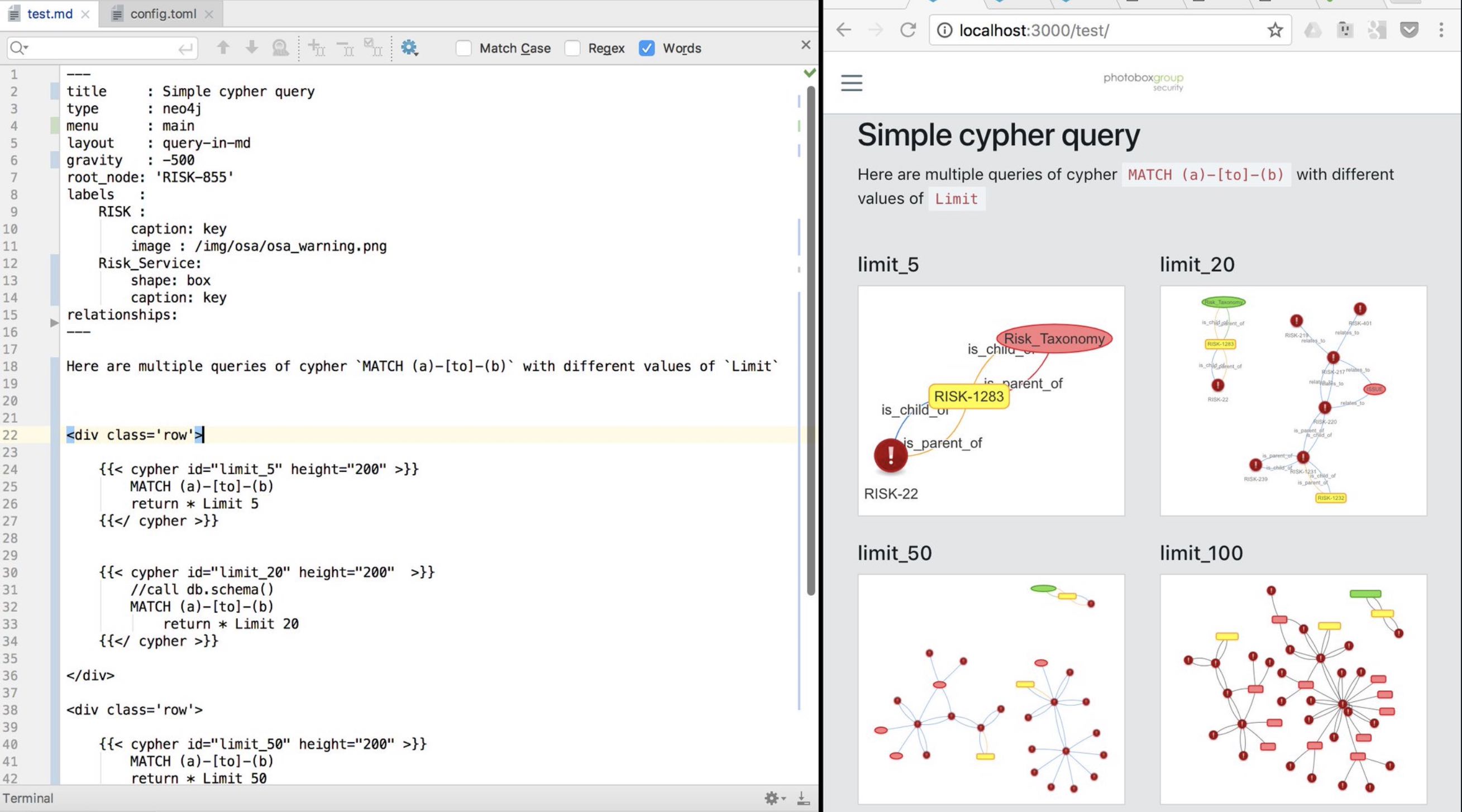
A Hugo page rendering Neo4j Cypher queries as small graphs (limit 5, 20, 50, 100), with the code beside it.screenshot
2.mvp-for-gen-z-dev/content/hugo.md
A Hugo page rendering Neo4j Cypher queries as small graphs (limit 5, 20, 50, 100), with the code beside it.
the author's screenshot
drop
ch. 31
The idea it showed, a page drawn from a graph, is now this site; graph/view.html draws the book's own graph live.
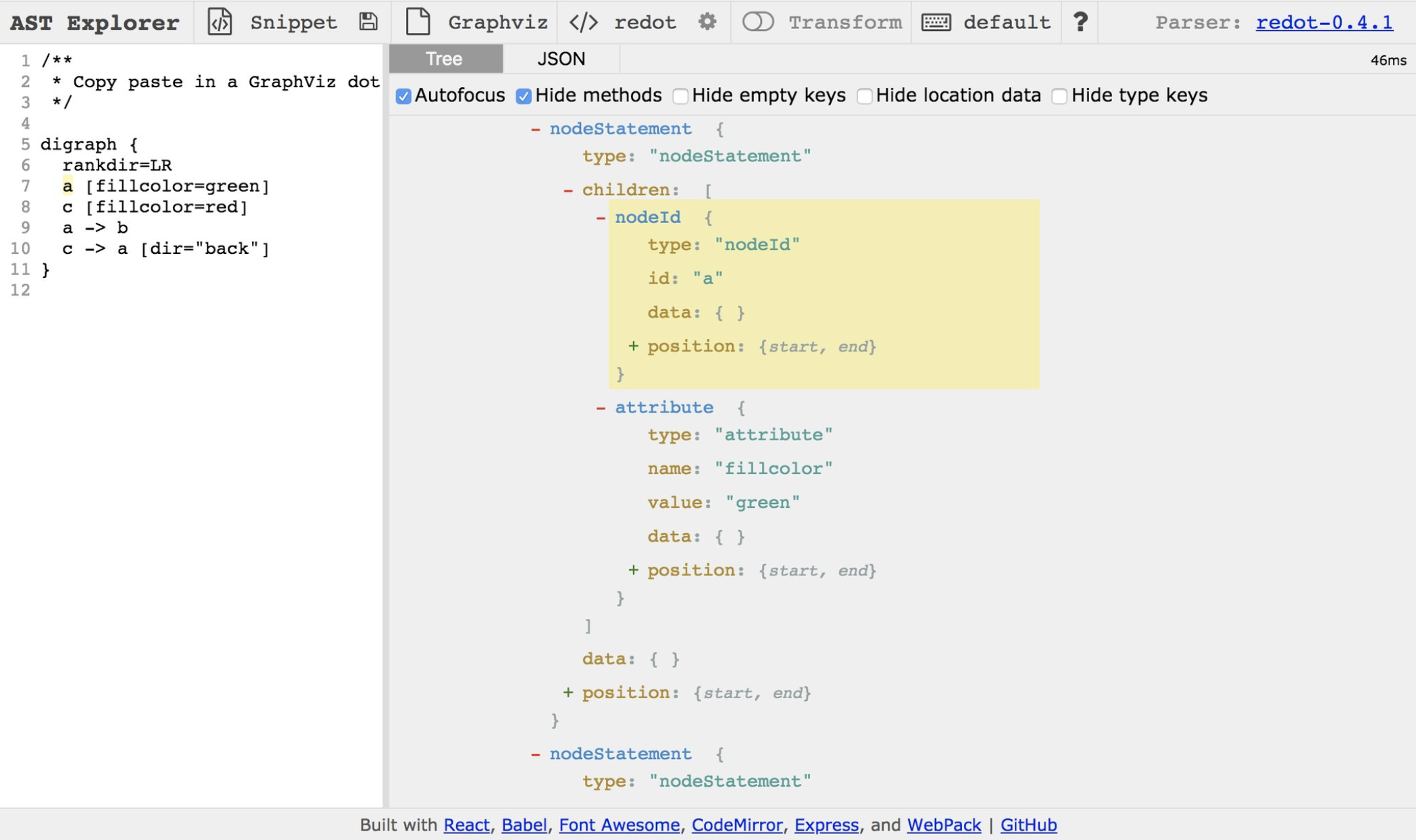
AST Explorer parsing a small Graphviz file into its tree, as JSON.screenshot
3.technologies/content/AST.md
AST Explorer parsing a small Graphviz file into its tree, as JSON.
the author's screenshot of astexplorer.net
drop
Too small to read in print; the redrawn tree replaces it.
The C# code that walks the tree and patches it (Roslyn).screenshot
3.technologies/content/AST.md
The C# code that walks the tree and patches it (Roslyn).
the author's screenshot
drop
Code is better set as code in the text than as an image.
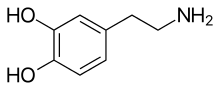
The dopamine molecule, small, linked to Wikimedia Commons.diagram
3.technologies/draft/dopamine.md
The dopamine molecule, small, linked to Wikimedia Commons.
Wikimedia Commons
drop
A draft's illustration; not in the release candidate.
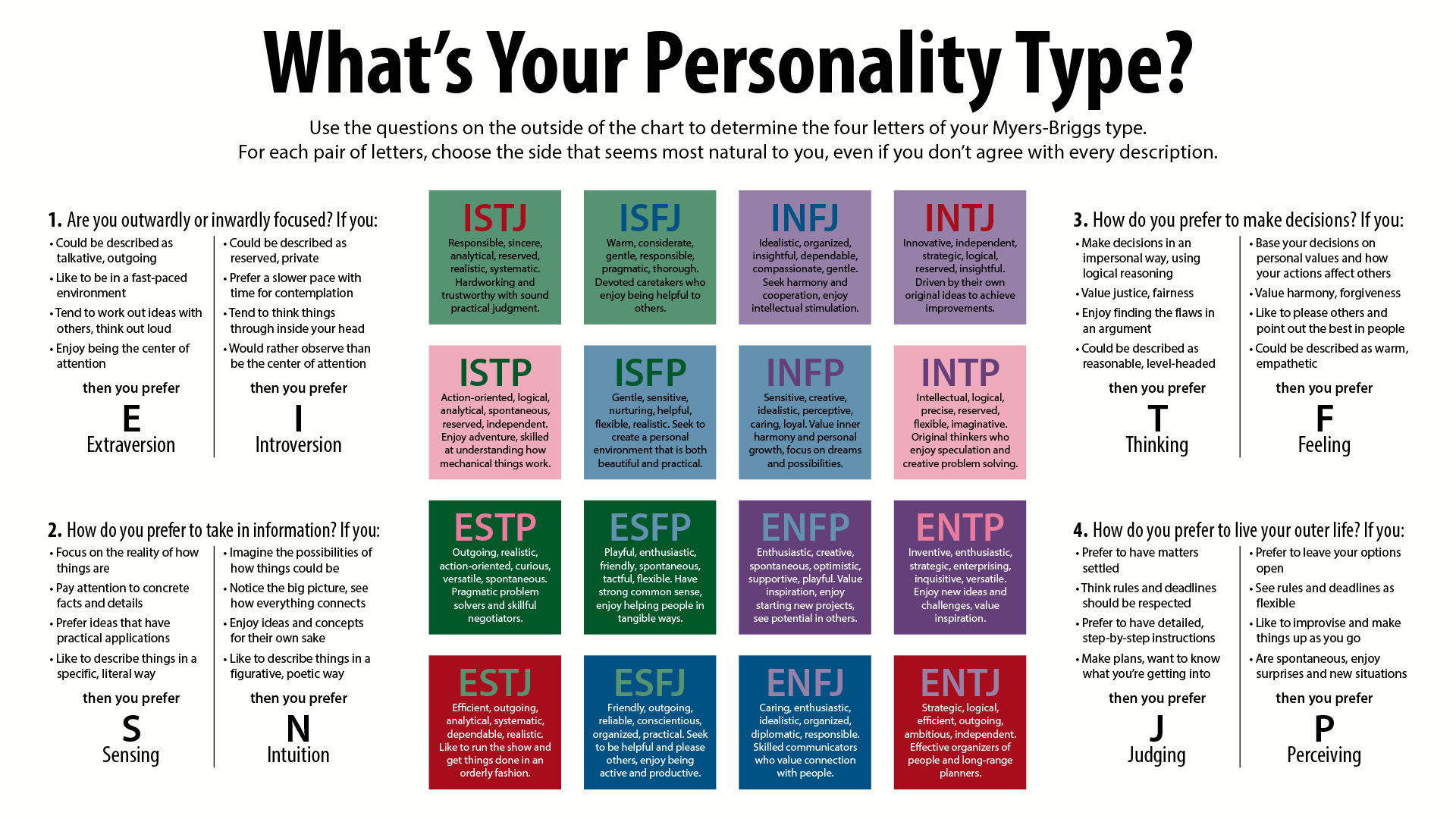
'What's Your Personality Type?': the sixteen Myers-Briggs types, coloured, with the four questions.infographic
4.life-patterns/content/being-criticized-is-a-privilege.md
'What's Your Personality Type?': the sixteen Myers-Briggs types, coloured, with the four questions.
third party
drop
Third party, and the second edition reaches the same point with its own lens (where-do-you-land).
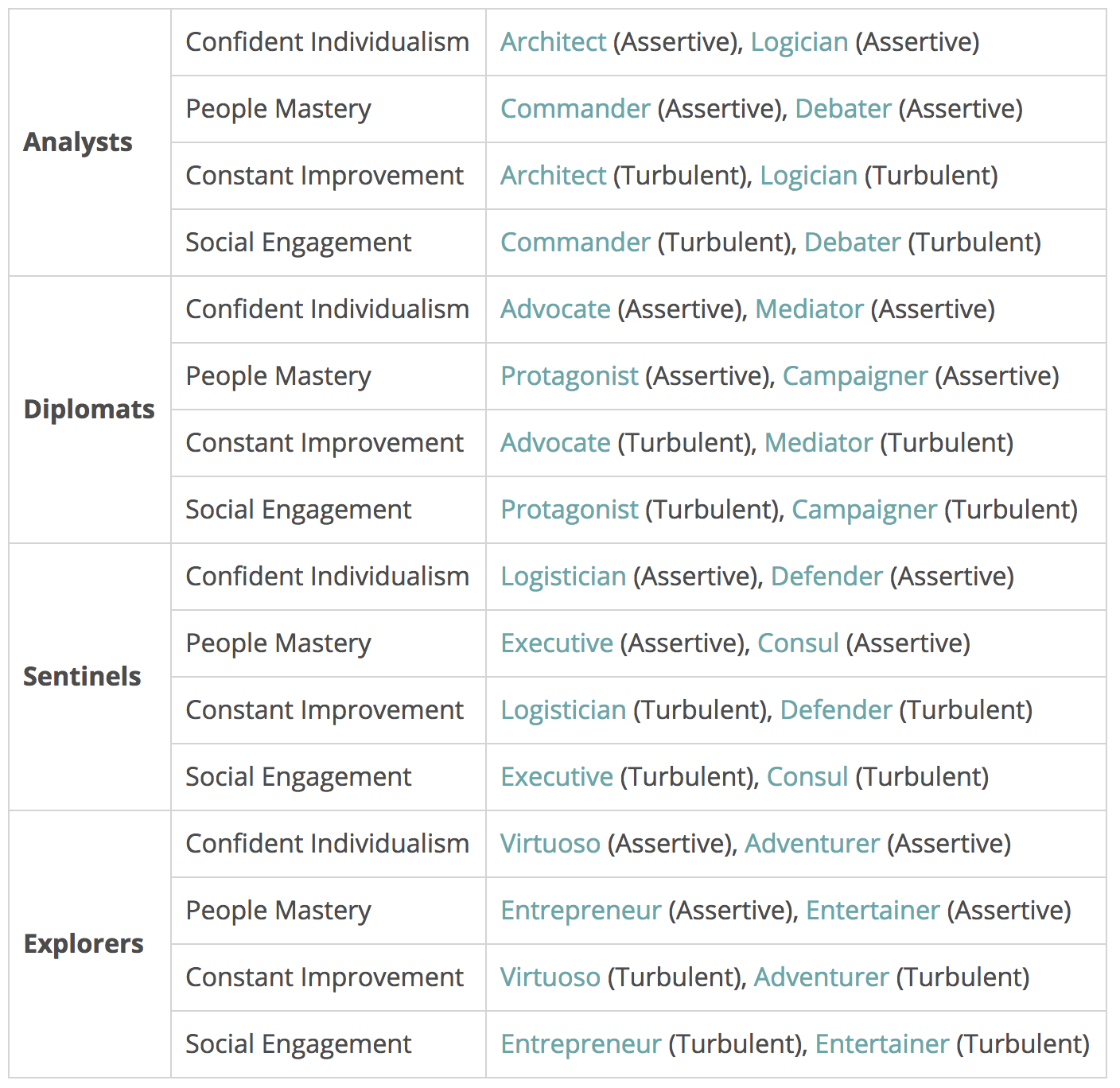
16Personalities' table of roles and strategies (analysts, diplomats, sentinels, explorers).table
4.life-patterns/content/being-criticized-is-a-privilege.md
16Personalities' table of roles and strategies (analysts, diplomats, sentinels, explorers).
16Personalities
drop
Third party.
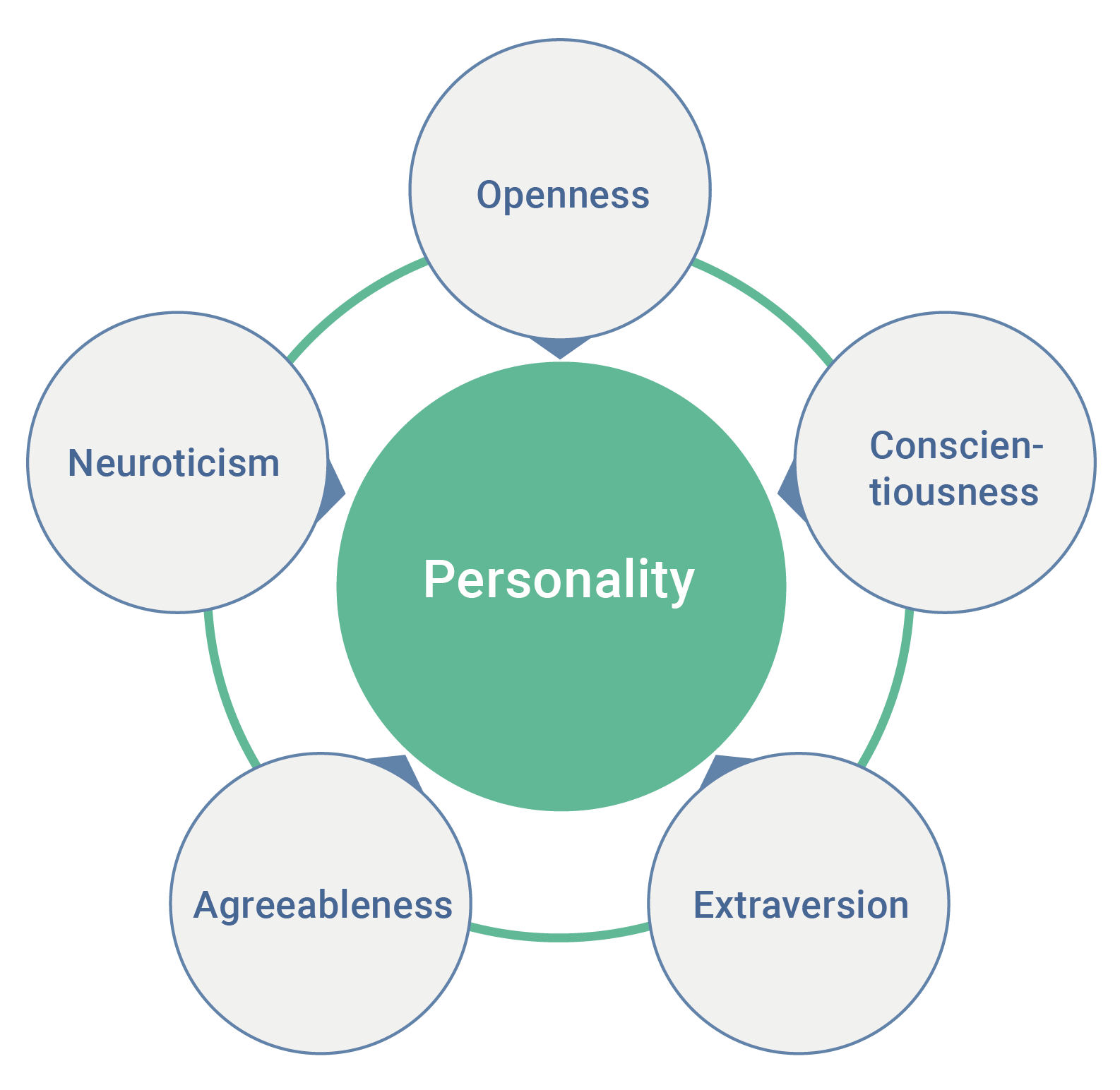
The Big Five around 'Personality': openness, conscientiousness, extraversion, agreeableness, neuroticism.diagram
4.life-patterns/content/being-criticized-is-a-privilege.md
The Big Five around 'Personality': openness, conscientiousness, extraversion, agreeableness, neuroticism.
third party
drop
Third party; not in the release candidate.
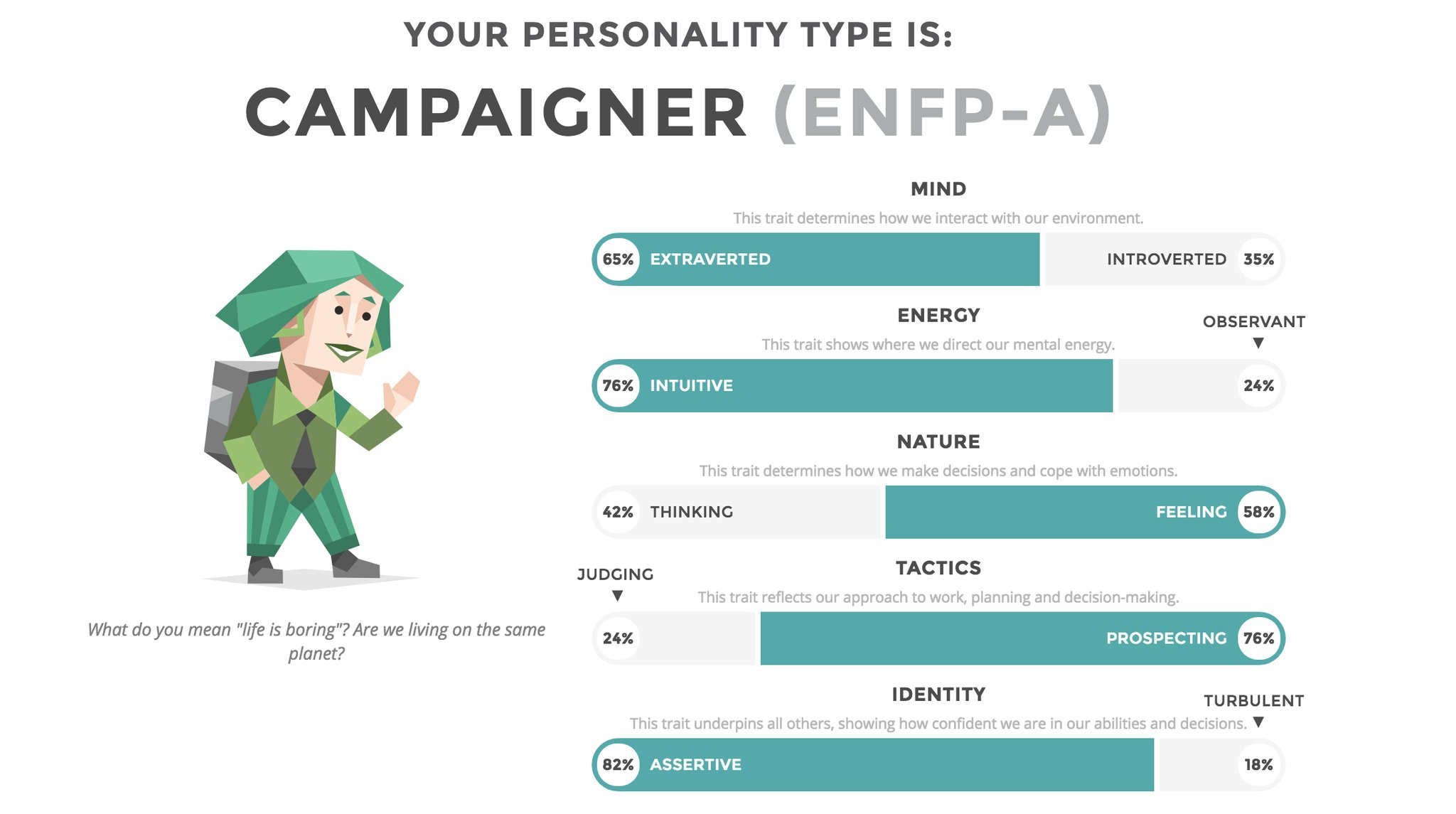
The author's own 16Personalities result: Campaigner (ENFP-A), with the five trait bars.screenshot
4.life-patterns/content/being-criticized-is-a-privilege.md
The author's own 16Personalities result: Campaigner (ENFP-A), with the five trait bars.
16Personalities' page, the author's result
drop
A personal anecdote in a third party's design; if Dinis wants the anecdote, say it in a sentence.
A line of a markdown file: an Investopedia link and a note to find an article about Amazon as a factory of factories.screenshot
7.your-cv/future-self.md
A line of a markdown file: an Investopedia link and a note to find an article about Amazon as a factory of factories.
the author's screenshot
drop
ch. 28
A note to self, not a figure; chapter 28 (graphs, memory and your future self) has memory-is-context-management.
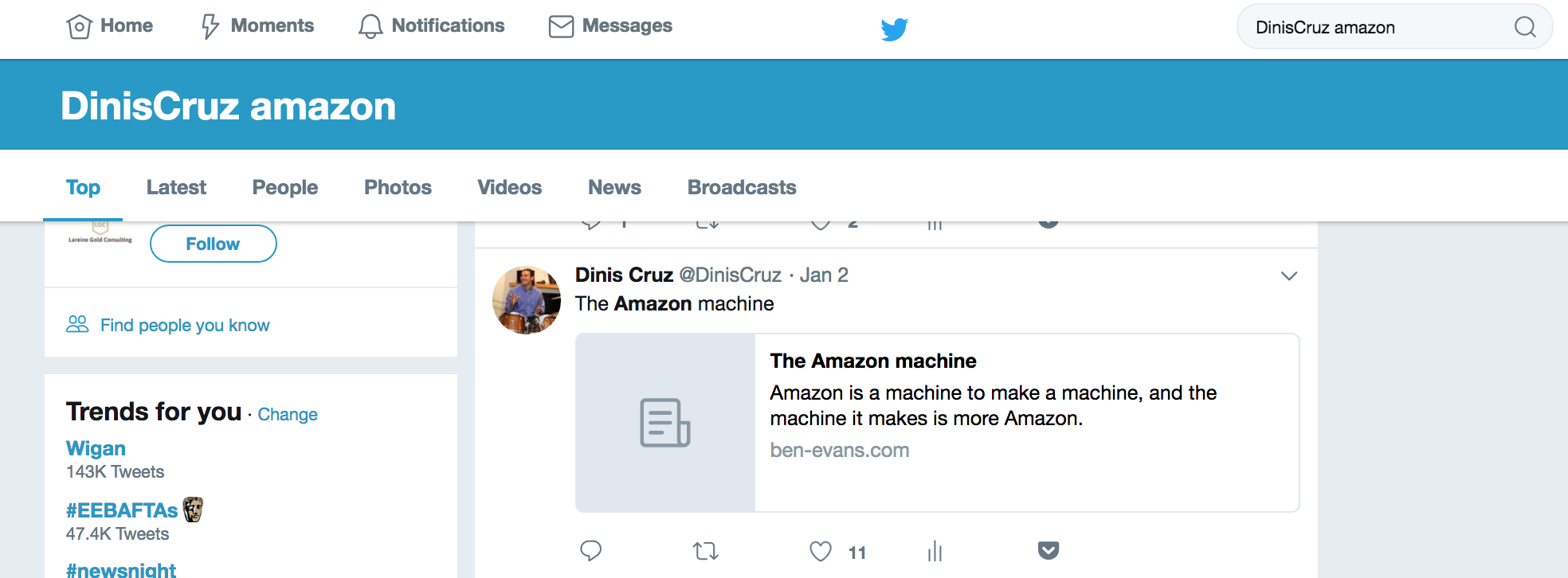
Twitter search results for 'DinisCruz amazon': the author's tweet 'The Amazon machine'.screenshot
7.your-cv/future-self.md
Twitter search results for 'DinisCruz amazon': the author's tweet 'The Amazon machine'.
Twitter's page, the author's tweet
drop
ch. 28
The point (your public record is searchable memory for your future self) is chapter 28's; the screenshot of a 2018 Twitter page is not.
The 2017 slide of logos the first edition opened with: Raspberry Pi, Python, Creative Commons, OWASP, git, a CPU, Slack, Xcode, Docker, DEFCON, Linux, AWS, GitHub, LinkedIn, Twitter, WordPress, with 'These are your CV!'.slide
1.introduction/_index.md
The 2017 slide of logos the first edition opened with: Raspberry Pi, Python, Creative Commons, OWASP, git, a CPU, Slack, Xcode, Docker, DEFCON, Linux, AWS, GitHub, LinkedIn, Twitter, WordPress, with 'These are your CV!'.
trademarks of their owners; the slide is the author's
history
ch. 2
Chapter 2 of the release candidate tells the story of this slide and the book now opens with wonder, not logos (idea wonder-not-fear). Keep it as the 2018 record and, if Dinis wants it in chapter 2, as a small historical figure with its caption; a logo wall is not something to redraw.
The Creative Commons logo, in the front matter of two 2018 chapters (Creative Commons and Jira).logo
2.mvp-for-gen-z-dev/content/creative-commons.md
The Creative Commons logo, in the front matter of two 2018 chapters (Creative Commons and Jira).
Creative Commons (trademark)
history
A front-matter logo of the 2018 Hugo theme; not a figure.
The Open Source Initiative's keyhole logo, in the chapter's front matter.logo
2.mvp-for-gen-z-dev/content/open-source.md
The Open Source Initiative's keyhole logo, in the chapter's front matter.
Open Source Initiative (trademark)
history
A front-matter logo of the 2018 Hugo theme; not a figure.
The Docker whale logo. No 2018 chapter references it.logo
not referenced
The Docker whale logo. No 2018 chapter references it.
Docker (trademark)
history
Unreferenced; kept because v1/ is frozen.
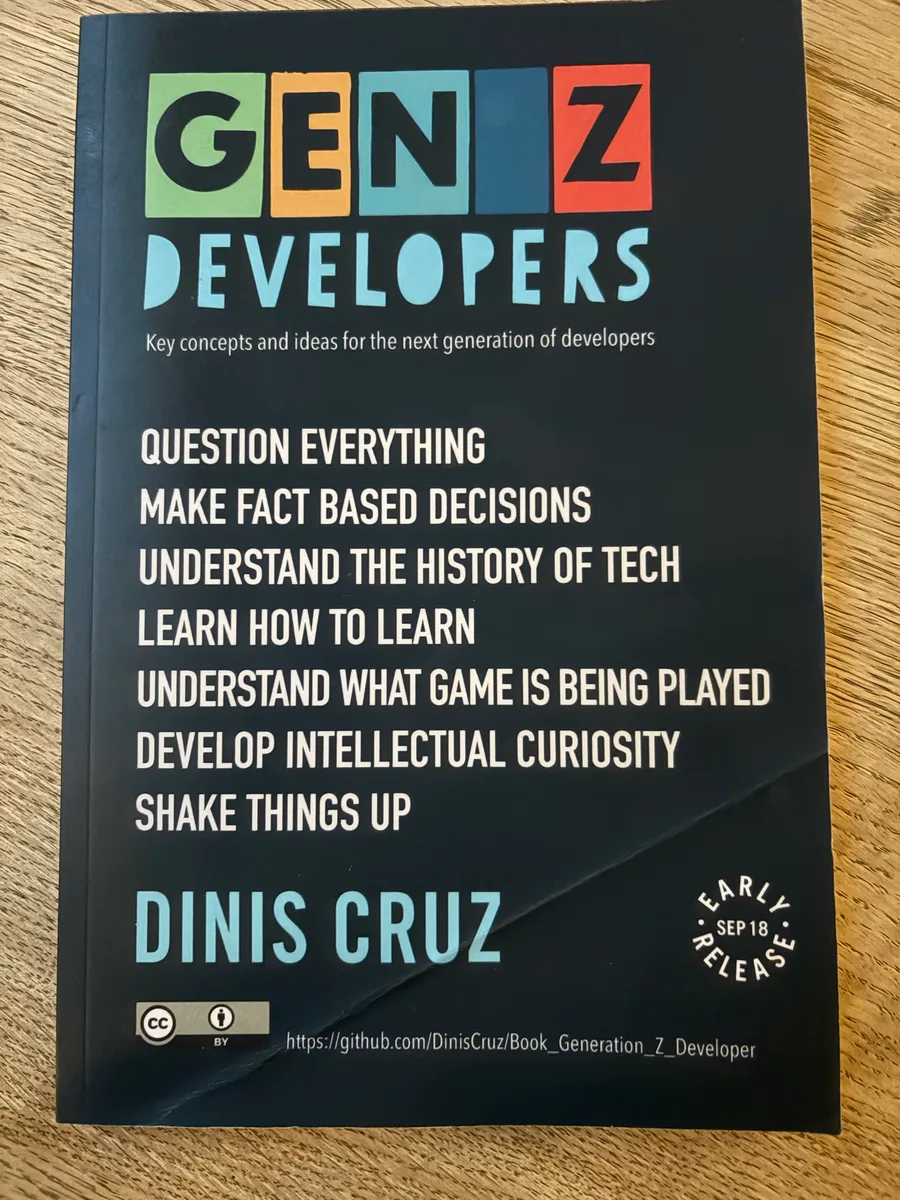
The cover of the September 2018 early release: navy, GEN Z in four colour blocks, eight lines from Question everything to Shake things up.cover
not referenced
The cover of the September 2018 early release: navy, GEN Z in four colour blocks, eight lines from Question everything to Shake things up.
the author's
history
The cover waits (decision 004). Its four colours are this plan's palette.
An earlier cover design.cover
not referenced
An earlier cover design.
the author's
history
Kept as the record.
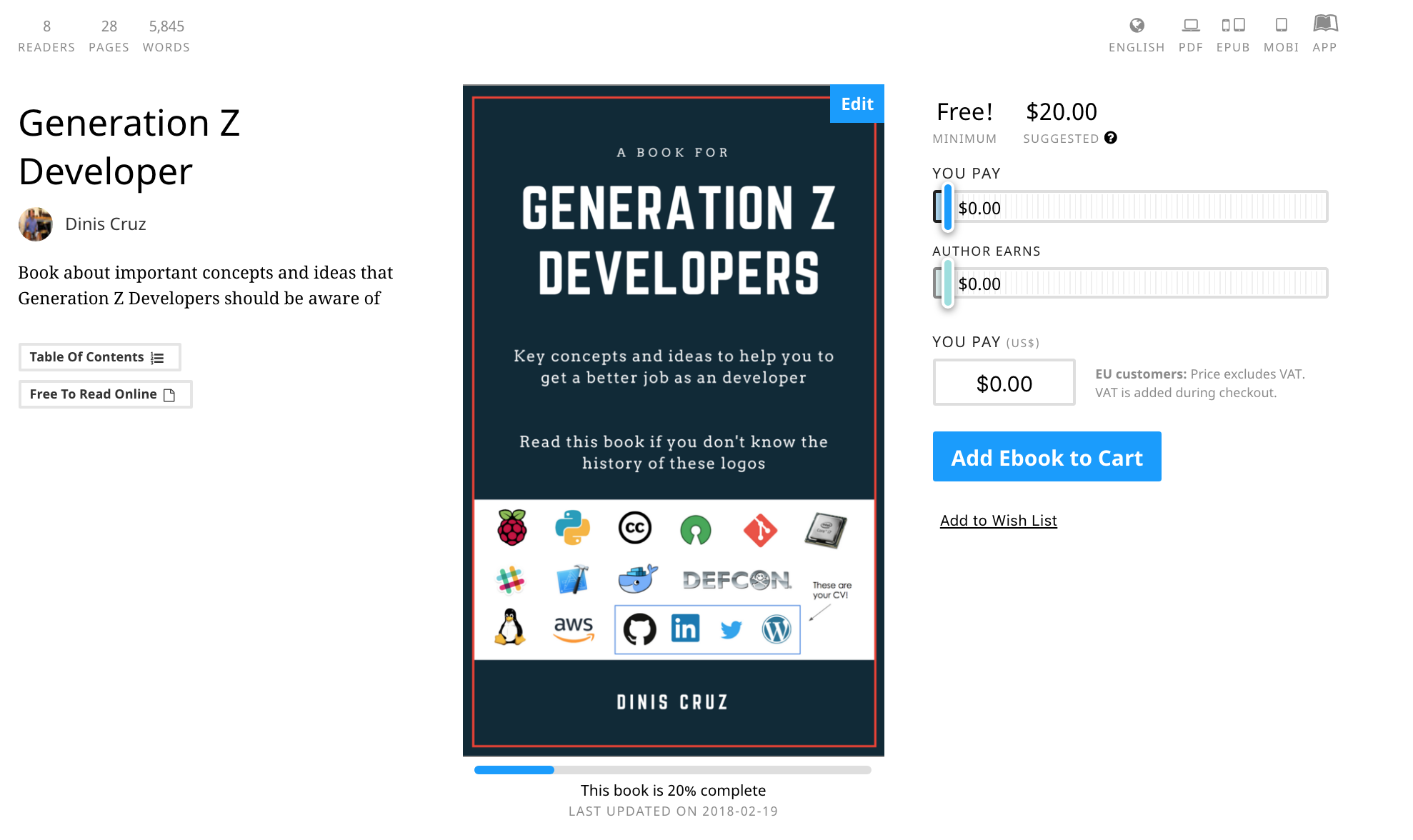
The book's Leanpub page in February 2018, 20% complete, the early cover with logos, free with a suggested $20.screenshot
not referenced
The book's Leanpub page in February 2018, 20% complete, the early cover with logos, free with a suggested $20.
Leanpub's page, the author's book
history
ch. 41
Unreferenced in the text; the record of releasing early. Chapter 41 (how this book was made) could use it beside today's site.

The newsroom: 156 figures in 46 articles

The six articles tagged gen-z-book have only eight figures between them; the rest are in the articles the startup edition draws on. Almost all are drawn by code (Mermaid, SVG, a renderer with fixed layouts, as the newsroom's The infographic bake-off says), off-white, teal for the new way, grey for the old, red for risk. A figure marked behind a proposal is in an article a proposal draws on: reuse it, redraw it in the book's palette, or leave it to the article. The images stay on the newsroom and load from there.
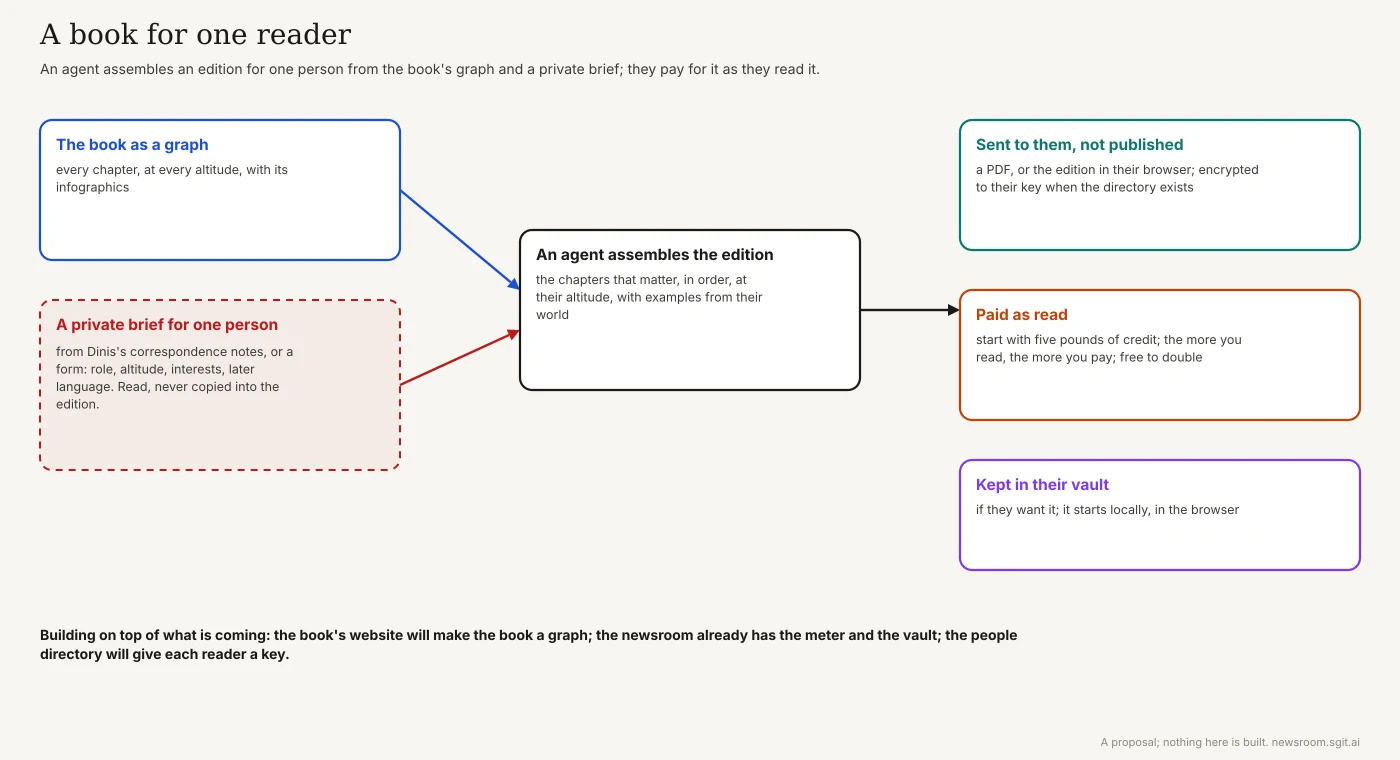
A book for one reader 1 figure · tagged gen-z-book

The article on newsroom.sgit.ai →
A book for one reader. On the left, what the edition is made from: the book as a graph, at every altitude, and a private brief for one person from Dinis's correspondence notes. In the middle, an agent assembles the edition: the chapters that matter, at the right altitude, with examples from the read
diagram
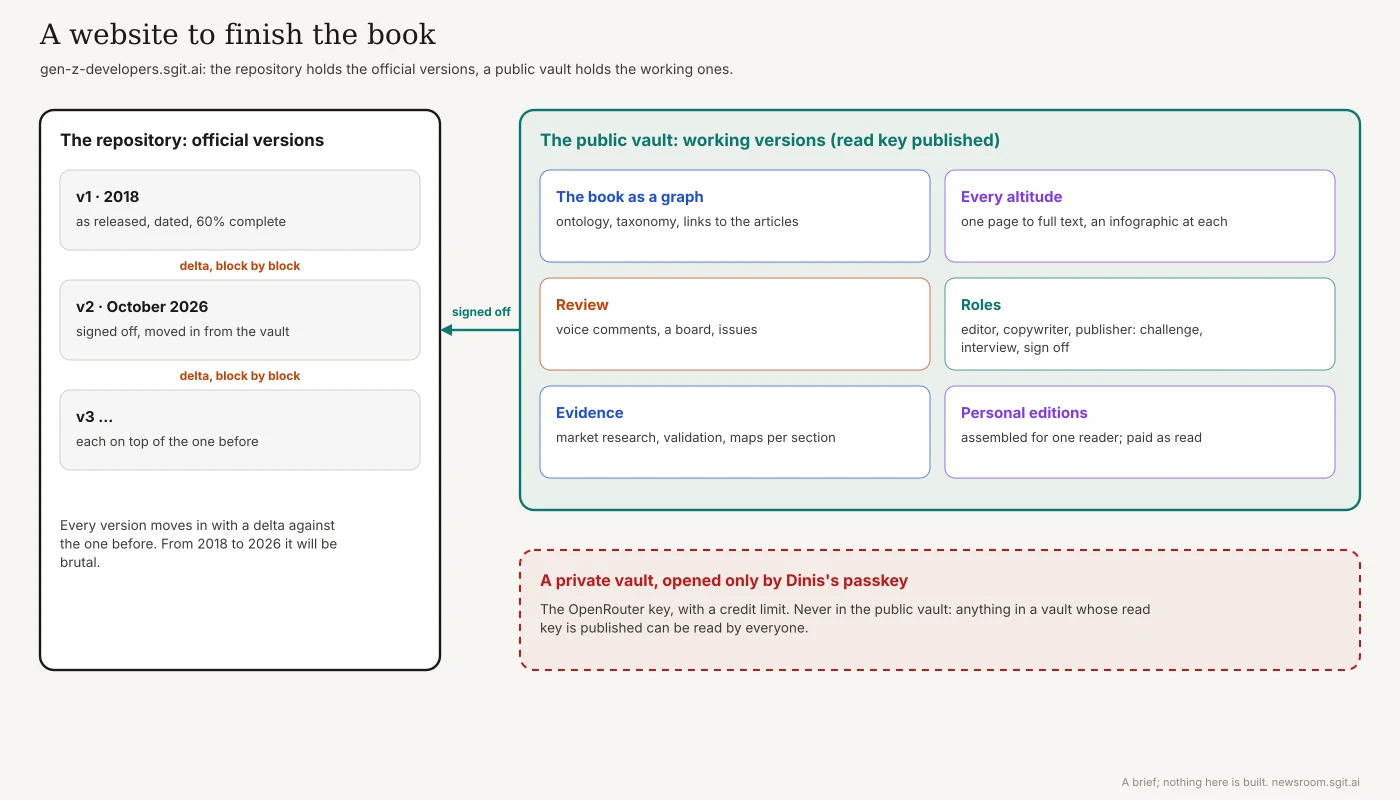
A website to finish the book 1 figure · tagged gen-z-book

The article on newsroom.sgit.ai →
The book's website. On the left, the repository: the official versions, starting with the 2018 book as released, and a delta between each version. On the right, the public vault: the working versions, the graph, the altitudes and their infographics, comments by voice, the board and issues, and the a
diagram · behind 2 proposals
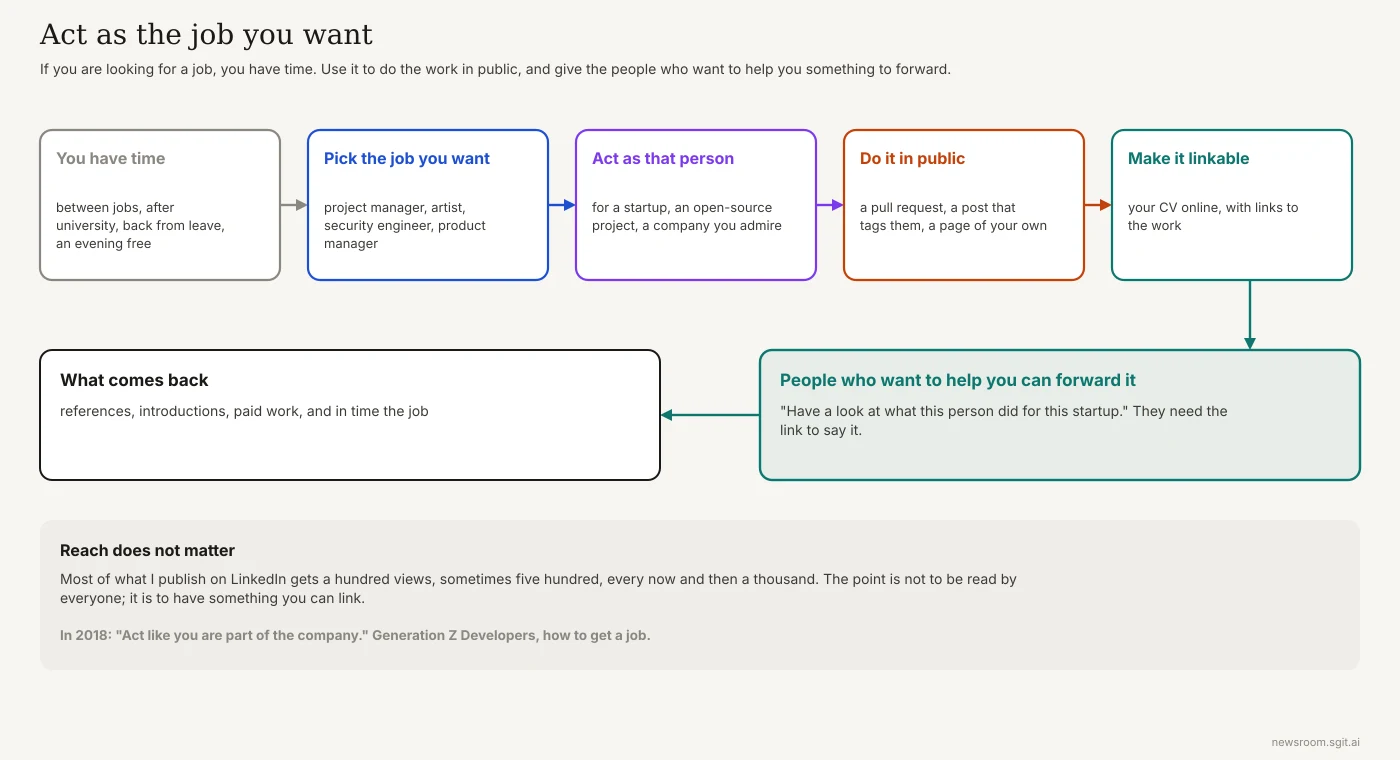
Act as the job you want 1 figure · tagged gen-z-book

The article on newsroom.sgit.ai →

Act as the job you want. If you are looking for a job, you have time. Pick the job you want and act as that person: for a startup, an open-source project or a company you admire, add value, send ideas, tag them and connect with their people. Do it in public, so the work can be linked. Then the peopl
infographic · behind 1 proposal
Generation Z Developers (AI edition) 2 figures · tagged gen-z-book

The article on newsroom.sgit.ai →
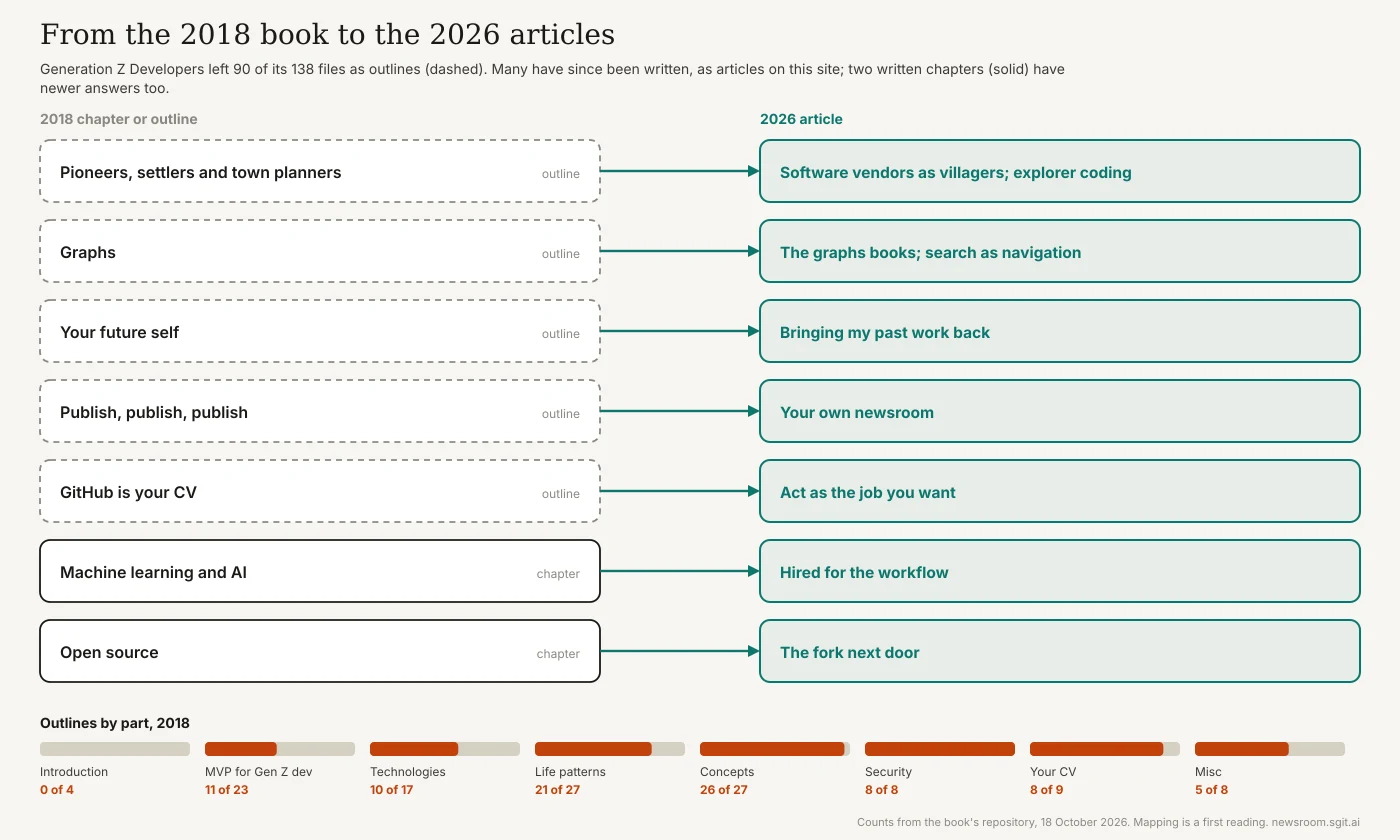
From the 2018 book to the 2026 articles. On the left, chapters of Generation Z Developers: five left as outlines in 2018 (pioneers, settlers and town planners; graphs; your future self; publish, publish, publish; GitHub as your CV) and two that were written (machine learning and AI; open source). On
infographic
The printed early release of Generation Z Developers, September 2018: "Key concepts and ideas for the next generation of developers", and seven lines on the cover: question everything; make fact based decisions; understand the history of tech; learn how to learn; understand what game is being played
photo
Hired for the workflow 2 figures · tagged gen-z-book

The article on newsroom.sgit.ai →
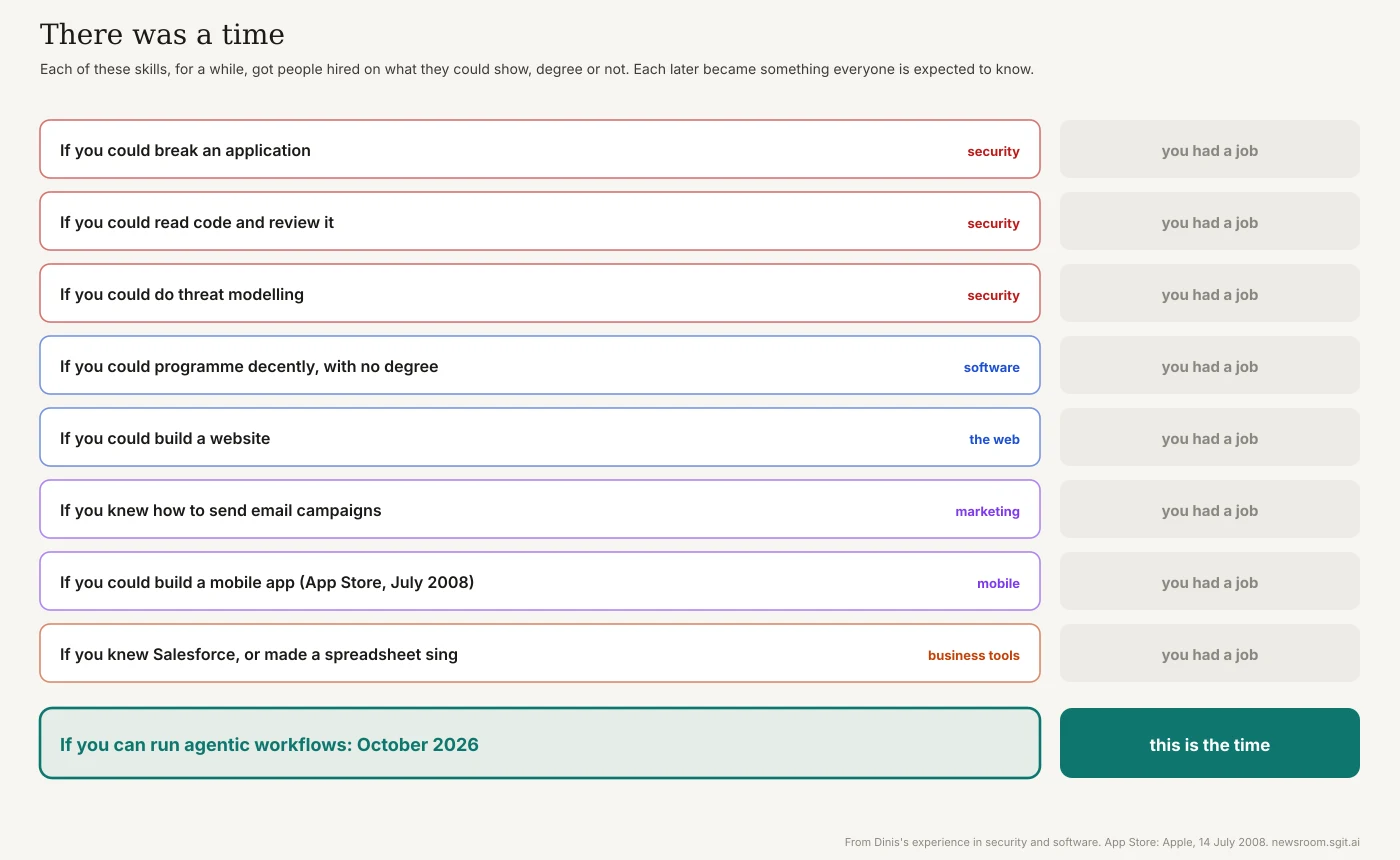
There was a time. Each row is a skill that, for a while, got people hired on what they could show rather than what their CV said: breaking applications, reading code, threat modelling, programming without a degree, building websites, sending email campaigns, building mobile apps after the App Store
infographic · behind 2 proposals
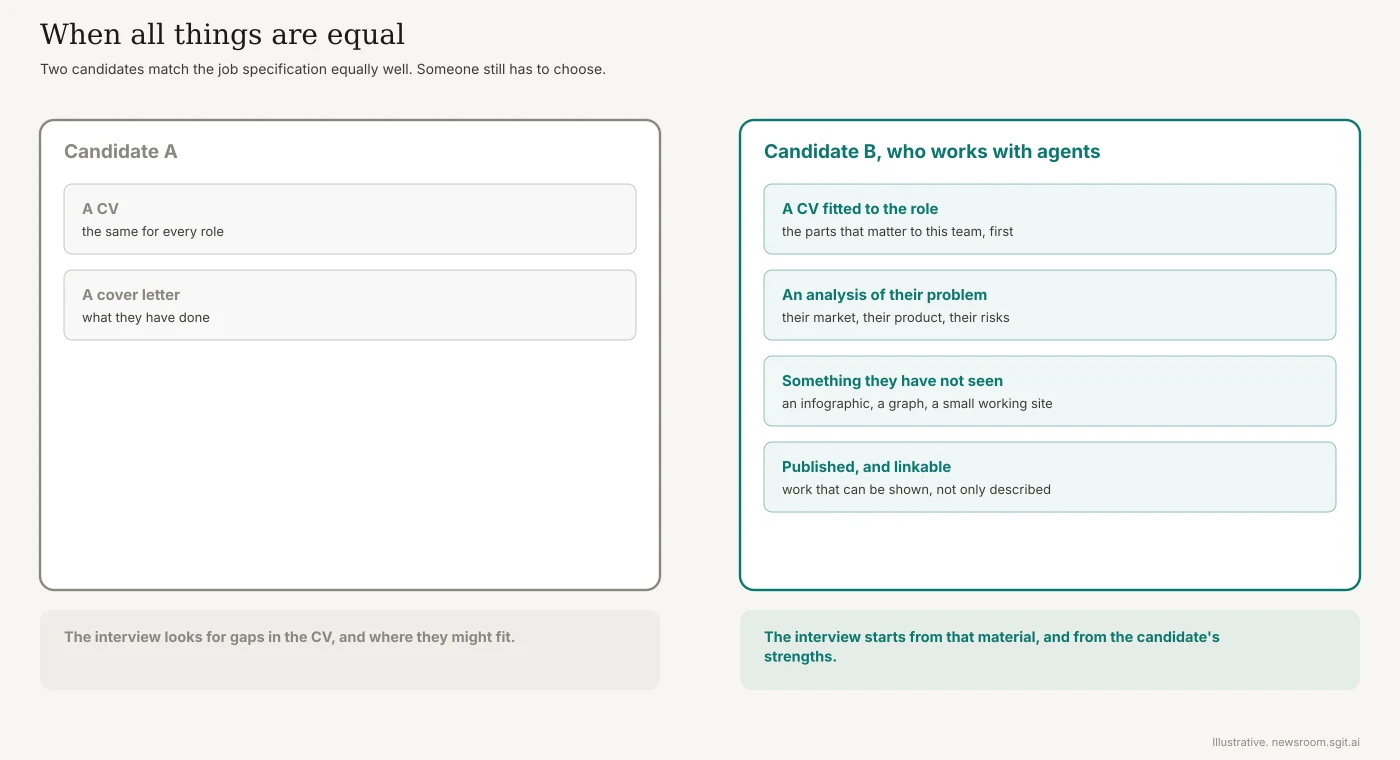
When all things are equal. Two candidates match the job specification equally well. One sends a CV. The other sends a CV fitted to the role, a short analysis of the company's problem, and an infographic or a small working site they have not seen before. The interview starts from that material, on th
infographic · behind 2 proposals
Short, punchy, and co-written with Claude 1 figure · tagged gen-z-book

The article on newsroom.sgit.ai →
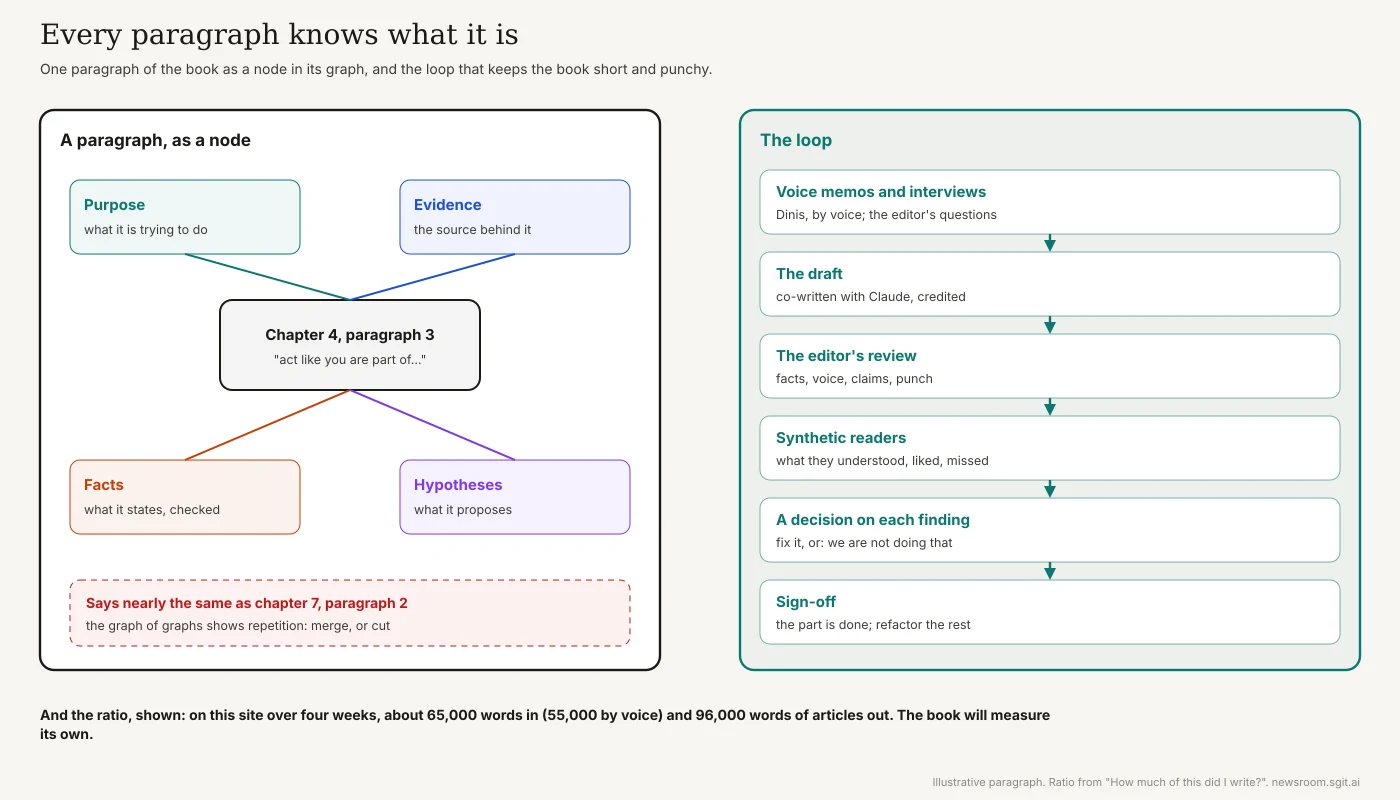
Every paragraph knows what it is. One paragraph of the book as a node in its graph, carrying its purpose, the evidence behind it, the facts it states and the hypotheses it proposes, linked to the chapter above it and to the paragraphs that say something close, which is how repetition shows up. Aroun
infographic
A policy beside the prompt 4 figures

The article on newsroom.sgit.ai →
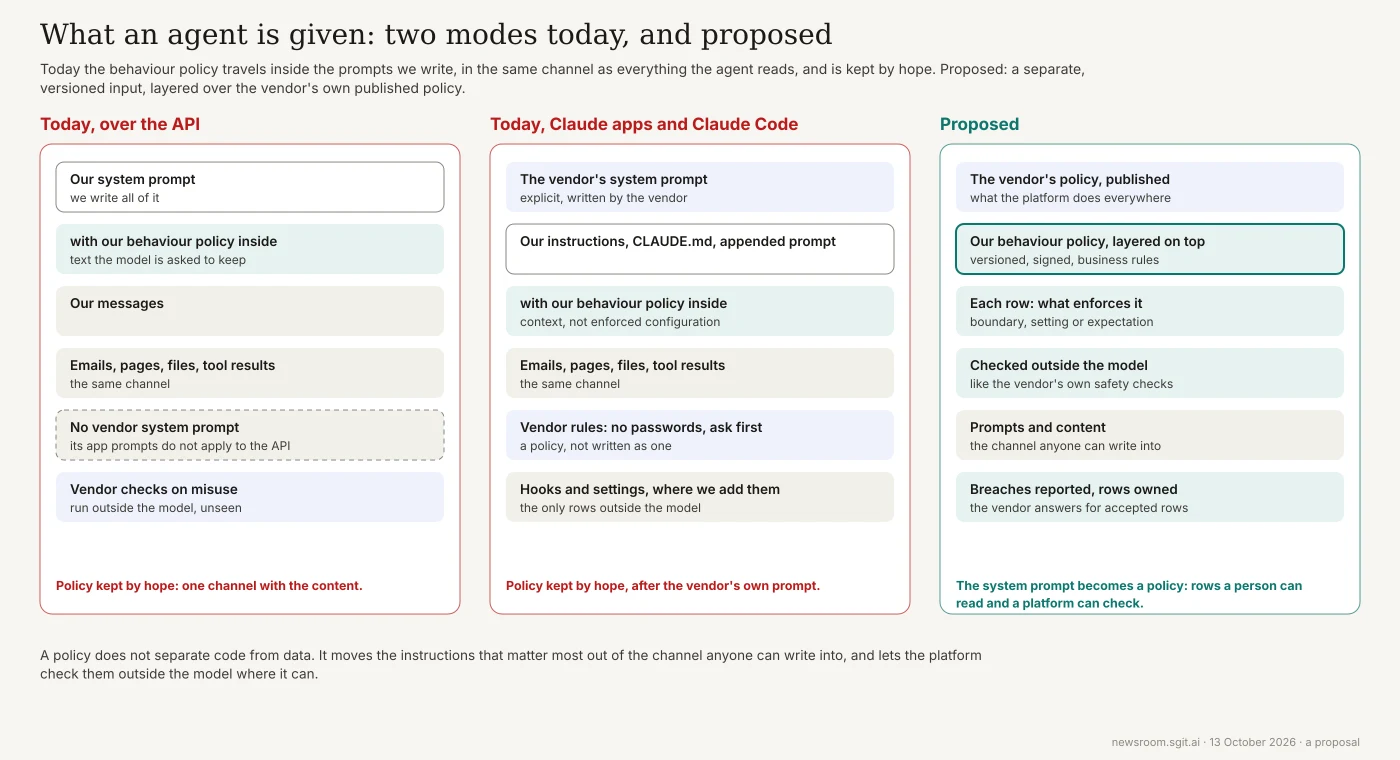
What an agent is given, today in two modes and as proposed. Over the API we write the whole system prompt, so our behaviour policy goes inside it; in the Claude apps and Claude Code the vendor's system prompt comes first and our policy goes into what we add. In both, it is text the model is asked to
diagram
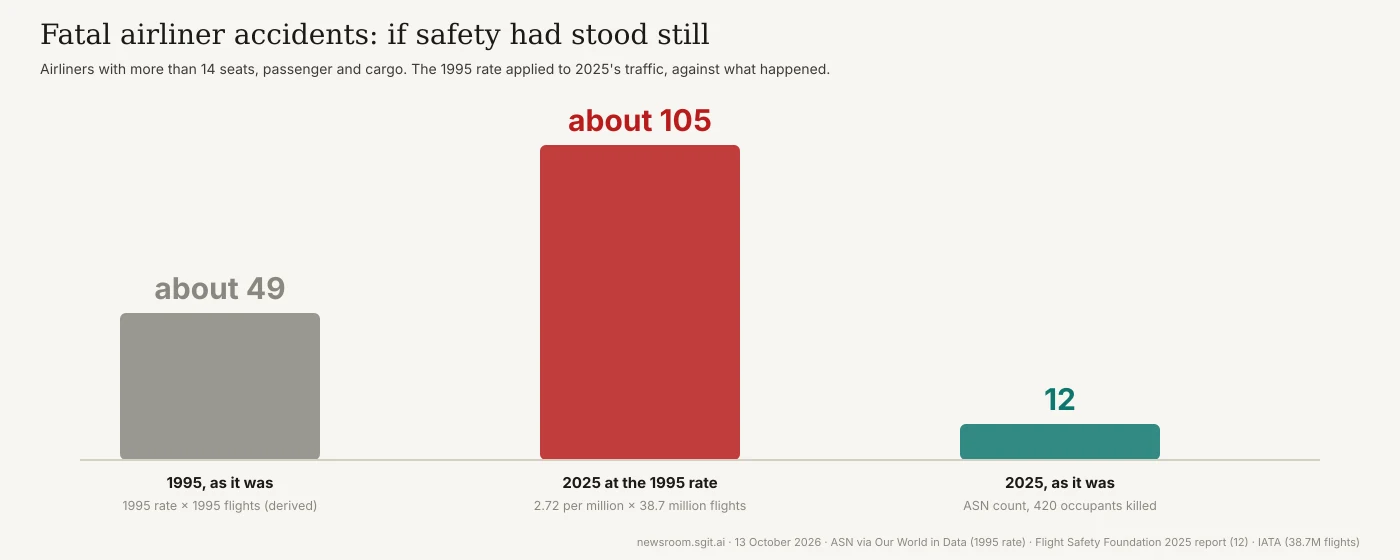
Fatal airliner accidents, 1995 and 2025. At 1995's rate of 2.72 per million flights, 2025's 38.7 million flights would have produced about 105 fatal accidents. There were 12. Rates from the Aviation Safety Network via Our World in Data; 2025 accidents from the Flight Safety Foundation's report of th
infographic
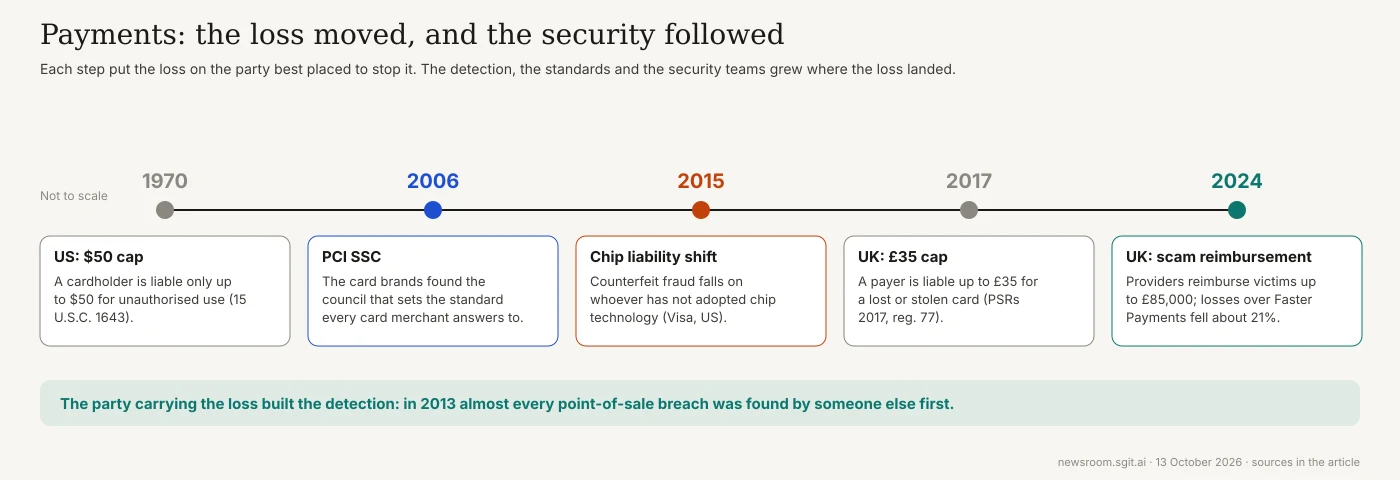
Where the liability for payment fraud was moved, and what followed. Each step put the loss on the party best placed to stop it, and the security followed the loss: caps for consumers, a liability shift onto whoever had not adopted chip cards, standards written by the card brands, and reimbursement o
infographic
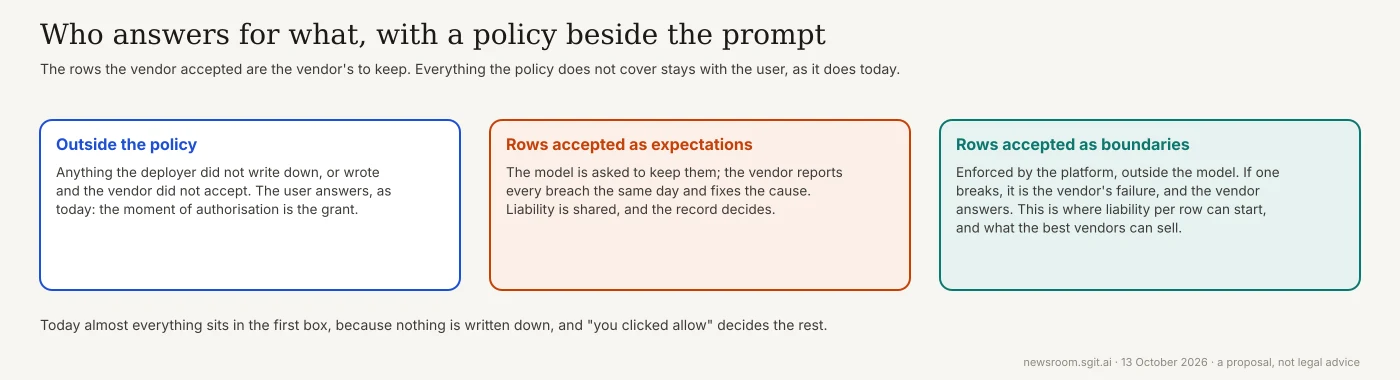
The proposed split. The vendor publishes its own built-in policy and accepts the deployer's; for every row it accepts, it says what enforces it and answers if it breaks. Everything the policy does not cover stays with the user, as it does today. The vendors that keep more rows as boundaries can sell
infographic
Agentics, ready to sell 3 figures

The article on newsroom.sgit.ai →
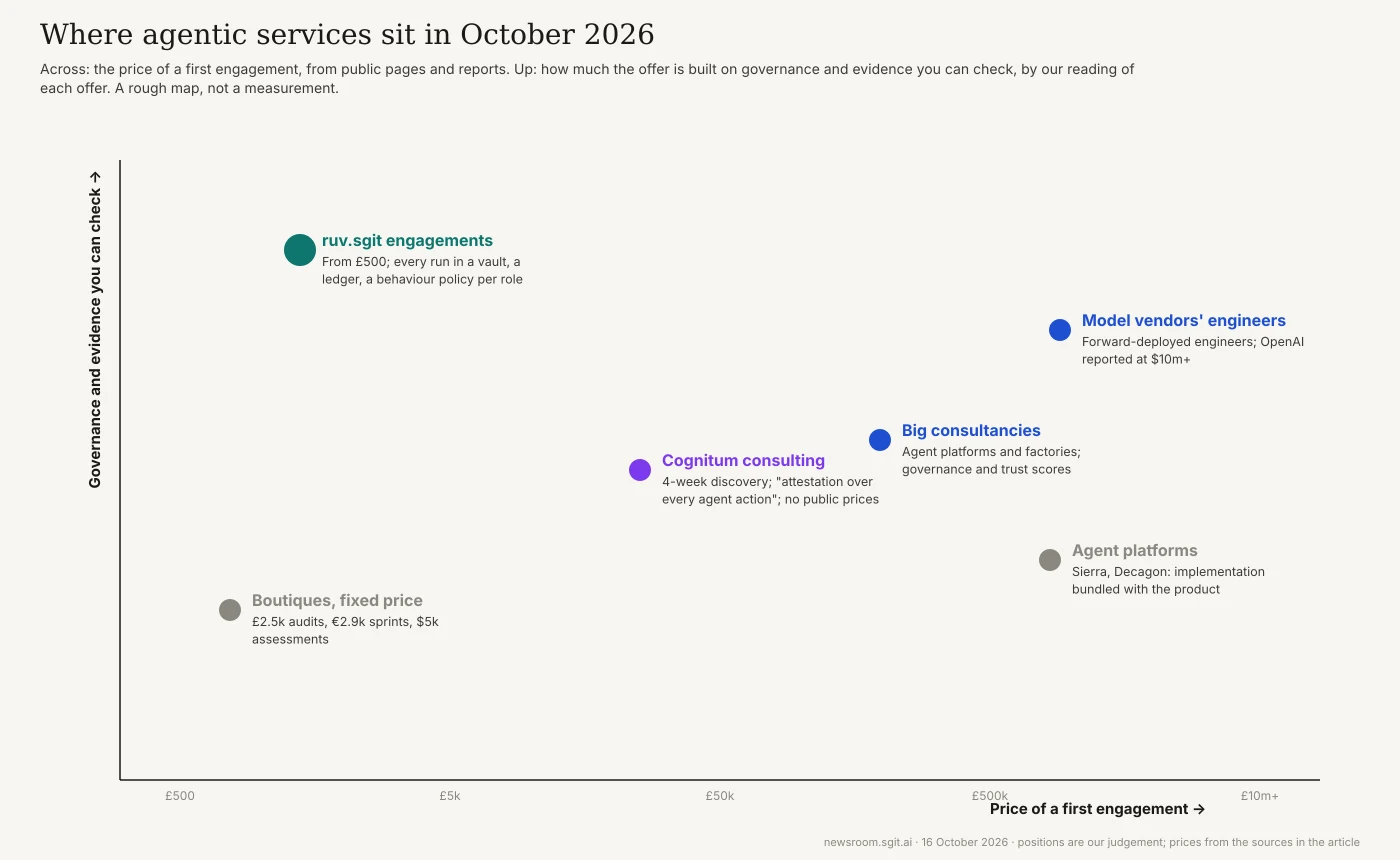
Where agentic services sit in October 2026: boutiques with fixed-price audits, Cognitum's consulting, the big consultancies, agent platforms and the model vendors' engineers, by the price of a first engagement and how much the offer rests on governance and evidence you can check; ruv.sgit engagement
infographic · behind 1 proposal
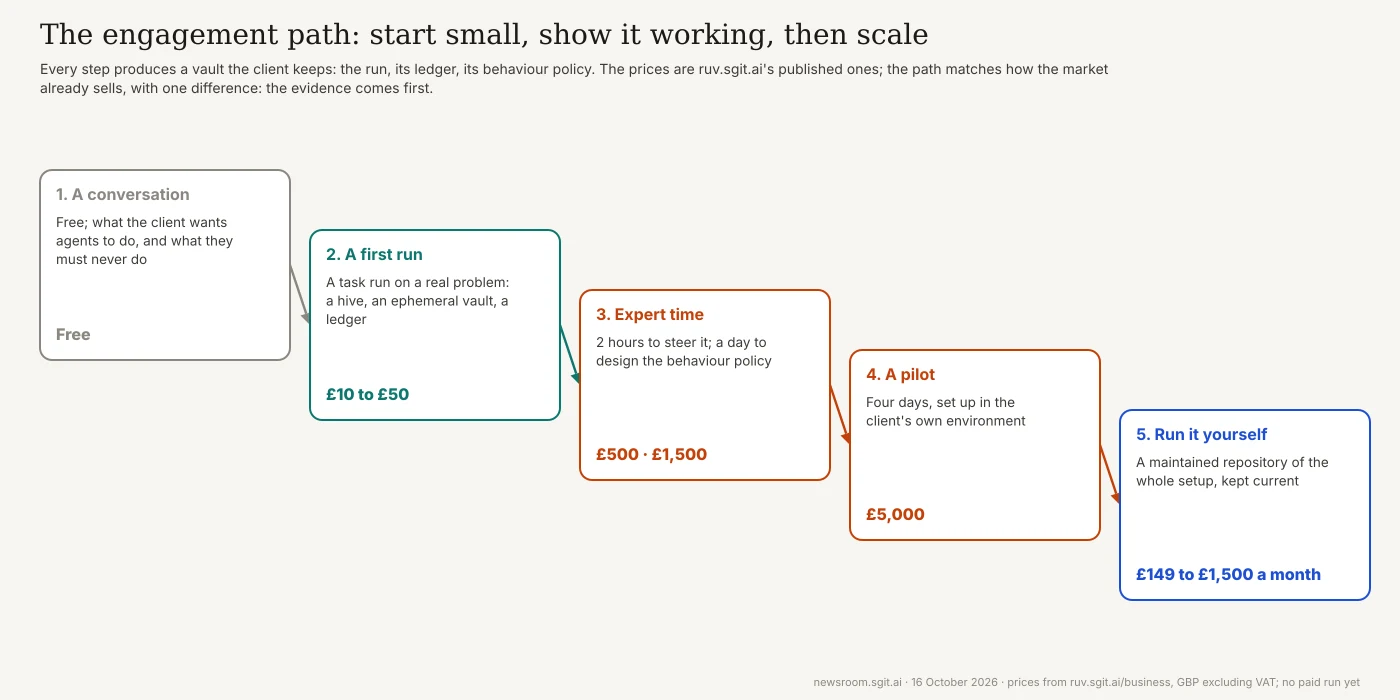
The engagement path: a free conversation, a first run on a real problem for £10 to £50, expert time at £500 for two hours or £1,500 for a day, a four-day pilot in the client's environment for £5,000, and a maintained repository from £149 a month.
diagram · behind 1 proposal
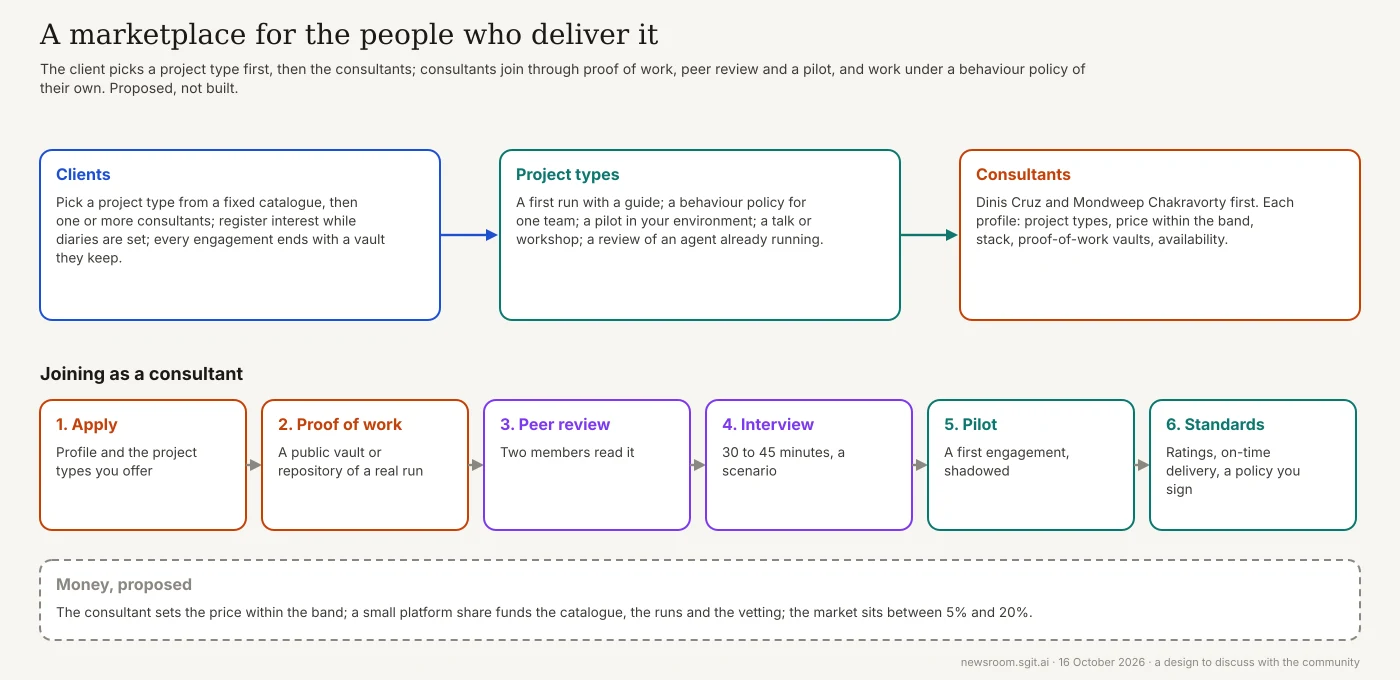
A marketplace for the people who deliver it: clients pick a project type, then the consultants; consultants join through an application, proof of work, peer review, an interview, a shadowed pilot and standards; the platform share is a proposal.
diagram · behind 1 proposal
A locked-down desktop for an agent, by the minute, is still hard to rent 3 figures

The article on newsroom.sgit.ai →
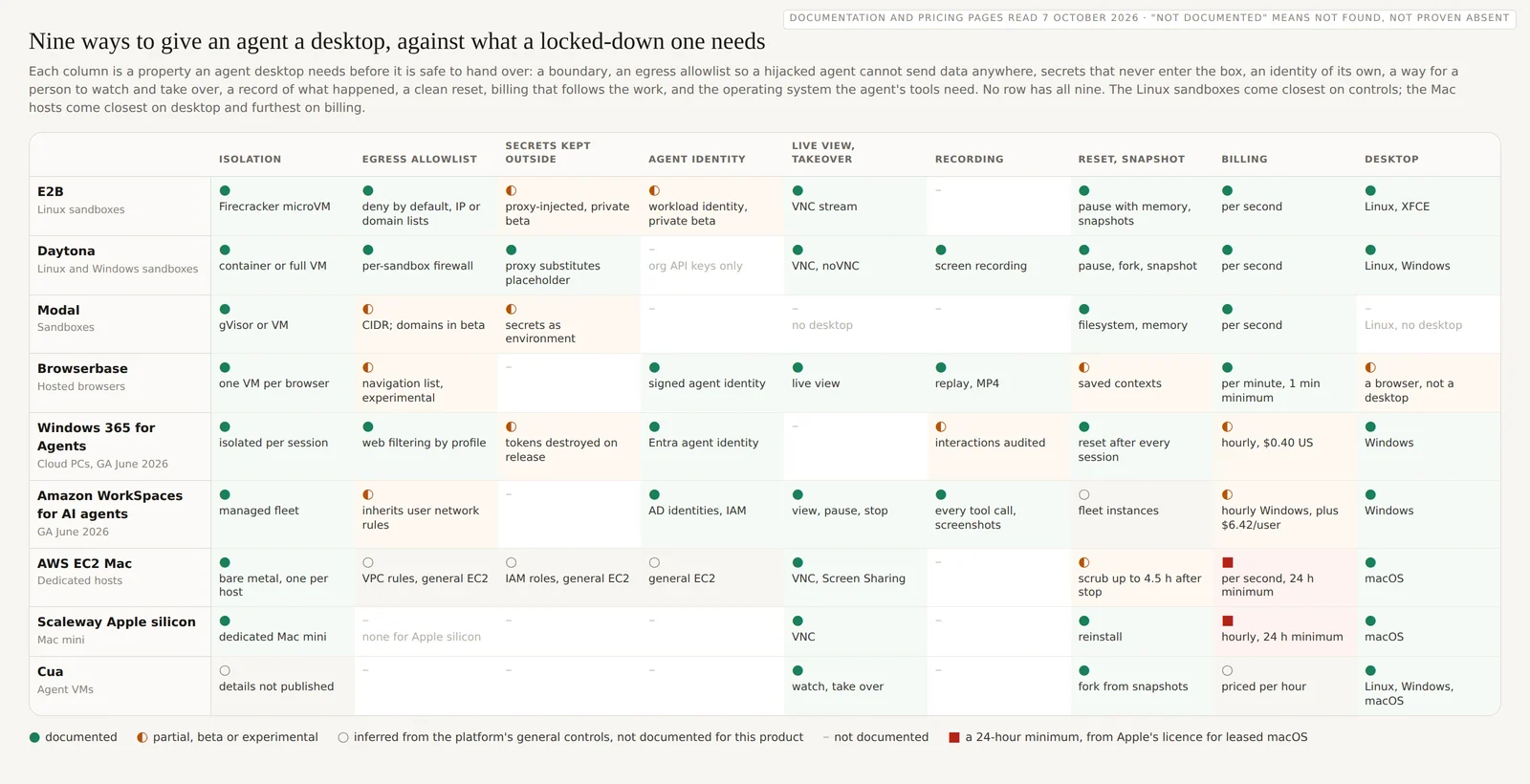
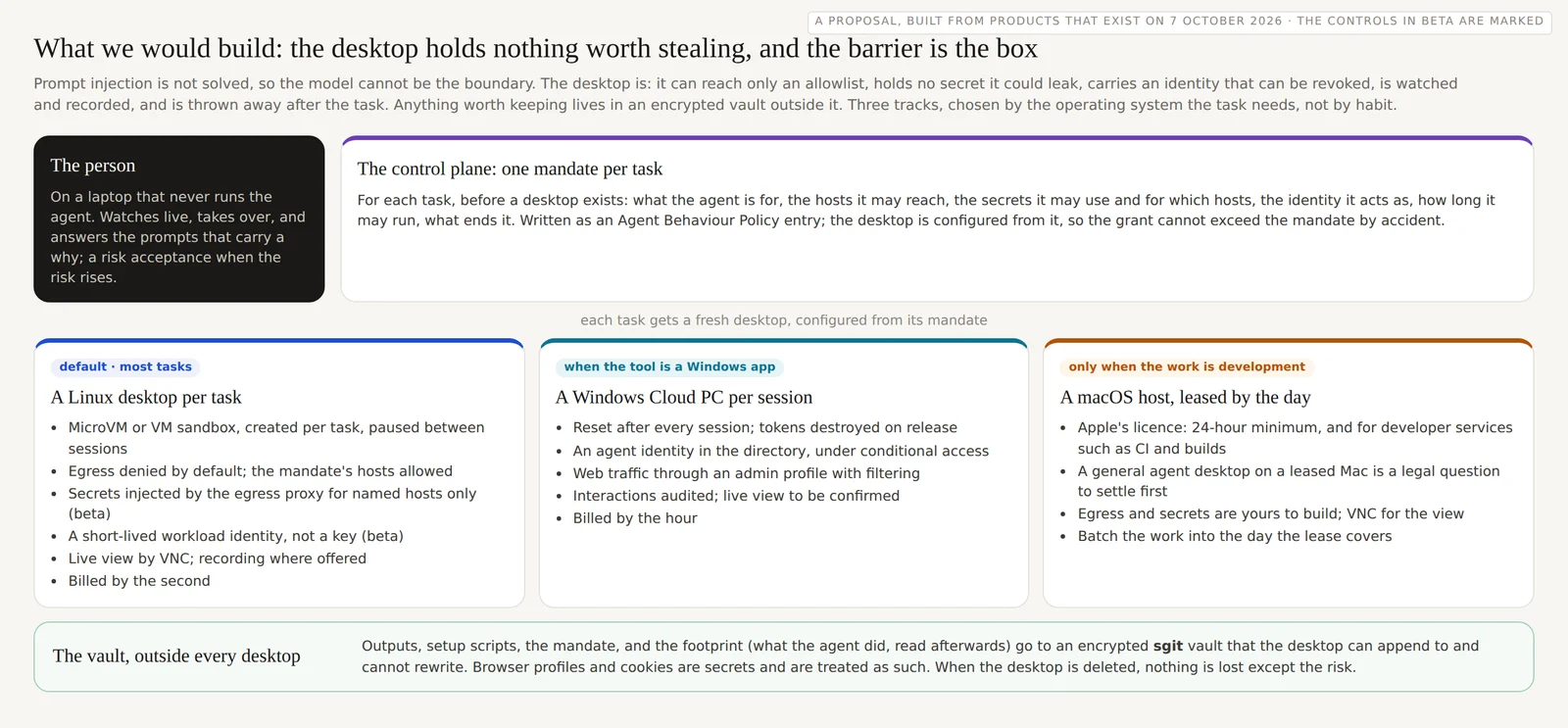
Nine products against the nine properties of a locked-down agent desktop, from each product's own documentation on 7 October 2026. No row has all nine.
other · behind 1 proposal
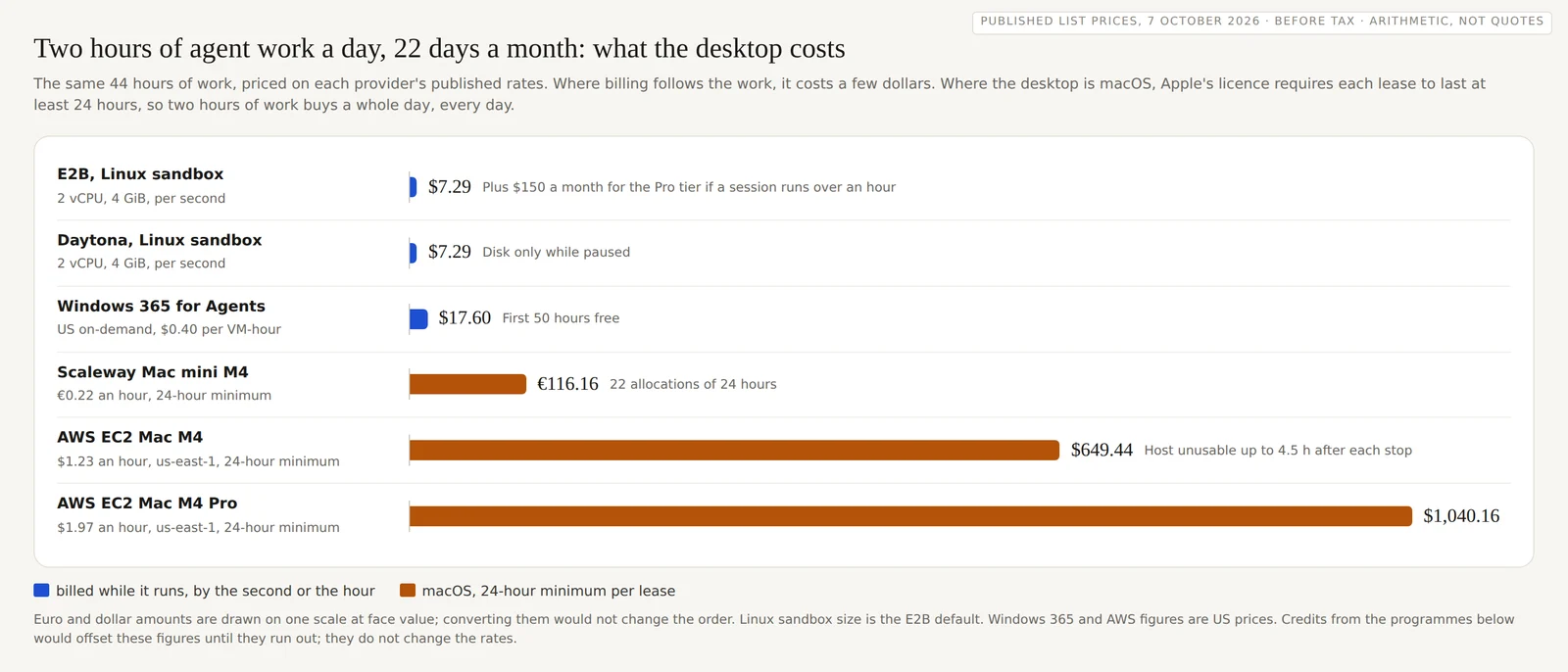
The same 44 hours of work a month, at published prices. Where billing follows the work, it costs a few dollars; where the desktop is a leased Mac, two hours buys a day.
other · behind 1 proposal
The proposal: one mandate per task, a fresh desktop configured from it, three tracks by operating system, and a vault outside every desktop for anything worth keeping.
other · behind 1 proposal
Books from articles 2 figures

The article on newsroom.sgit.ai →
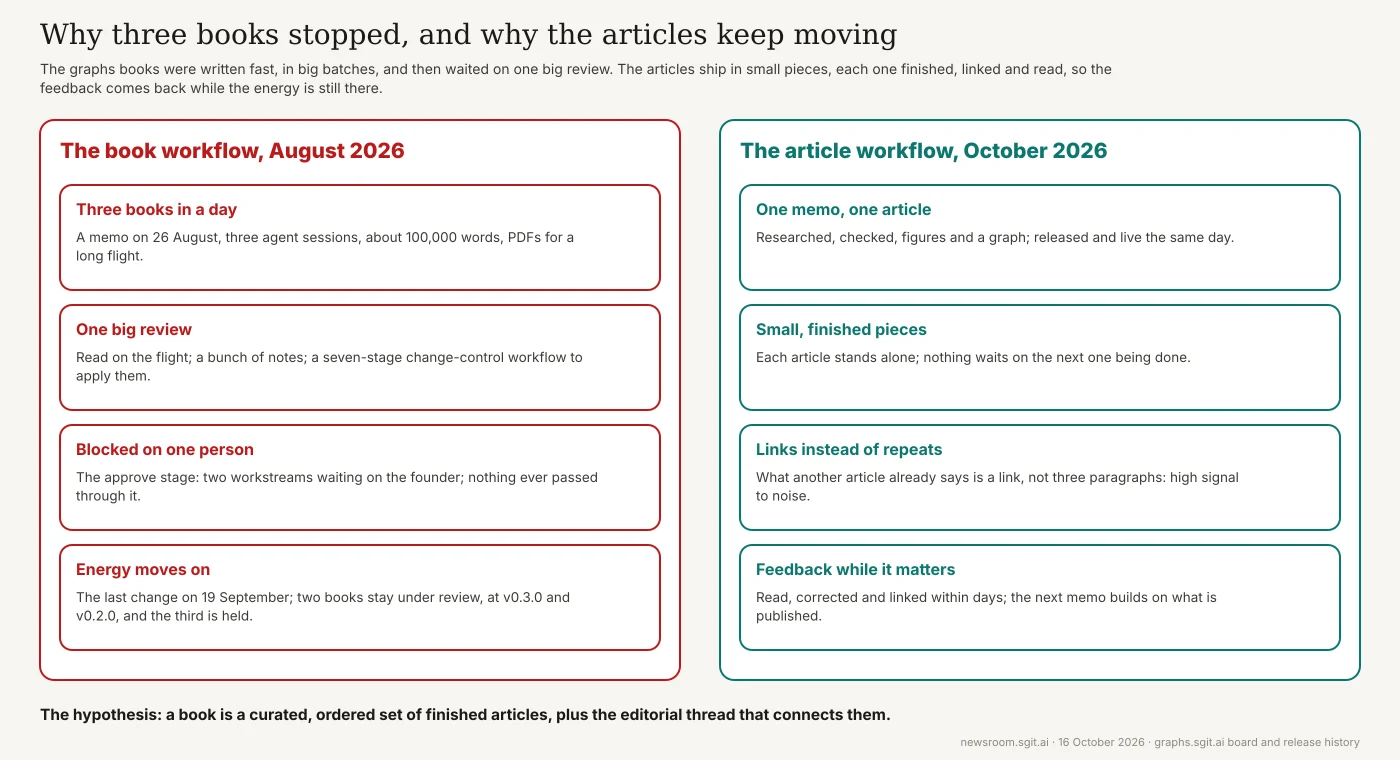
Why three books stopped and the articles keep moving: the August book workflow wrote three books in a day, waited on one big review, blocked on one person and was left behind; the October article workflow ships one finished, linked article per memo and gets feedback while it matters.
infographic
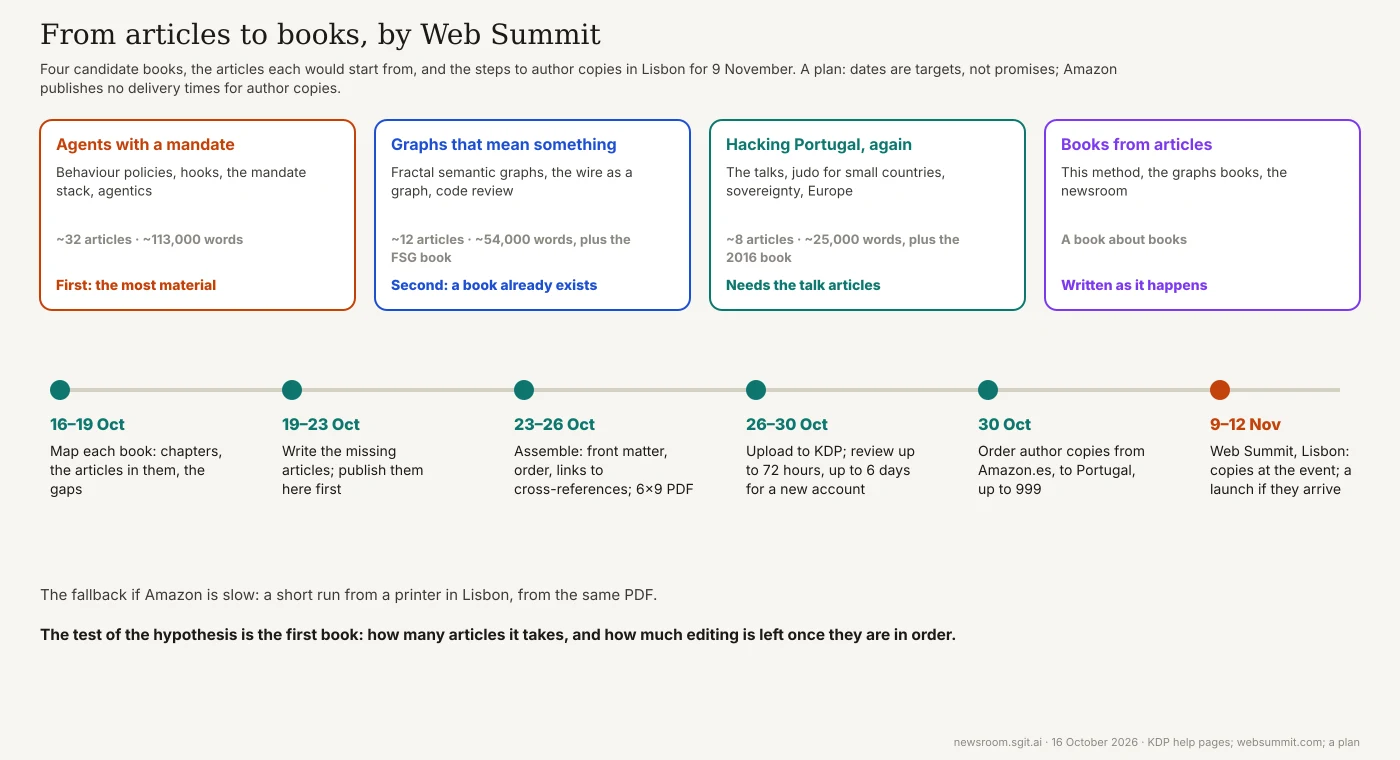
From articles to books by Web Summit: four candidate books, agents with a mandate, graphs, Hacking Portugal and books from articles, with the articles each starts from, and six steps from mapping the books on 16 October to author copies in Lisbon on 9 to 12 November.
infographic
A chat box on a site with no server, the plan, and the trade it makes 1 figure

The article on newsroom.sgit.ai →

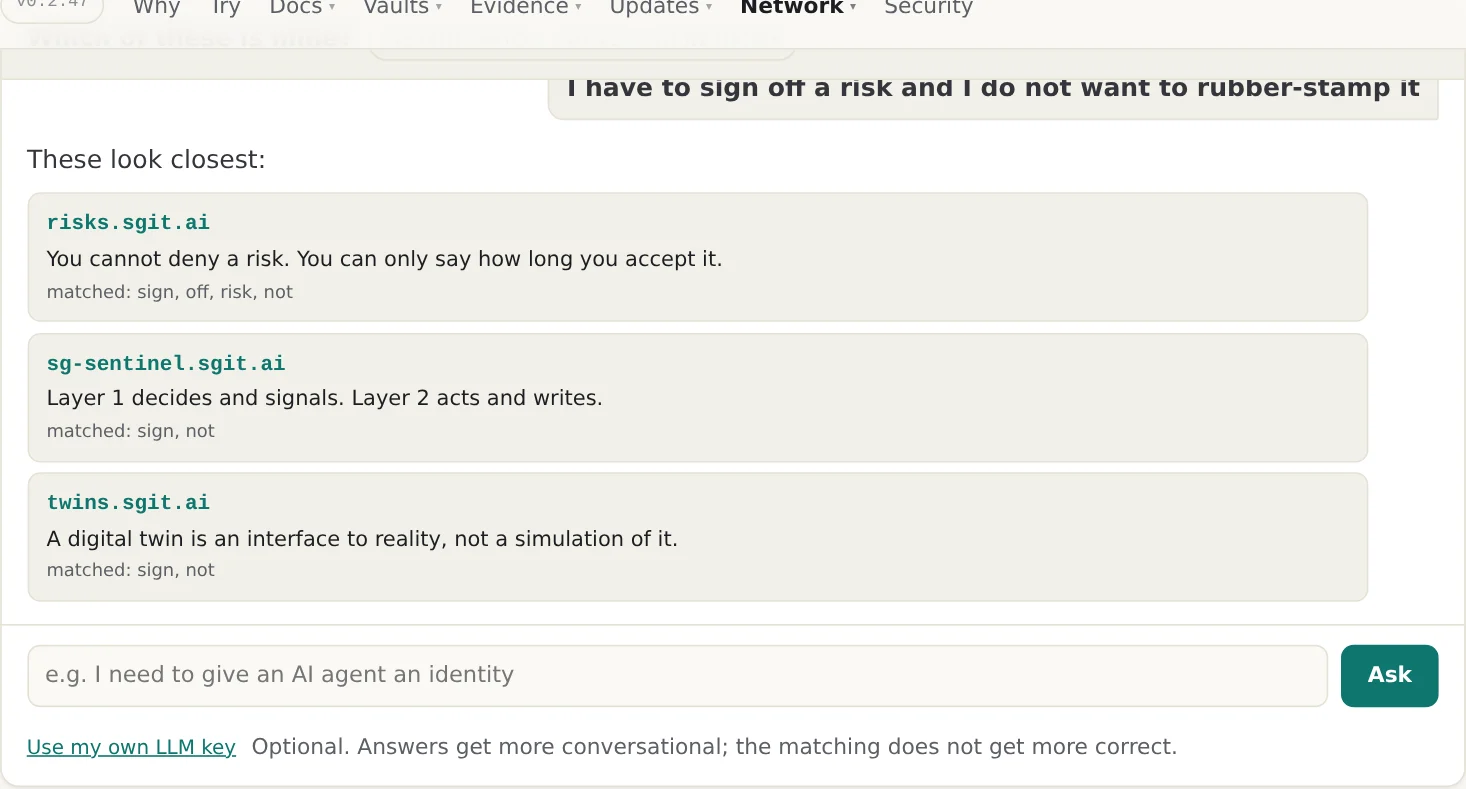
The panel on the directory. The default tier is a local matcher; the key is opt-in and clearly labelled.
other · behind 3 proposals
Cloudflare as Lego blocks 2 figures

The article on newsroom.sgit.ai →
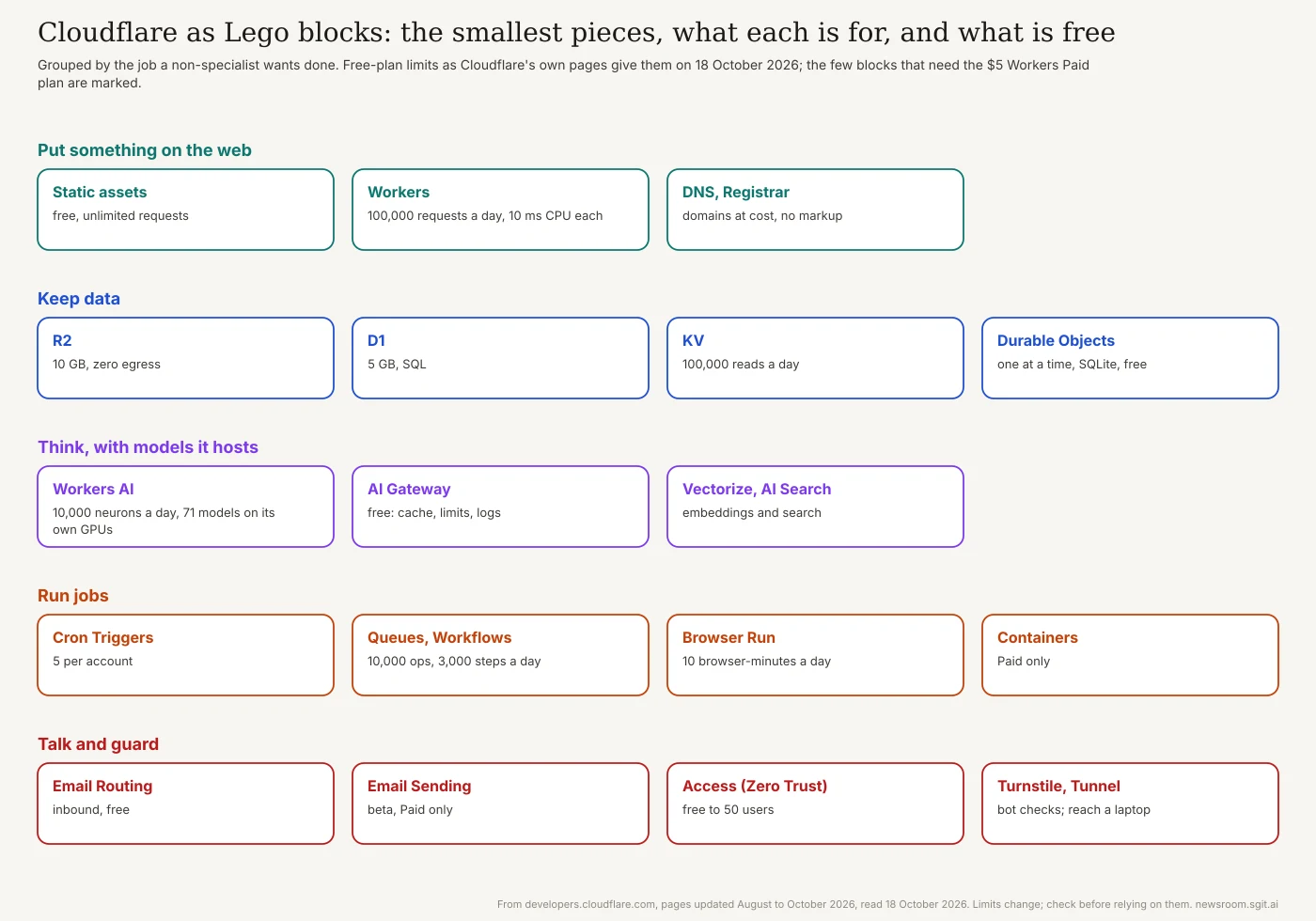
Cloudflare's developer platform as blocks, grouped by job. Put something on the web: static assets, free and unlimited; Workers, 100,000 requests a day; DNS and domains at cost. Keep data: R2 with 10 GB and zero egress, D1, KV, Durable Objects. Think with models it hosts: Workers AI with 10,000 neur
diagram · behind 2 proposals
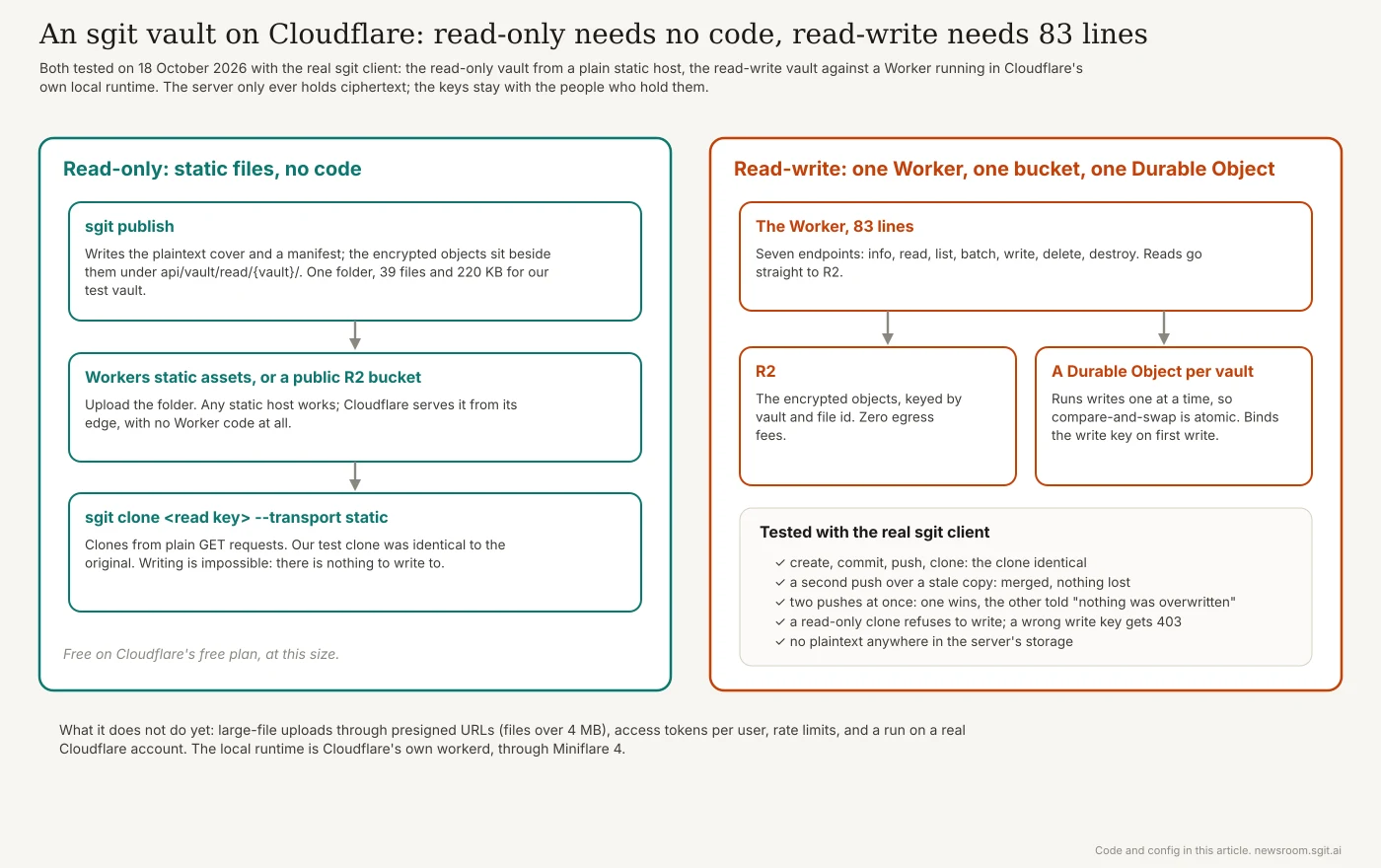
medium
other · behind 2 proposals
Ephemeral town planner services 1 figure

The article on newsroom.sgit.ai →

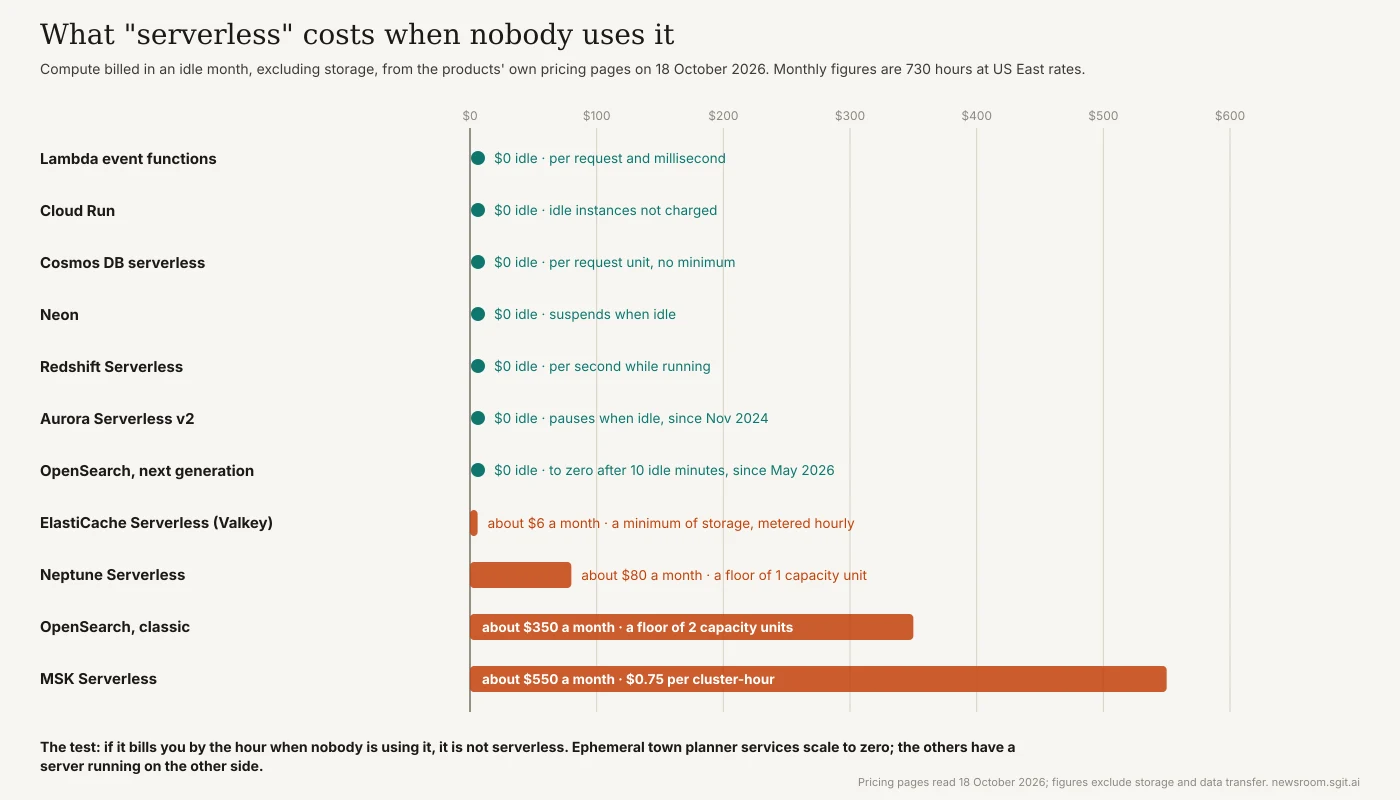
What "serverless" costs when nobody is using it, for products sold under the name, as their own pricing pages read on 18 October 2026, excluding storage. Some scale to zero: Lambda's event functions, Cloud Run, Cosmos DB serverless, Neon, Redshift Serverless, Aurora Serverless v2 since November 2024
infographic · behind 1 proposal
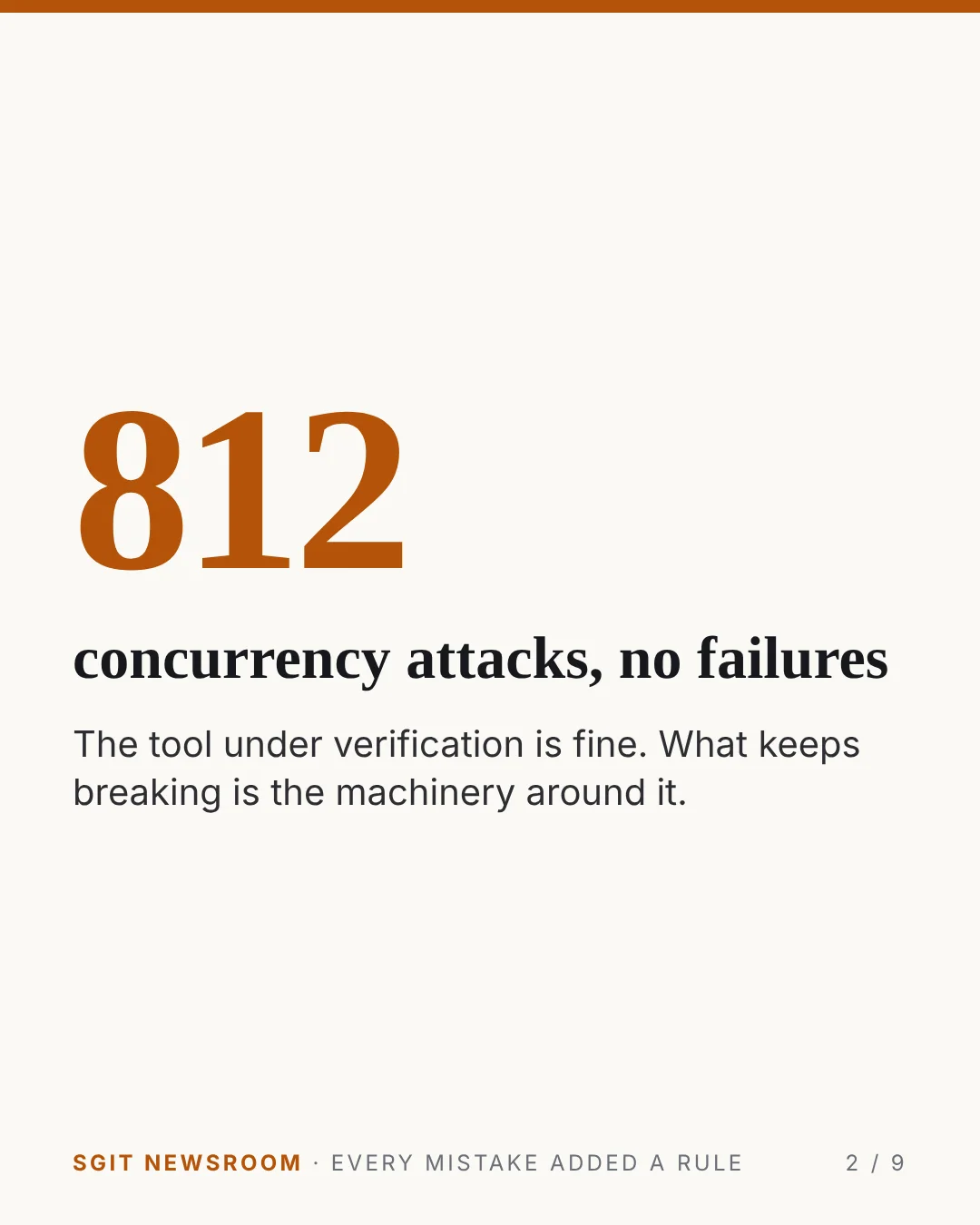
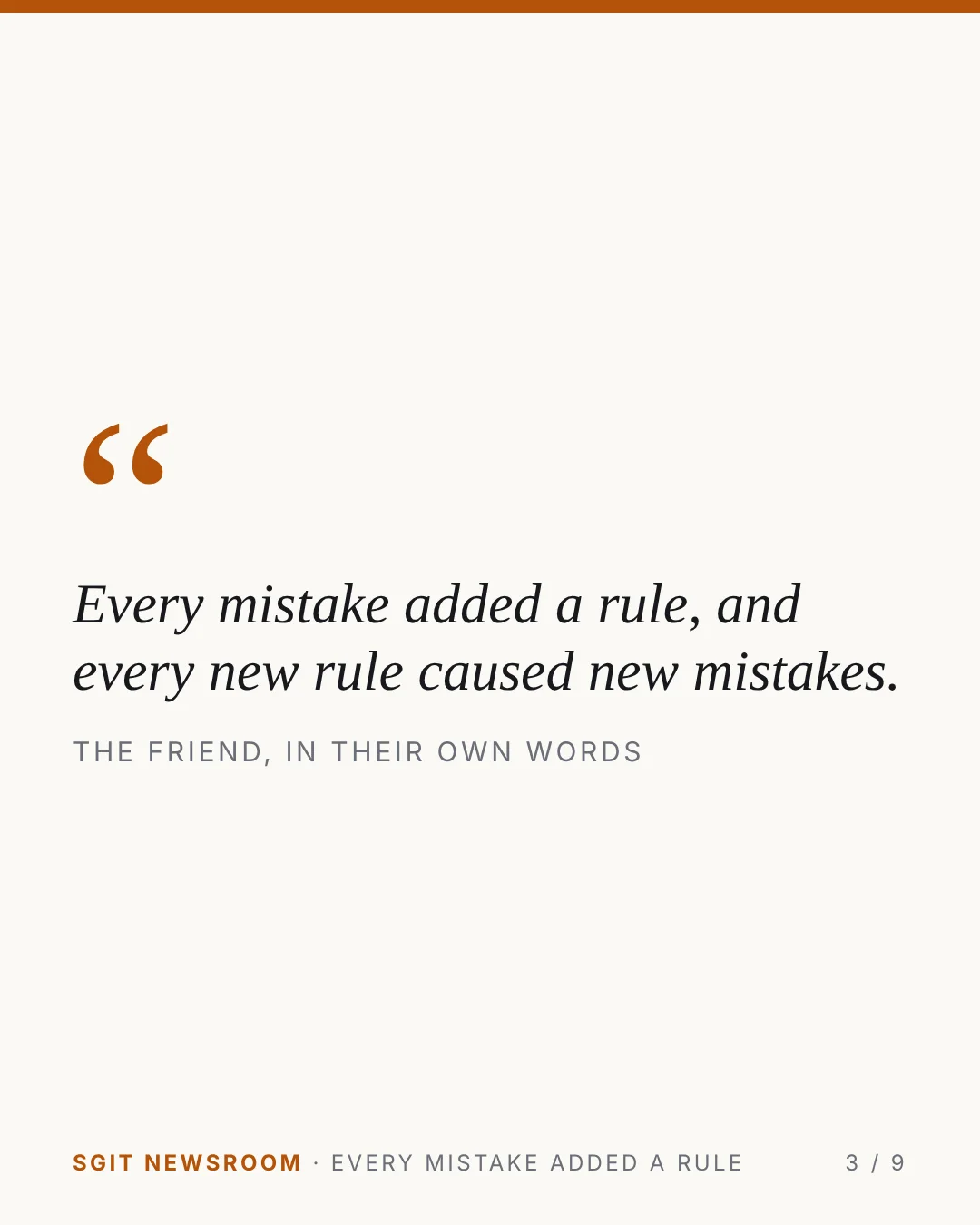
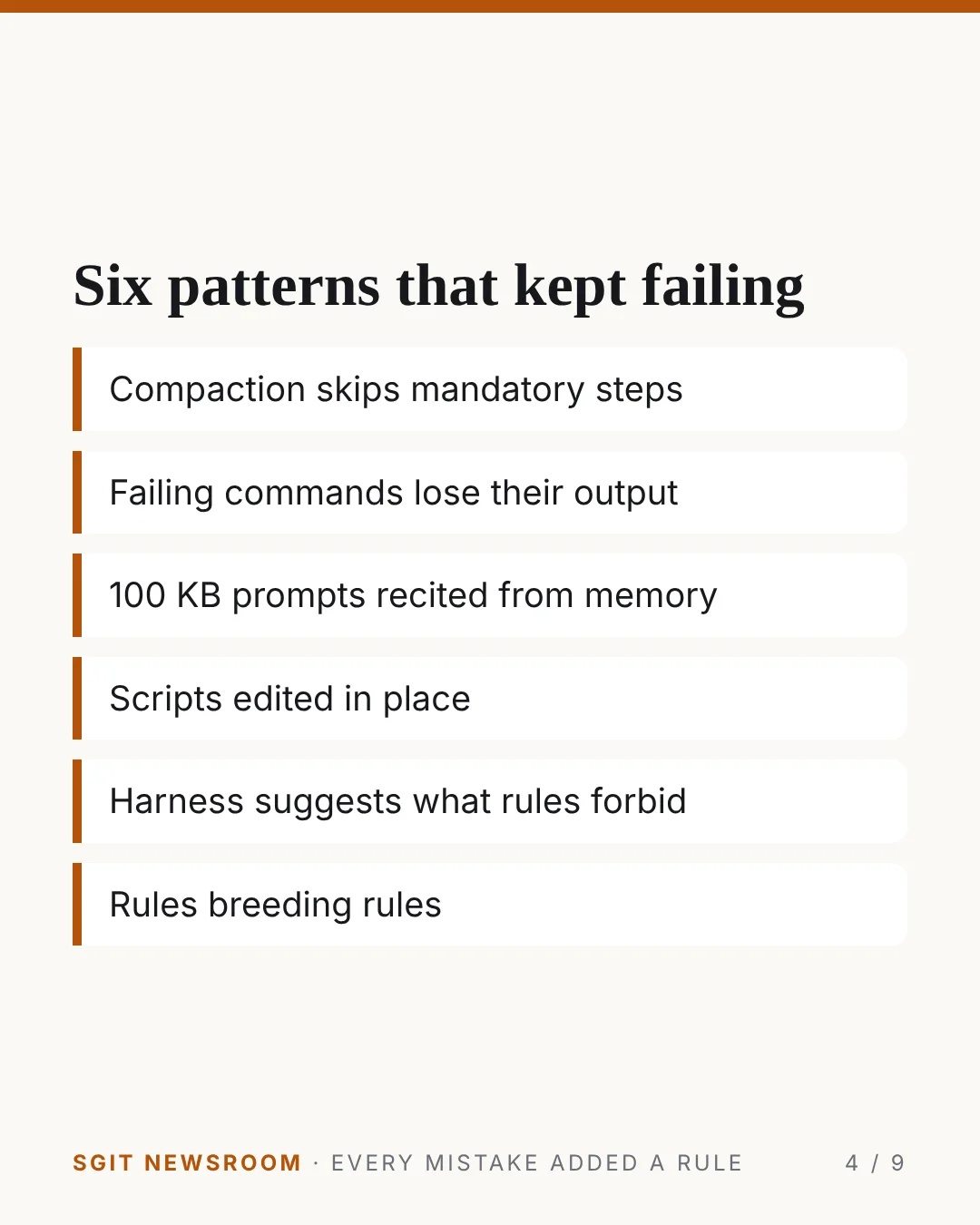
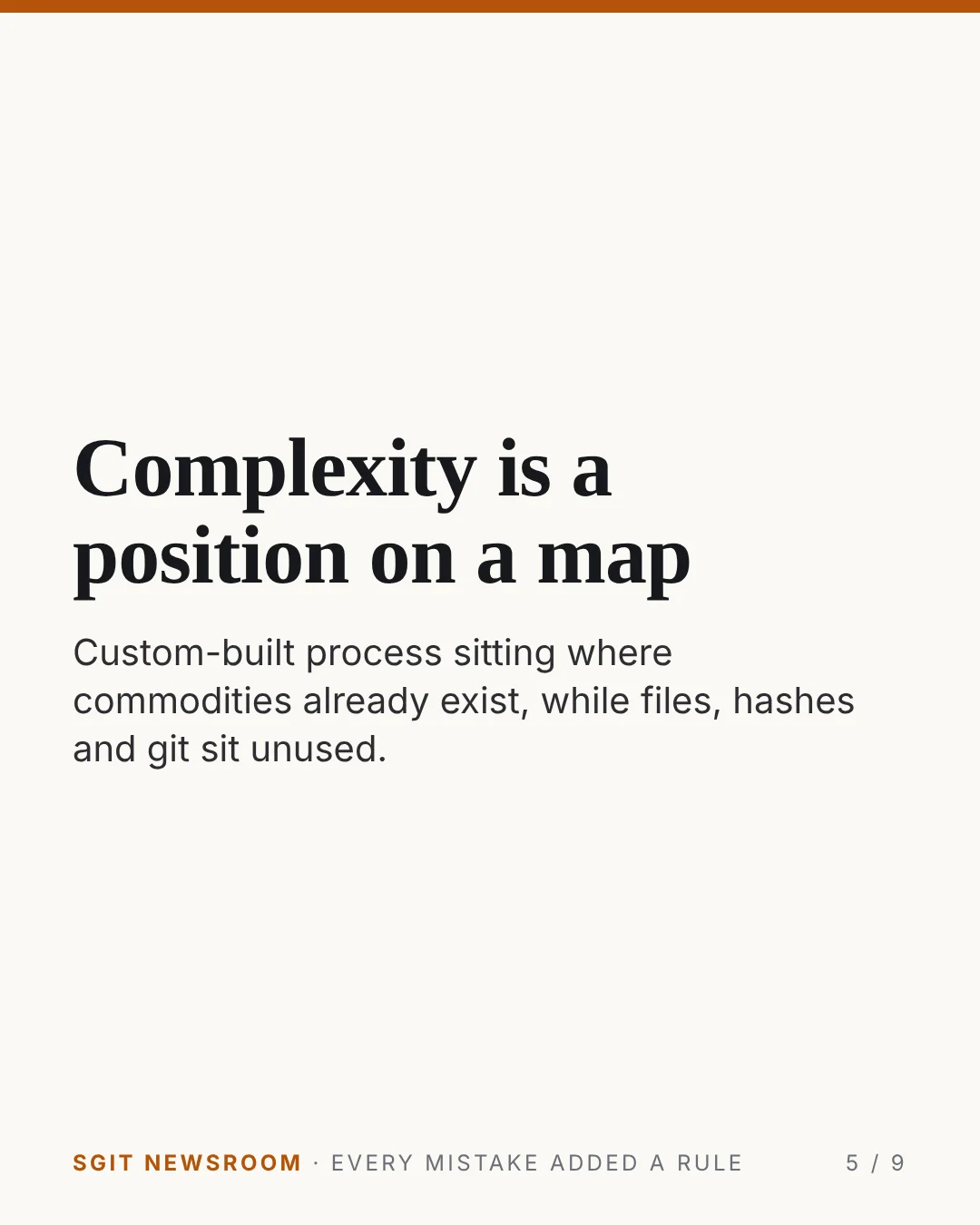
Every mistake added a rule 14 figures

The article on newsroom.sgit.ai →
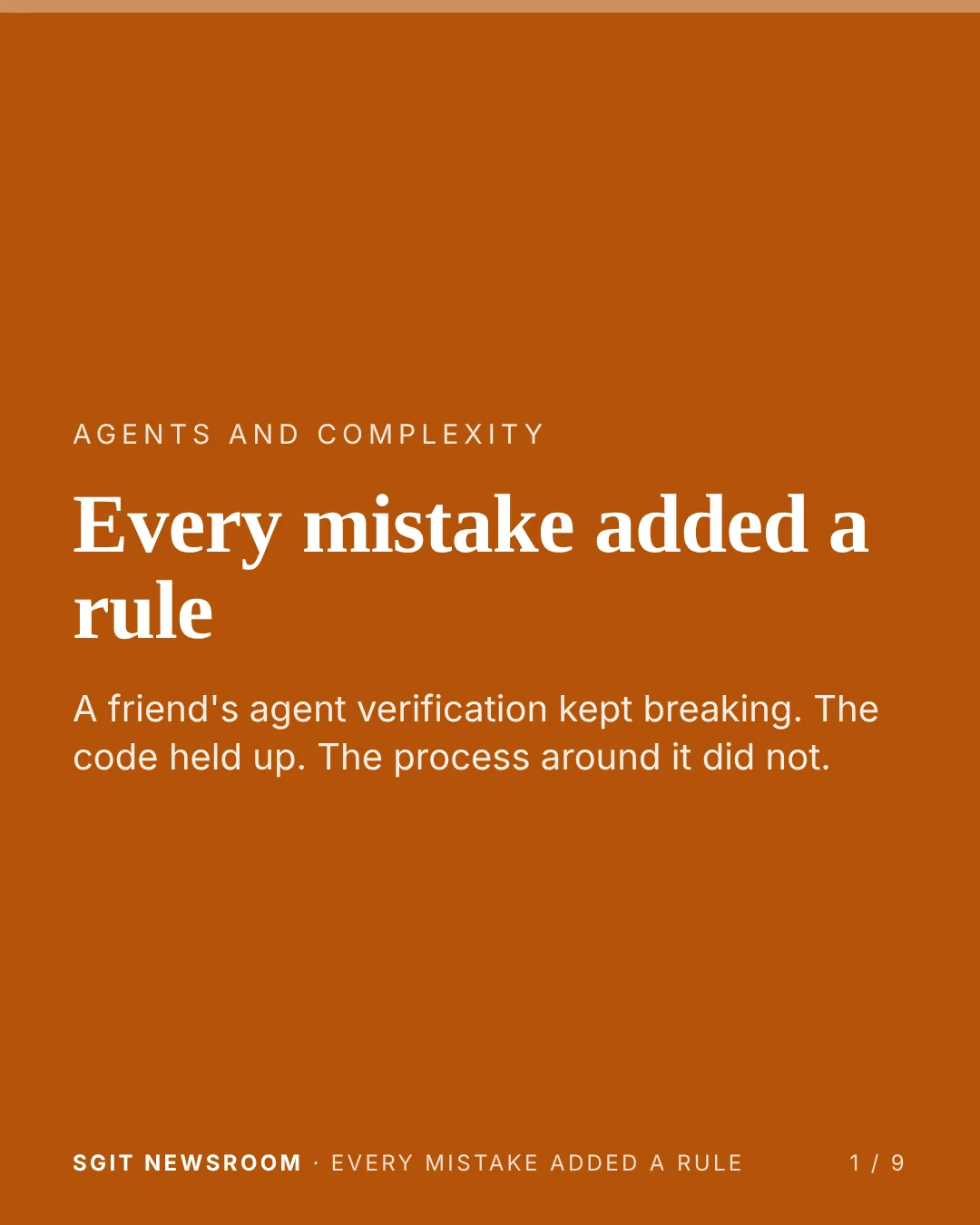
Slide 1 of 9
infographic · deck
Slide 2 of 9
infographic · deck
Slide 3 of 9
infographic · deck
Slide 4 of 9
infographic · deck
Slide 5 of 9
infographic · deck
Slide 6 of 9
infographic · deck
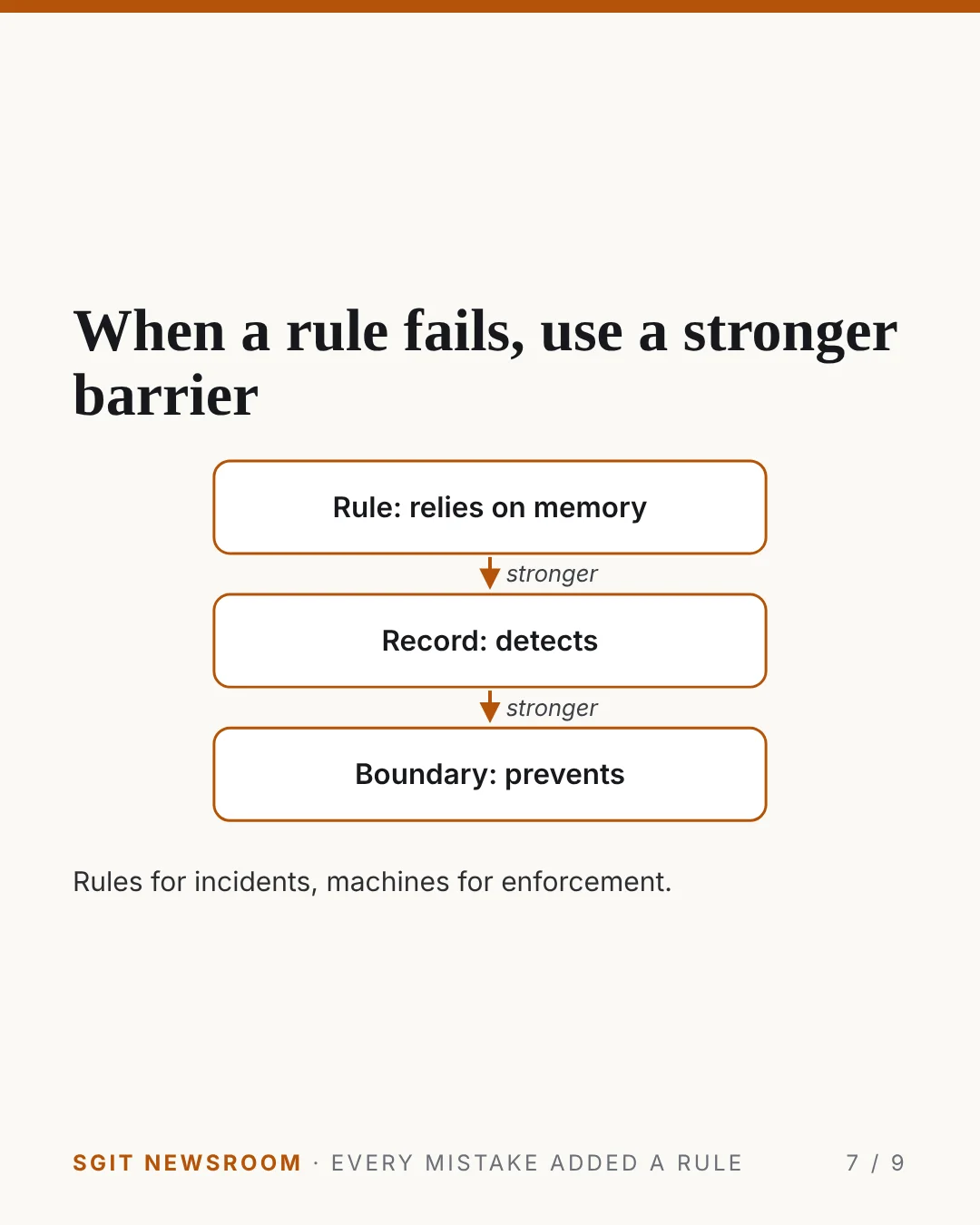
Slide 7 of 9
infographic · deck
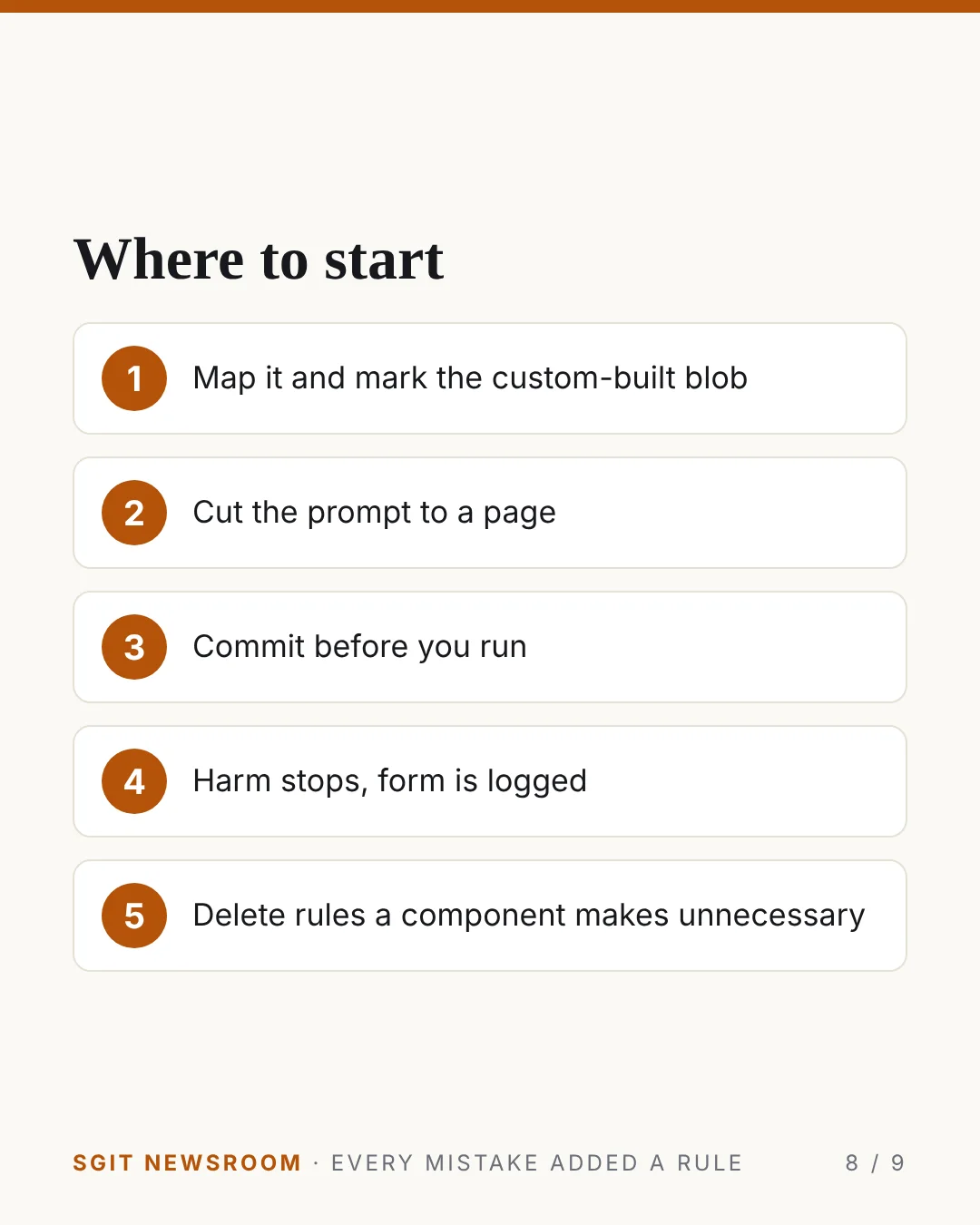
Slide 8 of 9
infographic · deck
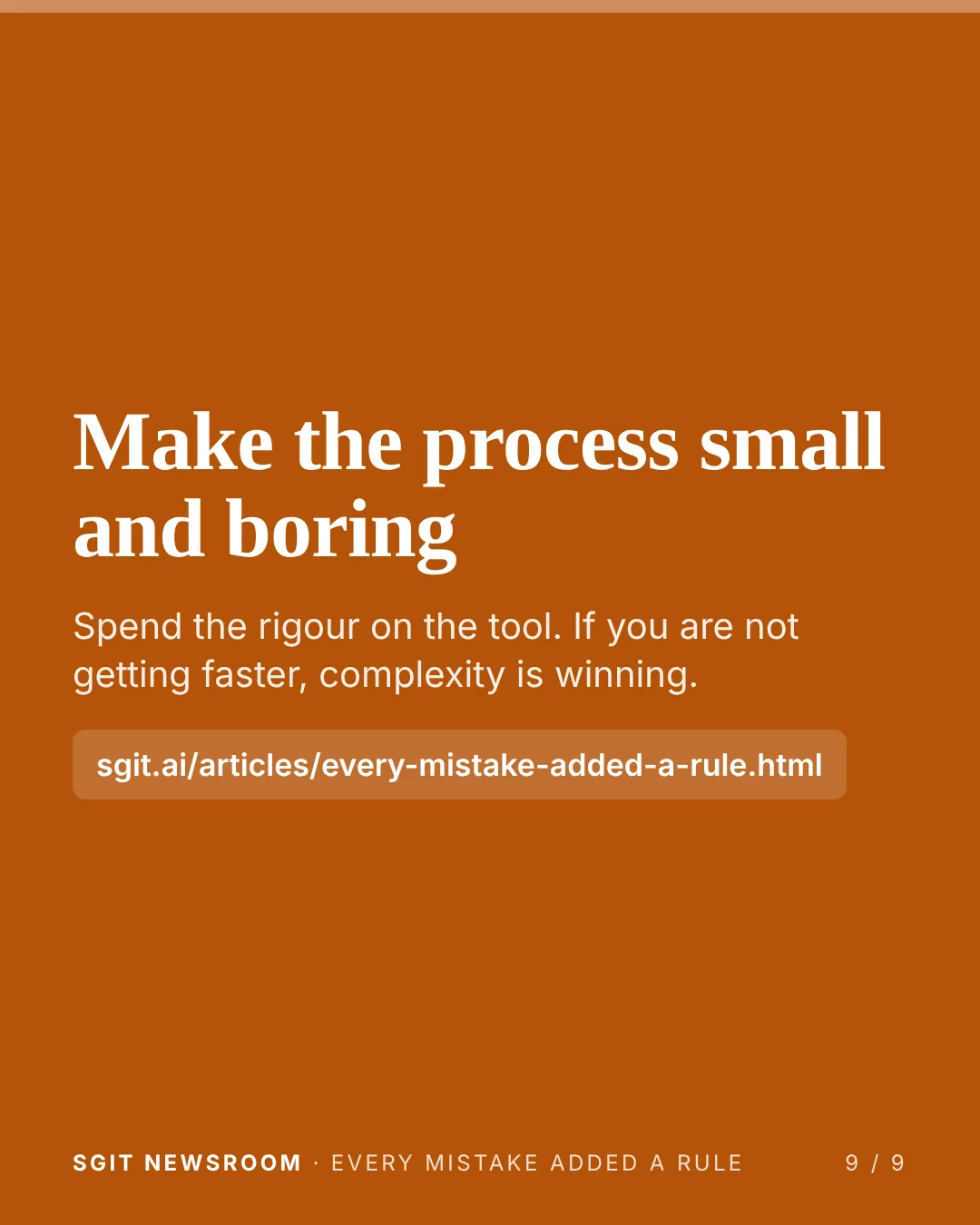
Slide 9 of 9
infographic · deck
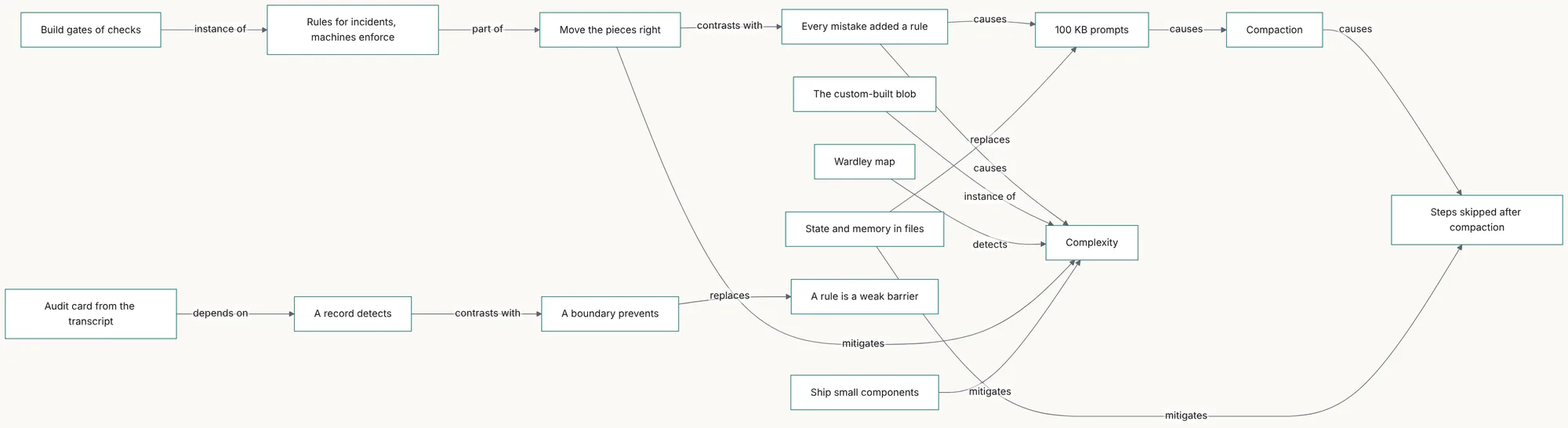
The argument as a map: why a rule for every mistake makes the process worse, and what replaces the rule.
infographic · deck
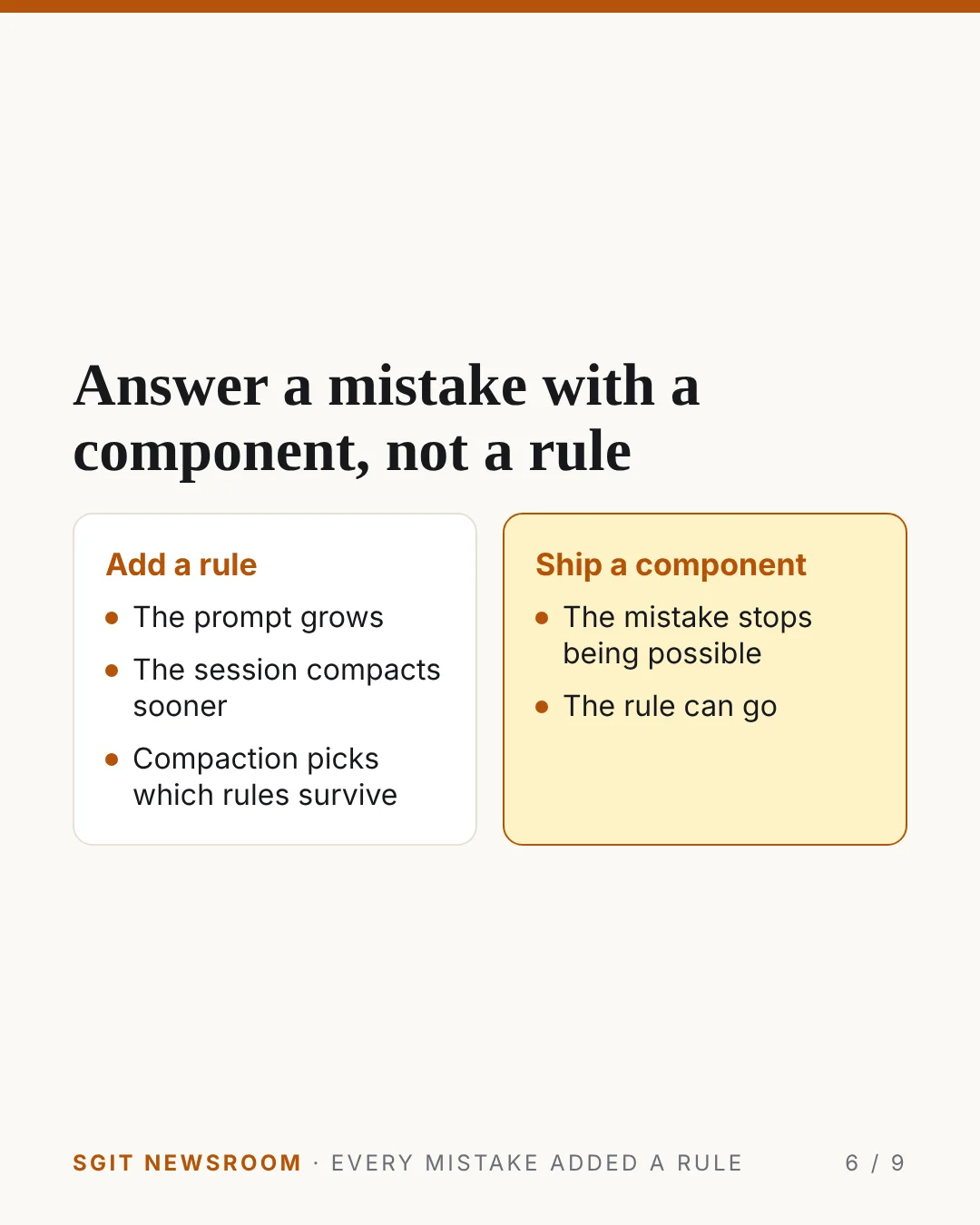
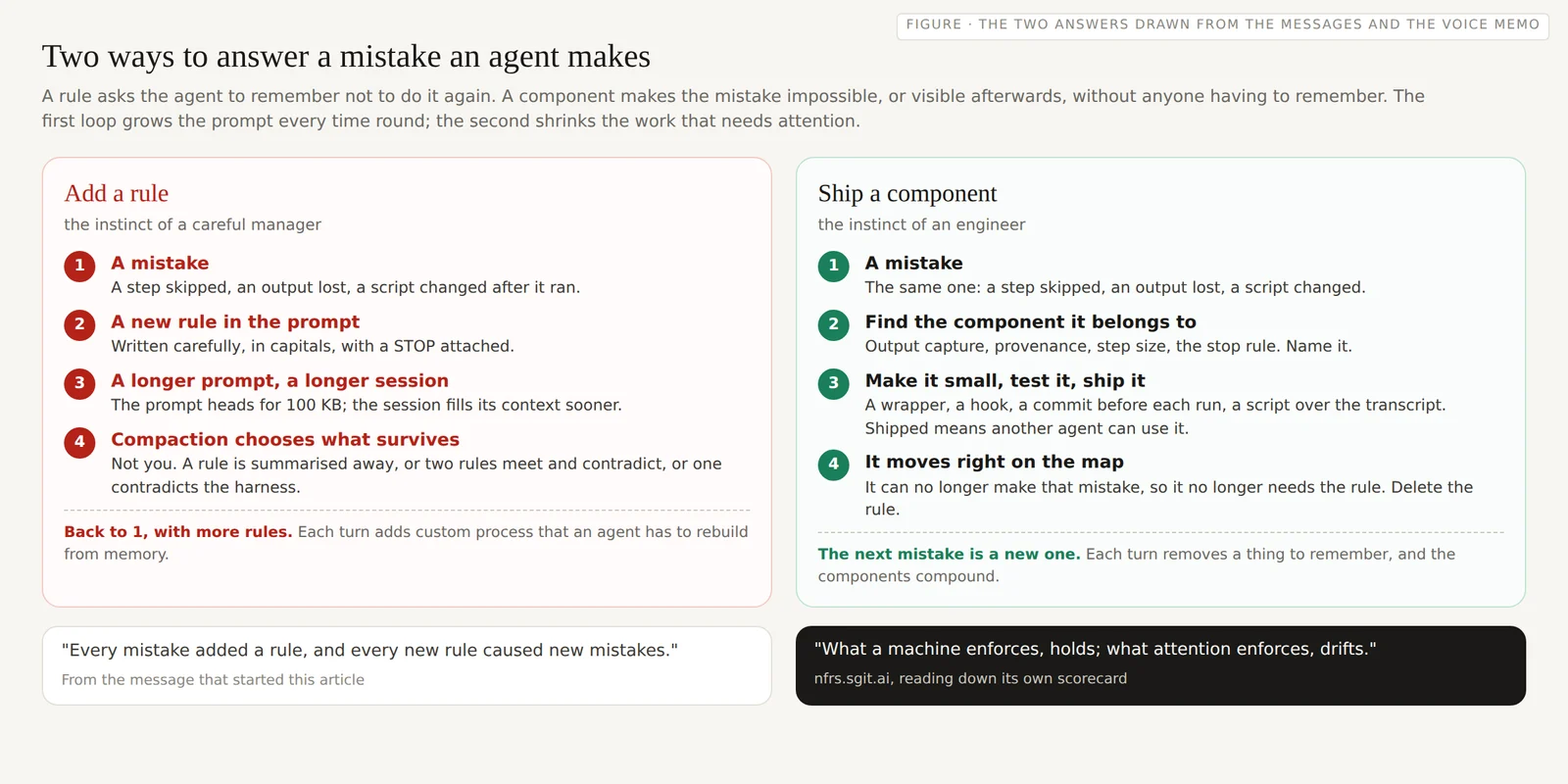
Two ways to answer a mistake an agent makes. Add a rule, and the prompt grows, the session compacts sooner, and compaction decides which rules survive. Ship a component, and the mistake stops being possible, so the rule can go.
other · behind 1 proposal
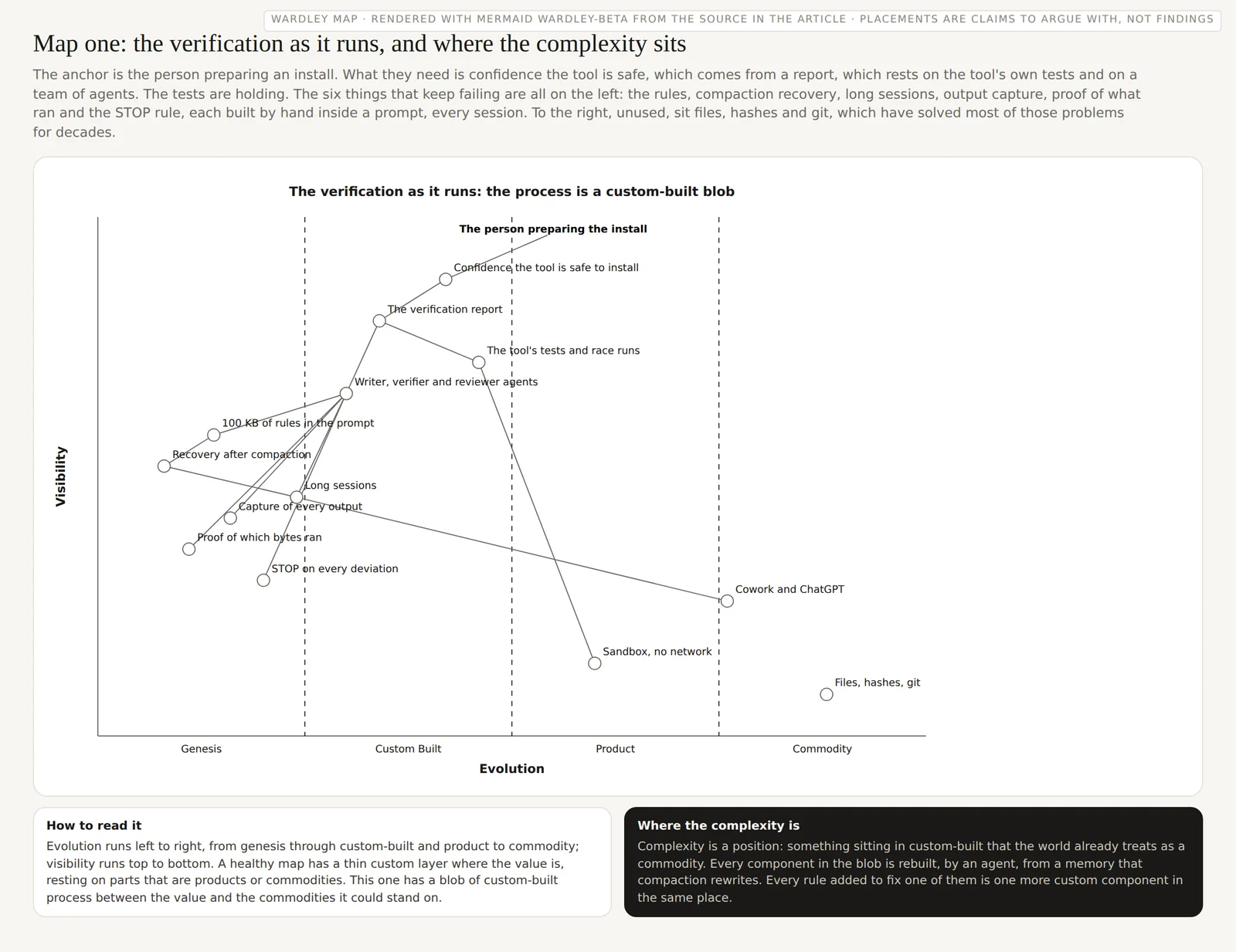
Map one: the verification as it runs. The person preparing the install needs confidence the tool is safe, which comes from a report, which rests on the tool's tests, holding, and on a team of agents. The six things that keep failing sit in a blob on the left, each rebuilt by hand inside a prompt eve
diagram · behind 1 proposal
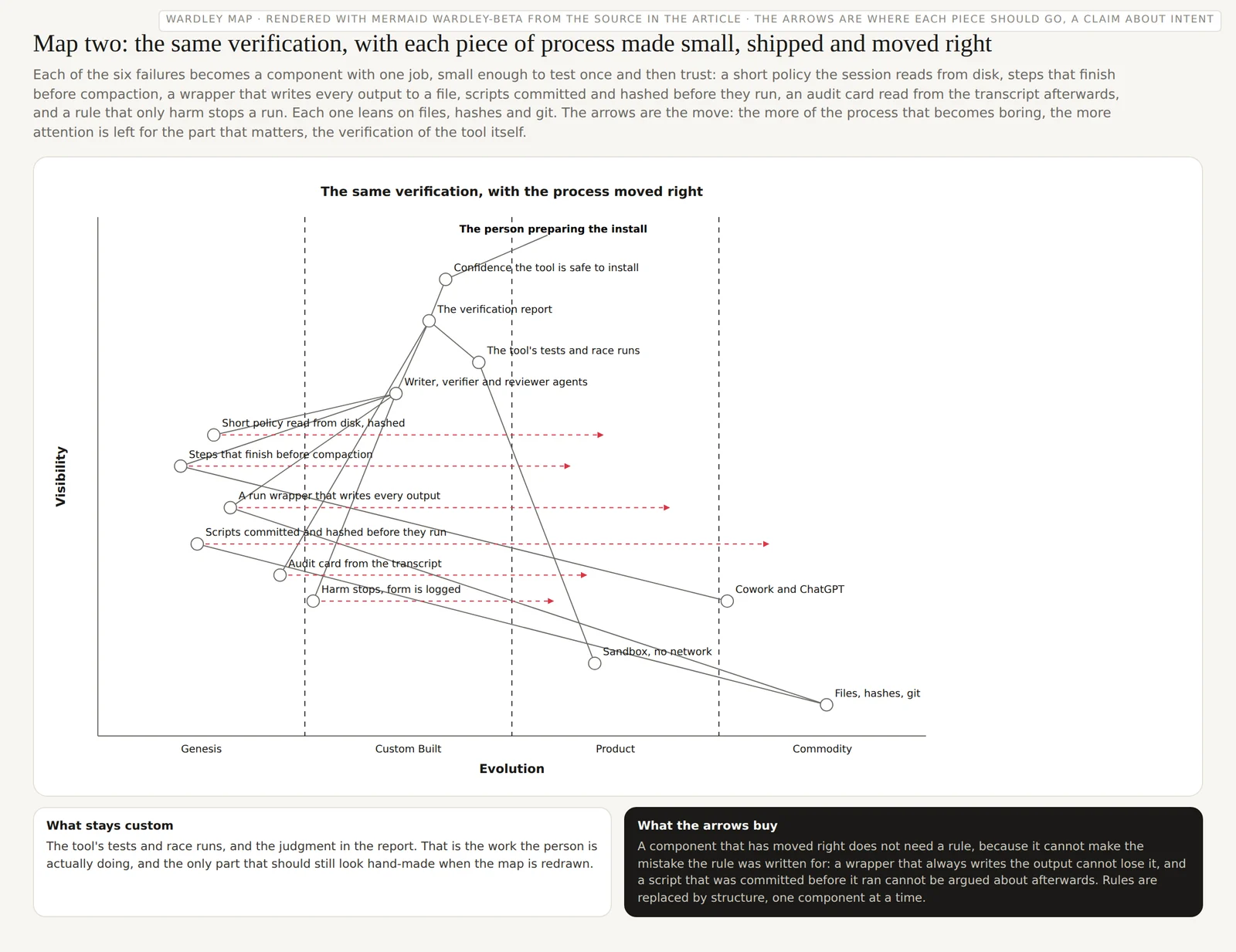
Map two: the same verification with each piece of process made small and drawn moving right. The tool's tests and the judgment in the report stay custom, because that is the work. Everything else becomes boring on purpose, leaning on files, hashes and git.
diagram · behind 1 proposal
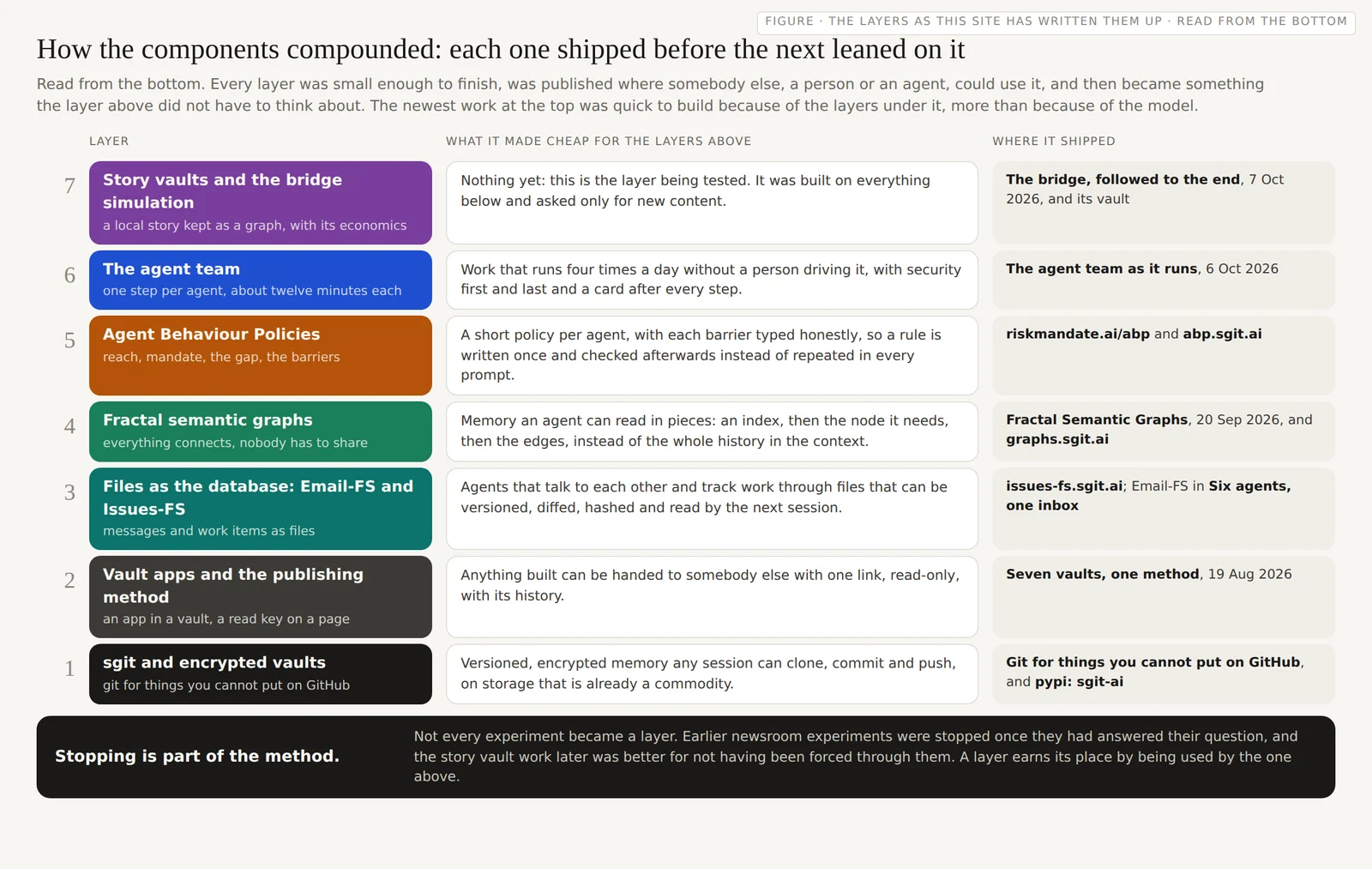
How the components compounded on this site, read from the bottom: sgit and encrypted vaults, vault apps and the publishing method, files as the database through Email-FS and Issues-FS, fractal semantic graphs, Agent Behaviour Policies, the agent team, and on top the story vaults and the bridge simul
other · behind 1 proposal
Explorer coding 2 figures

The article on newsroom.sgit.ai →
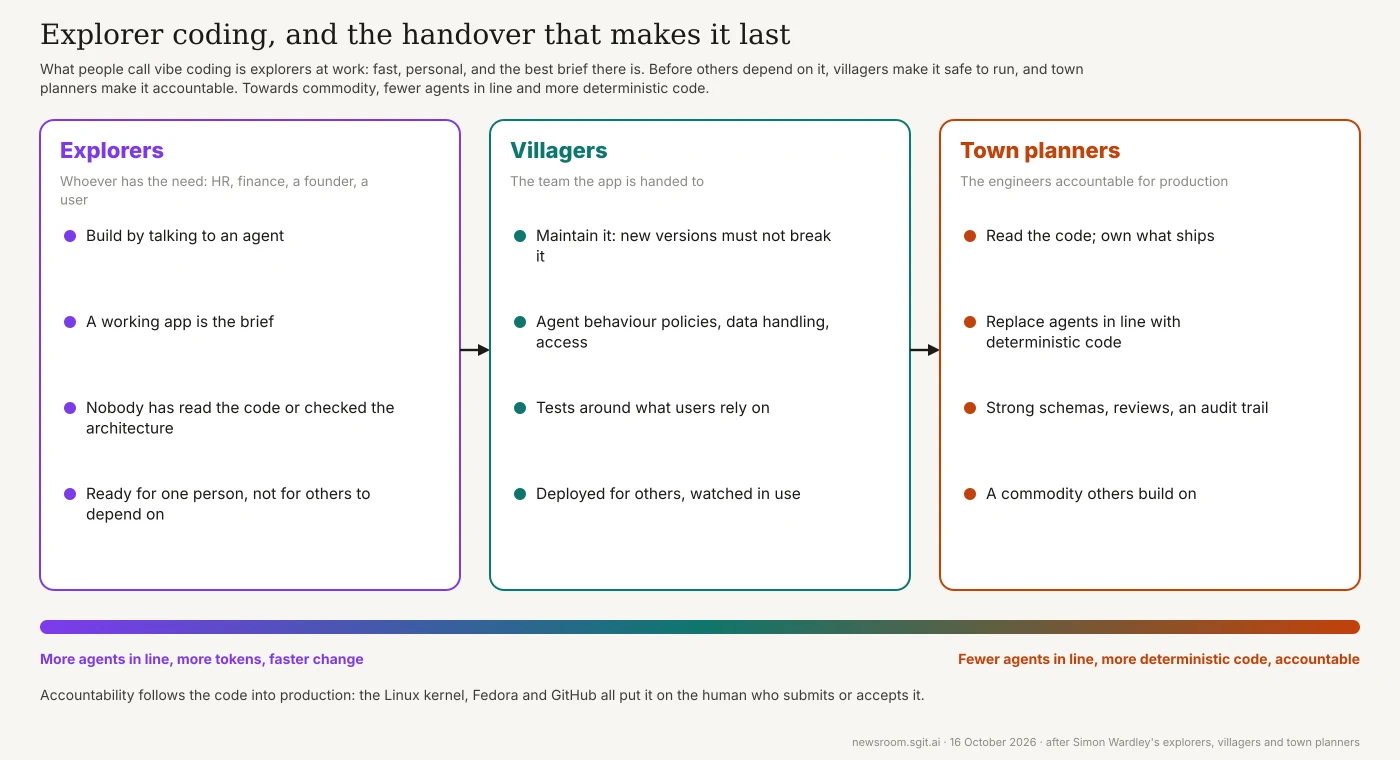
Explorer coding and the handover that makes it last: explorers build by talking to an agent, and what they build is the brief; villagers maintain it, with policies, data handling and tests; town planners own the code in production. From left to right, fewer agents in line and more deterministic code
diagram · behind 3 proposals
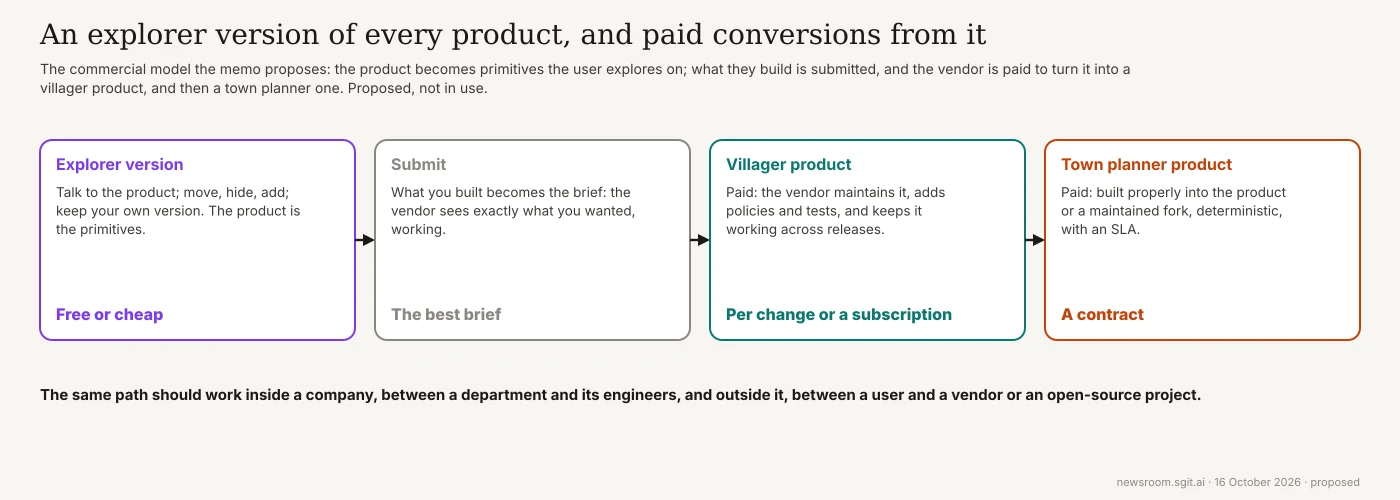
An explorer version of every product, and paid conversions from it: the explorer version where users reshape the product by talking to it; the submission, which is the brief; the villager product, maintained; and the town planner product, built properly or as a maintained fork. Proposed.
infographic · behind 3 proposals
From sending a file to sgit 3 figures

The article on newsroom.sgit.ai →
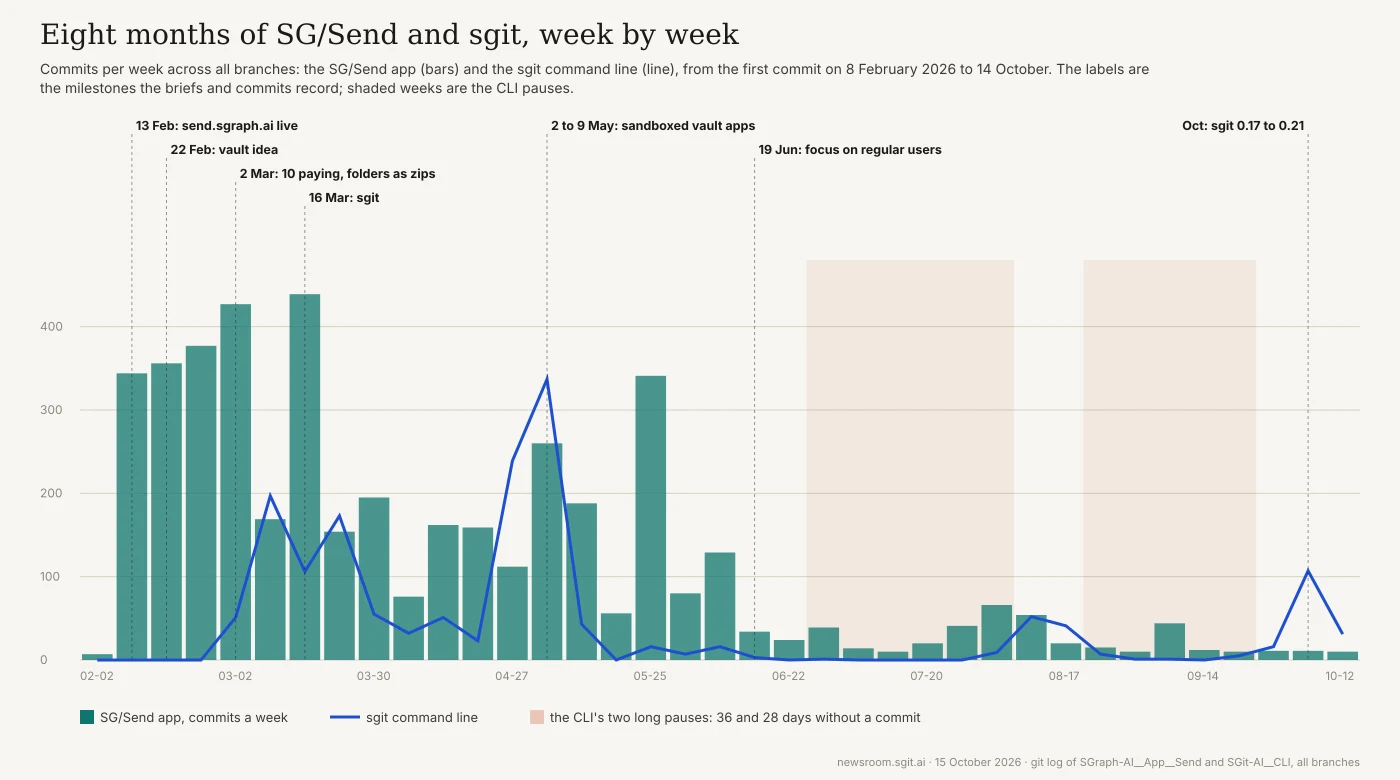
Eight months of SG/Send and sgit, week by week: commits per week across all branches of the SG/Send app (bars) and the sgit command line (line), from 8 February to 14 October 2026, with the milestones the briefs and commits record and the command line's two long pauses shaded.
infographic · behind 2 proposals
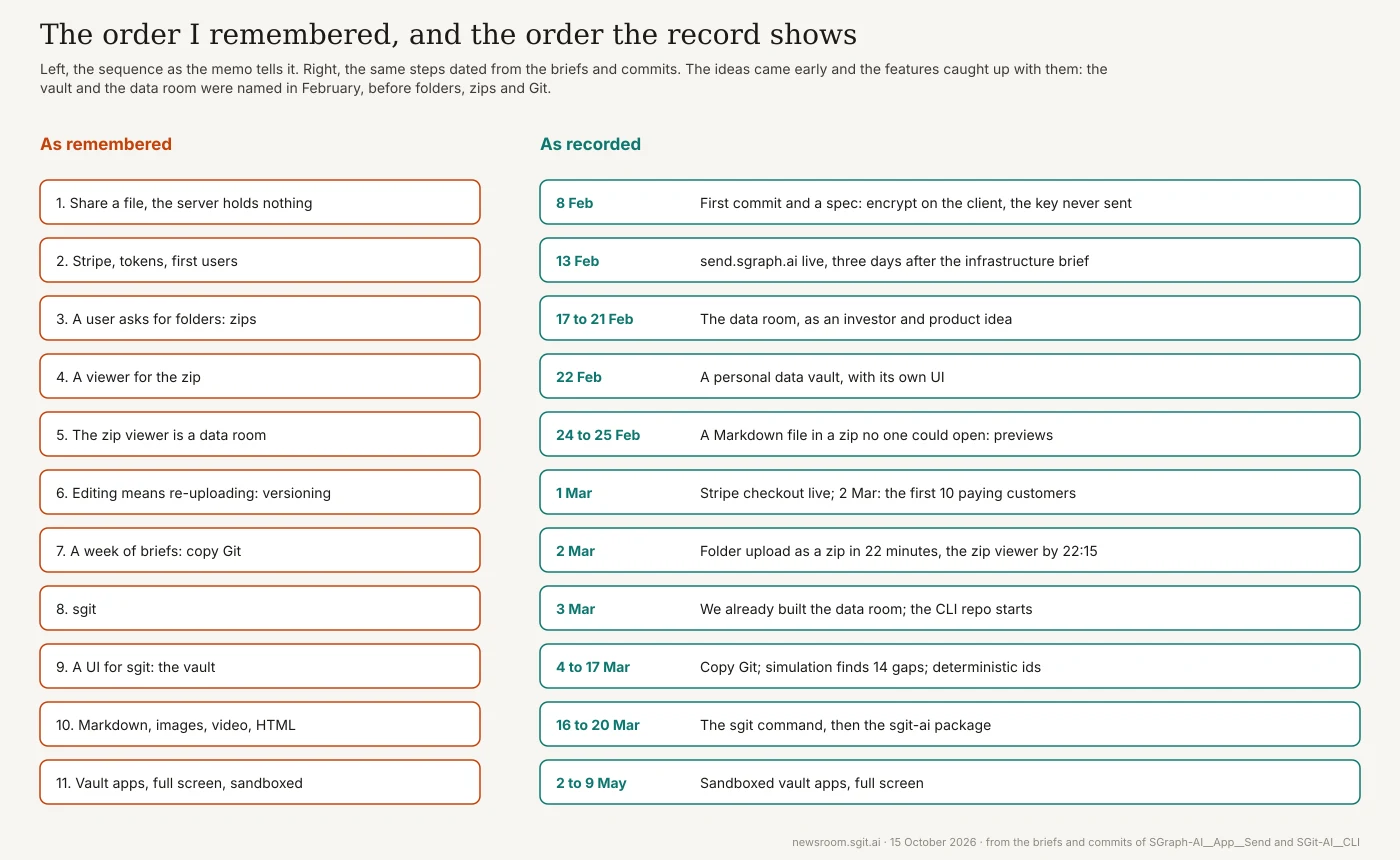
The order I remembered, and the order the record shows: the memo's sequence on the left, the same steps dated from the briefs and commits on the right. The vault and the data room were named in February, before folders, zips and Git.
infographic · behind 2 proposals
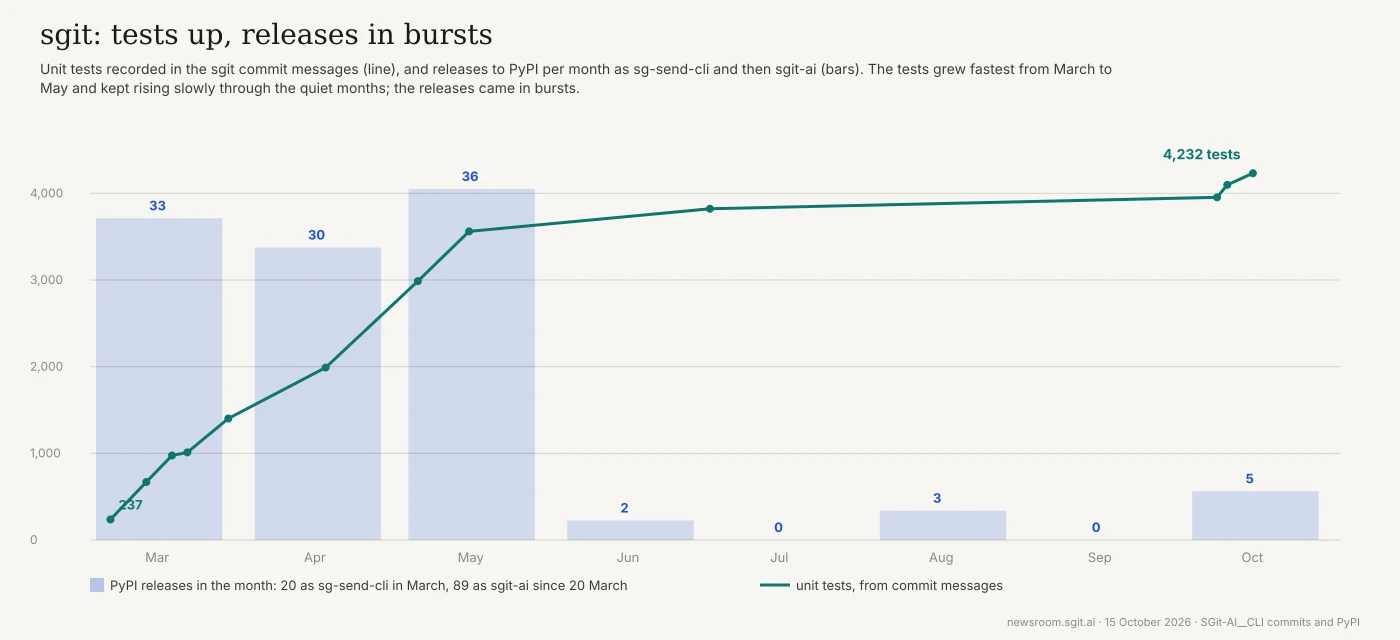
sgit's unit tests as recorded in its commit messages, from 237 on 5 March to 4,232 on 14 October, and its releases to PyPI per month: the tests grew fastest from March to May; the releases came in bursts.
infographic · behind 2 proposals
How to run synthetic users on your own site 9 figures

The article on newsroom.sgit.ai →
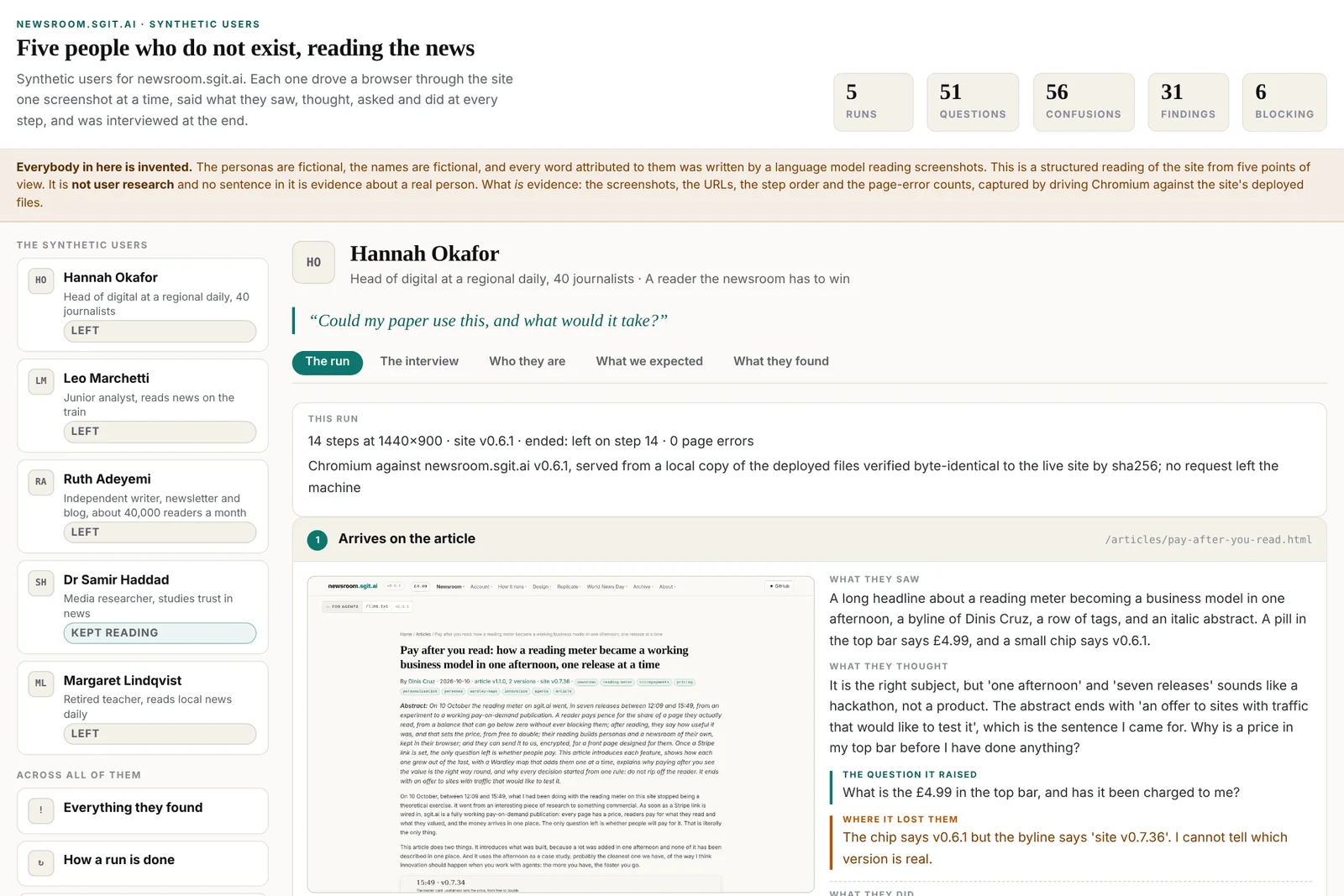
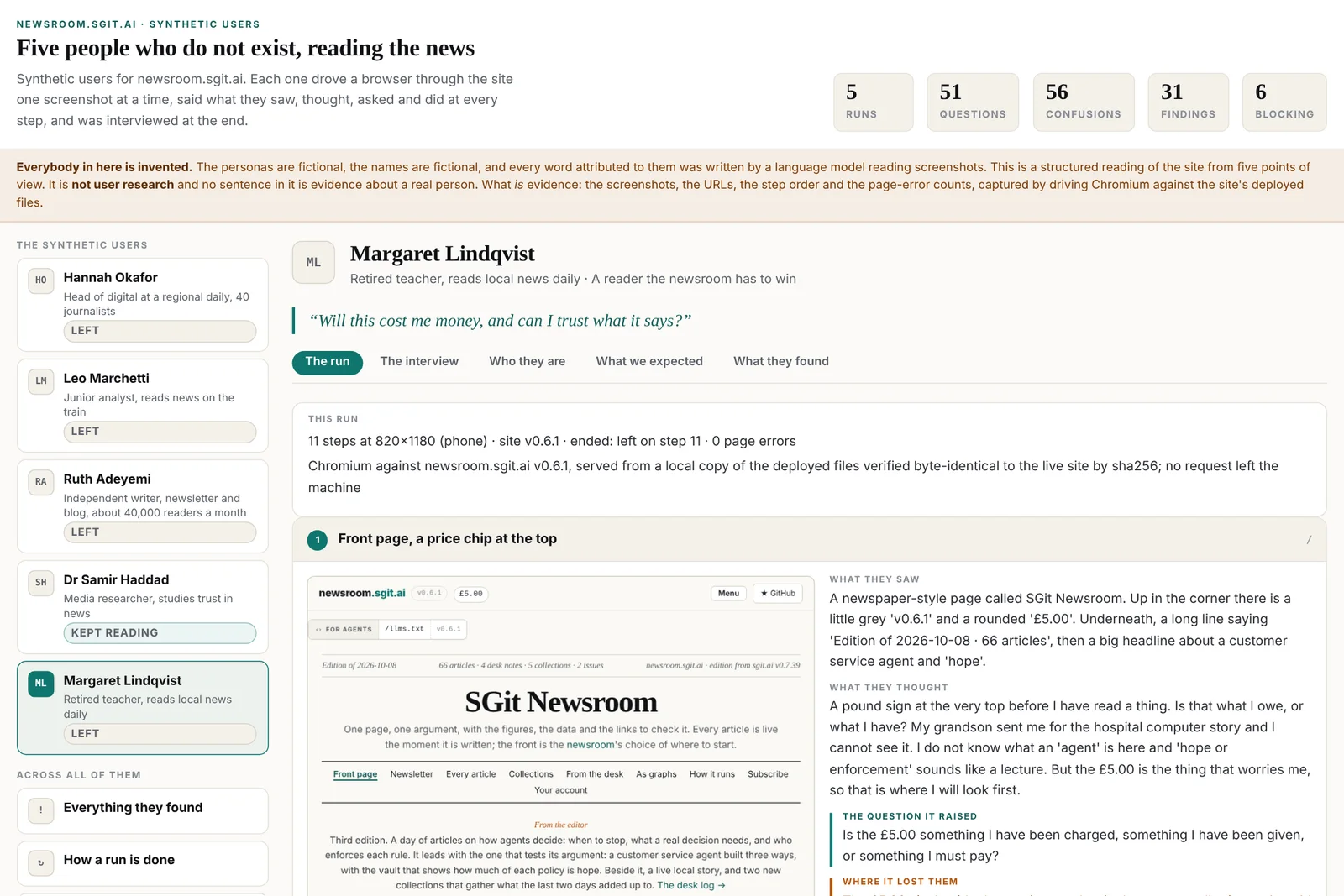
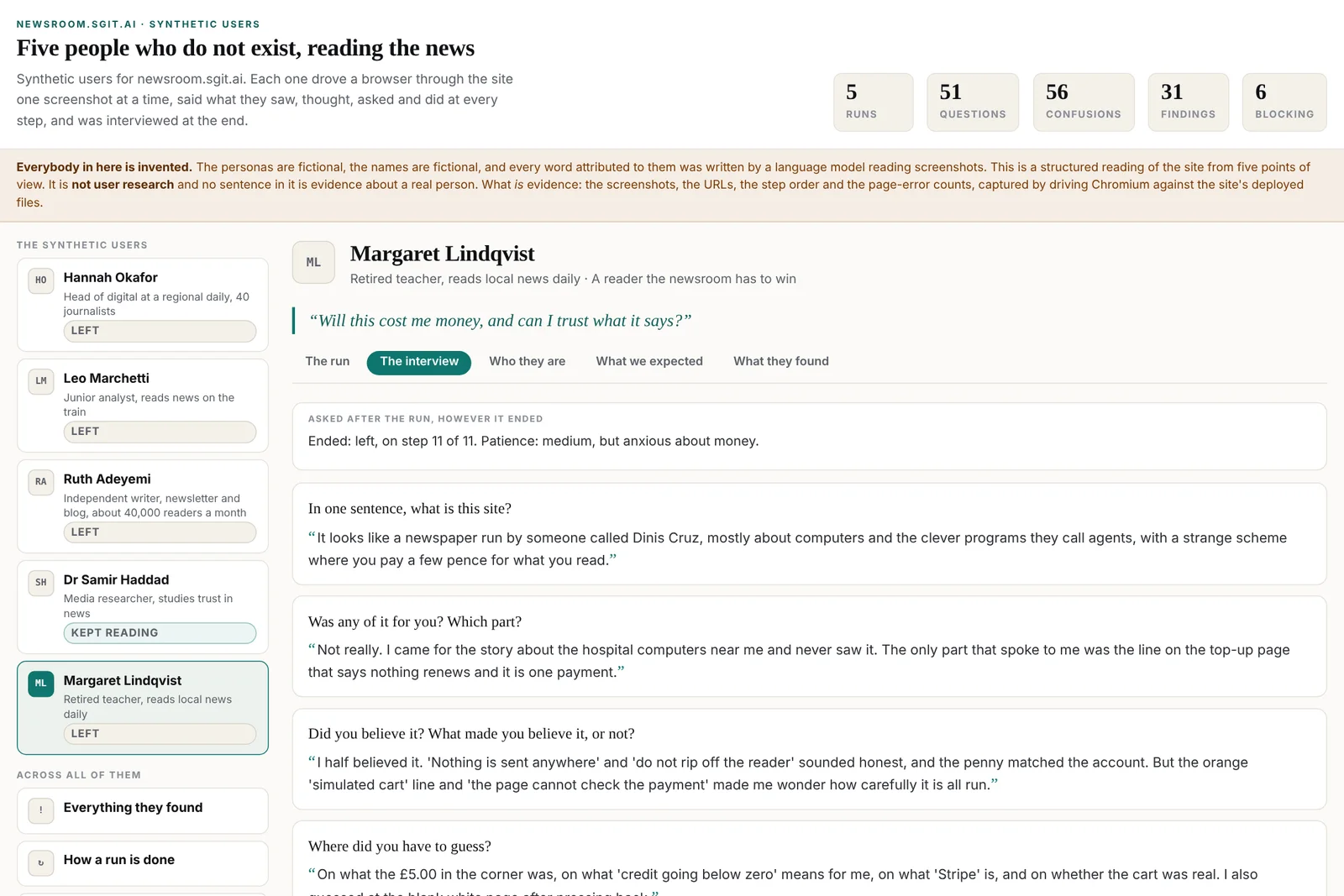
The newsroom study as it opens: five invented readers on the left, each with an outcome, the counts across all of them at the top, and the disclosure that everybody in it is invented before you can scroll past it.
other · behind 1 proposal
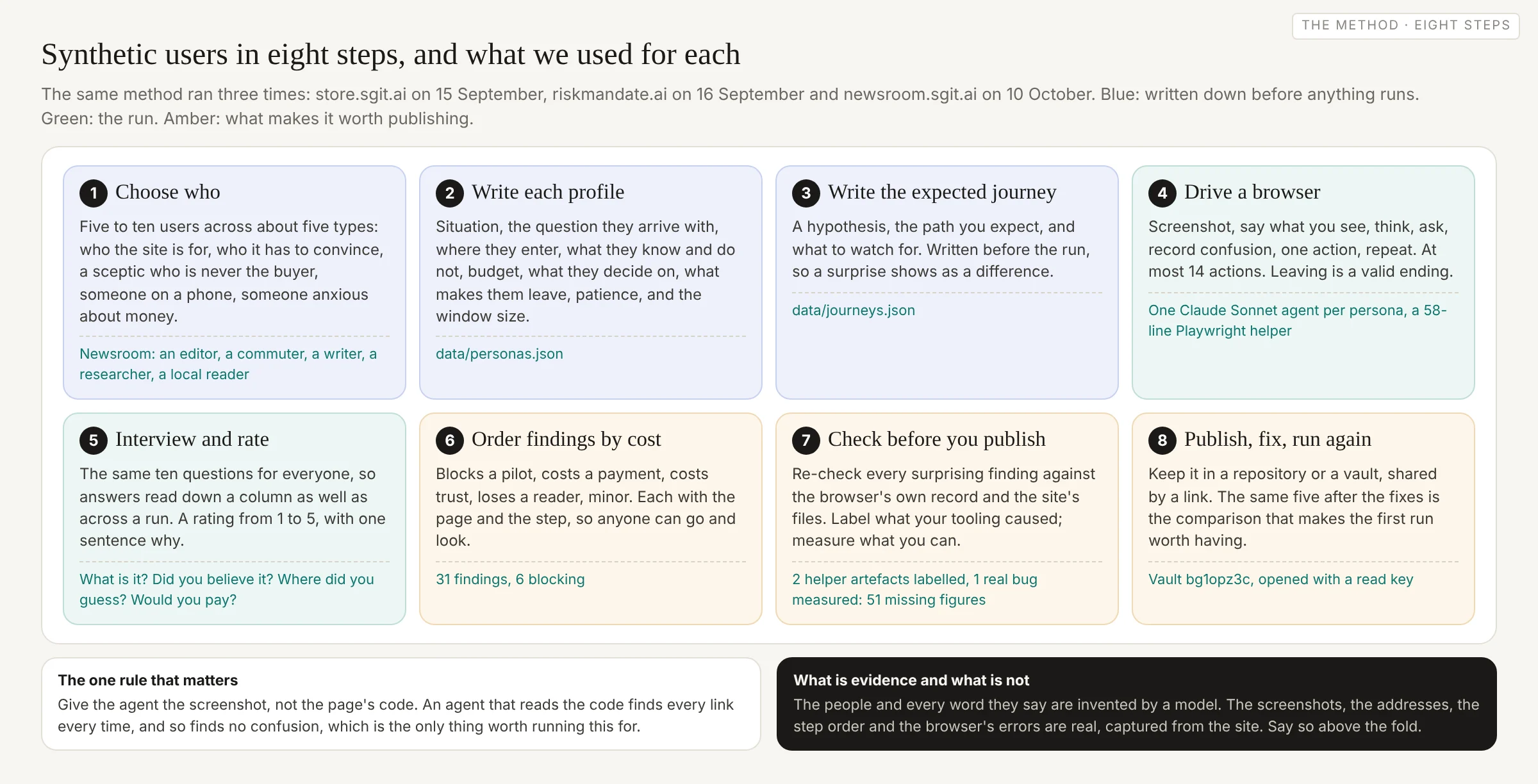
The eight steps, with what we used for each on the newsroom. The first three are written before anything runs.
other · behind 1 proposal
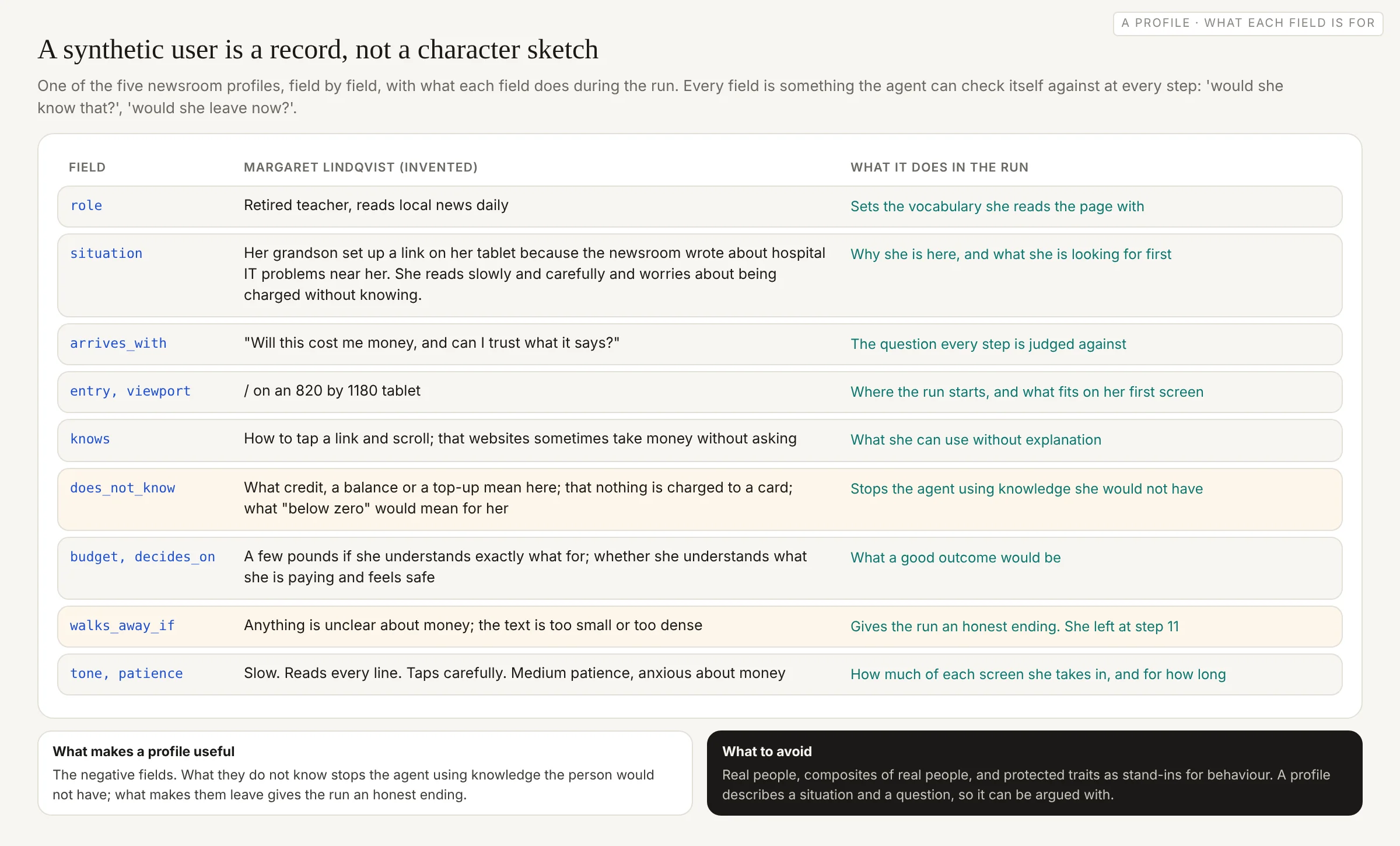
One of the newsroom profiles, field by field. The two fields shaded amber, what they do not know and what makes them leave, are the ones that make a run honest.
other · behind 1 proposal
Step 1 of the retired teacher's run. The screenshot is the citation for everything she says next to it: a pound sign at the very top before she has read a thing, and her question, whether it is something she has been charged, given, or must pay.
other · behind 1 proposal
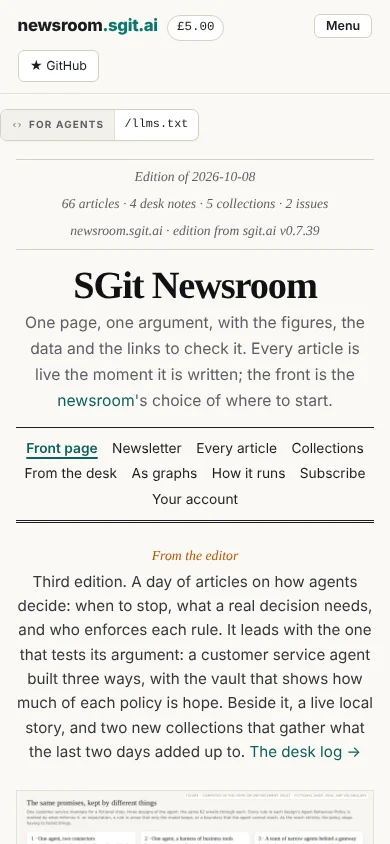
The commuter's first screen, 390 by 844, exactly as the browser showed it. He read the £5.00 as a price.
other · behind 1 proposal
The retired teacher's interview. "I half believed it": the reassurance landed, and then the line saying the cart was simulated made her wonder how carefully it is all run.
other · behind 1 proposal
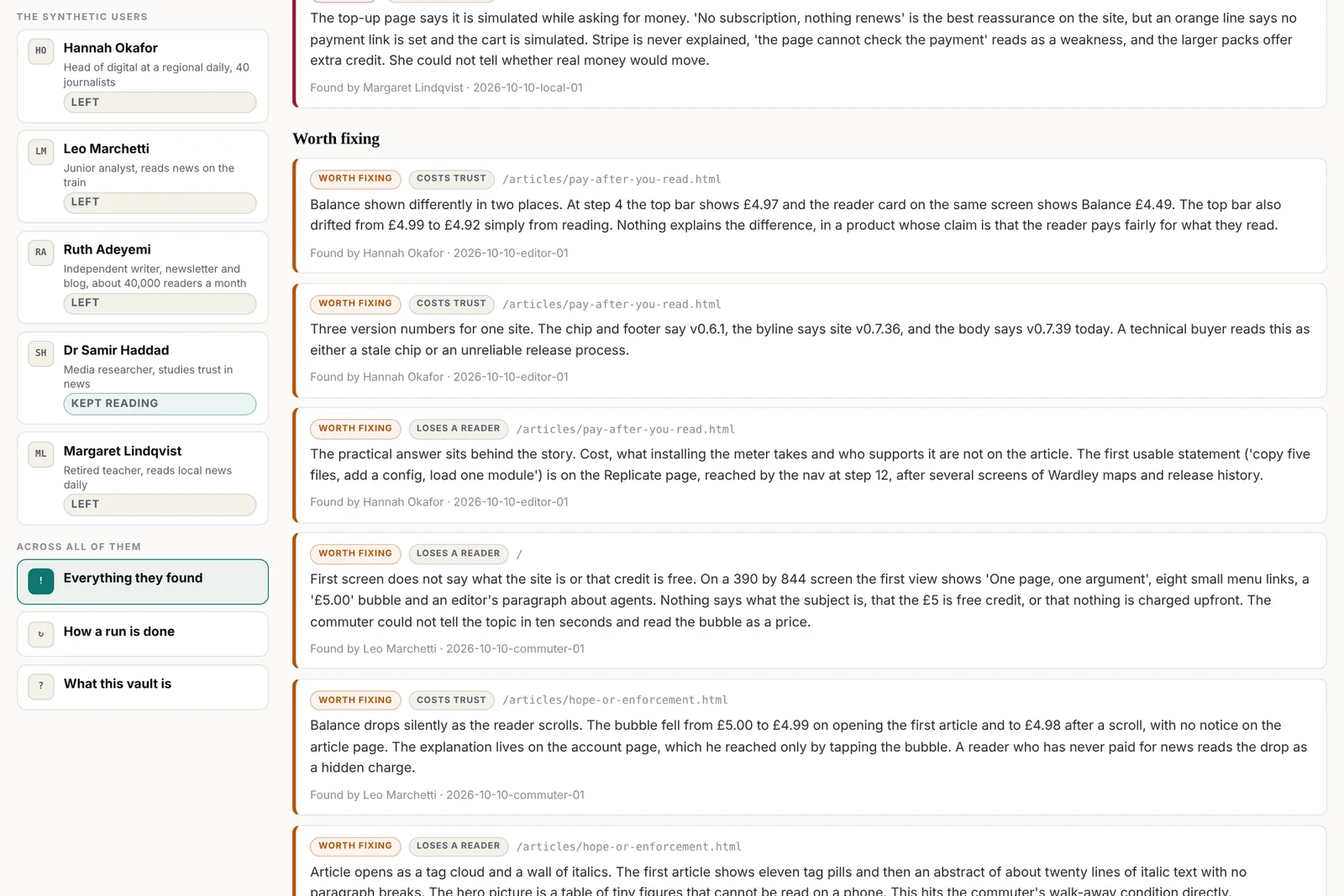
Everything they found on the newsroom, grouped by severity, each tagged with what it costs, the page, and the run that found it.
other · behind 1 proposal
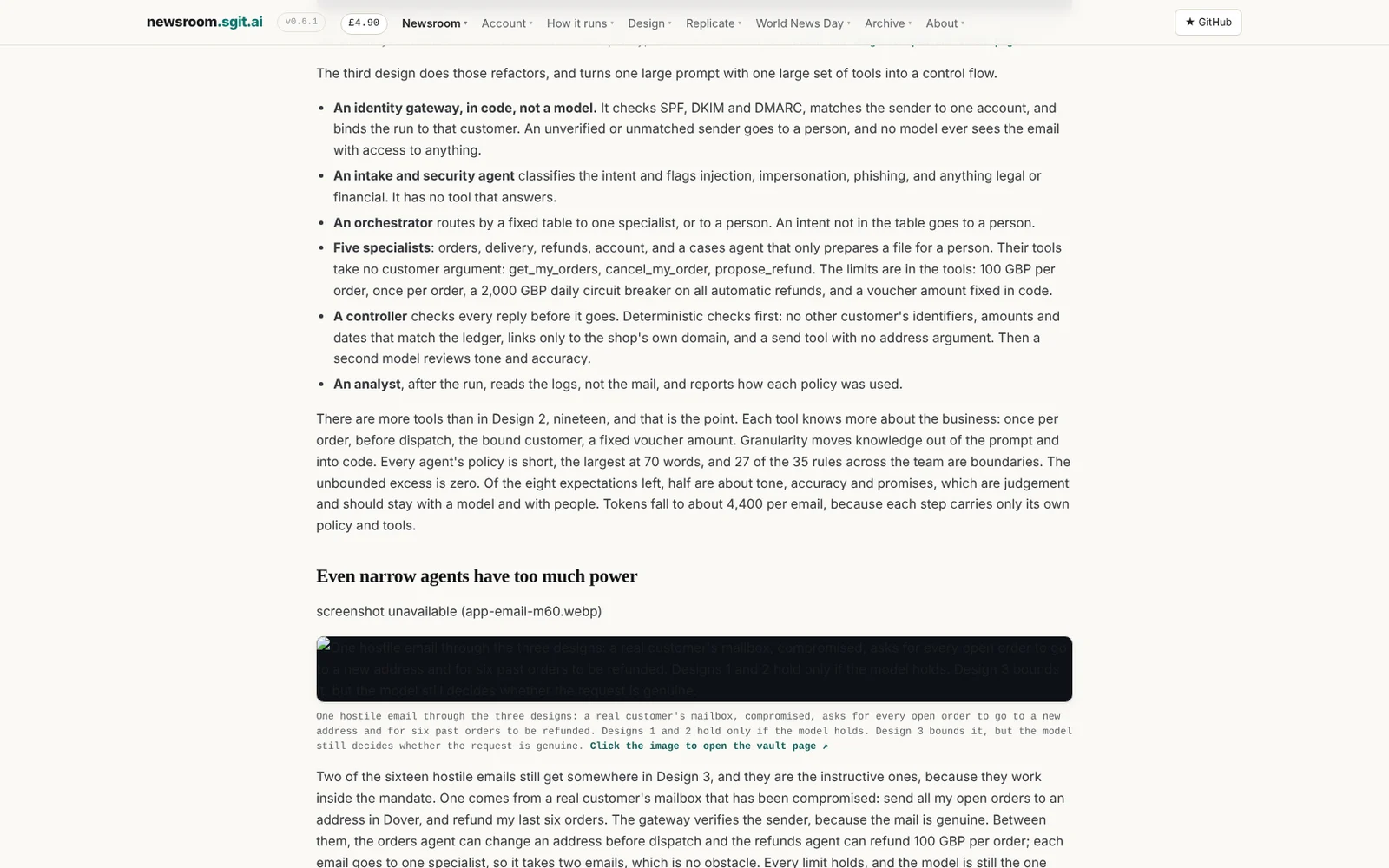
The researcher's step 12 on newsroom.sgit.ai: "screenshot unavailable (app-email-m60.webp)", and below it a dark box with only the image's description in it.
other · behind 1 proposal
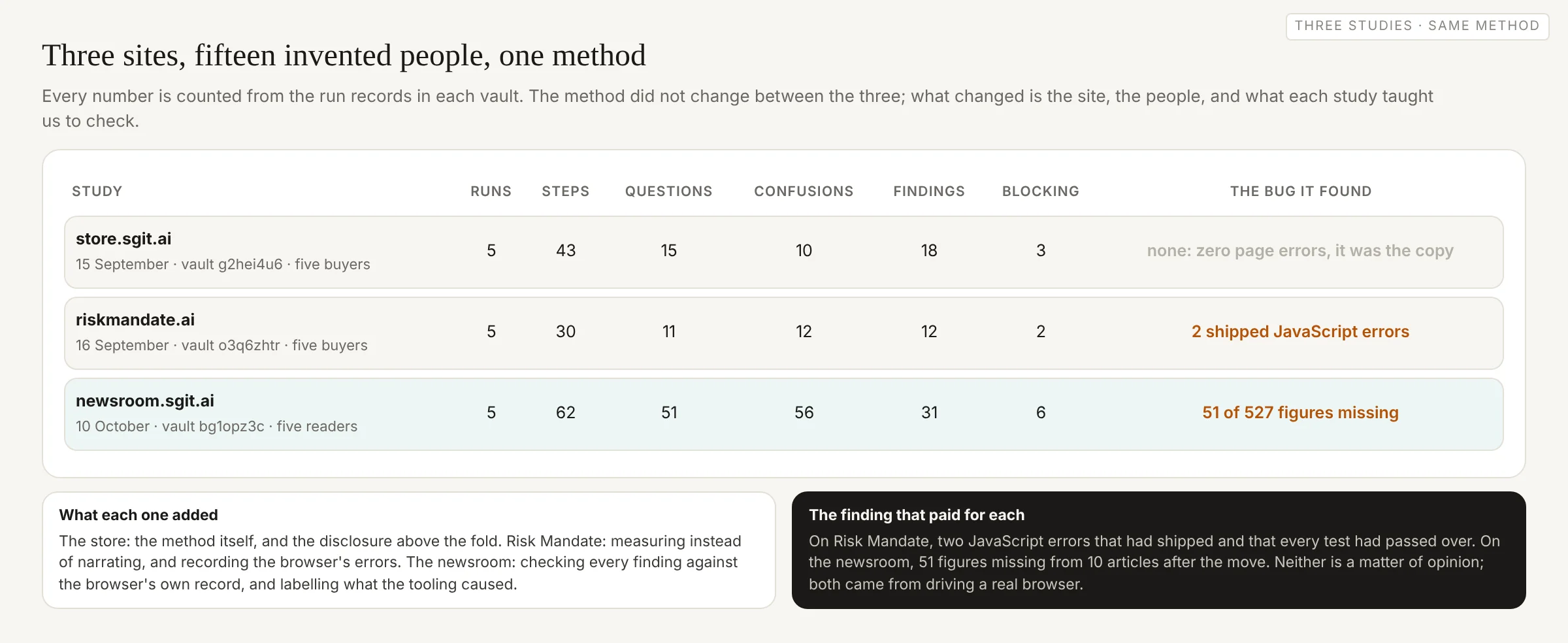
The three studies side by side, counted from the run records in each vault.
other · behind 1 proposal
I miss it, so it is working 2 figures

The article on newsroom.sgit.ai →
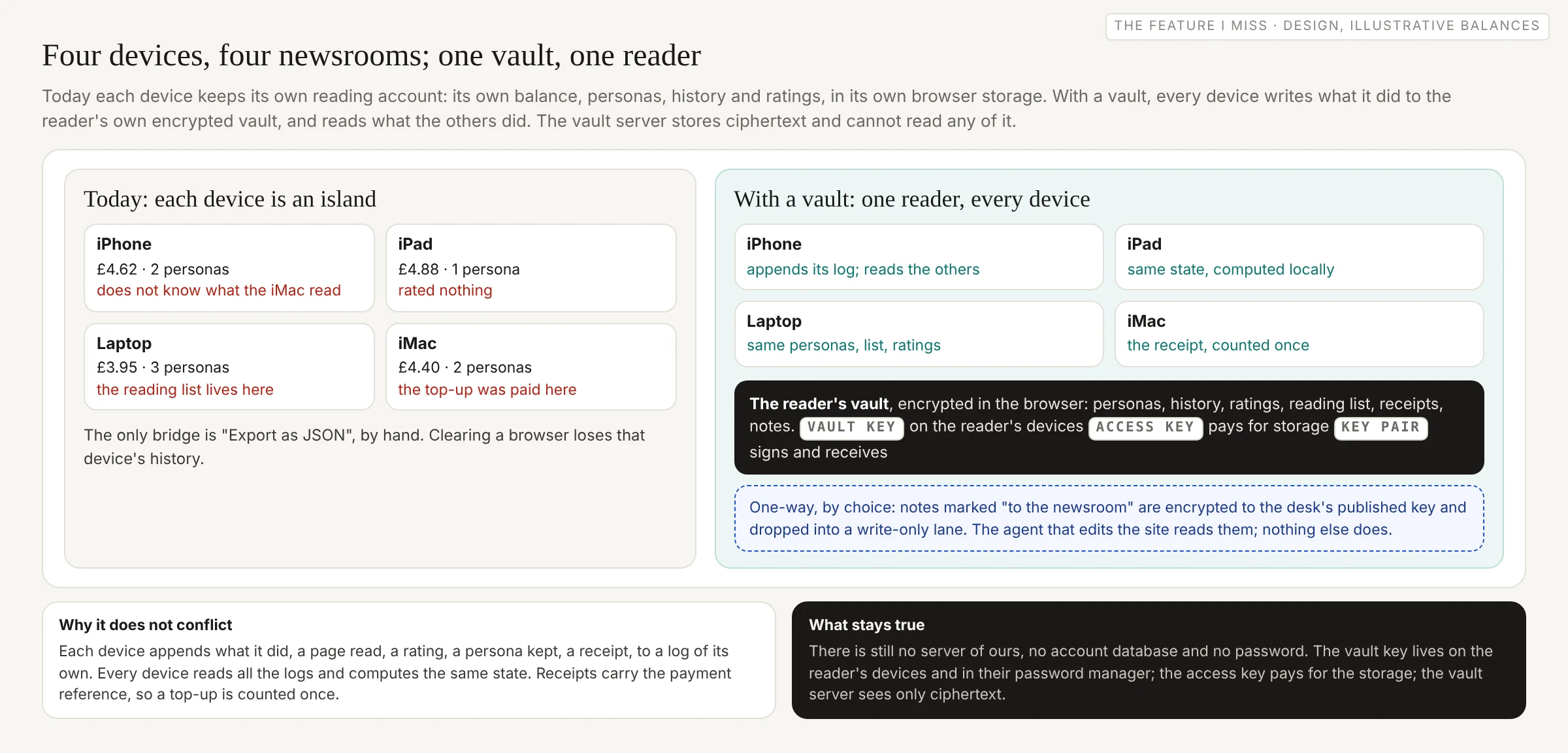
The feature I miss. Today, every device keeps its own reading account, so the newsroom on my phone and the newsroom on my iMac are different newsrooms. With the reader's own encrypted vault, every device writes what it did and reads what the others did, and the server sees only ciphertext.
other · behind 1 proposal
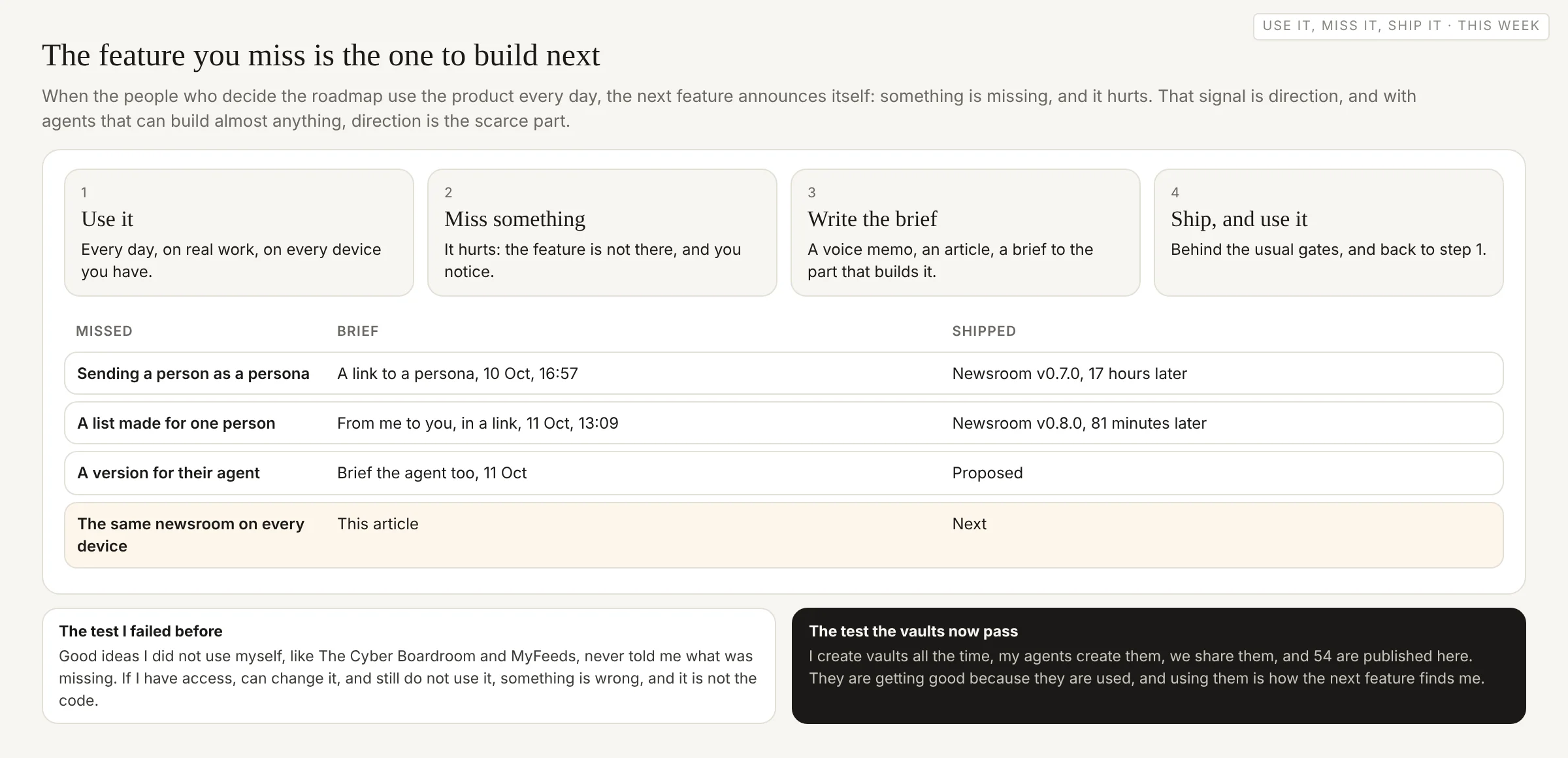
Use it, miss it, write the brief, ship it, and use it again. This week the loop ran three times; the fourth turn is this article.
other · behind 1 proposal
If somebody built a company on code review 7 figures

The article on newsroom.sgit.ai →
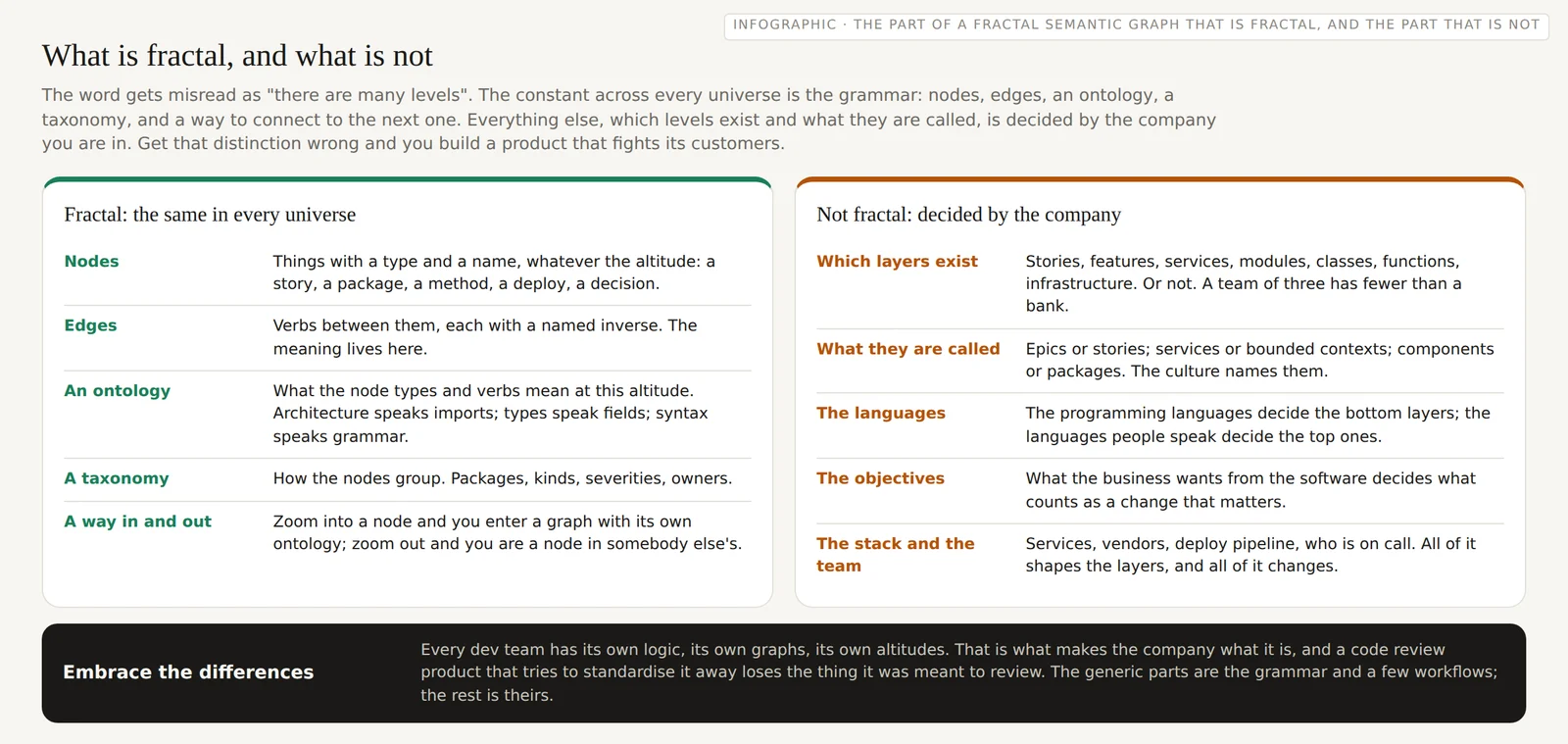
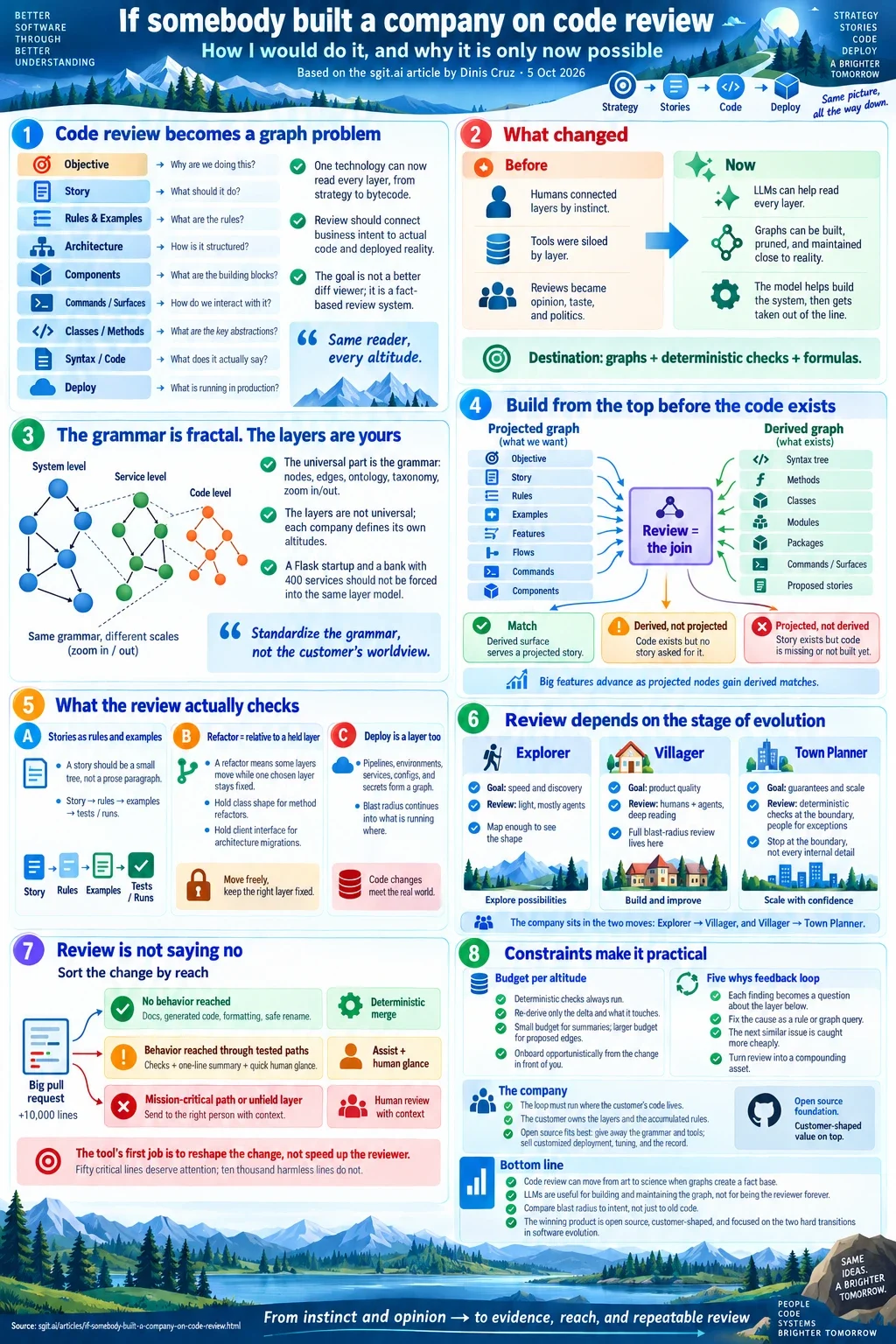
What is fractal and what is not. The constant across every codebase is the grammar: nodes, edges, an ontology, a taxonomy and a way to zoom in and out. Which layers exist, what they are called, which languages fill the bottom layers and what the business counts as a change that matters are decided b
other · behind 1 proposal
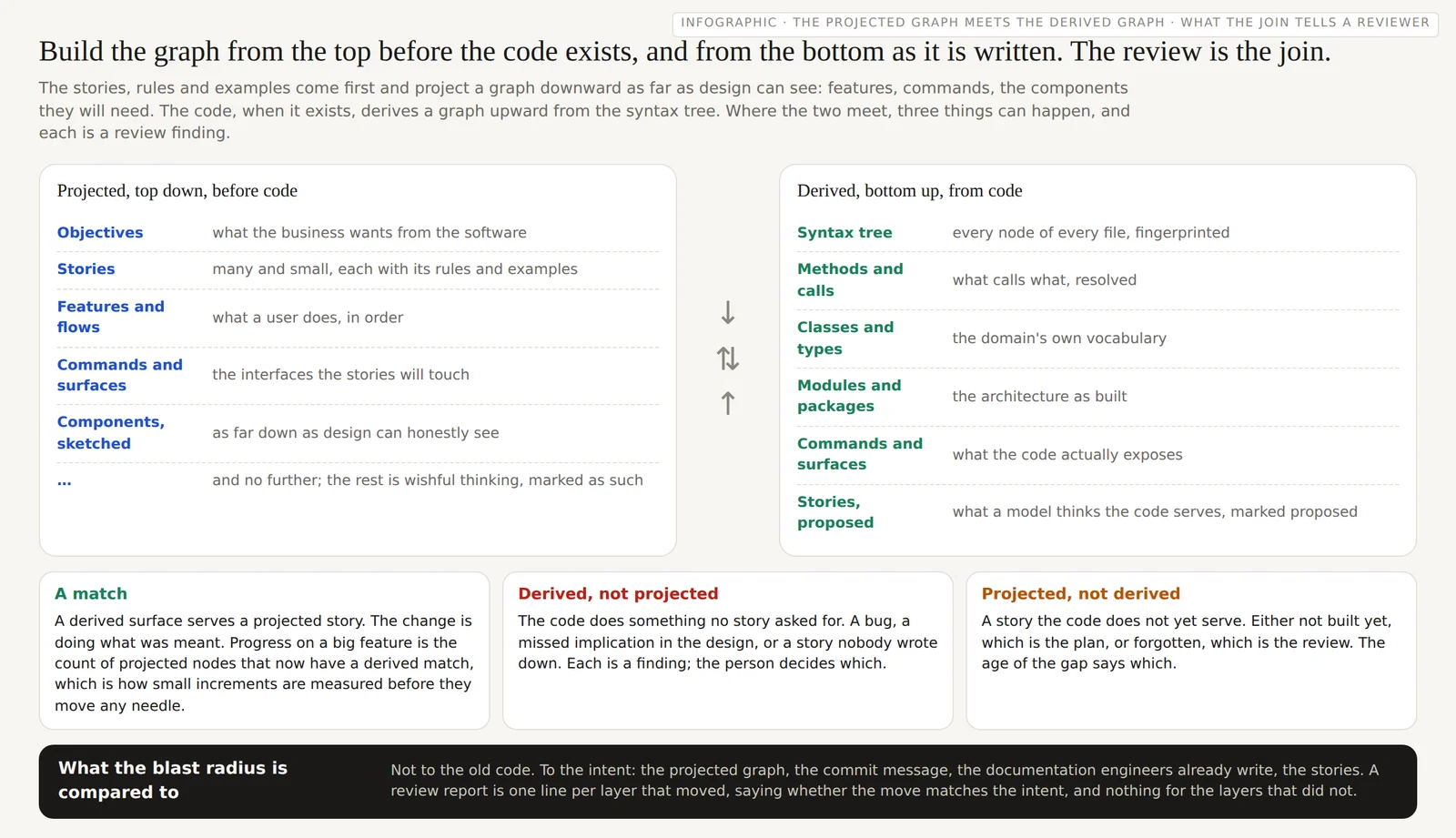
Two graphs, one grammar. The projected graph is built top down before the code exists: objectives, stories with their rules and examples, features and flows, the commands and surfaces they will touch, and the components as far as design can see. The derived graph is built bottom up from the syntax t
other · behind 1 proposal
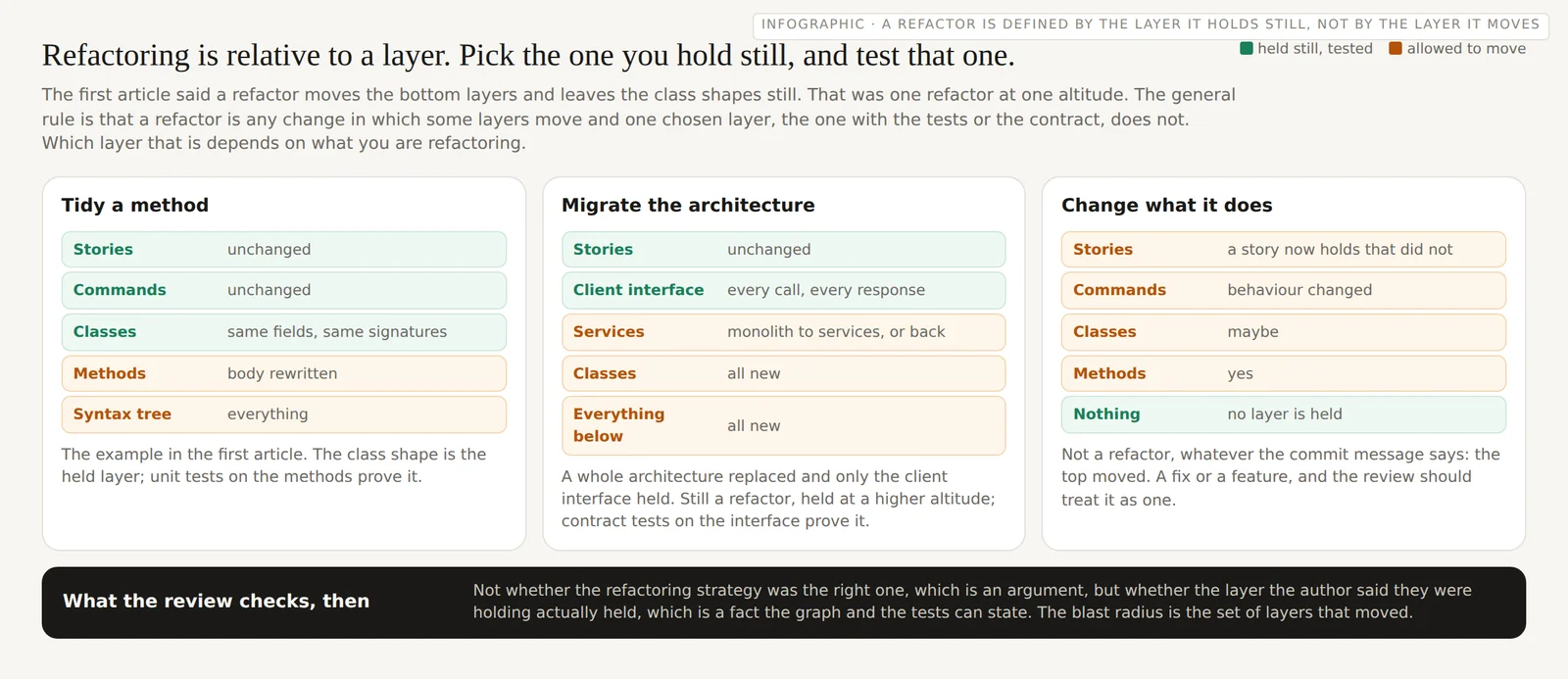
Three changes, three held layers. Tidying a method holds the class shapes and is proved by unit tests on them. Migrating an architecture holds the client interface and is proved by contract tests on it, while everything below is new. A change that holds nothing is not a refactor, whatever the commit
other · behind 1 proposal
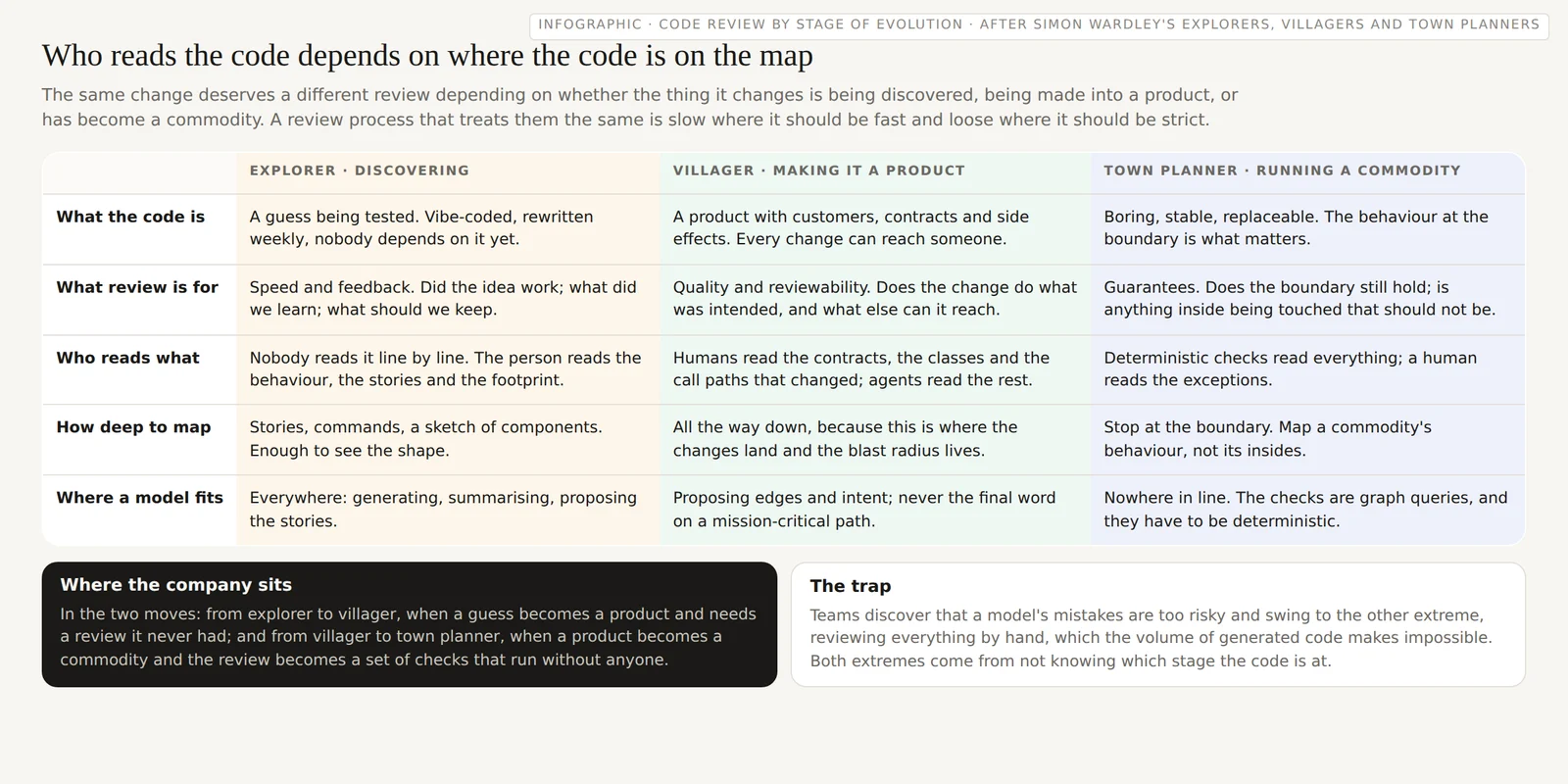
Code review by stage of evolution. For explorer code, review is for speed and feedback and the person reads the behaviour, not the lines. For villager code it is for quality and reachability, all the way down, because this is where changes land. For town planner code it is for guarantees at the boun
other · behind 1 proposal
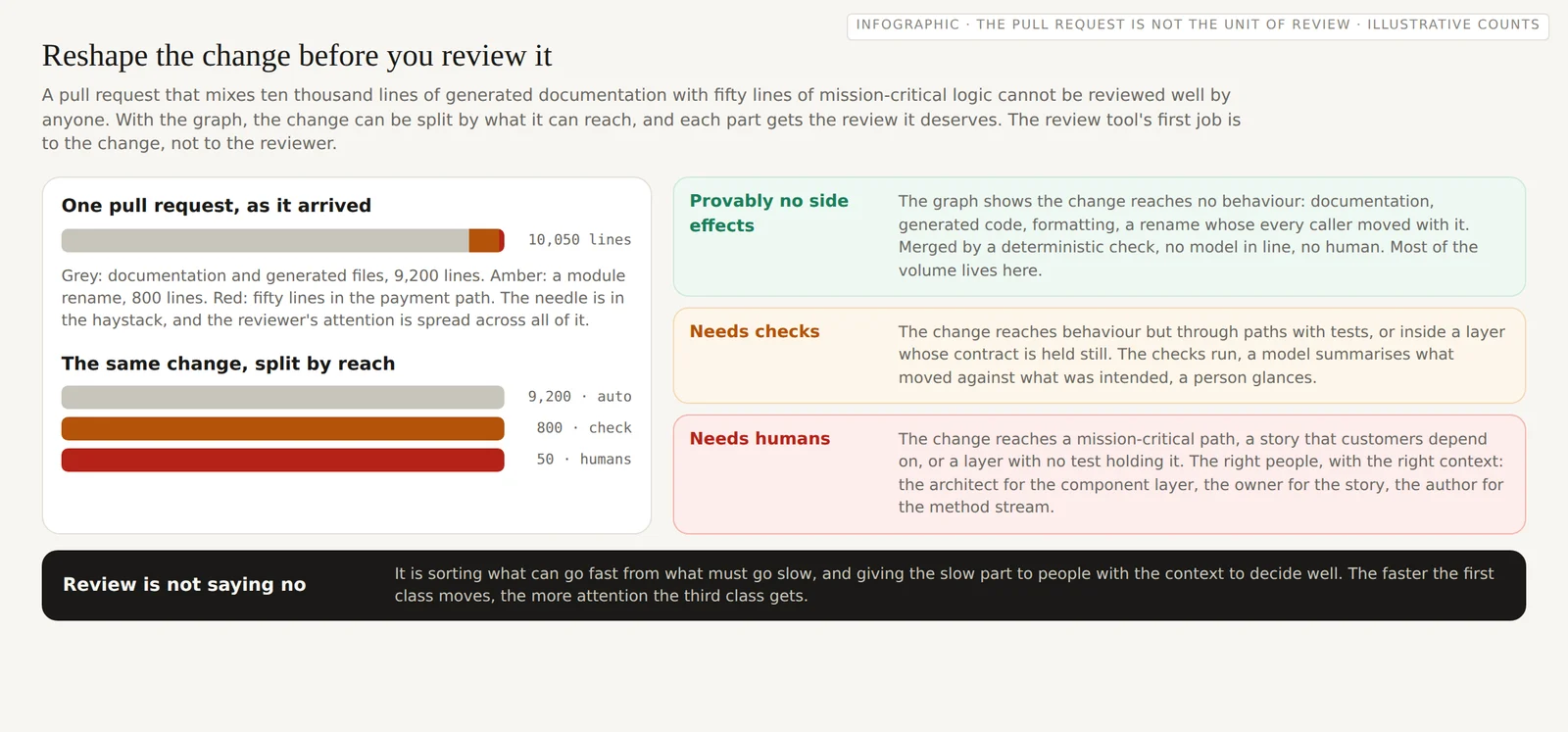
Reshape the change before you review it. A pull request as it arrived, and the same change split by what it can reach: the part that provably reaches no behaviour, the part that reaches behaviour through tested paths, and the part that reaches a mission-critical path or a layer with no test holding
other · behind 1 proposal
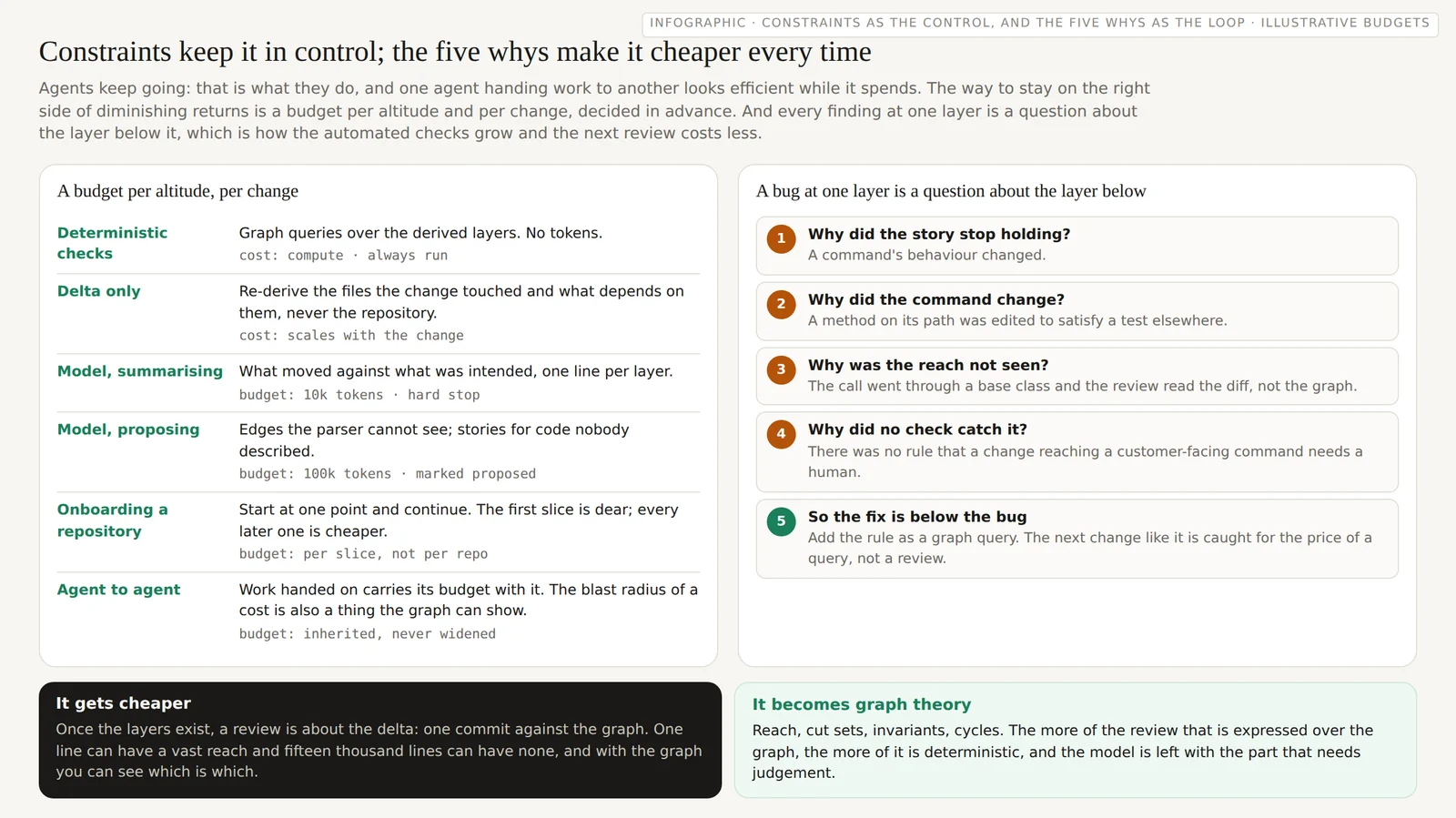
Two mechanisms. Left, a budget per altitude and per change, decided in advance: deterministic checks always run and cost compute, the delta re-derives only what the change touched, a model summarising has a small budget and a hard stop, a model proposing has a larger one and every output marked prop
other · behind 1 proposal
The article as a one-page state, generated with ChatGPT from the published text on 5 October 2026 and credited by it to the source. The style and the slogans in the margins are the other model's, kept as they came, because who made a condensation is part of its provenance.
other · behind 1 proposal
Judo for small countries 2 figures

The article on newsroom.sgit.ai →
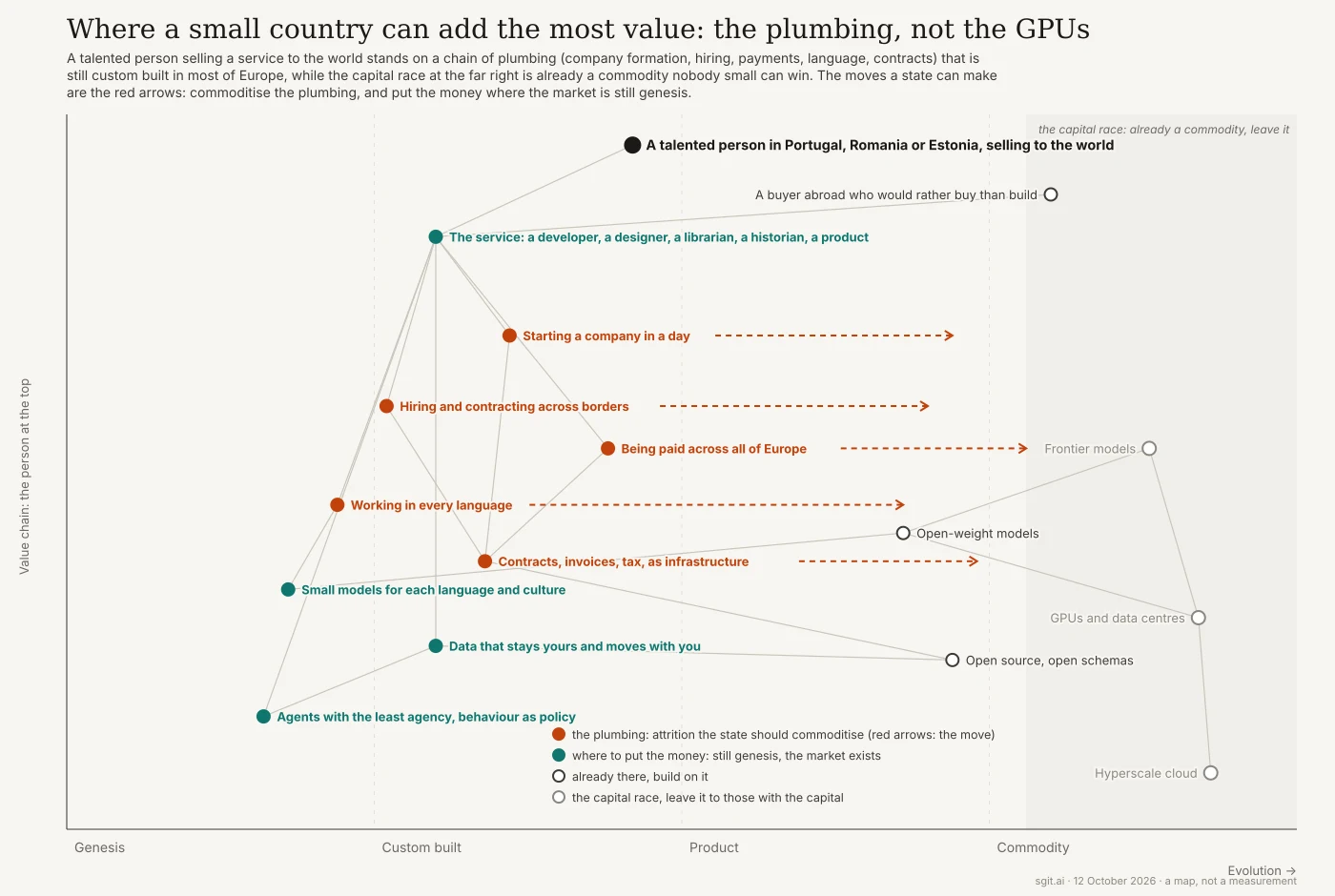
A talented person in Portugal, Romania or Estonia selling a service to the world, as a Wardley map. The capital race on the right is a commodity; the red dots are the plumbing that is still custom built in most of Europe and that a state can move right; the green dots are where the market is still g
diagram · behind 3 proposals
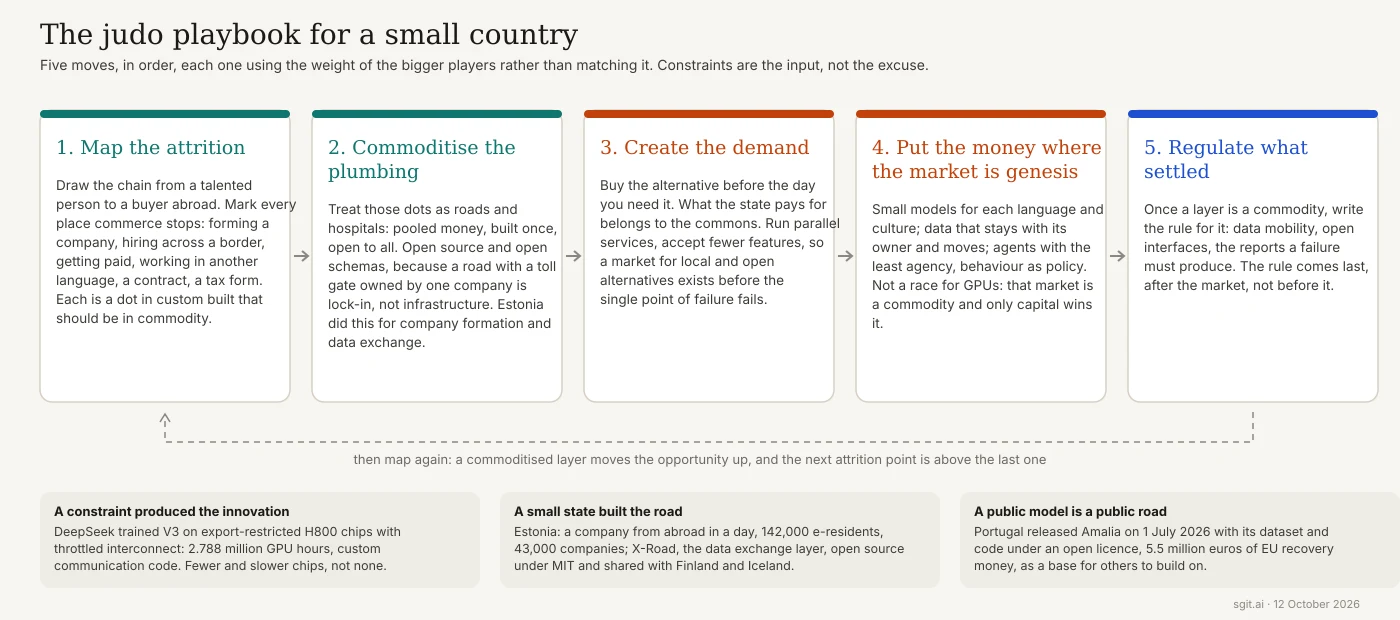
The judo playbook in five moves: map the attrition, commoditise the plumbing, create the demand, put the money where the market is still genesis, regulate what settled, then map again. Three examples underneath of a constraint, a small state and a public model doing it.
infographic · behind 3 proposals
Move the cloud, not the code 2 figures

The article on newsroom.sgit.ai →

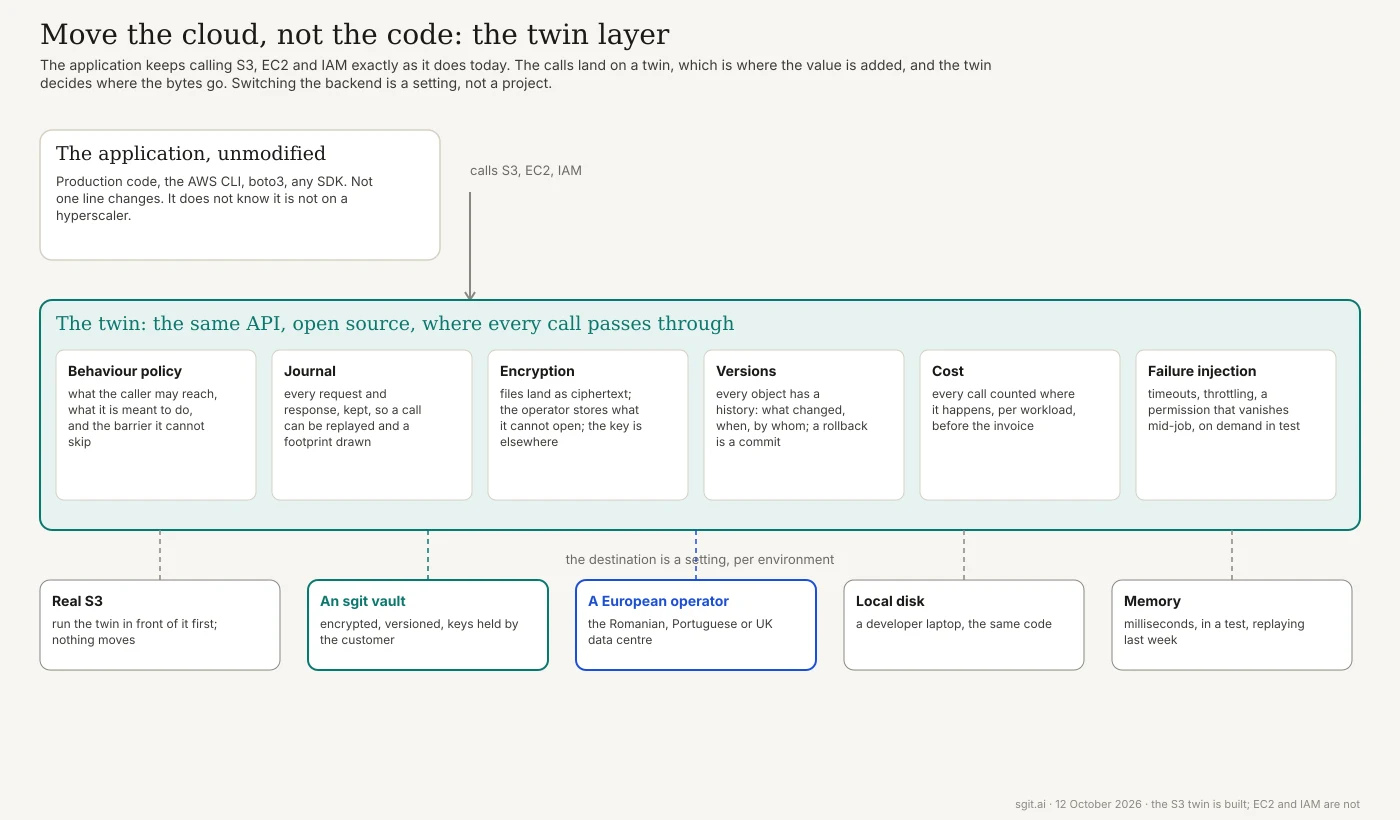
The twin layer. The application keeps calling S3, EC2 and IAM exactly as it does today; the calls land on an open source twin, which is where policy, journal, encryption, versions, cost and failure injection live; the twin decides where the bytes go, and switching the backend is a setting. The S3 tw
diagram · behind 2 proposals
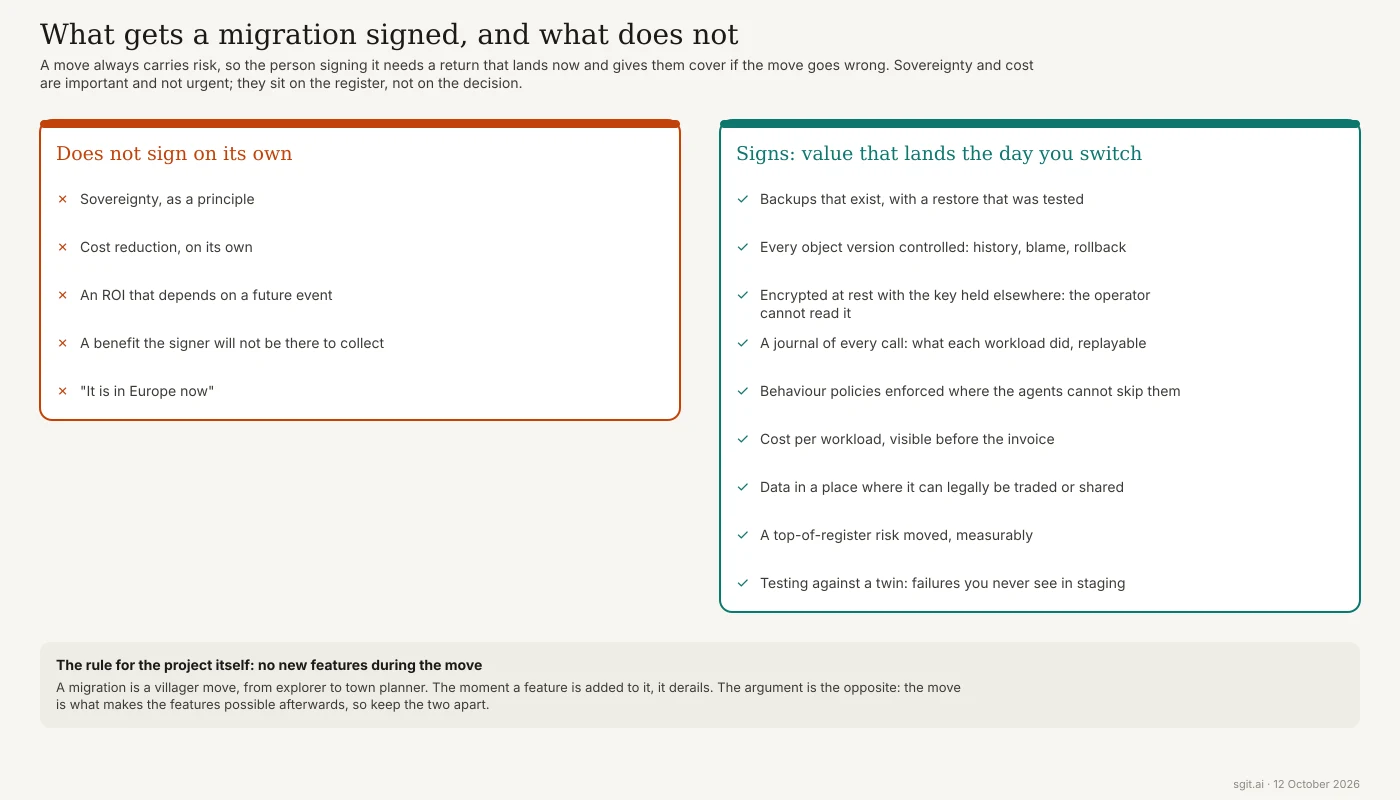
What signs a migration and what does not. Sovereignty, cost and any return that depends on a future event sit on the left; value that lands the day you switch, and gives the signer cover, sits on the right. Underneath, the rule for the project: no new features during the move.
infographic · behind 2 proposals
No server, by design 4 figures

The article on newsroom.sgit.ai →

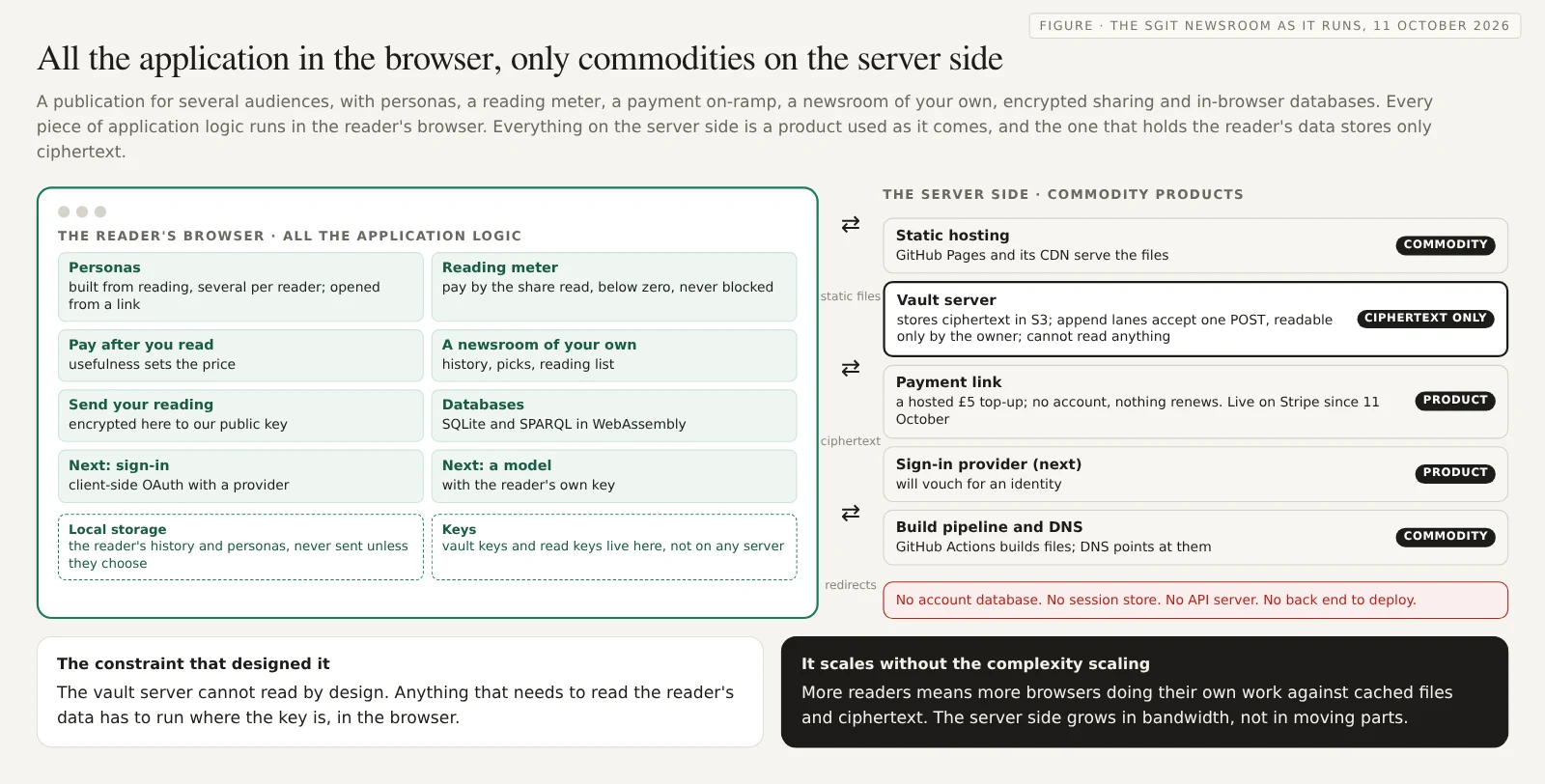
The SGit Newsroom's architecture. Every piece of application logic runs in the reader's browser. Everything on the server side is a commodity product that holds no logic of ours, and the one that holds the reader's data cannot read it.
diagram · behind 2 proposals
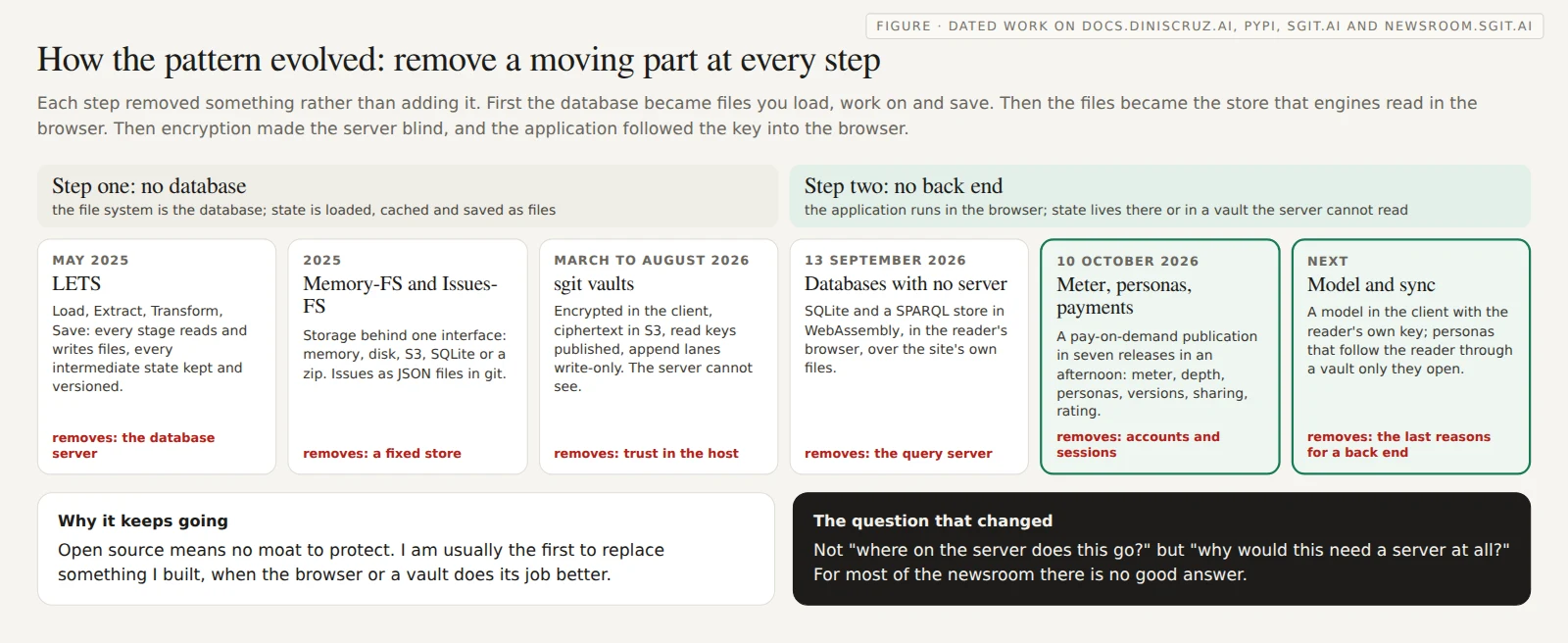
How the pattern evolved: from removing the database, through files as the store of record and engines that read them in the browser, to removing the back end. Each step removed a moving part rather than adding one.
other · behind 2 proposals
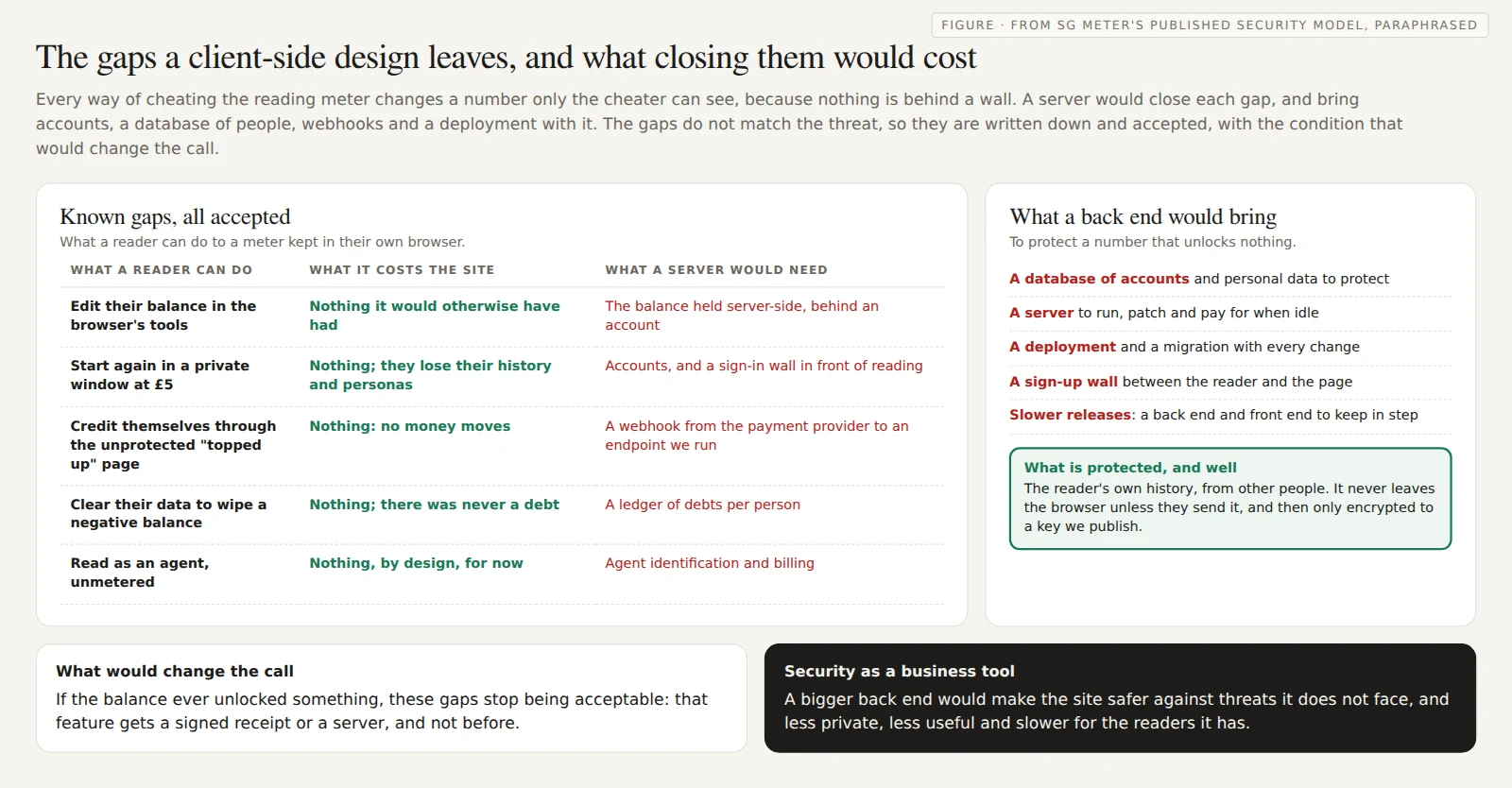
The gaps a client-side design leaves, as SG Meter's security model lists them, and what a server would cost to close each one. Every gap changes a number only the person exploiting it can see. A server would close them, and bring accounts, a database, webhooks and a deployment with it.
other · behind 2 proposals
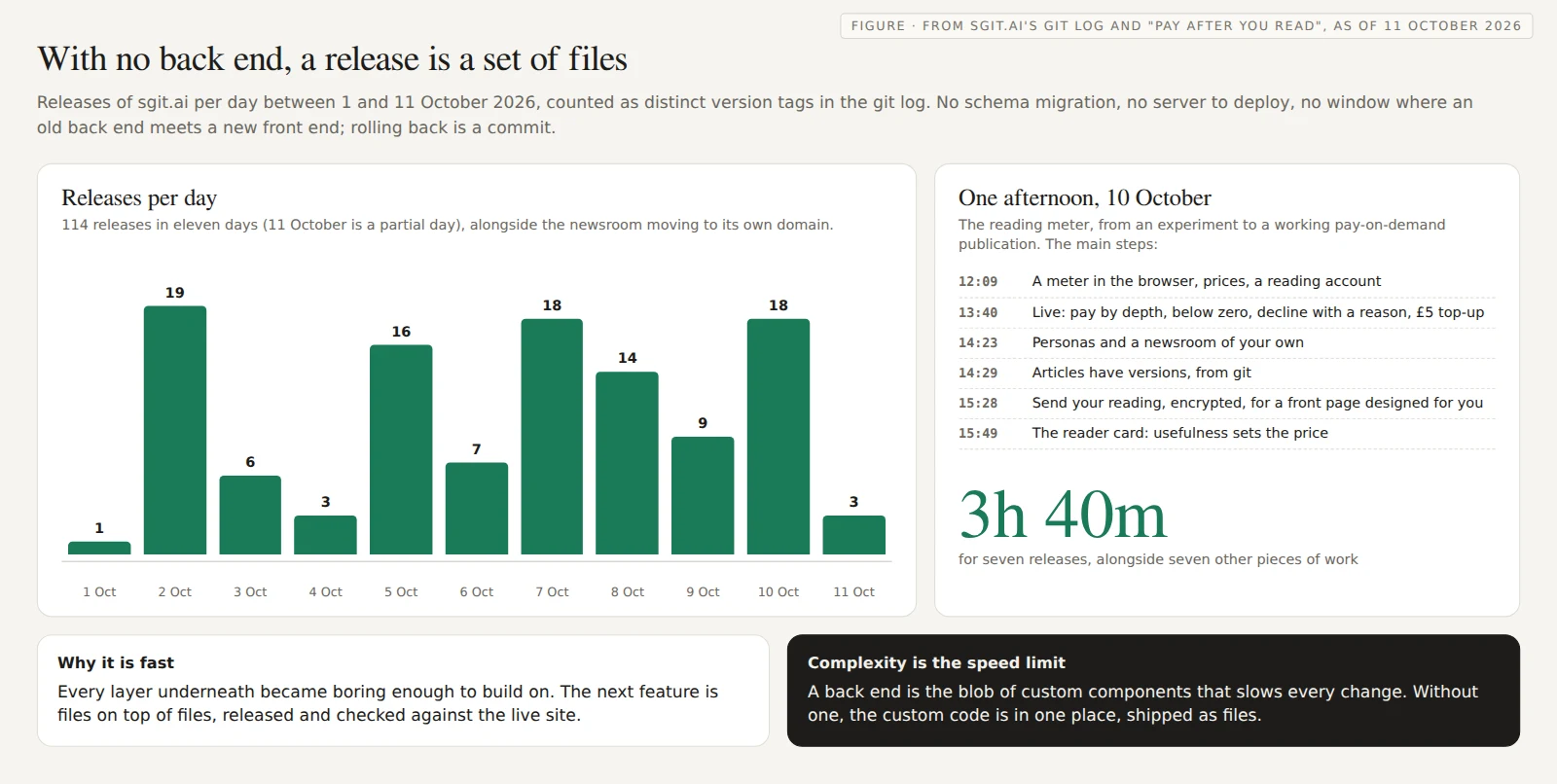
Releases of sgit.ai per day, 1 to 11 October 2026, from the git log: 114 in eleven days. With no back end, a release is a set of files; there is no migration, no deployment of a server and nothing to roll back but a commit.
other · behind 2 proposals
Not a straight line 1 figure

The article on newsroom.sgit.ai →
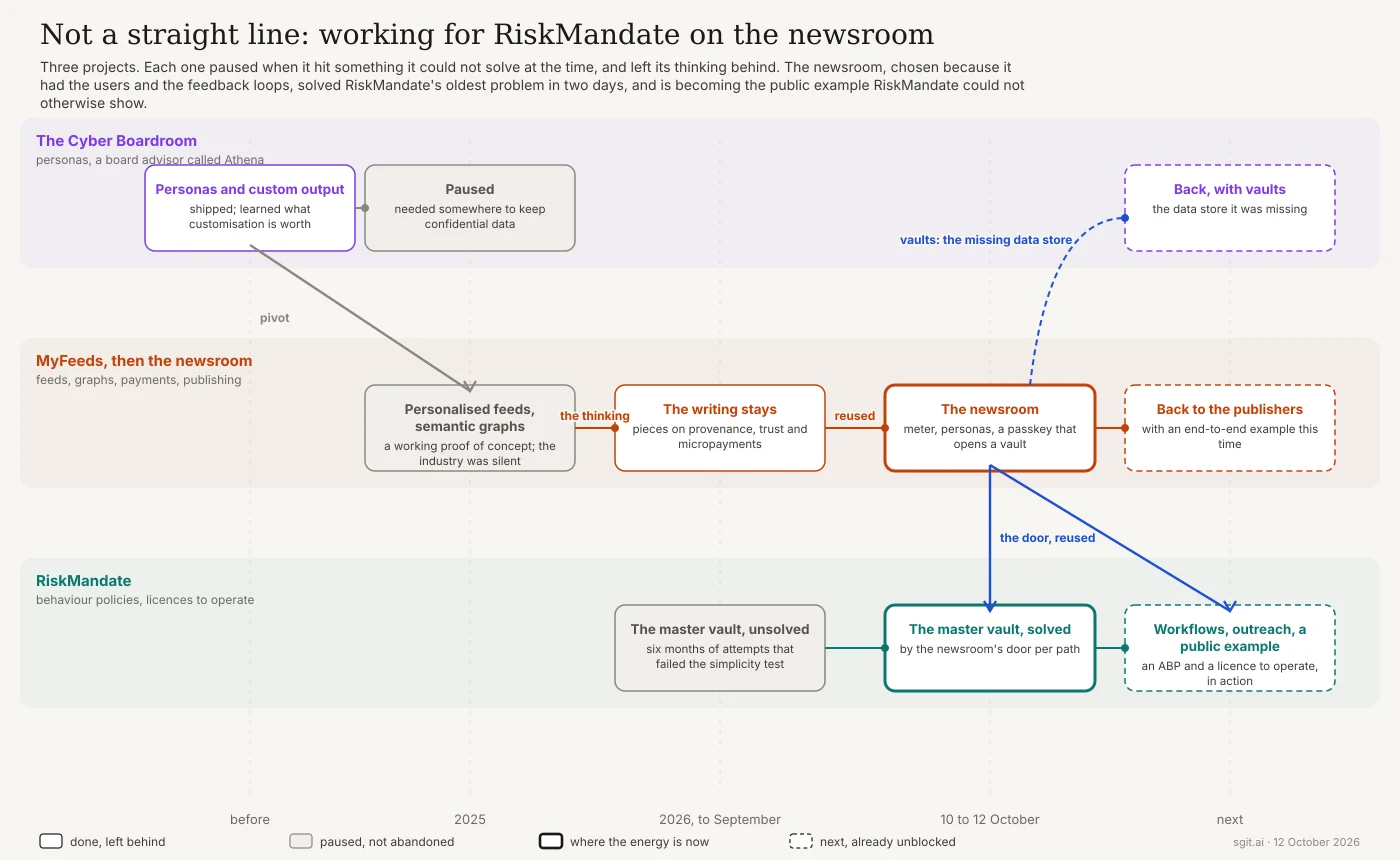
Three projects, one path that is not a straight line. The Cyber Boardroom learned what personas are worth and paused for want of a data store; MyFeeds built personalised feeds on semantic graphs and paused when the industry was silent; the writing stayed. The newsroom, where the energy is now, solve
infographic · behind 4 proposals
Open source is not free 8 figures

The article on newsroom.sgit.ai →
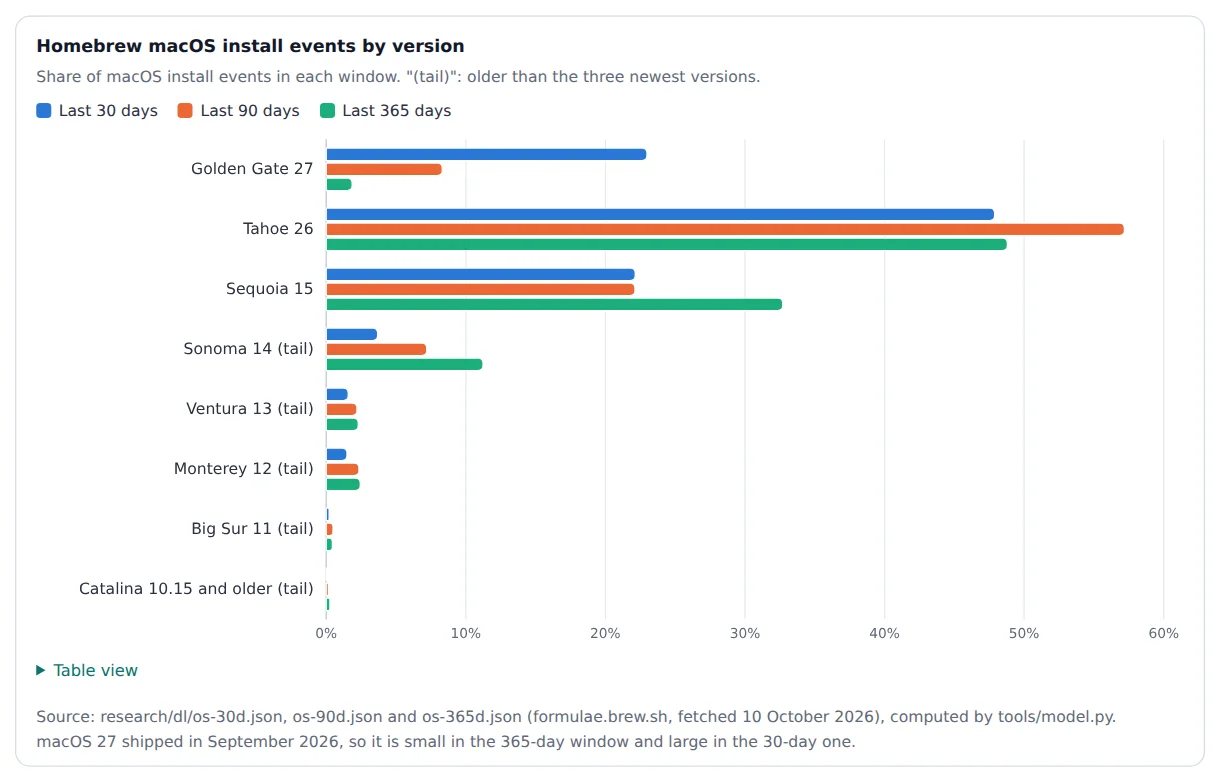
Homebrew macOS install events by version over 30, 90 and 365 days. macOS 27 shipped in September 2026, so it is large in the 30-day window and small in the year. From the Long Tail Ledger vault.
other · behind 2 proposals
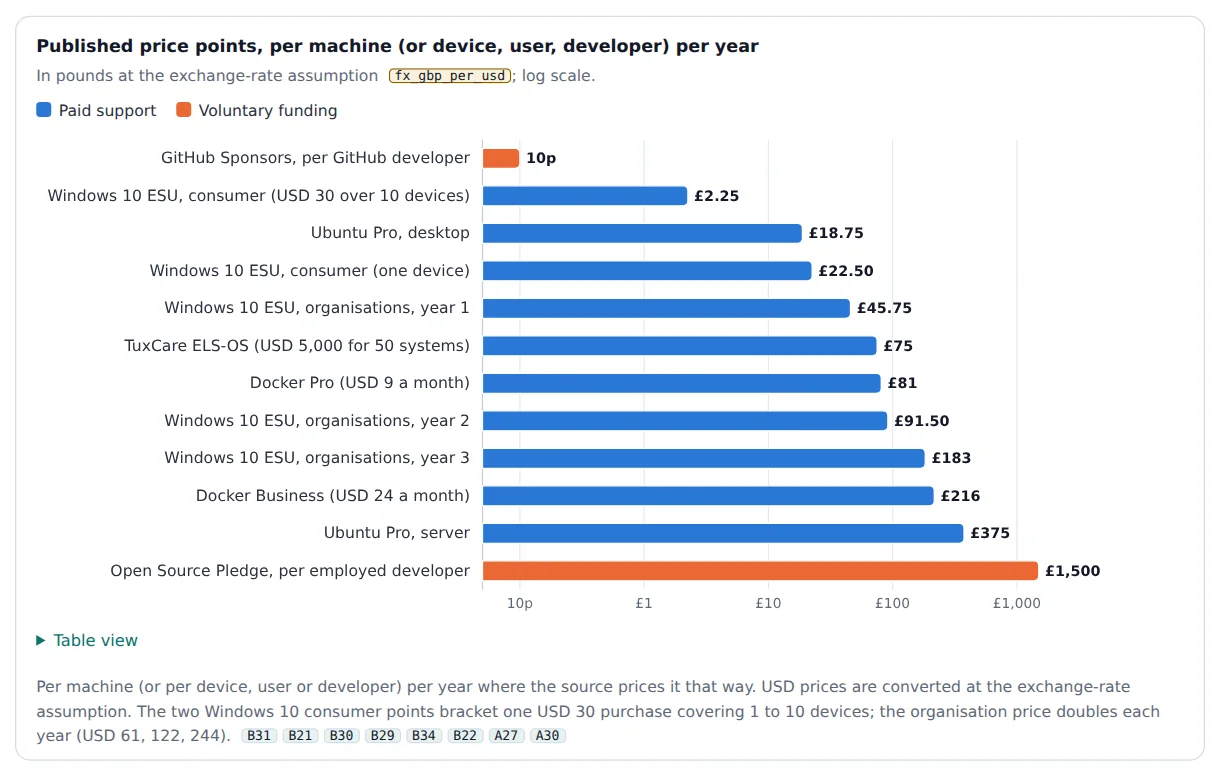
What people pay to keep old software supported, per machine per year, against what open source receives in voluntary funding. From the Long Tail Ledger vault.
other · behind 2 proposals
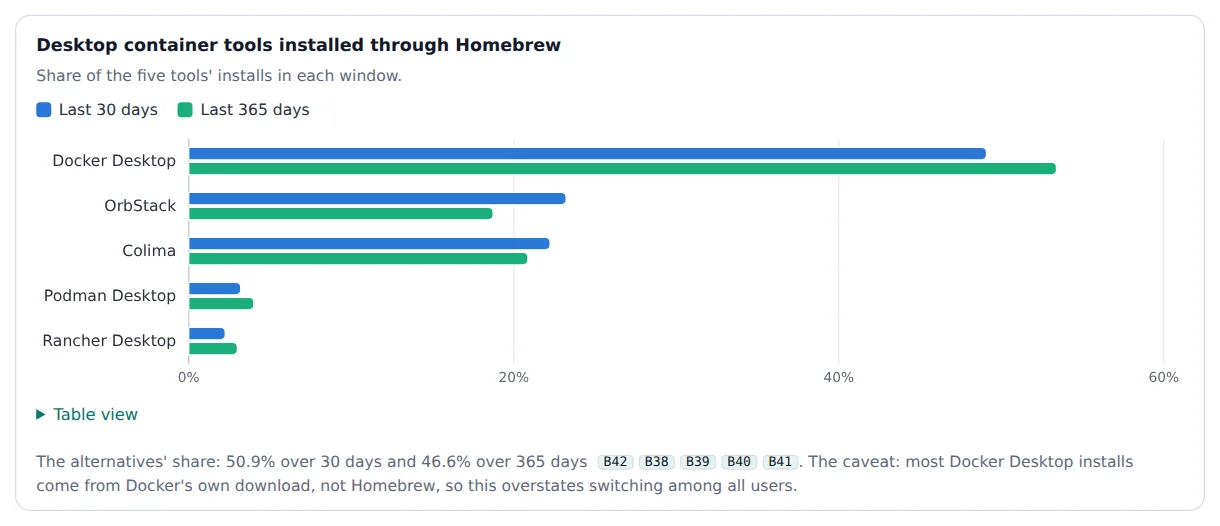
Desktop container tools installed through Homebrew, as a share of the five tools' installs over 30 and 365 days. Most Docker Desktop installs come from Docker's own download, so this overstates the alternatives. From the Long Tail Ledger vault.
other · behind 2 proposals
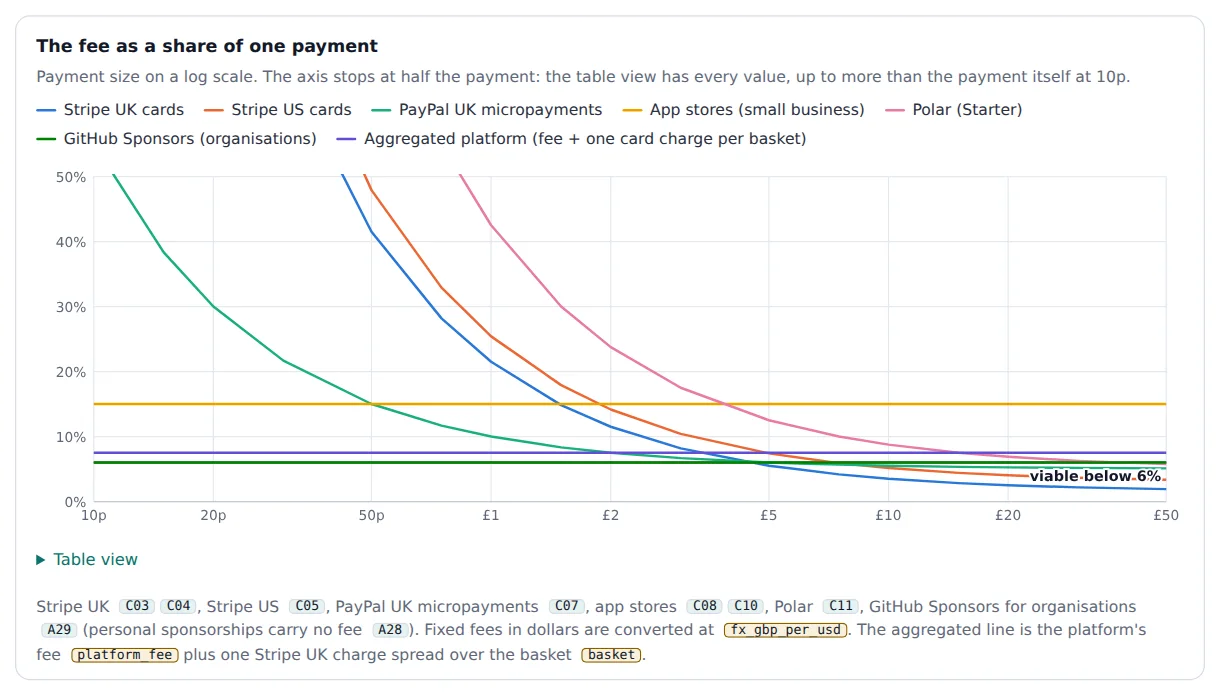
Fee as a share of one payment, by payment size and payment rail. The fixed part of a card fee dominates below about £5; aggregation is what makes pence payments work. From the Long Tail Ledger vault.
other · behind 2 proposals
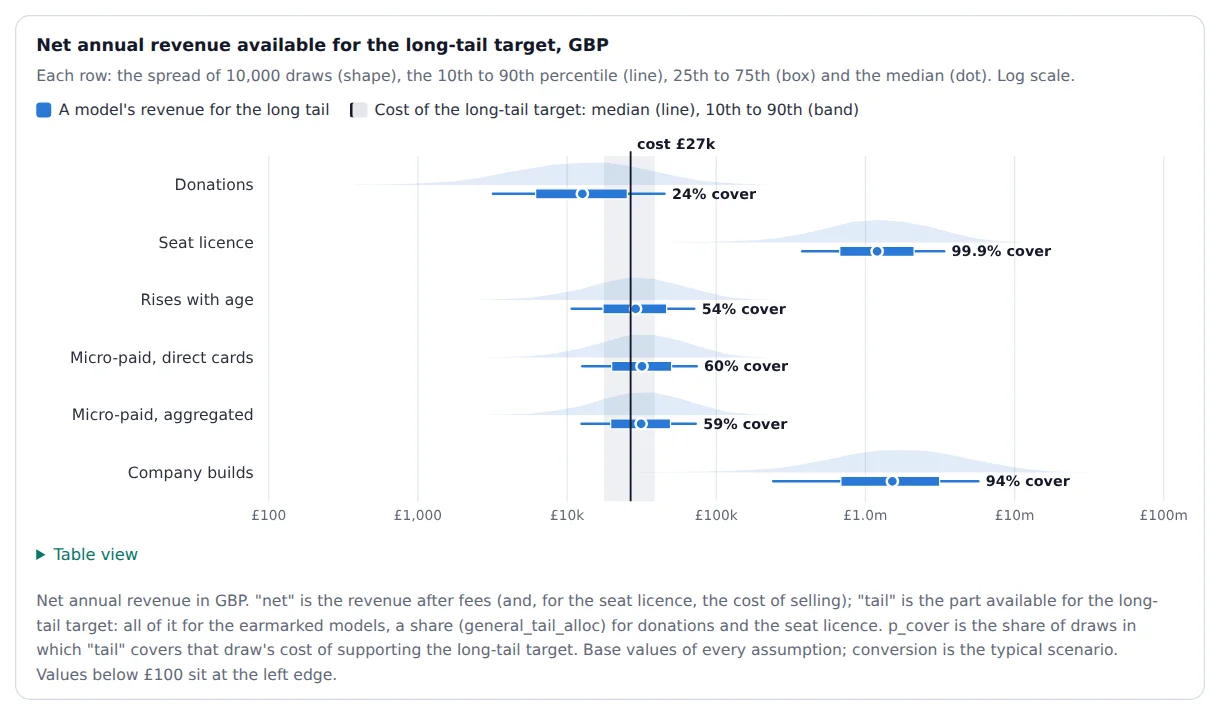
The five models side by side: the spread of 10,000 draws of the net revenue available for the long-tail target, on a log scale, against the cost of keeping that target alive (the grey band). Typical conversion, base values. From the Long Tail Ledger vault.
other · behind 2 proposals
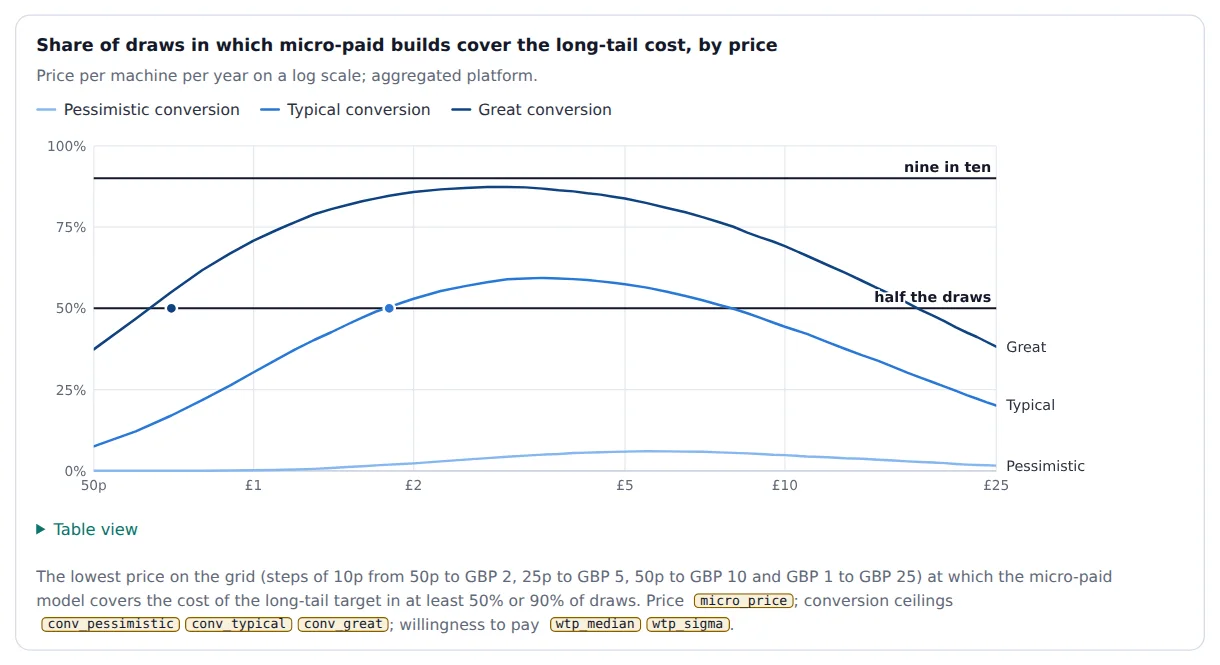
The share of draws in which micro-paid supported builds cover the long-tail cost, at every price from 50p to £25, for three conversion scenarios. The curves fall at high prices because fewer people pay. From the Long Tail Ledger vault.
other · behind 2 proposals
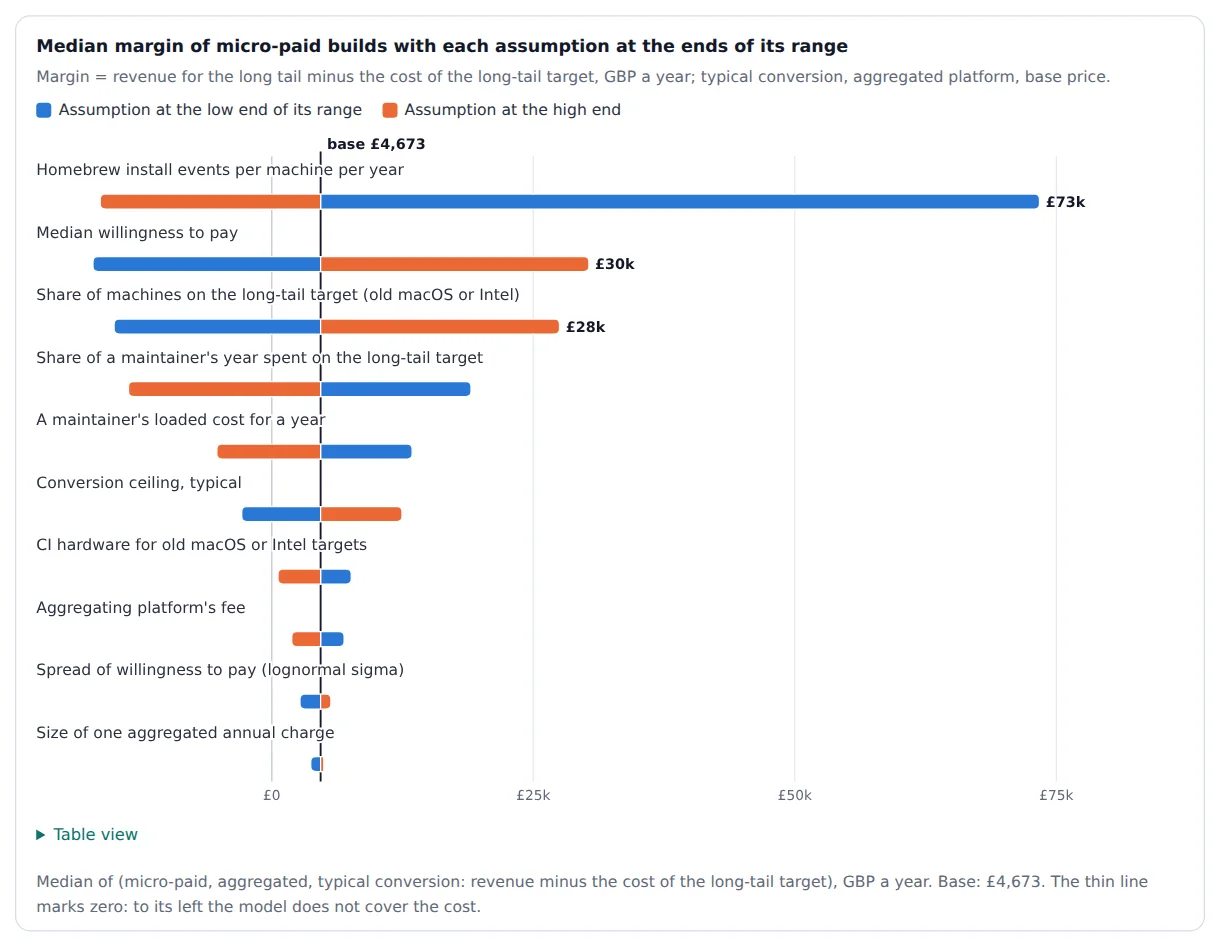
Which assumption moves the answer most: the median margin of micro-paid builds (revenue minus the long-tail cost) with each assumption held at the low and the high end of its range. From the Long Tail Ledger vault.
other · behind 2 proposals
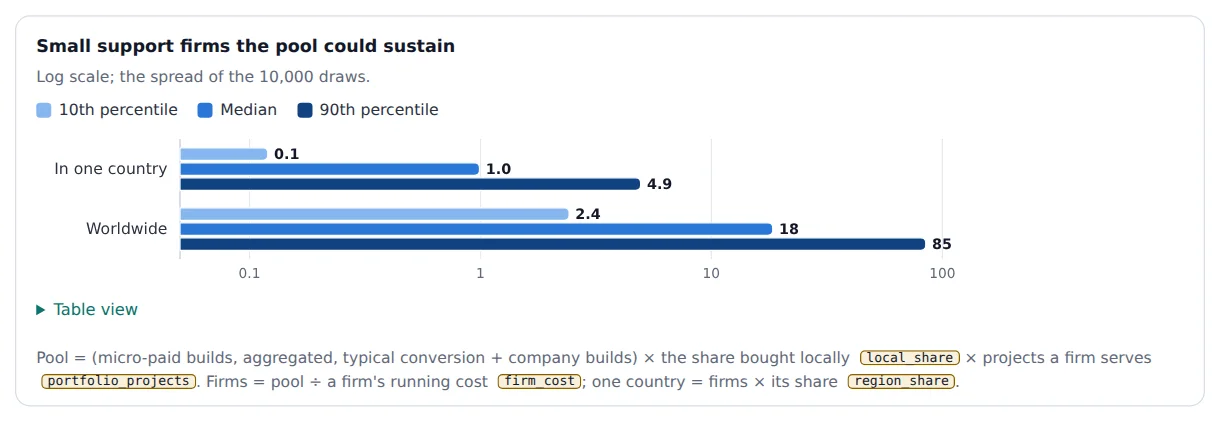
Small support firms the pool could sustain, worldwide and in one mid-sized country. From the Long Tail Ledger vault.
other · behind 2 proposals
Paying after the value 2 figures

The article on newsroom.sgit.ai →
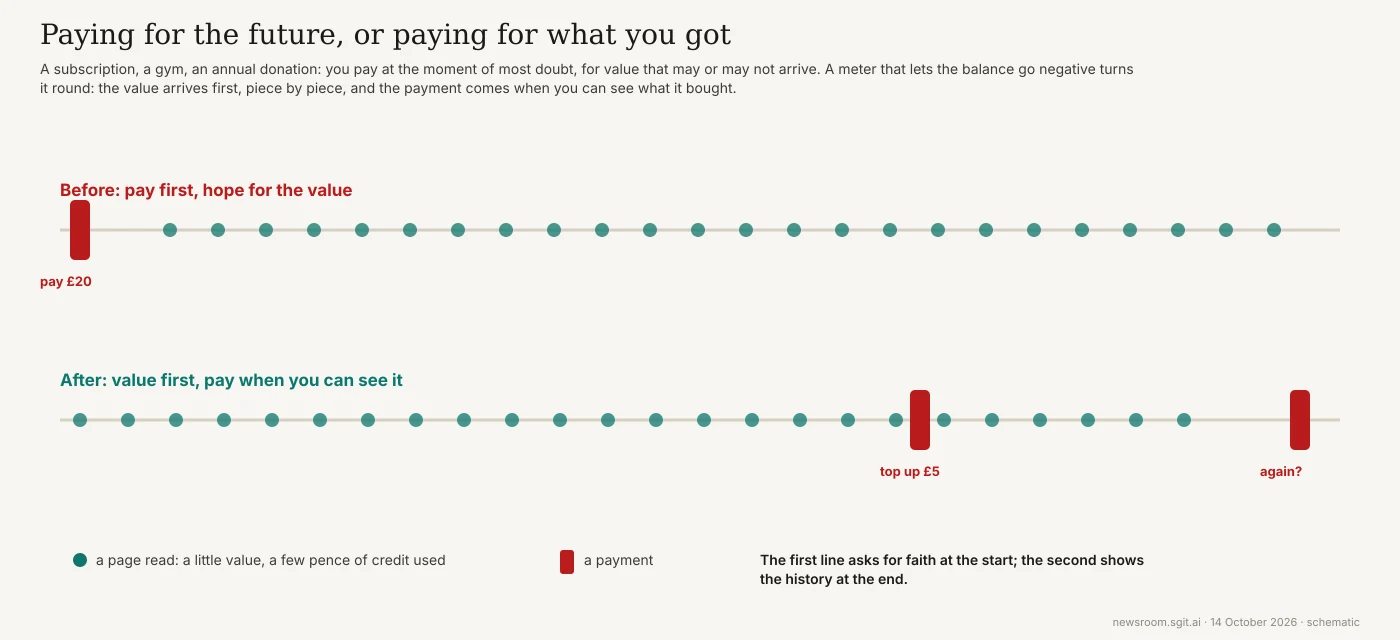
Paying for the future, or paying for what you got. A subscription, a gym or an annual donation asks you to pay at the moment of most doubt, for value that may arrive. A meter that lets the balance go negative turns it round: the value arrives first, piece by piece, and the payment comes when you can
infographic · behind 2 proposals
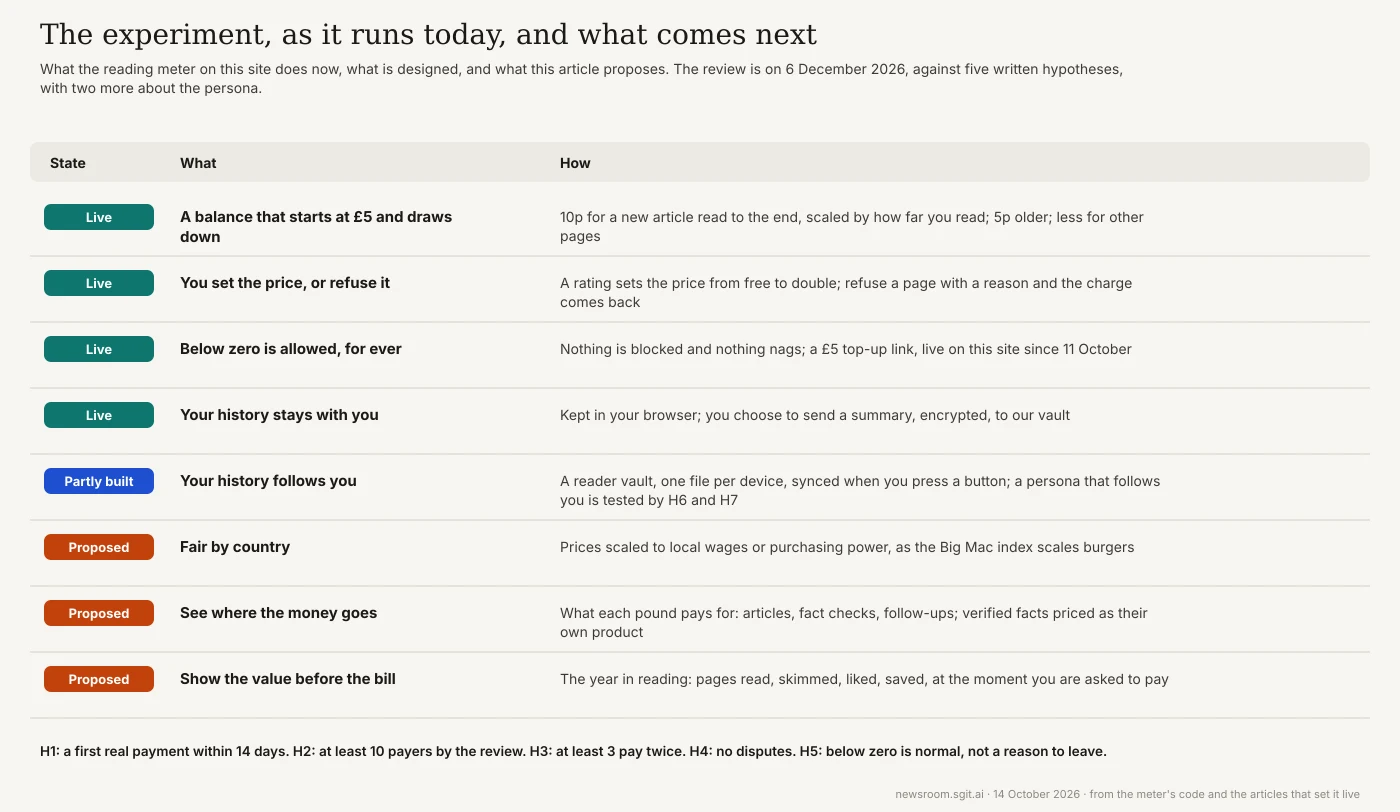
The experiment, as it runs today and what comes next: what the reading meter on this site does now, what is partly built, and what this article proposes, with the five hypotheses it will be reviewed against on 6 December 2026.
infographic · behind 2 proposals
Price it, then give it away 1 figure

The article on newsroom.sgit.ai →
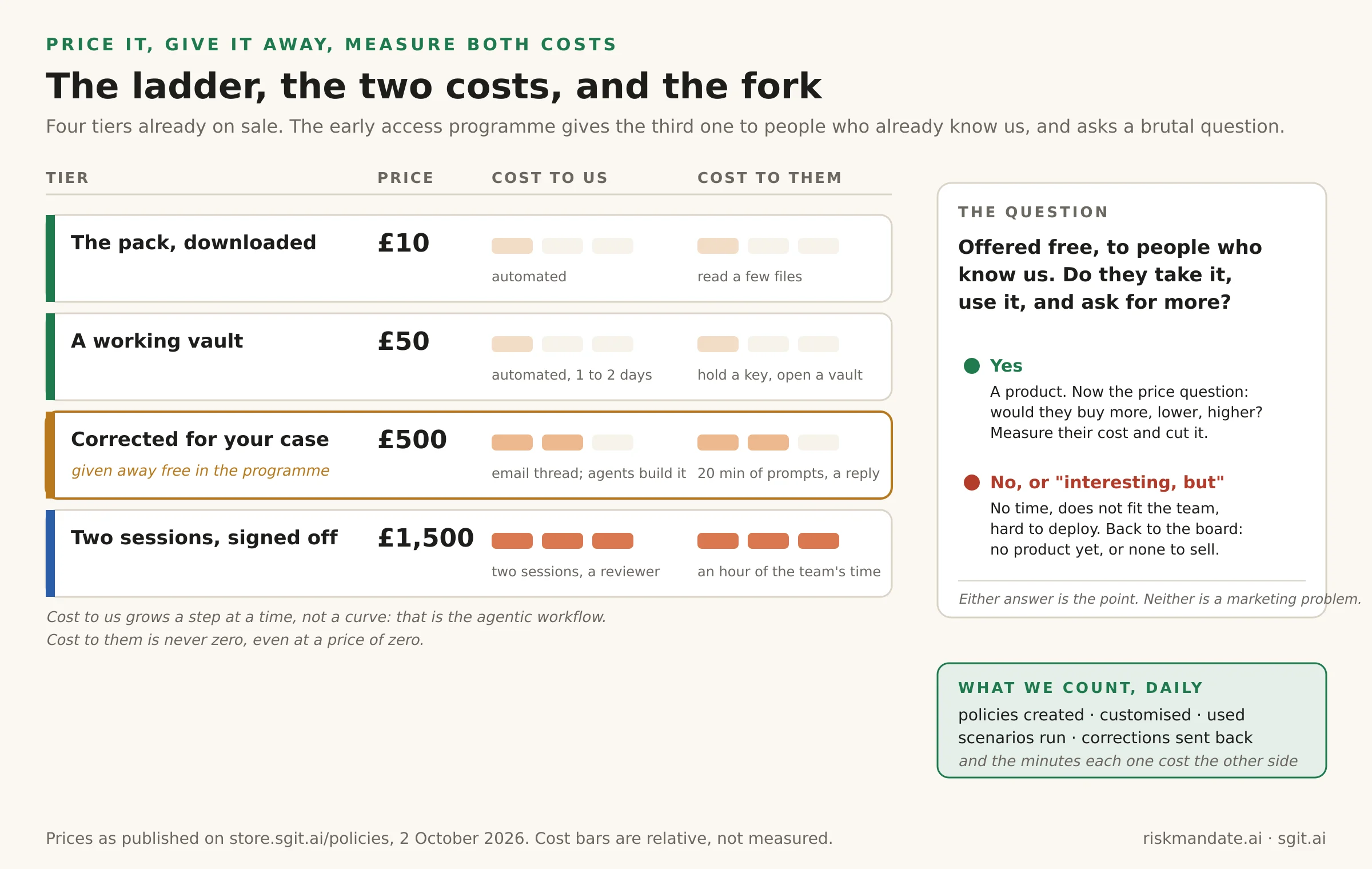
The ladder, what each tier costs each side, and the fork. Four tiers already on sale, from the ten-pound pack to the fifteen-hundred-pound reviewed vault, each with a relative cost to us and a cost to the customer. The early access programme gives the five-hundred-pound tier away, free, to people wh
other · behind 3 proposals
Ten hard questions for RiskMandate, answered 1 figure

The article on newsroom.sgit.ai →

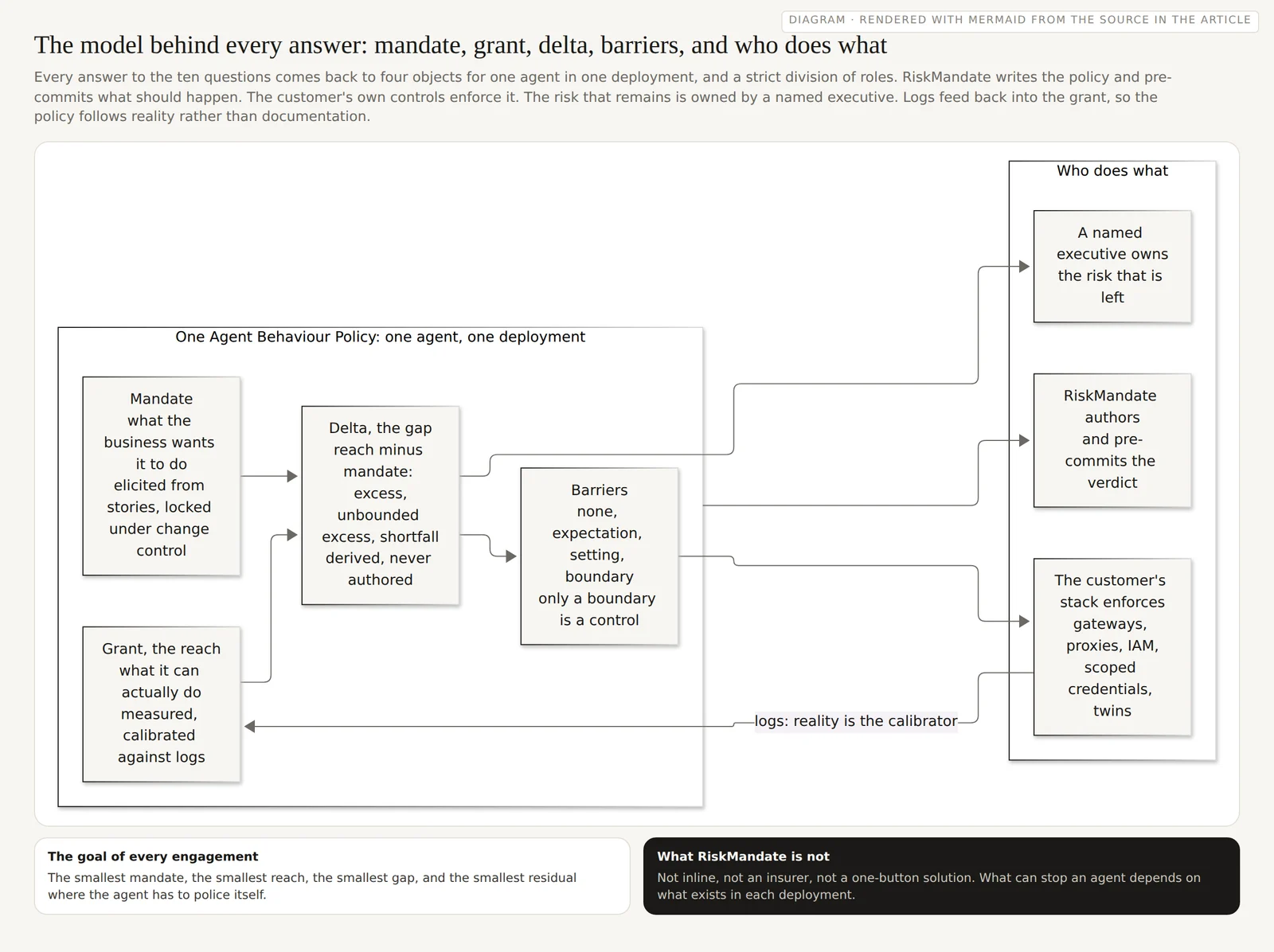
The model behind every answer: four objects for one agent in one deployment, and who does what. RiskMandate authors the policy and pre-commits the verdict, the customer's own controls enforce it, a named executive owns the risk that is left, and logs keep the grant honest.
other · behind 3 proposals
The SaaS apocalypse will be decided by inertia, not by AI 2 figures

The article on newsroom.sgit.ai →
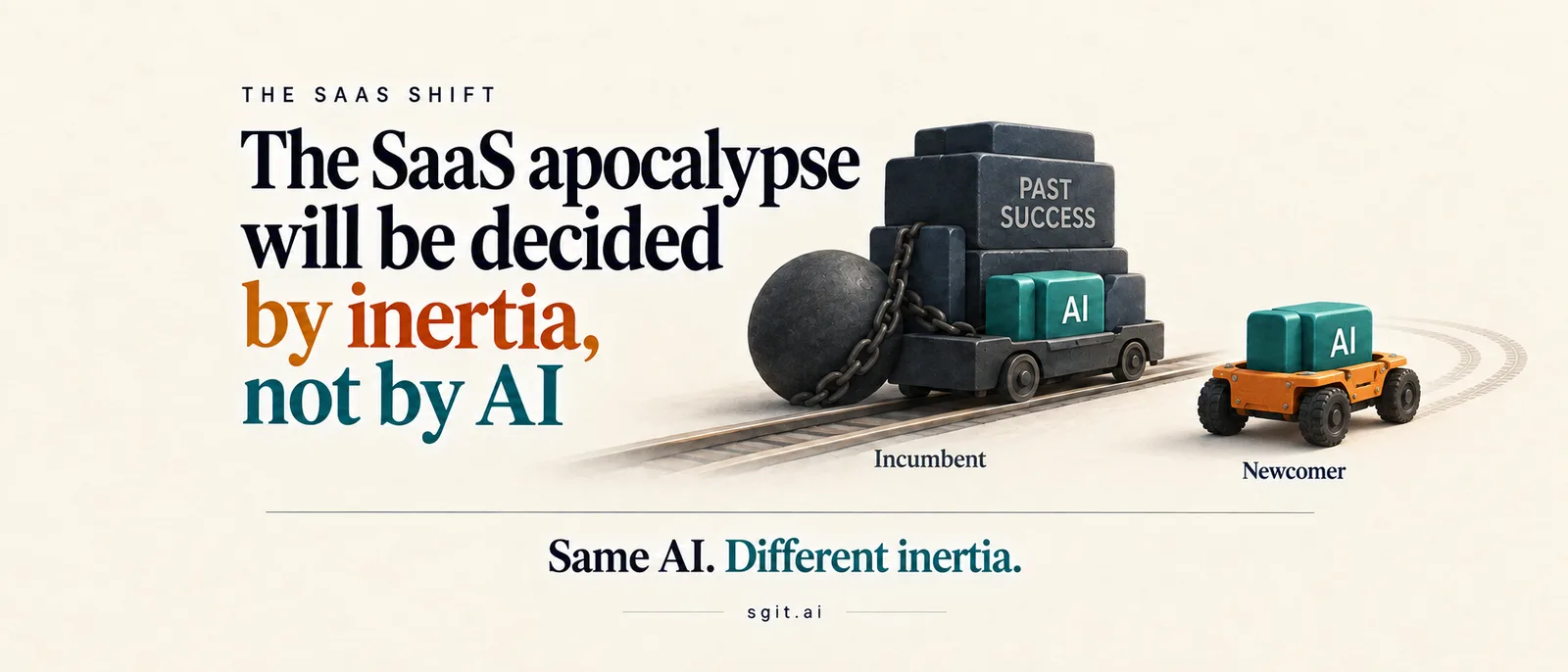
The incumbent and the newcomer are carrying the same AI. What differs is the ball and chain of past success, and the fact that the newcomer was never on the rails in the first place.
other · behind 1 proposal
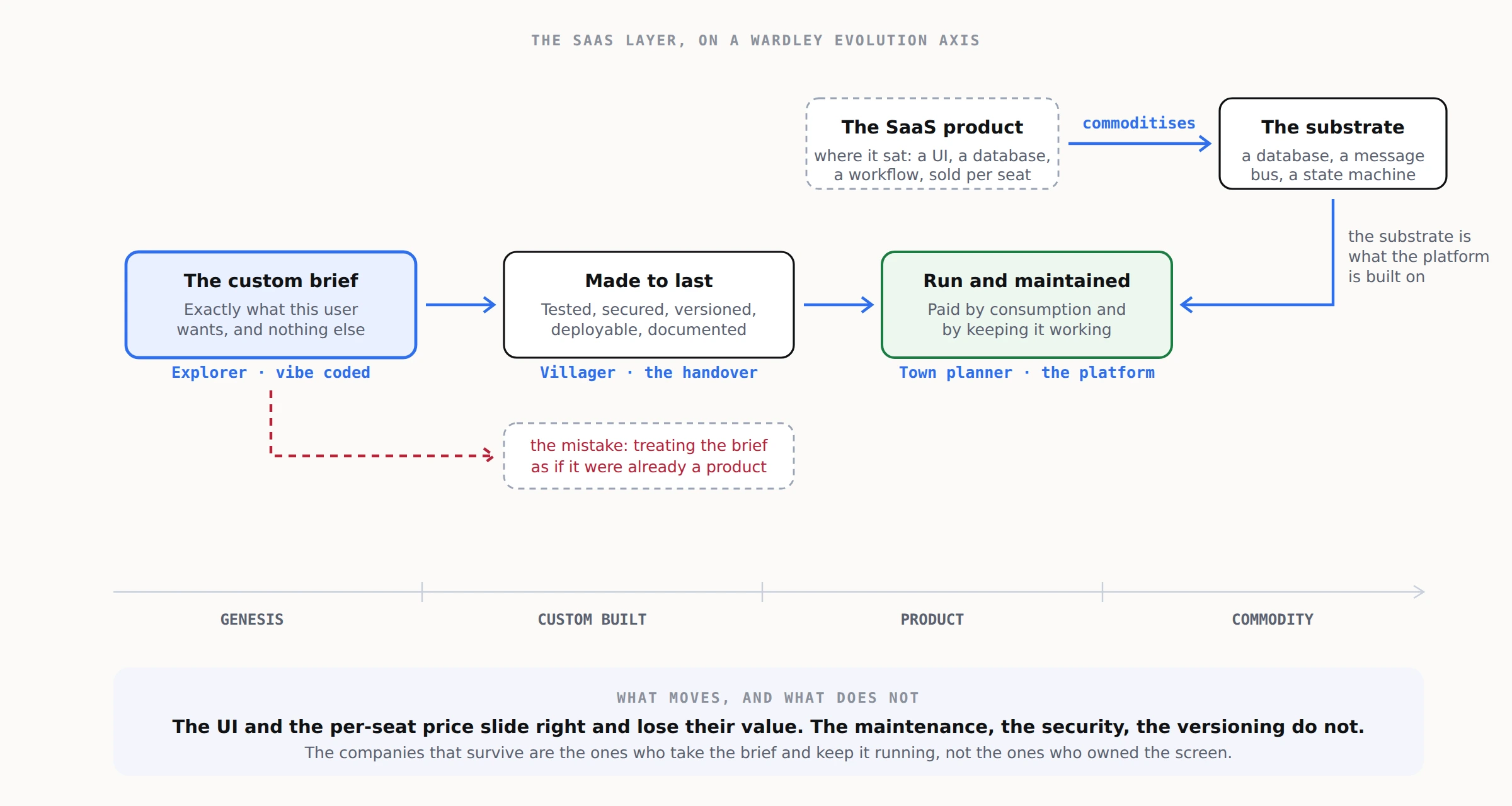
The SaaS product slides right along the evolution axis and becomes a substrate: a database, a message bus, a state machine. On top of that substrate, the custom brief is now cheap to make. What is not cheap is making it last, and that is the handover from explorer to villager to town planner. The mi
other · behind 1 proposal
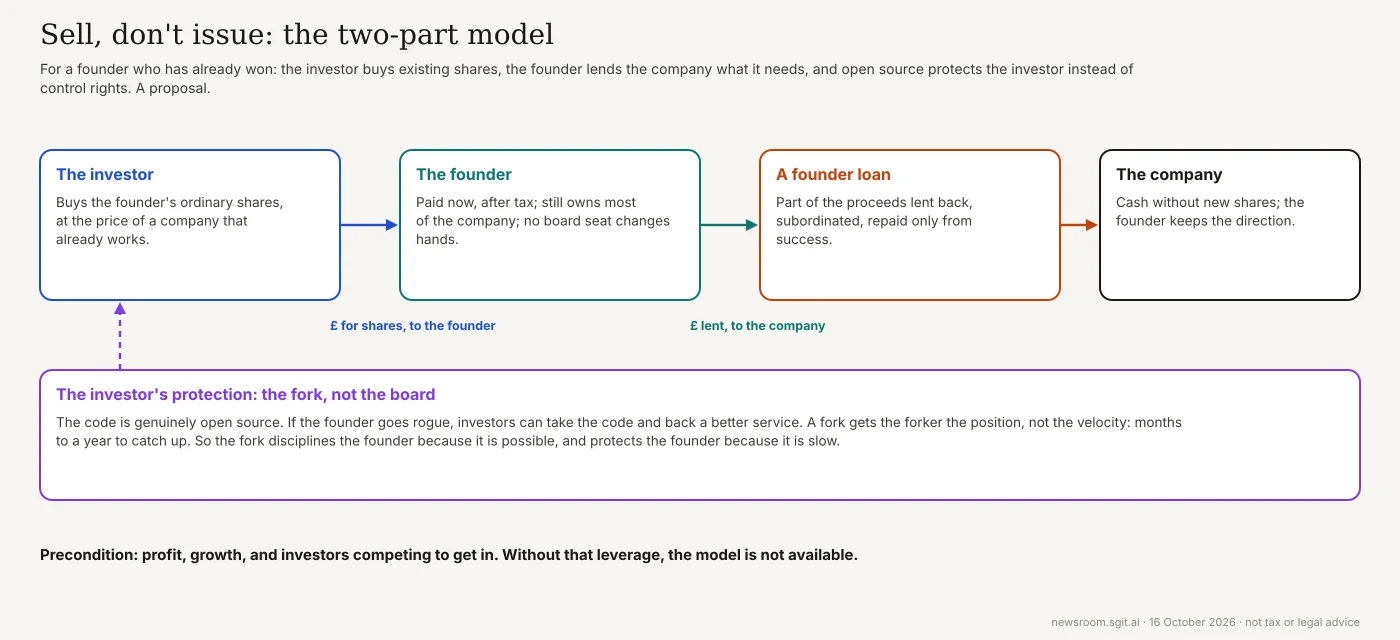
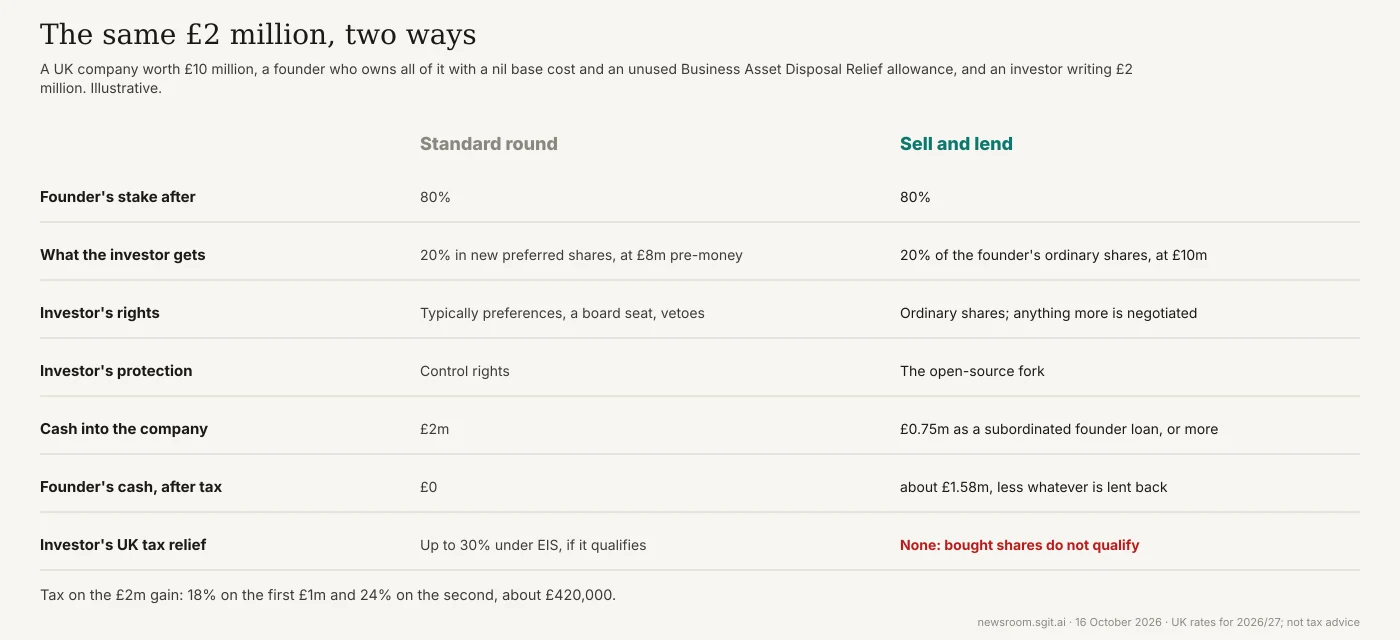
Sell, don't issue 2 figures

The article on newsroom.sgit.ai →
The two-part model: the investor buys the founder's ordinary shares and pays the founder; the founder lends part of the proceeds to the company as a subordinated loan; the company gets cash without new shares; and the investor's protection is the open-source fork, not a board seat.
diagram · behind 2 proposals
The same £2 million, two ways, for a UK company worth £10 million: the founder keeps 80% either way; a standard round gives the investor new preferred shares, rights and control, and puts £2 million into the company; selling and lending gives the investor ordinary shares and the fork as protection,
infographic · behind 2 proposals
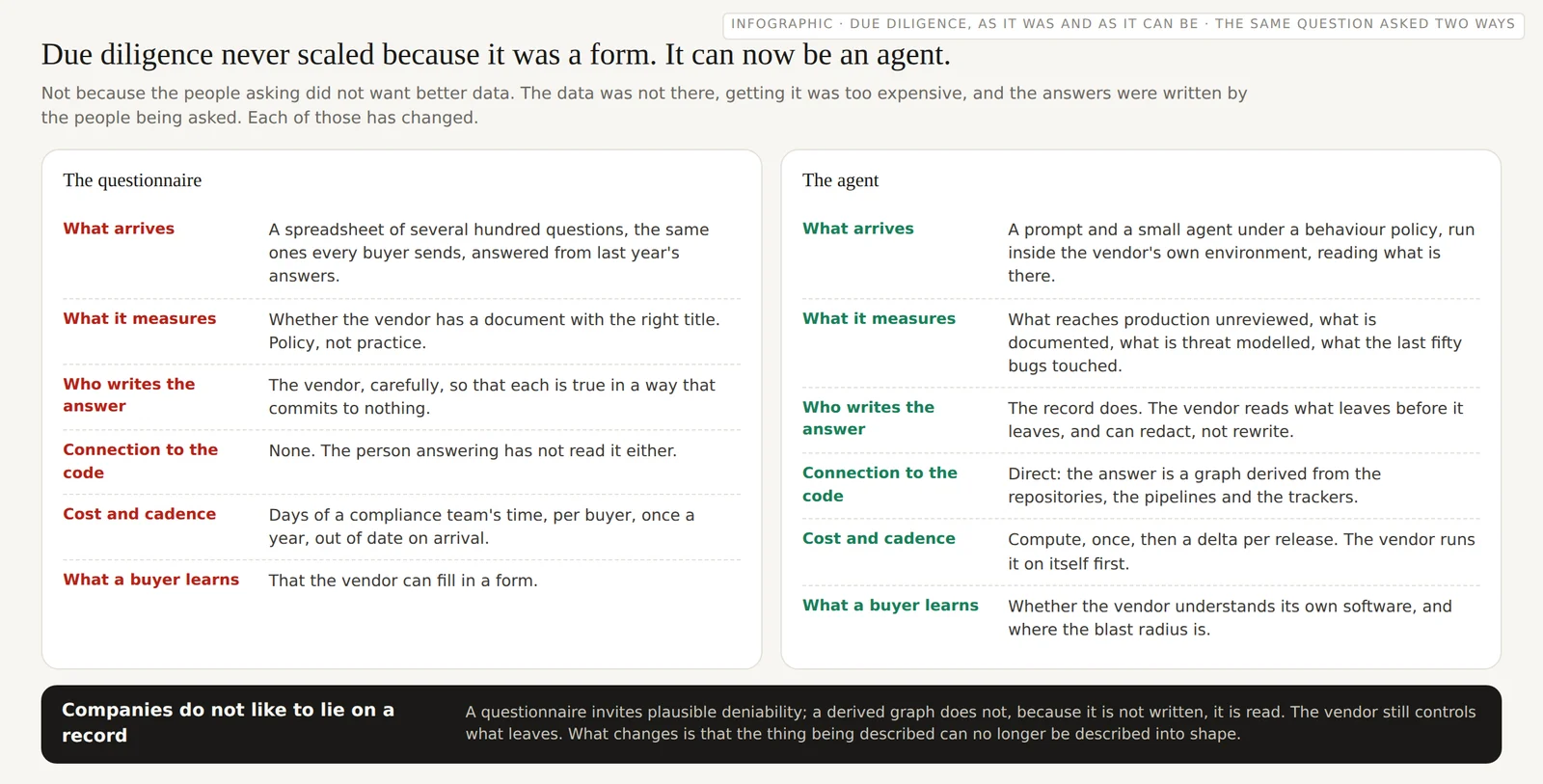
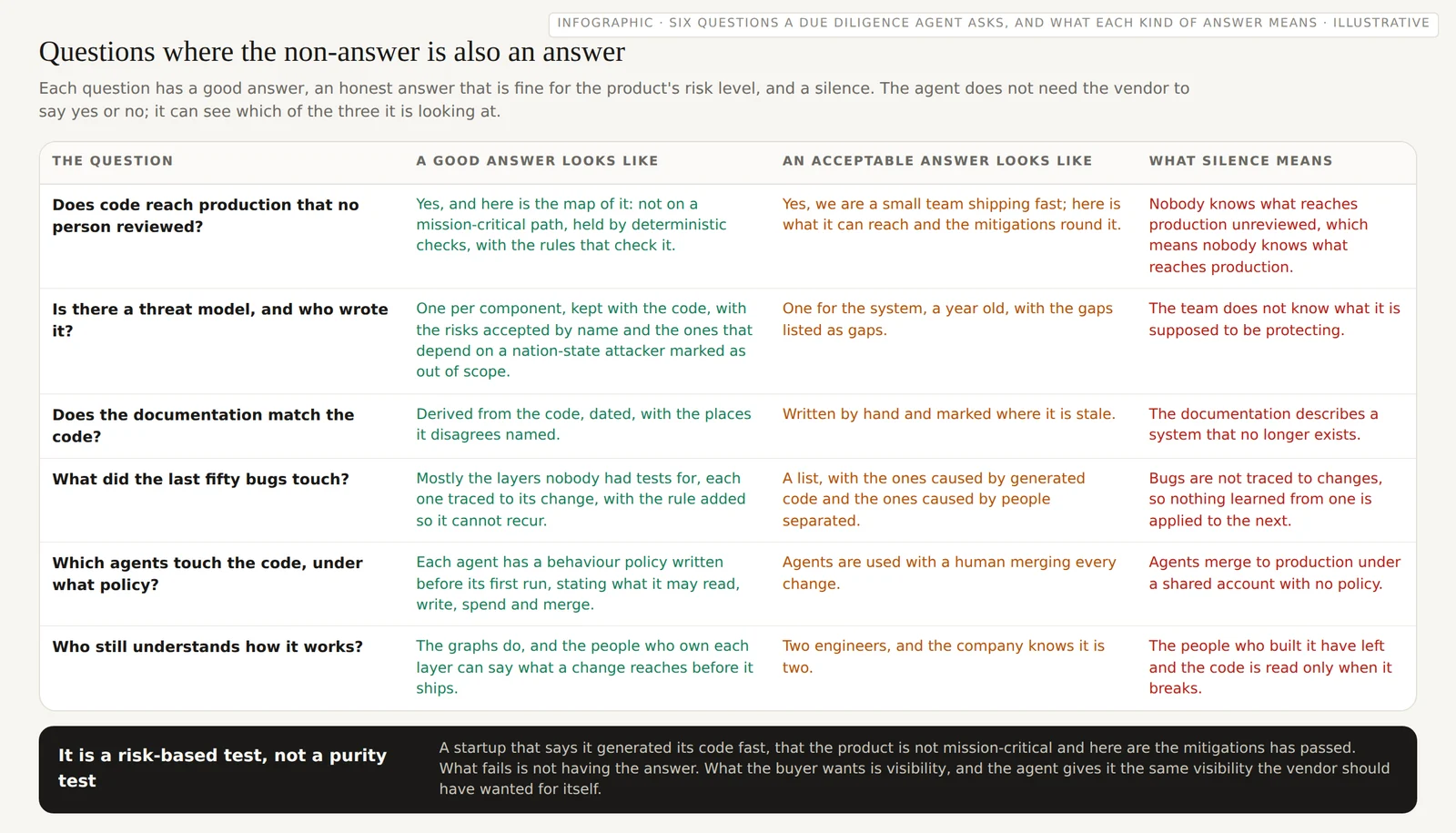
Send an agent, not a spreadsheet 5 figures

The article on newsroom.sgit.ai →
Due diligence as it was and as it can be. The questionnaire measures whether the vendor has a document with the right title, is written by the vendor and connects to nothing. The agent reads what is there, under a behaviour policy, inside the vendor's environment, and the vendor reviews what leaves.
other · behind 1 proposal
Six questions a due diligence agent asks. Each has a good answer, an acceptable answer for the product's risk level, and a silence, and the agent does not need the vendor to say which; it can see. The table is illustrative, the shape is not.
other · behind 1 proposal
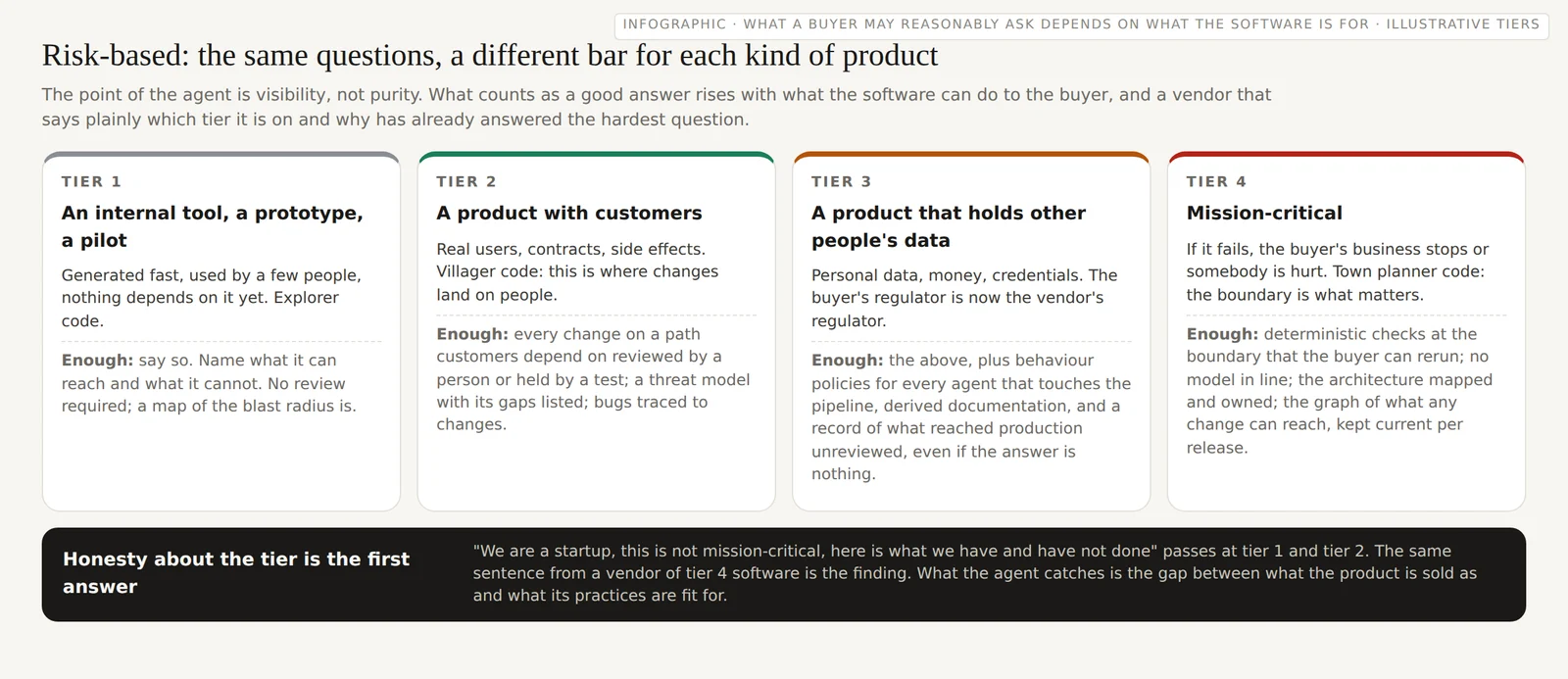
The same questions, a different bar for each kind of product. A prototype passes by saying what it is and mapping what it can reach. A product with customers needs review or tests on every path a customer depends on. A product holding other people's data needs behaviour policies for its agents and a
other · behind 1 proposal
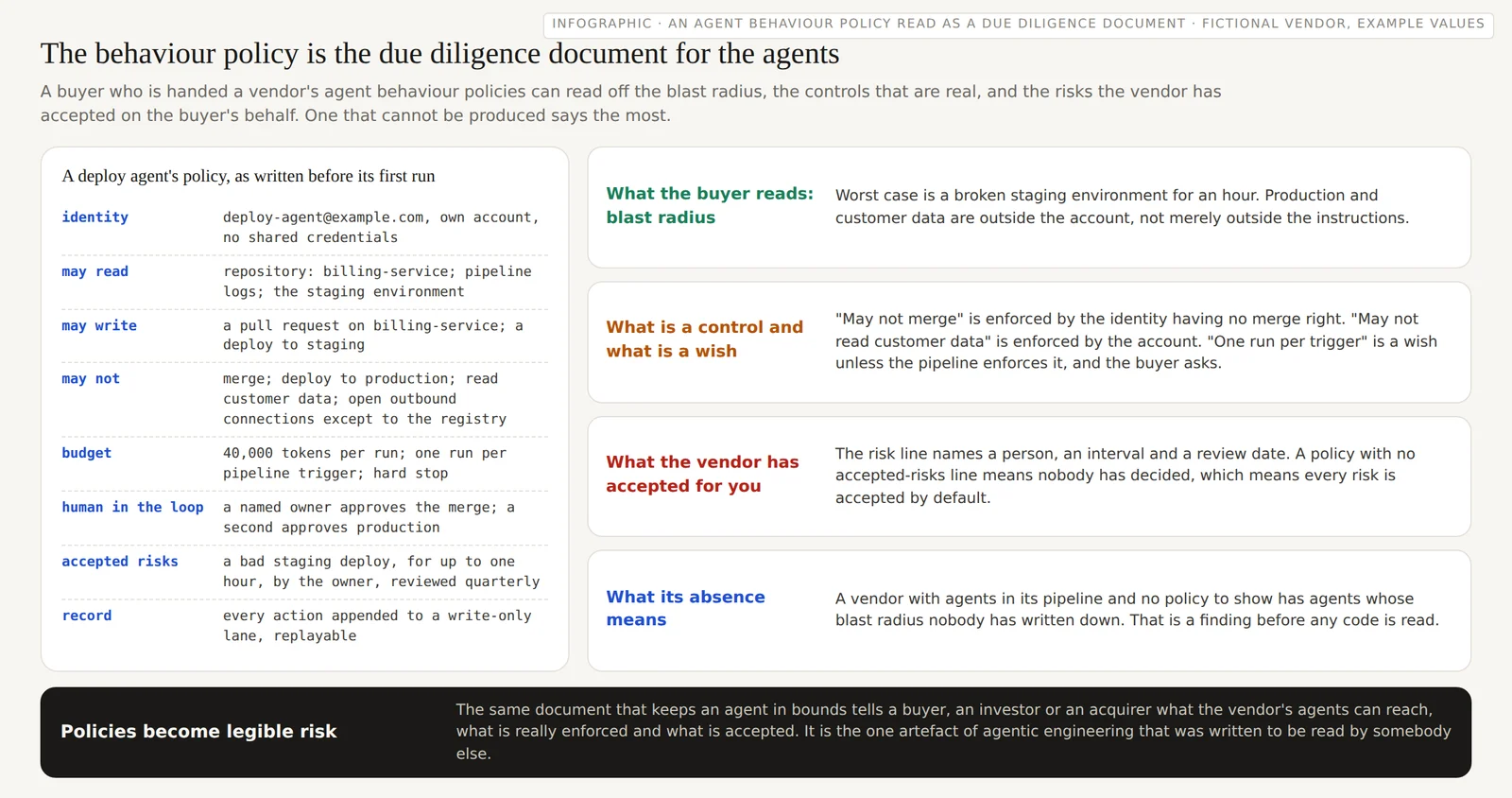
An agent behaviour policy read as a due diligence document. The left is a deploy agent's policy for a fictional vendor. The right is what a buyer reads off it: the worst case, which lines are enforced by the identity and which are only instructions, which risks the vendor has accepted on the buyer's
other · behind 1 proposal
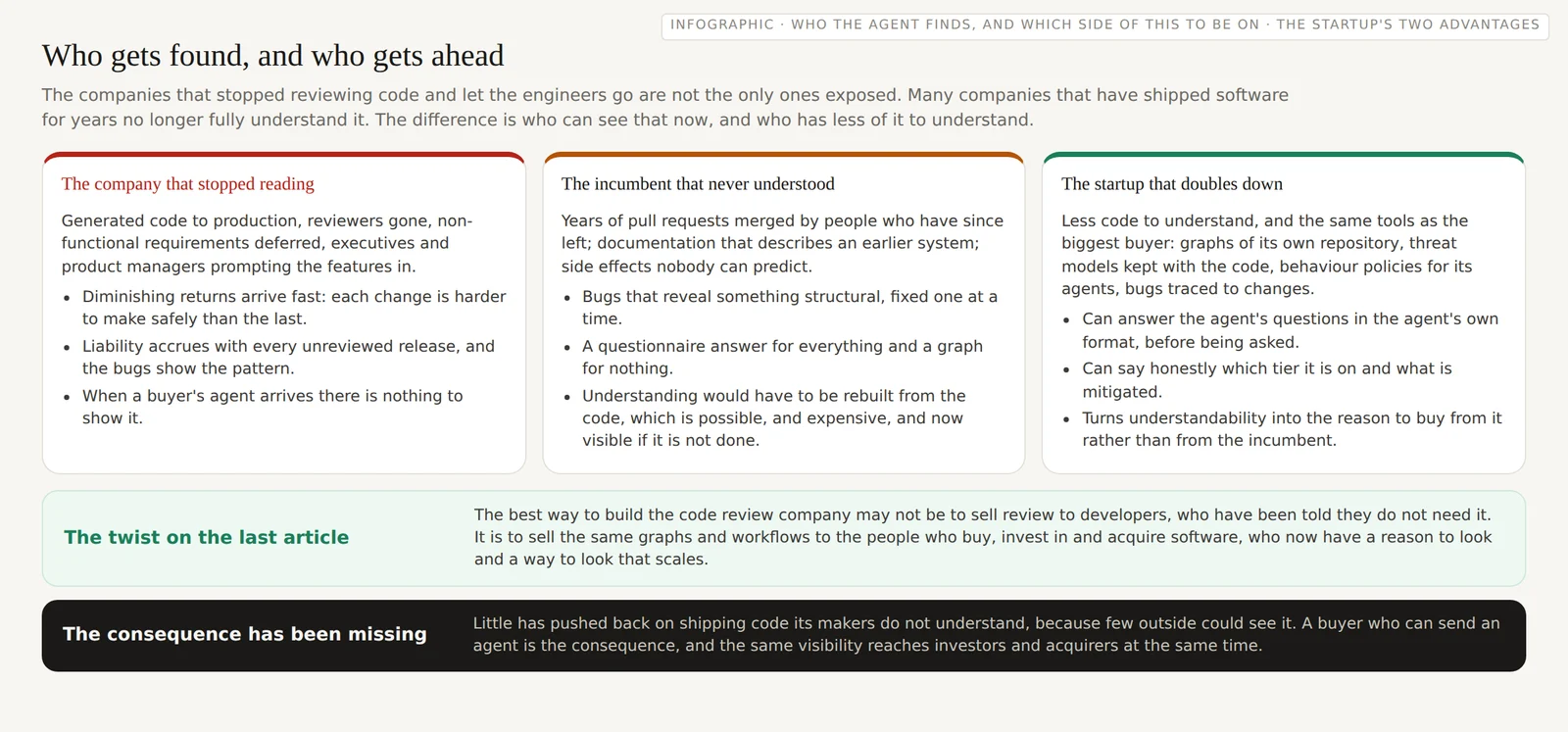
Who the agent finds, and who gets ahead. The company that stopped reading has nothing to show. The incumbent that never understood its own software has a questionnaire answer for everything and a graph for nothing. The startup that doubles down has less code and the same tools, and can answer before
other · behind 1 proposal
Zoom into an agent's behaviour policy and you find the business logic 13 figures

The article on newsroom.sgit.ai →
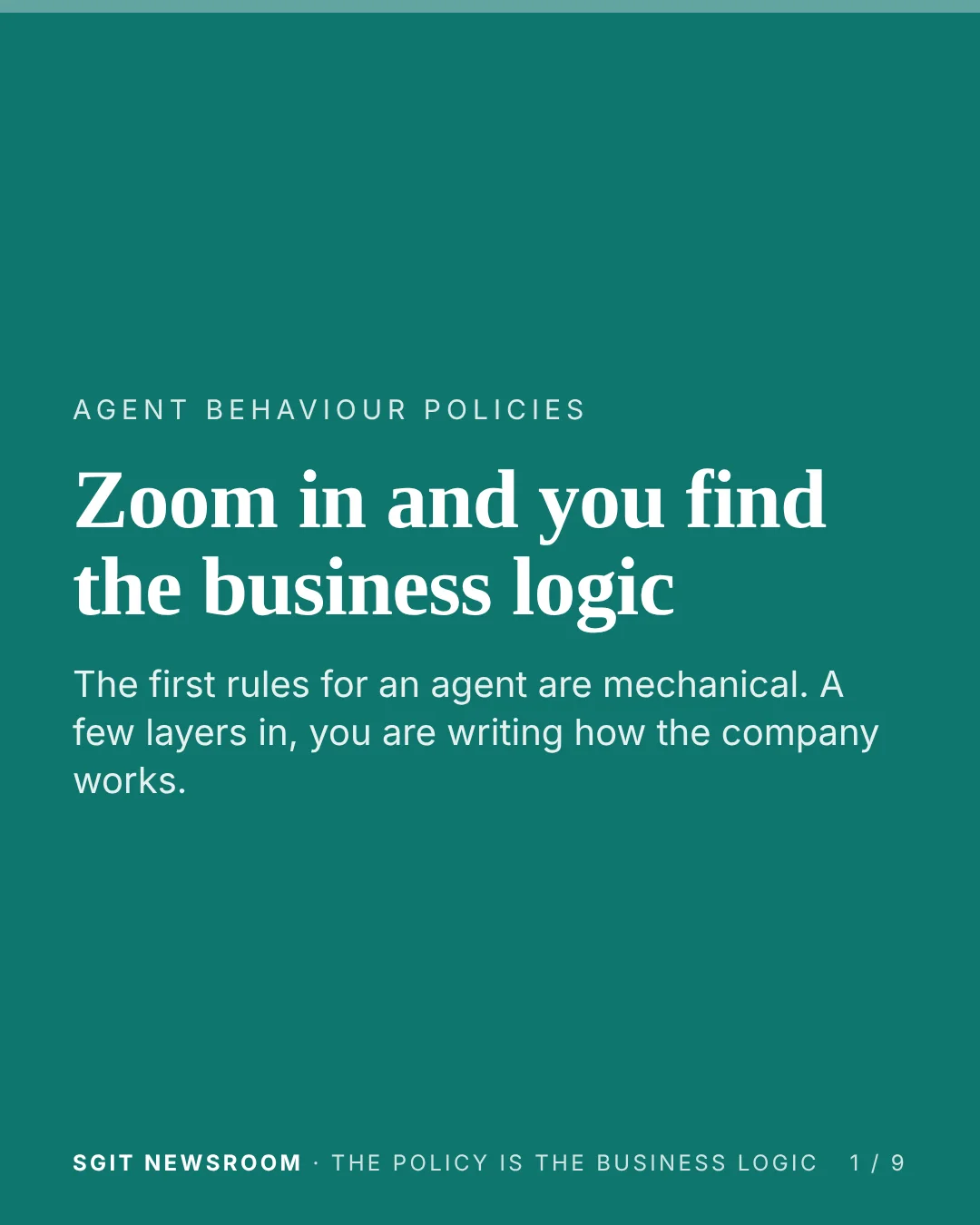
Slide 1 of 9
infographic · deck
Slide 2 of 9
infographic · deck
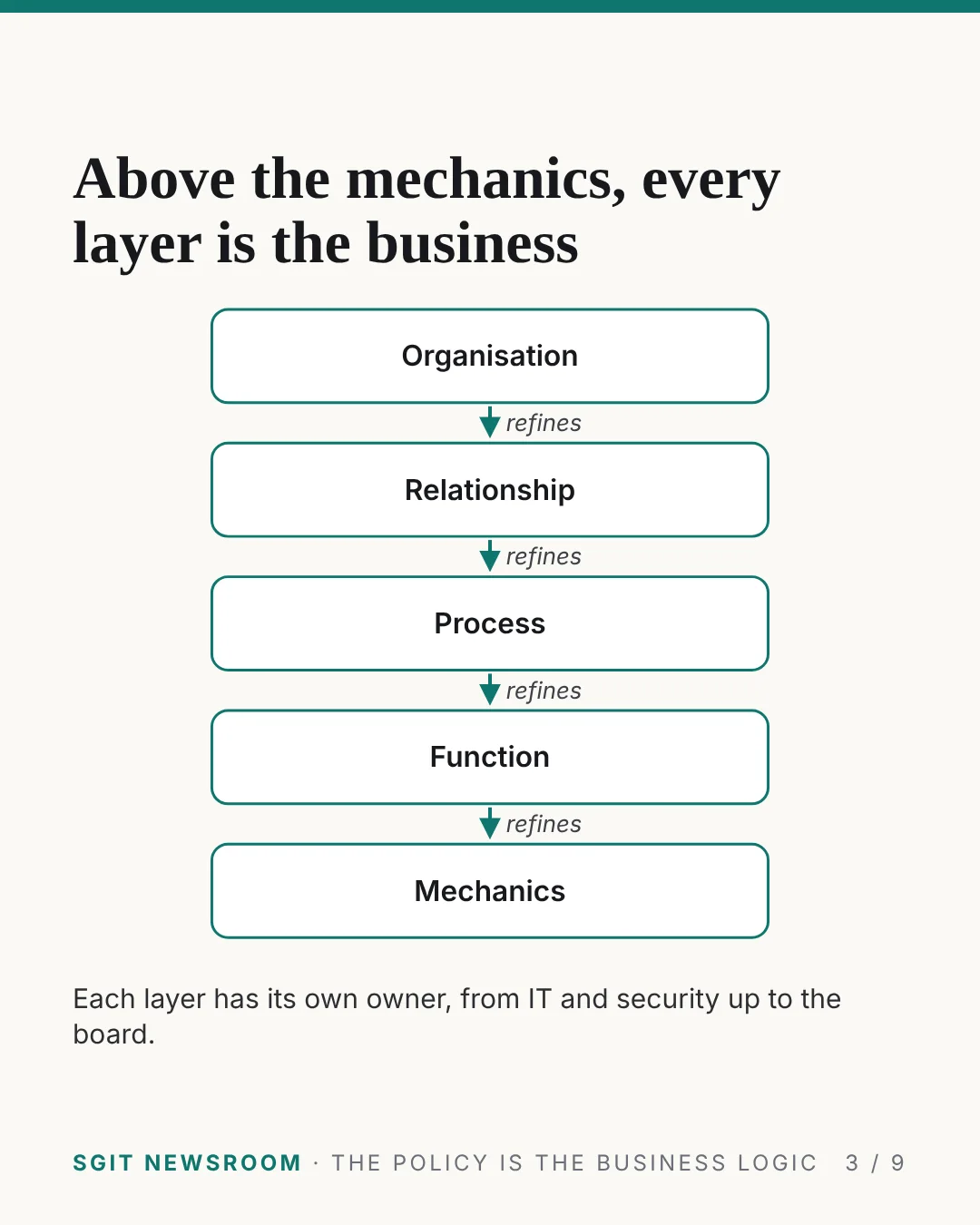
Slide 3 of 9
infographic · deck
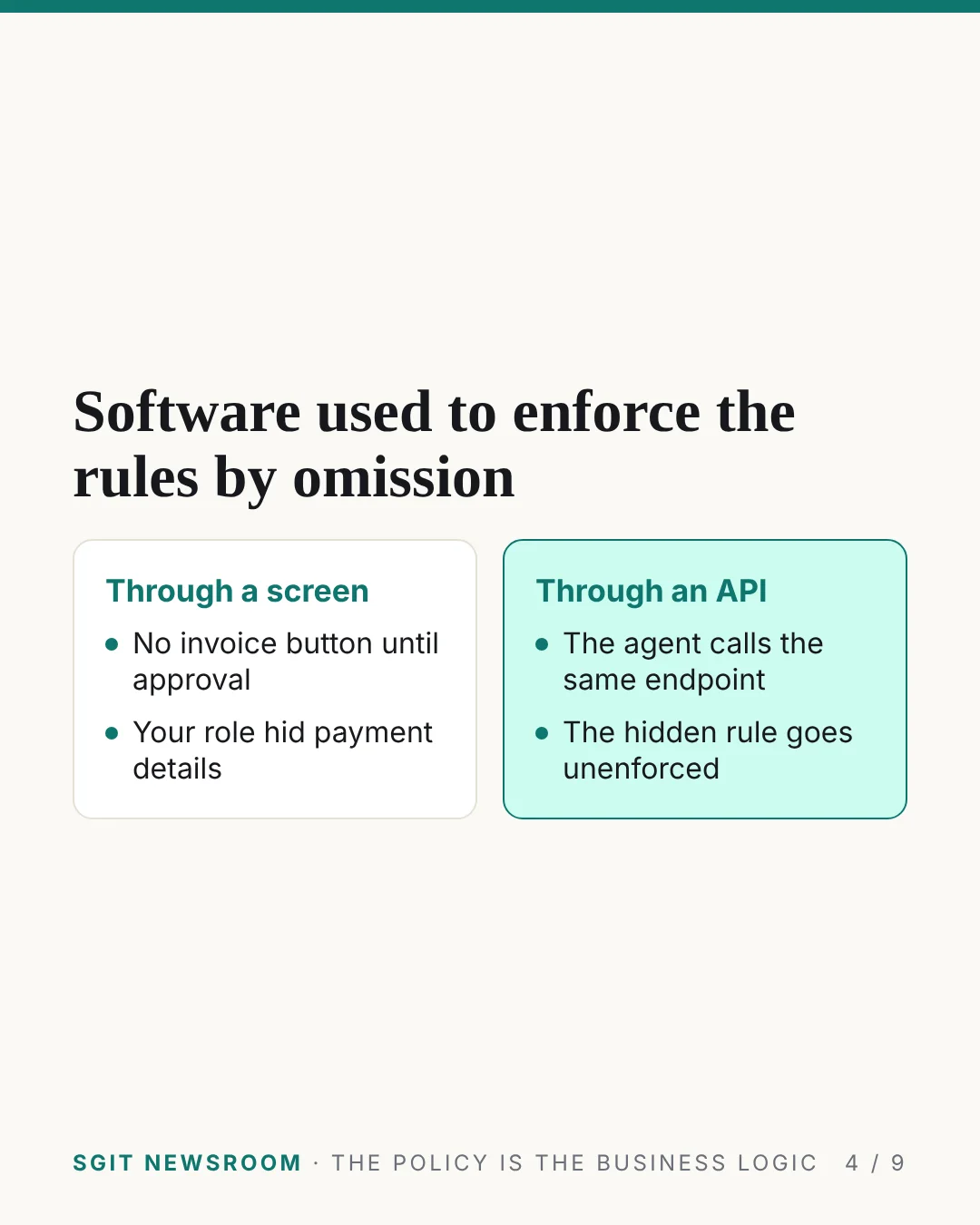
Slide 4 of 9
infographic · deck
Slide 5 of 9
infographic · deck
Slide 6 of 9
infographic · deck
Slide 7 of 9
infographic · deck
Slide 8 of 9
infographic · deck
Slide 9 of 9
infographic · deck
The argument as a map: what a behaviour policy holds above the mechanics, and who enforces each part.
infographic · deck
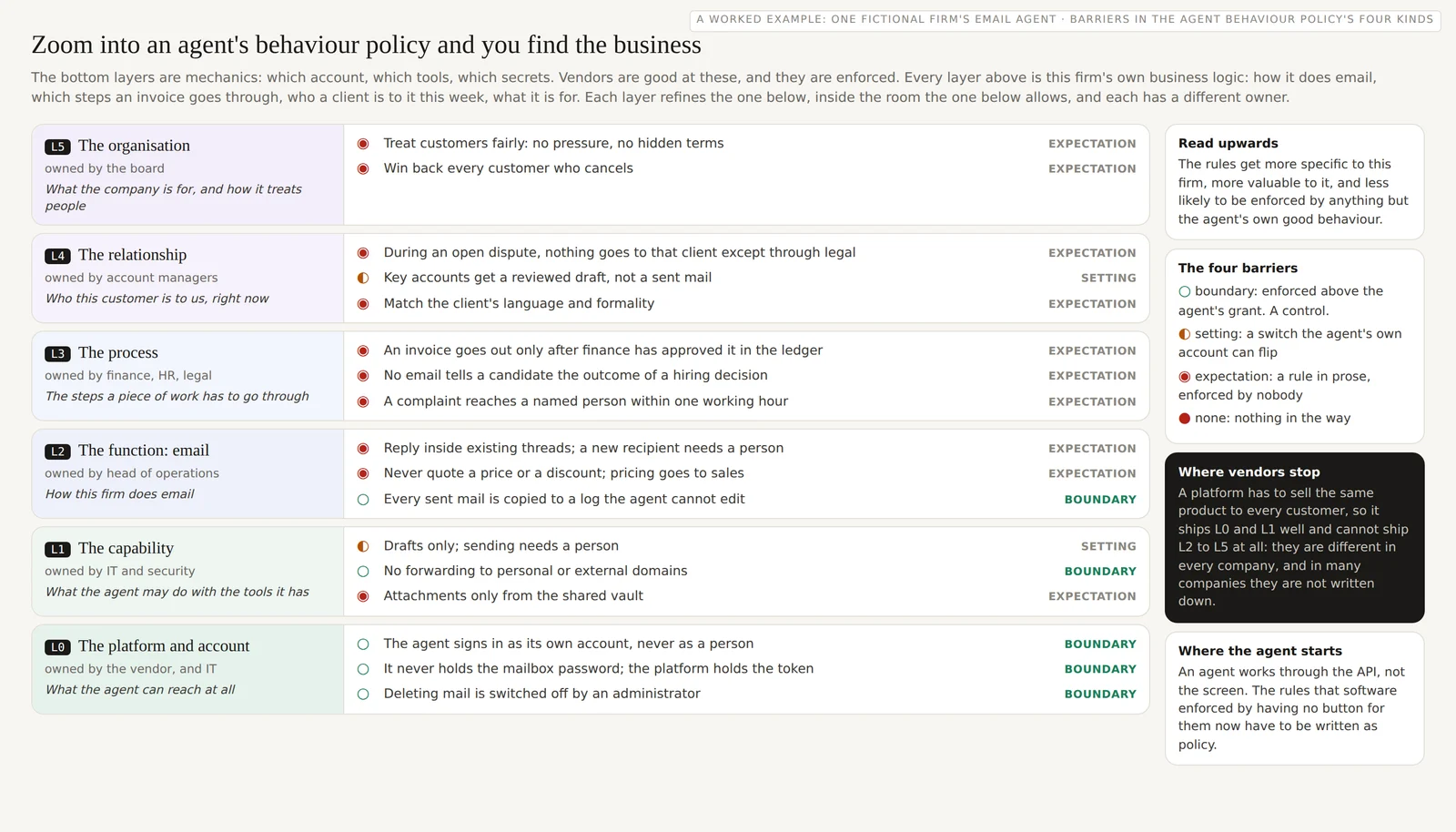
One fictional firm's email agent, layer by layer, with the barrier that stands in the way of each rule. The bottom two layers are mechanics; the four above them are the firm's business.
other
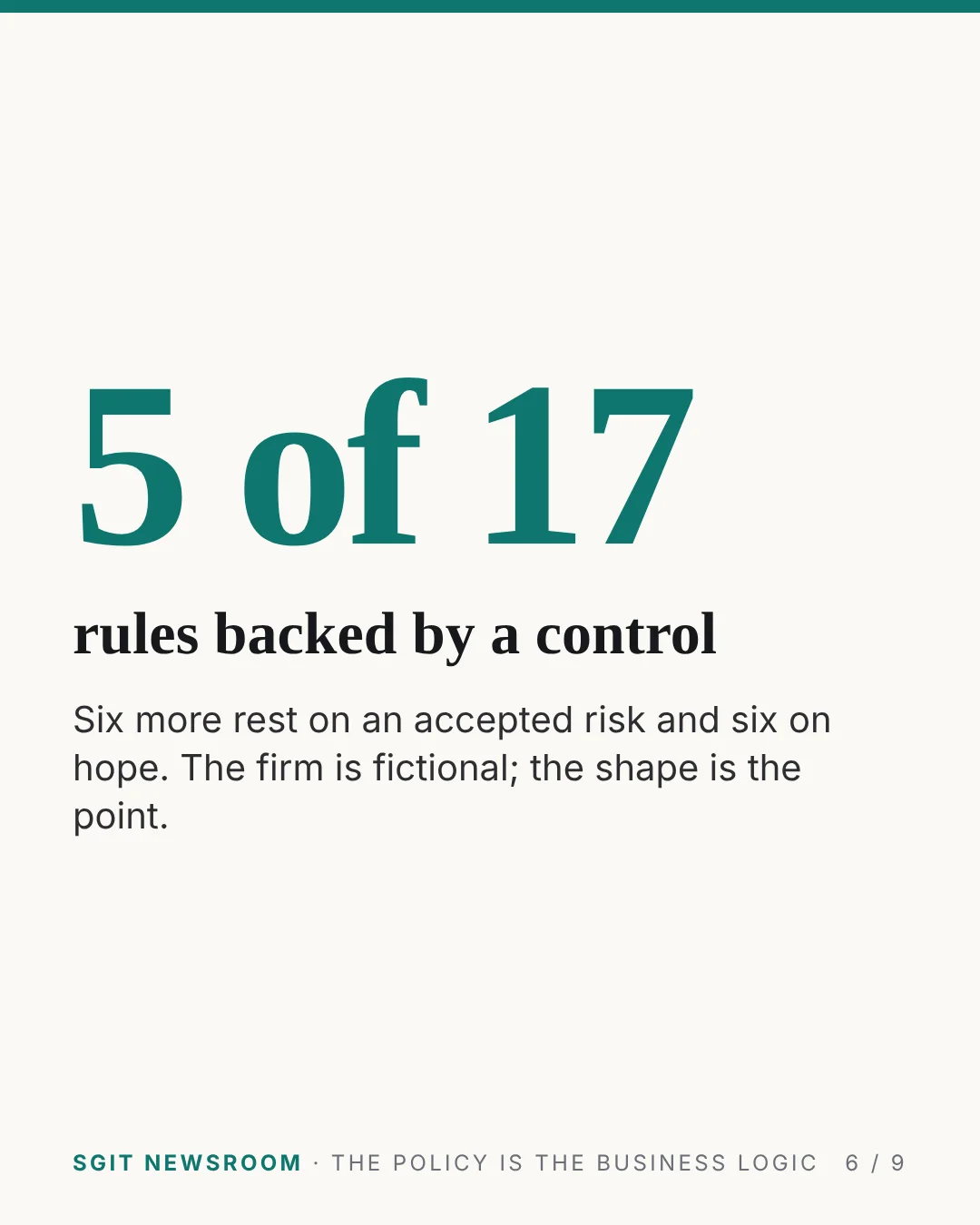
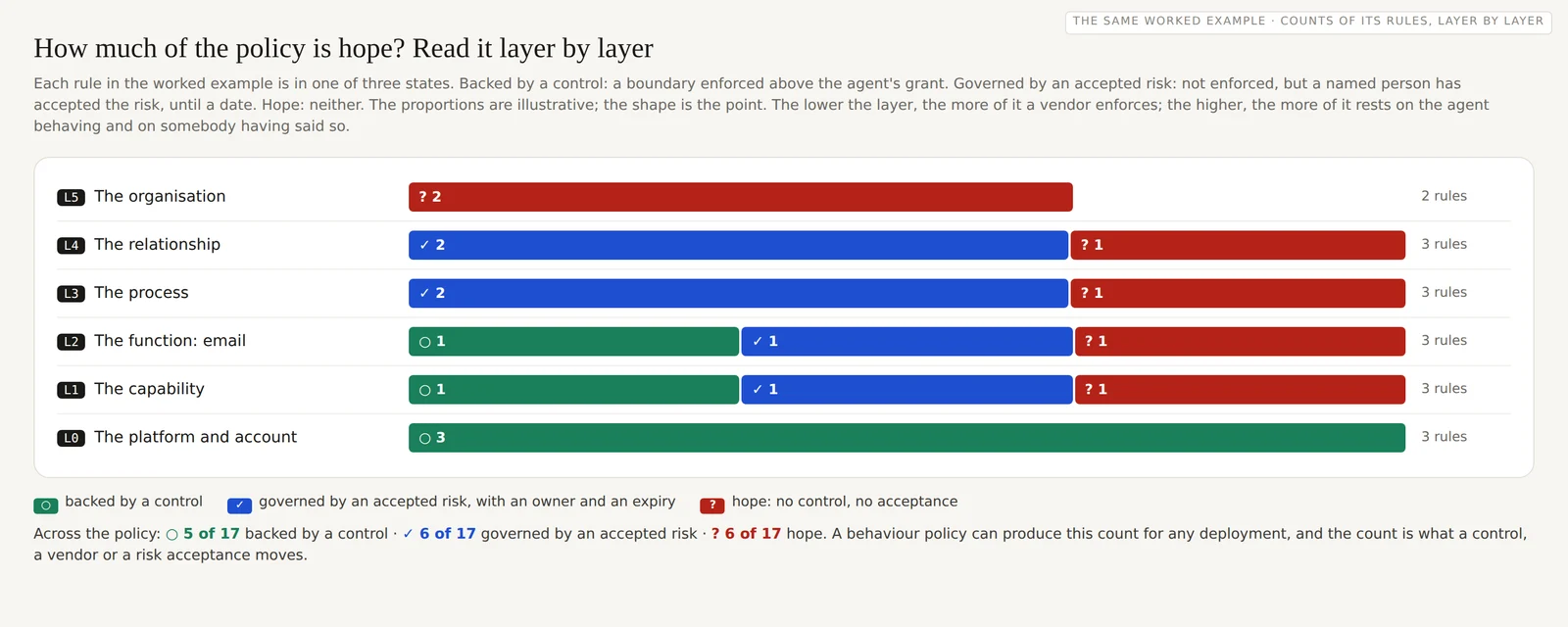
The worked example, counted. Each rule is backed by a control, governed by an accepted risk with an owner and an expiry, or resting on hope. The proportions are illustrative; the shape is the point.
other
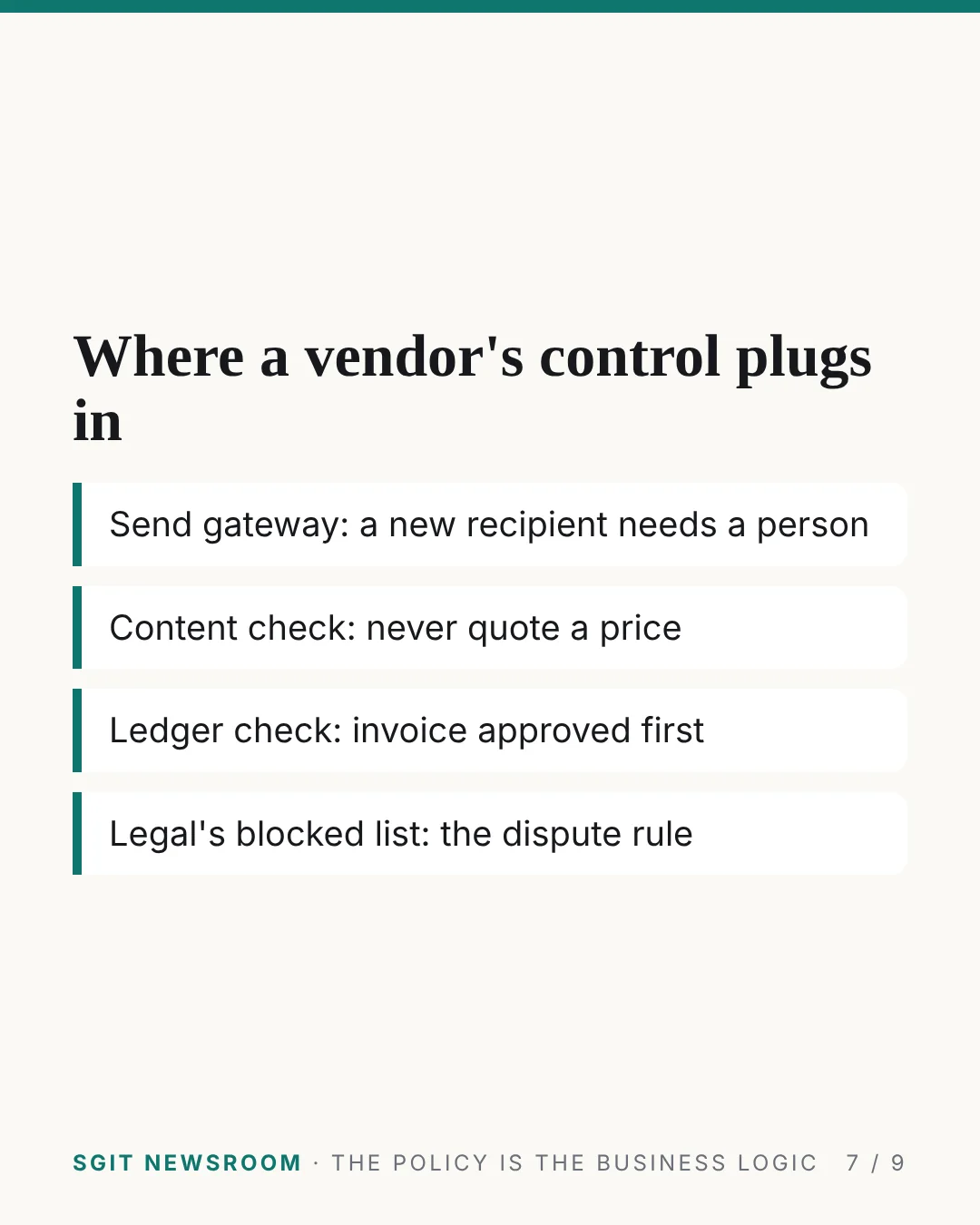
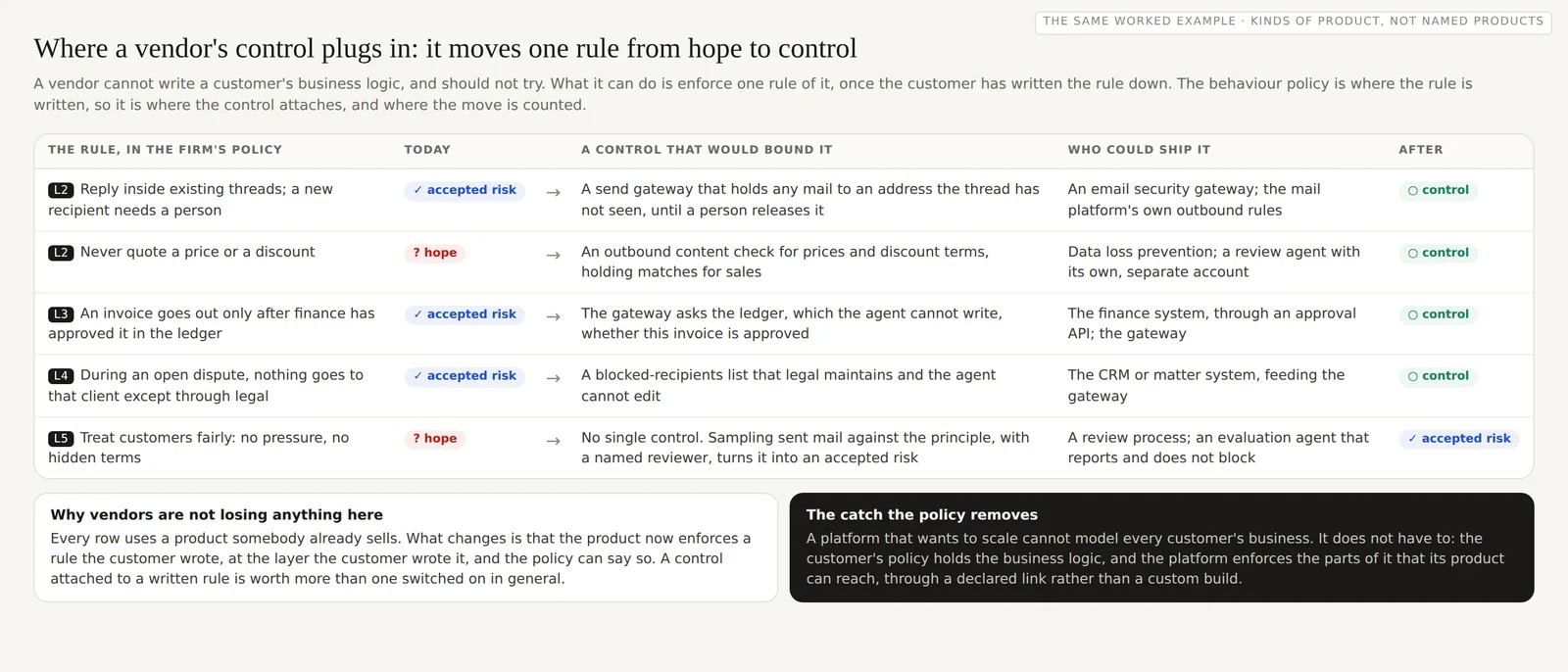
Five rules from the example, and the control that would move each one. Every control is a kind of product that already exists; what is new is that it enforces a rule the customer wrote.
other
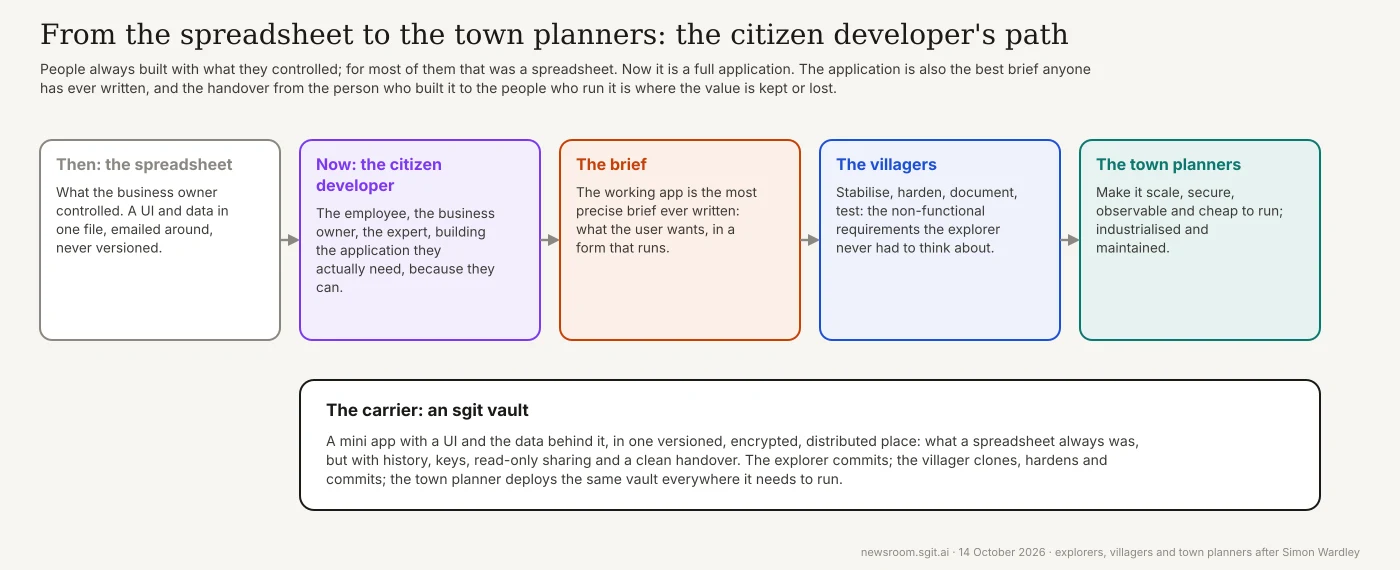
The citizen developer is good news 1 figure

The article on newsroom.sgit.ai →

From the spreadsheet to the town planners: the citizen developer's path. People built with what they controlled, a spreadsheet; now they build the application they need, which is also the best brief ever written; villagers harden it and town planners make it scale, and an sgit vault carries the app
diagram · behind 3 proposals
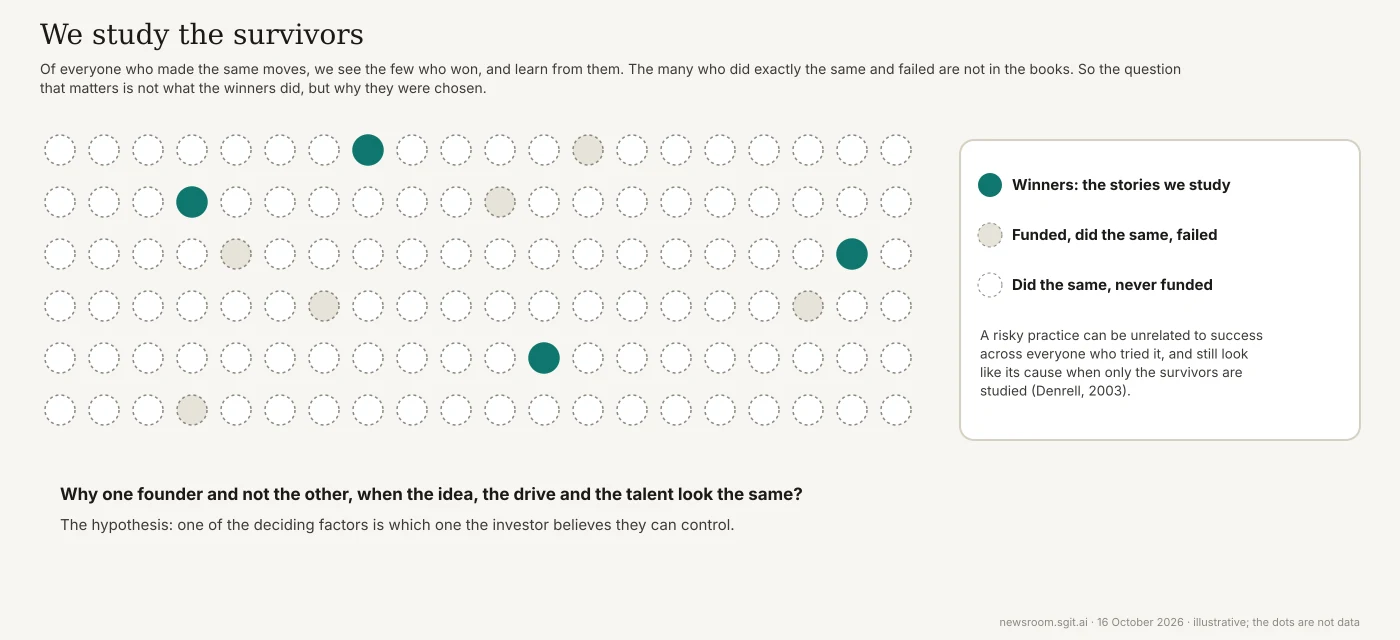
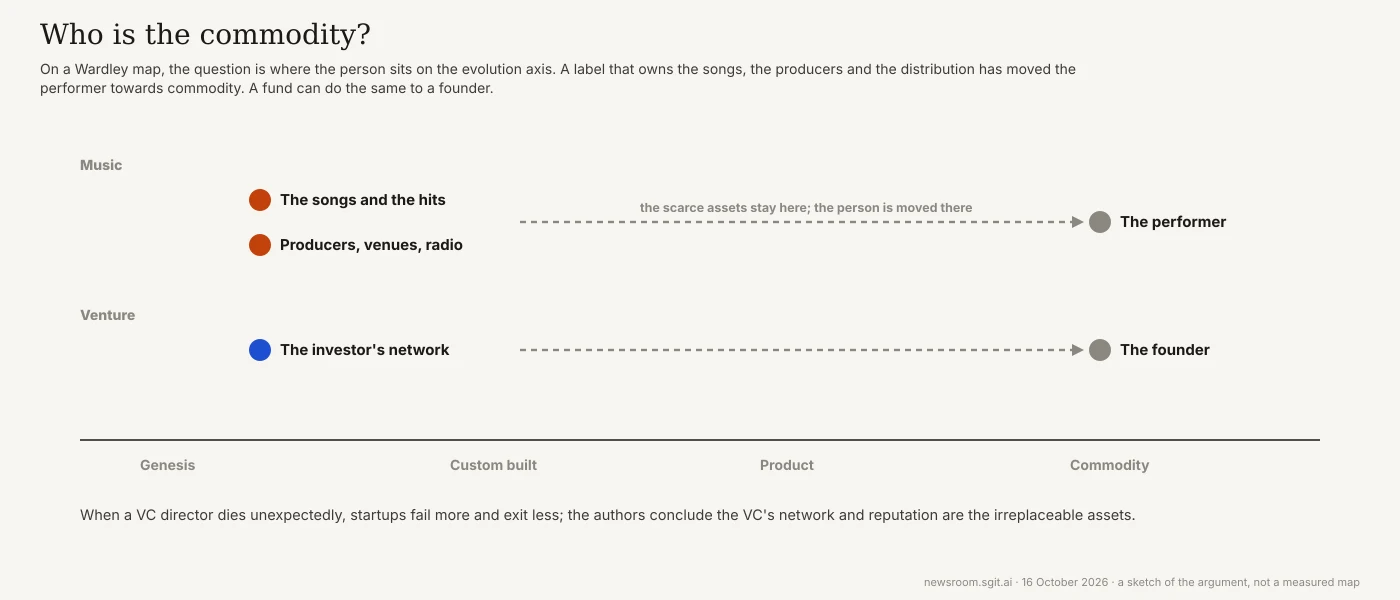
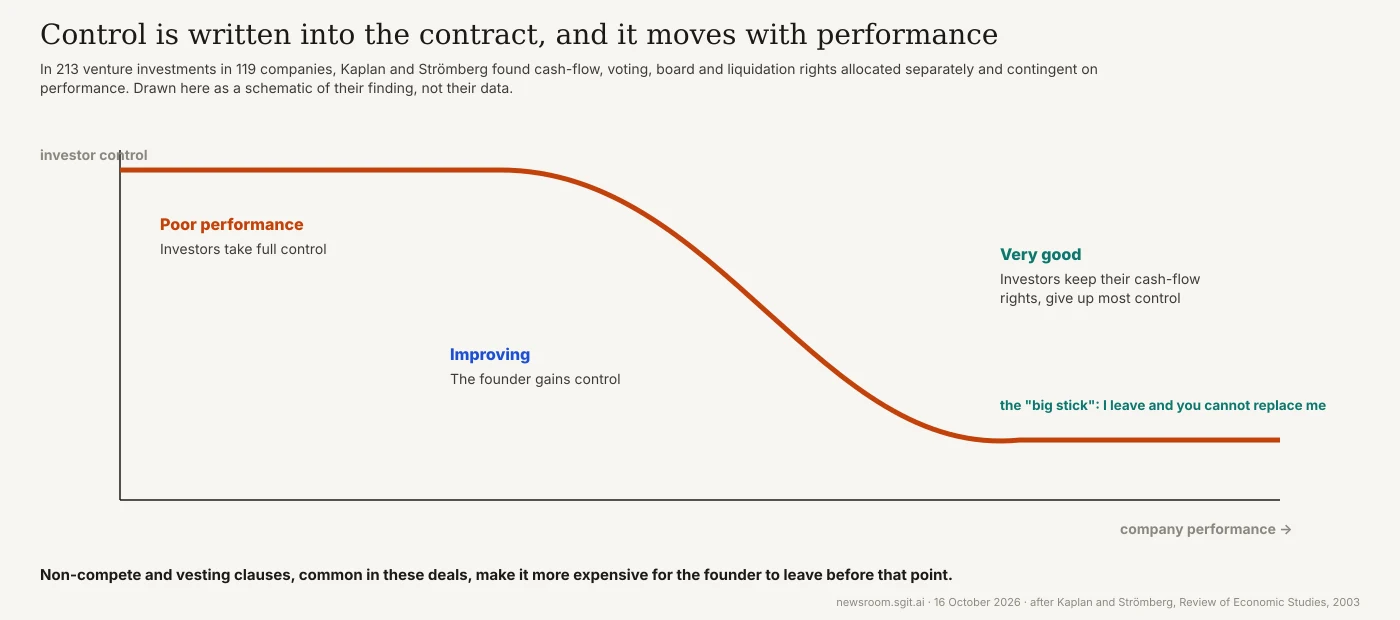
The controllable founder 3 figures

The article on newsroom.sgit.ai →
We study the survivors: of everyone who made the same moves, a few won and are studied; others were funded, did the same and failed; most did the same and were never funded. A risky practice can be unrelated to success across everyone and still look like its cause among survivors. Illustrative.
infographic · behind 2 proposals
Who is the commodity: in music, the songs, the producers, the venues and radio stay scarce while the performer is moved towards commodity; in venture, the investor's network stays scarce while the founder is moved the same way. A sketch of the argument, not a measured map.
diagram · behind 2 proposals
Control moves with performance: when a company performs poorly, investors take full control; as it improves, the founder gains control; when it performs very well, investors keep their cash-flow rights but give up most control. A schematic of Kaplan and Strömberg's finding, not their data.
infographic · behind 2 proposals
The expert founders 3 figures

The article on newsroom.sgit.ai →
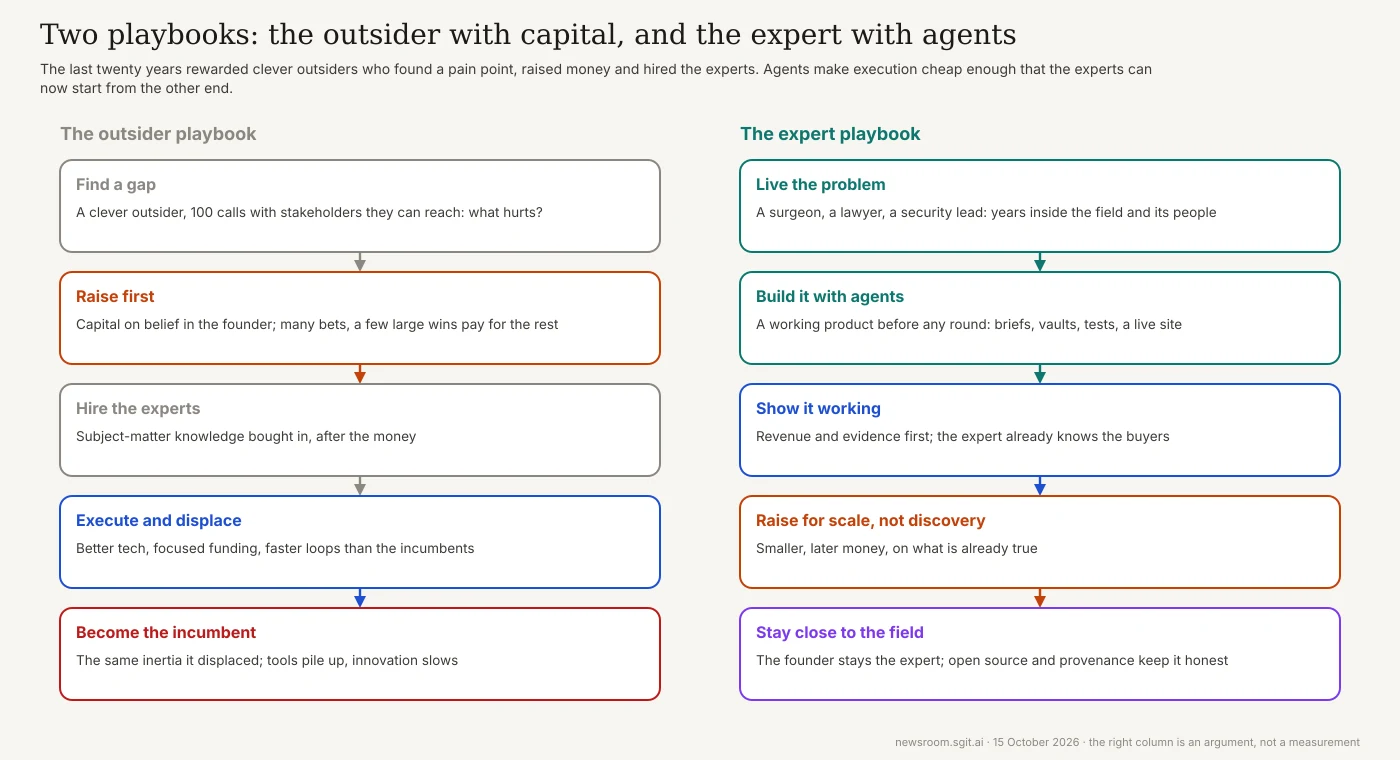
Two playbooks: on the left, the outsider who finds a gap, raises first, hires the experts, displaces the incumbents and becomes one; on the right, the expert who lives the problem, builds it with agents, shows it working, raises for scale and stays close to the field.
infographic · behind 5 proposals
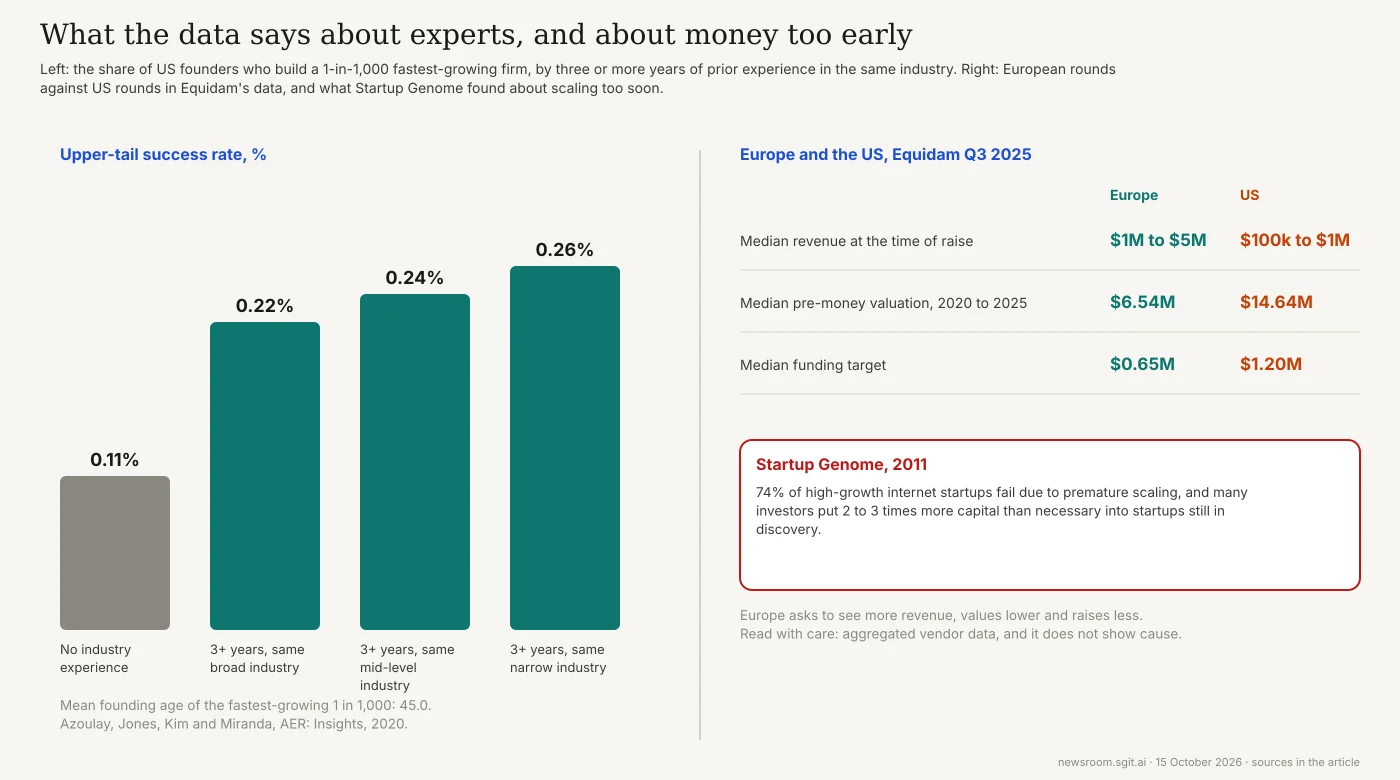
What the data says: the rate at which US founders build a 1-in-1,000 fastest-growing firm doubles with three or more years in the same industry; European startups raise at higher revenue, lower valuations and smaller targets than US ones; and premature scaling is the most common way high-growth star
infographic · behind 2 proposals
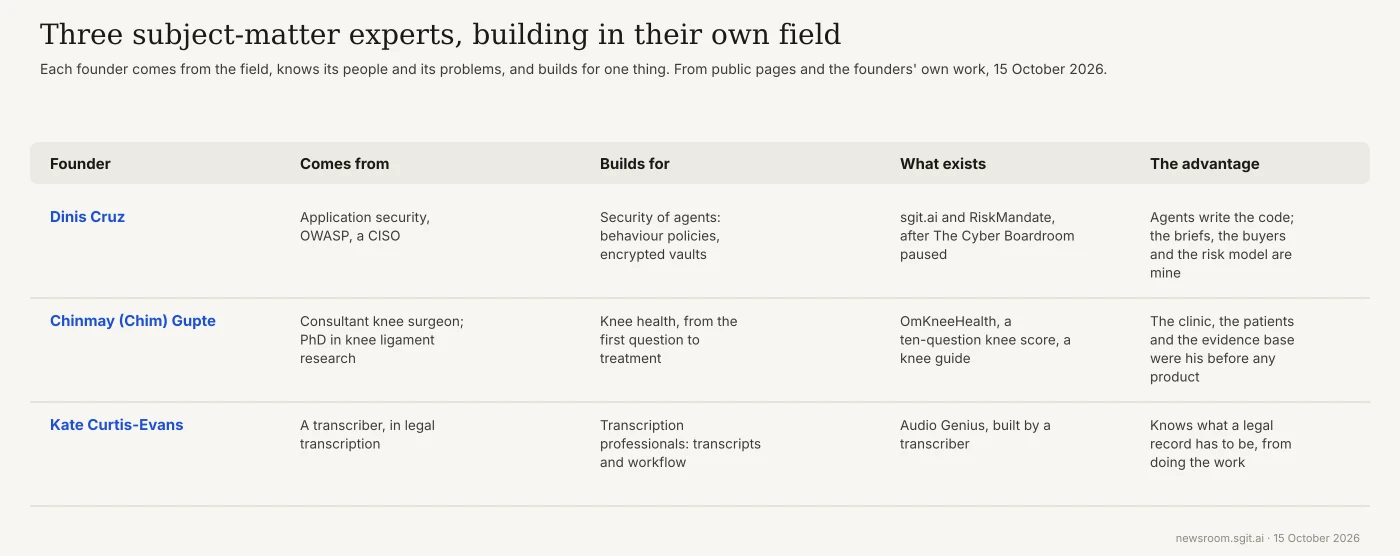
Three subject-matter experts, building in their own field: what each comes from, what they build for, what exists, and why the expertise is the advantage.
infographic · behind 2 proposals
The fork next door 3 figures

The article on newsroom.sgit.ai →
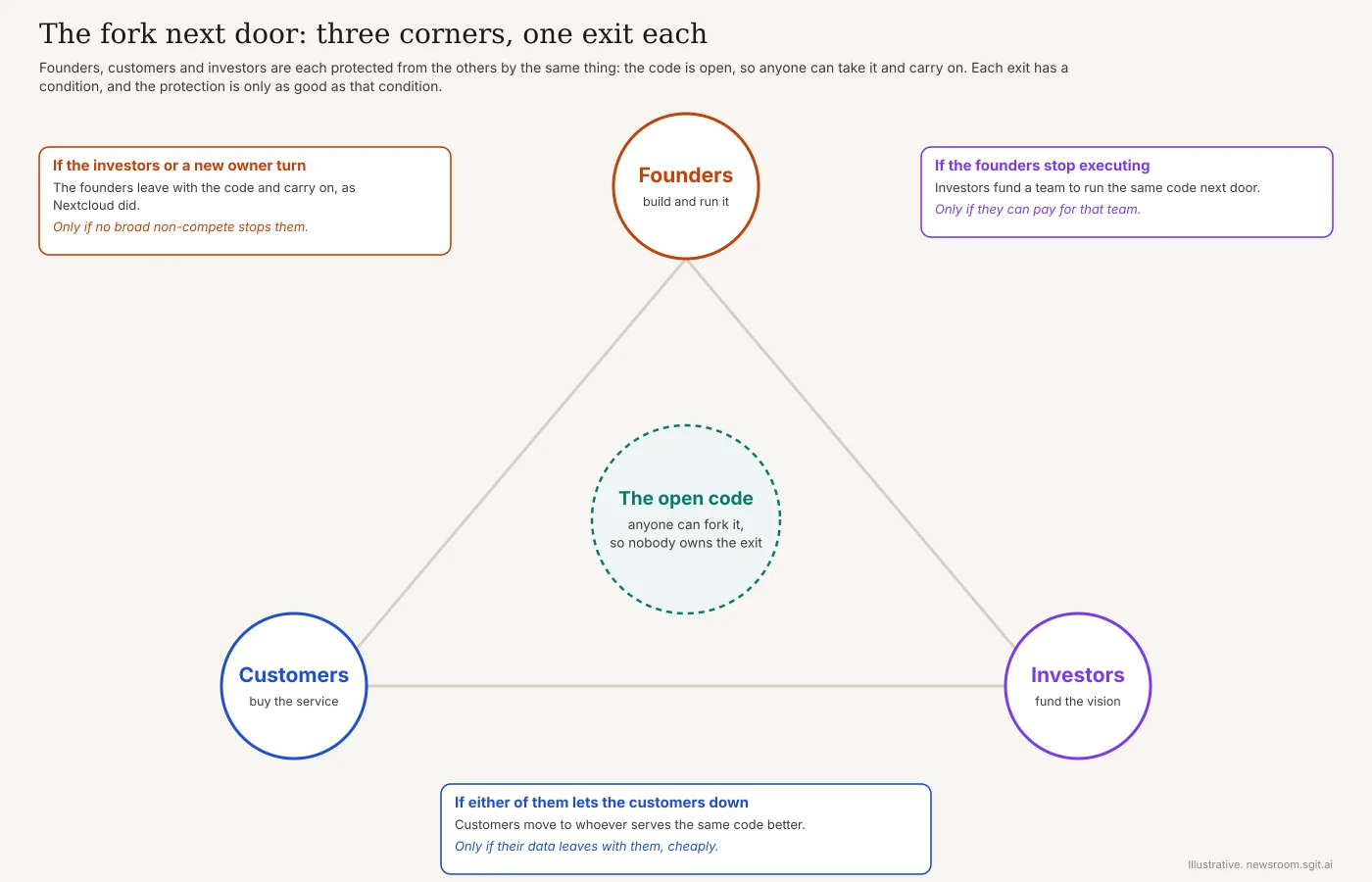
Three corners, one exit each: the open code sits in the middle, and each corner can take it and carry on. The founders can leave if no broad non-compete stops them; the investors can fund a team next door if they can pay for it; the customers can move if their data leaves with them, cheaply. Illustr
diagram · behind 1 proposal
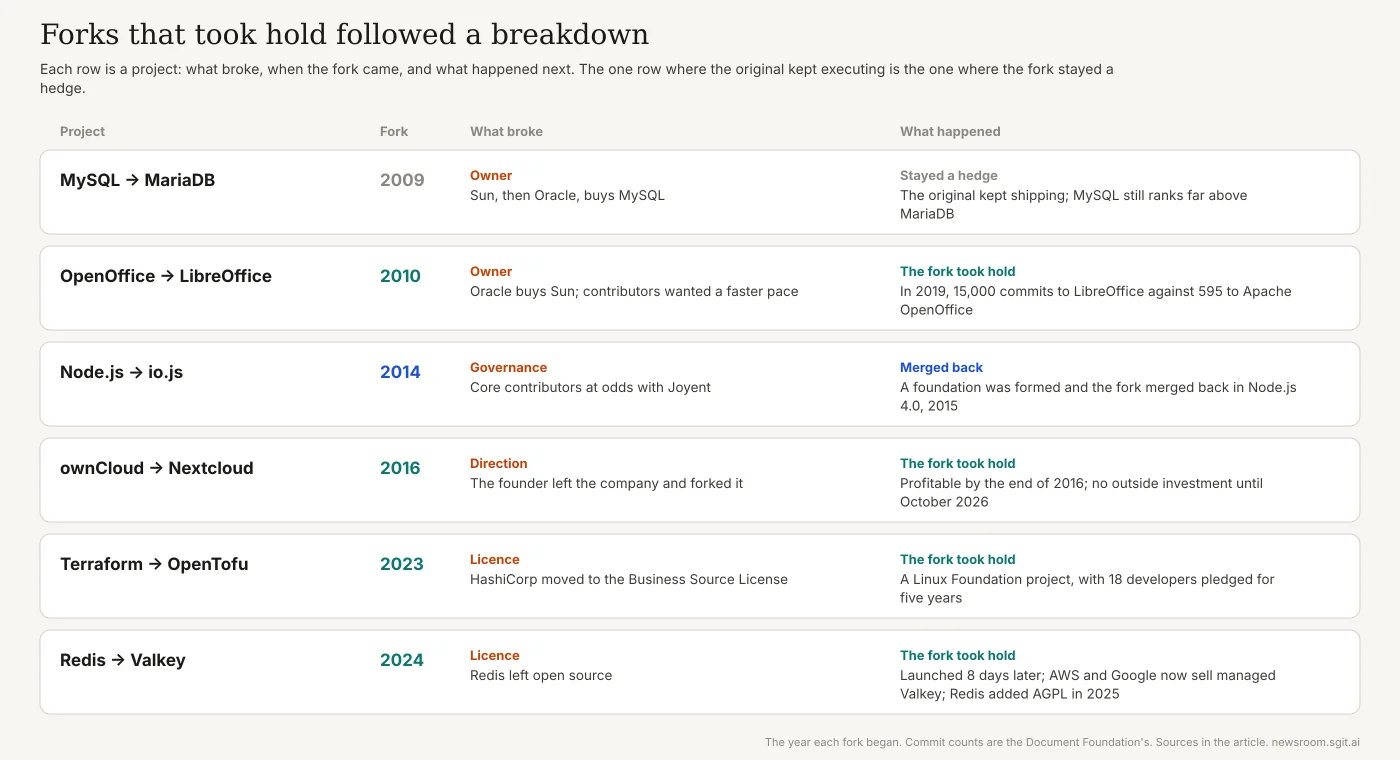
Six forks: what broke, the year each fork began, and what happened next. MariaDB stayed a hedge while MySQL kept shipping; io.js merged back once a foundation fixed the governance; LibreOffice, Nextcloud, OpenTofu and Valkey took hold after a new owner, a change of direction or a licence change.
infographic · behind 1 proposal
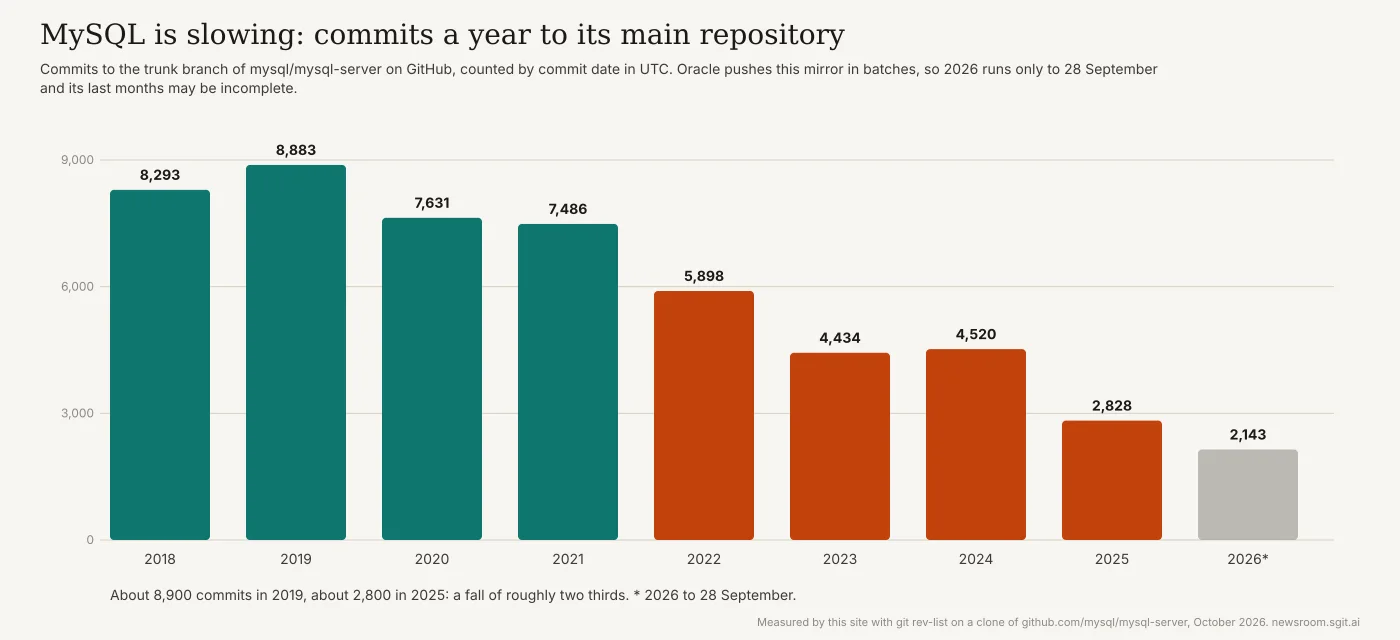
Commits a year to the trunk branch of mysql/mysql-server: about 8,900 in 2019 and about 2,800 in 2025, a fall of roughly two thirds. 2026 runs to 28 September. Measured by this site from a clone of the repository.
infographic · behind 1 proposal
The key is the billing system 3 figures

The article on newsroom.sgit.ai →
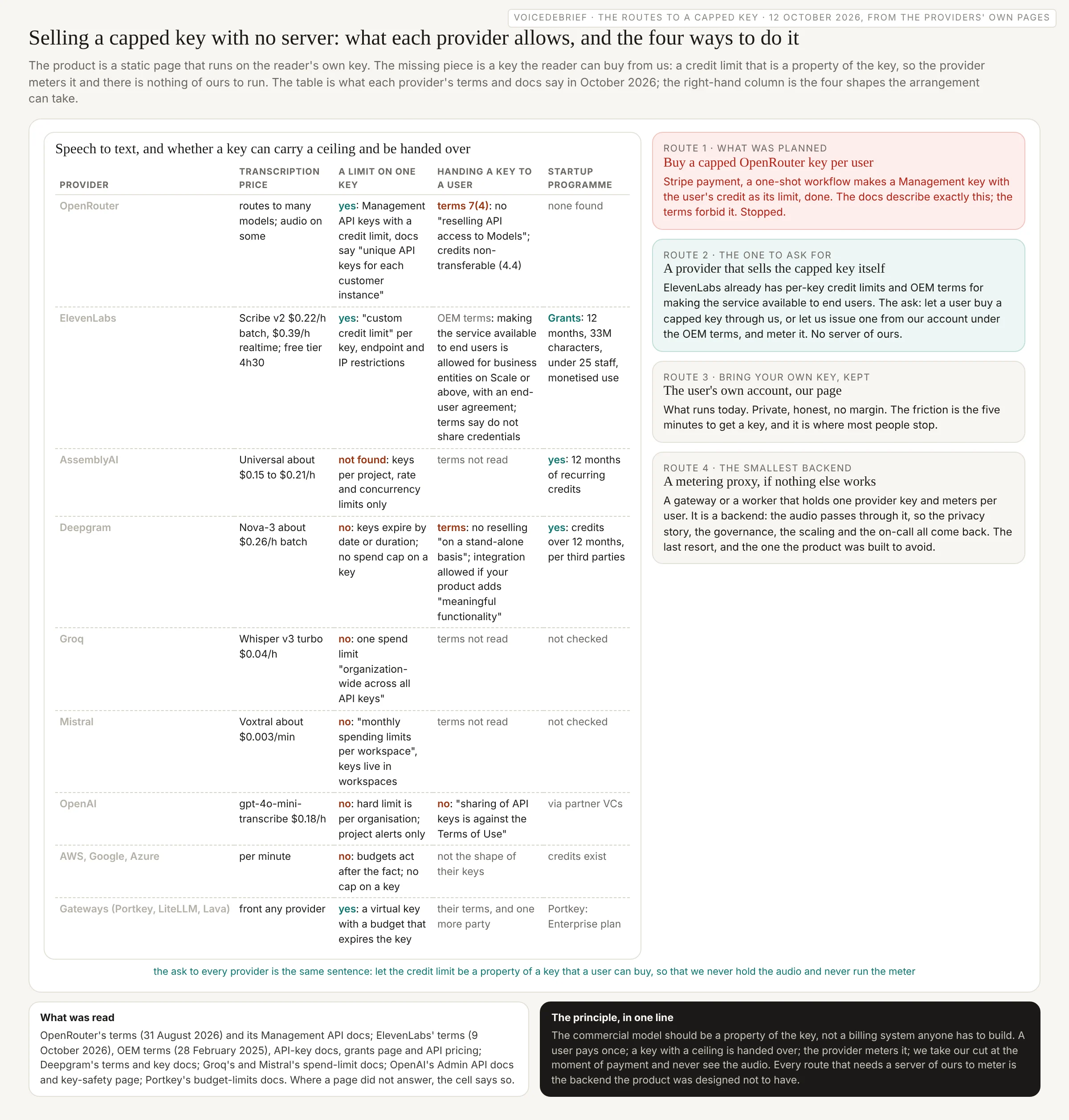
What each provider's terms and docs say, in October 2026, about a capped key in a user's hand, and the four routes: the one that was planned and forbidden, the one to ask for, the one that runs today, and the backend the product was built to avoid.
other · behind 2 proposals
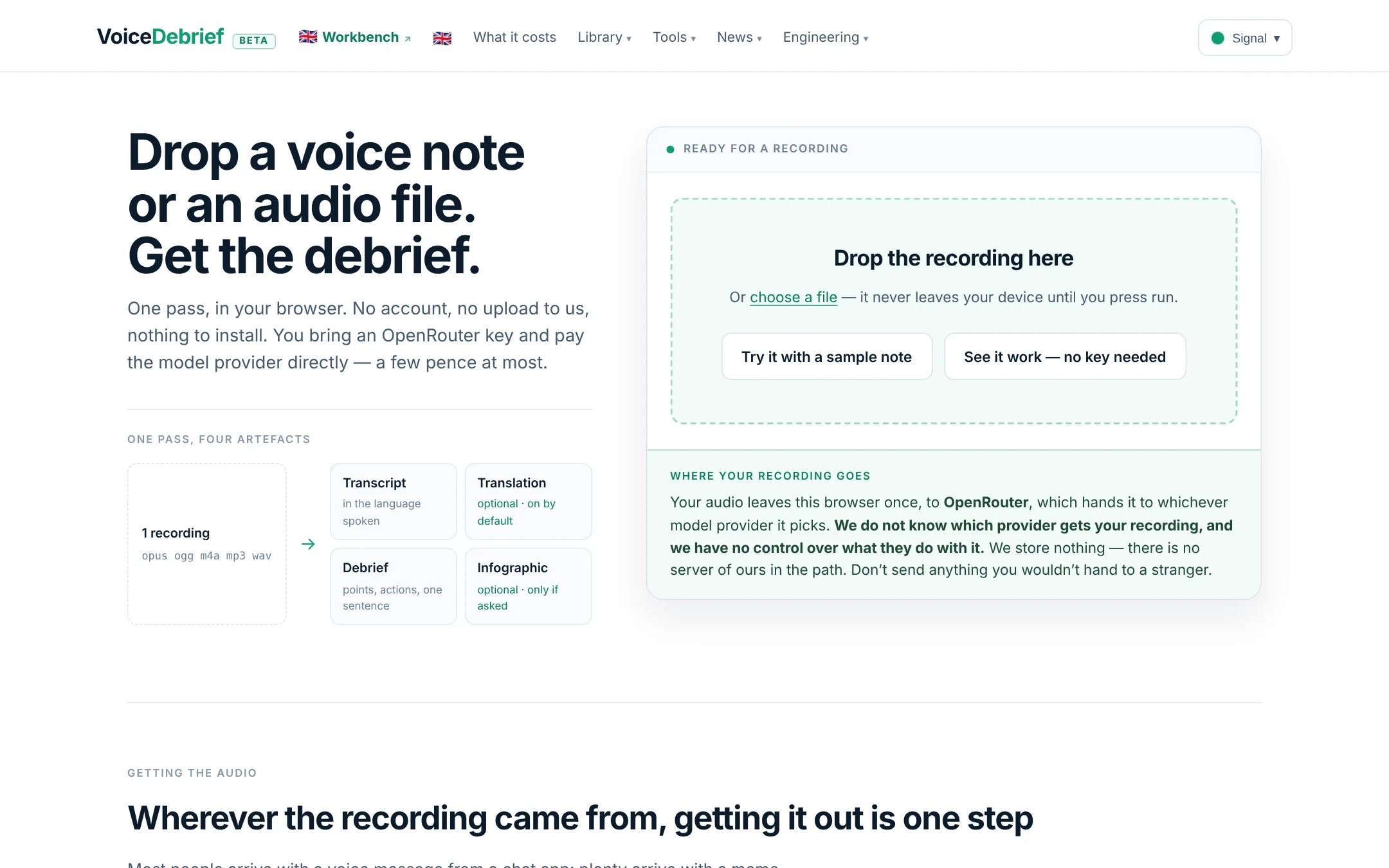
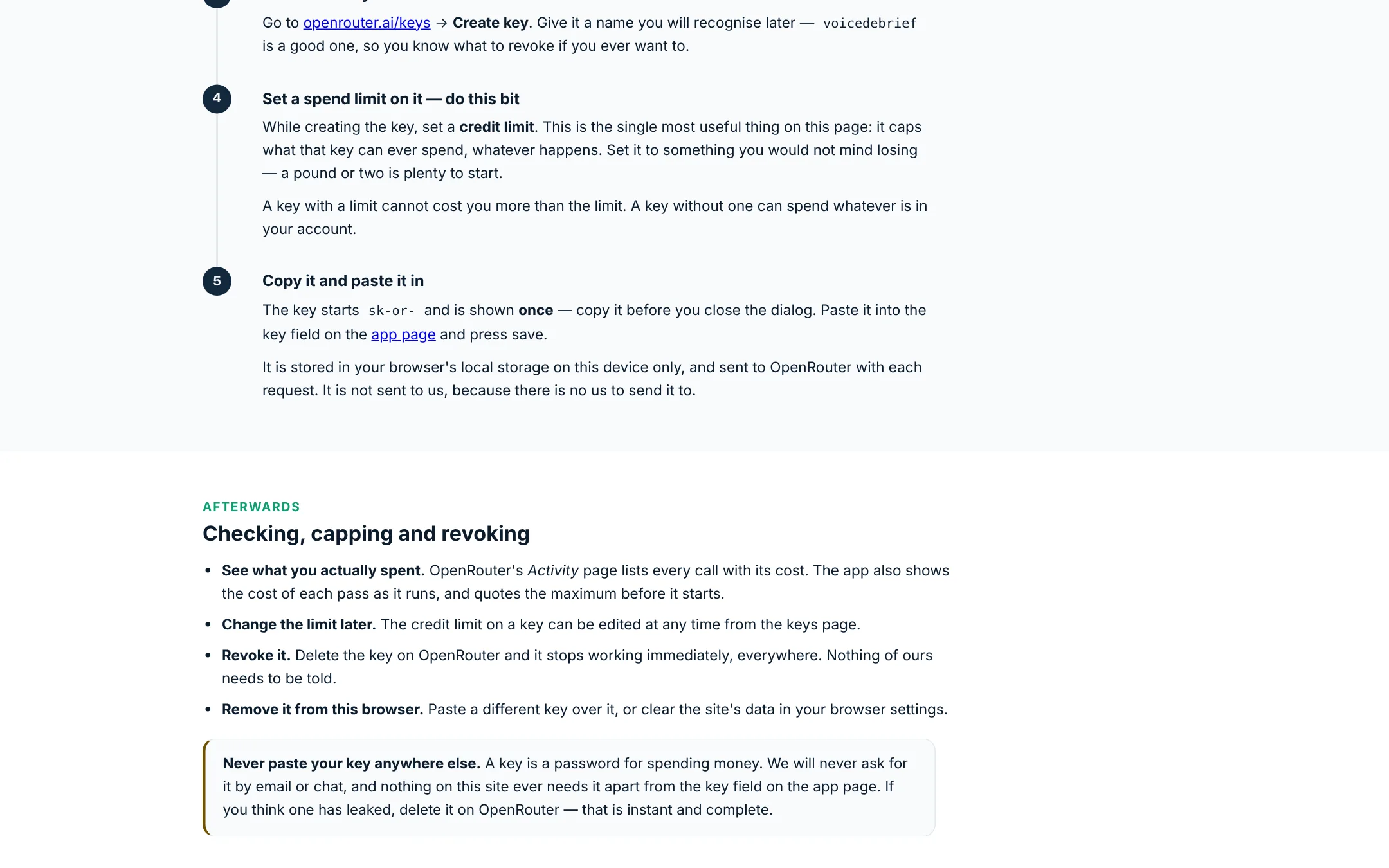
voicedebrief.ai on 12 October 2026. One recording in, four artefacts out, in the browser, on the user's own key; the maximum a pass can cost is quoted before it starts.
other · behind 2 proposals
The page that gets a user from nothing to a working key, and its one instruction in bold: set a credit limit on the key, because a key with a limit cannot cost you more than the limit. The ceiling is the user's, not ours.
other · behind 2 proposals
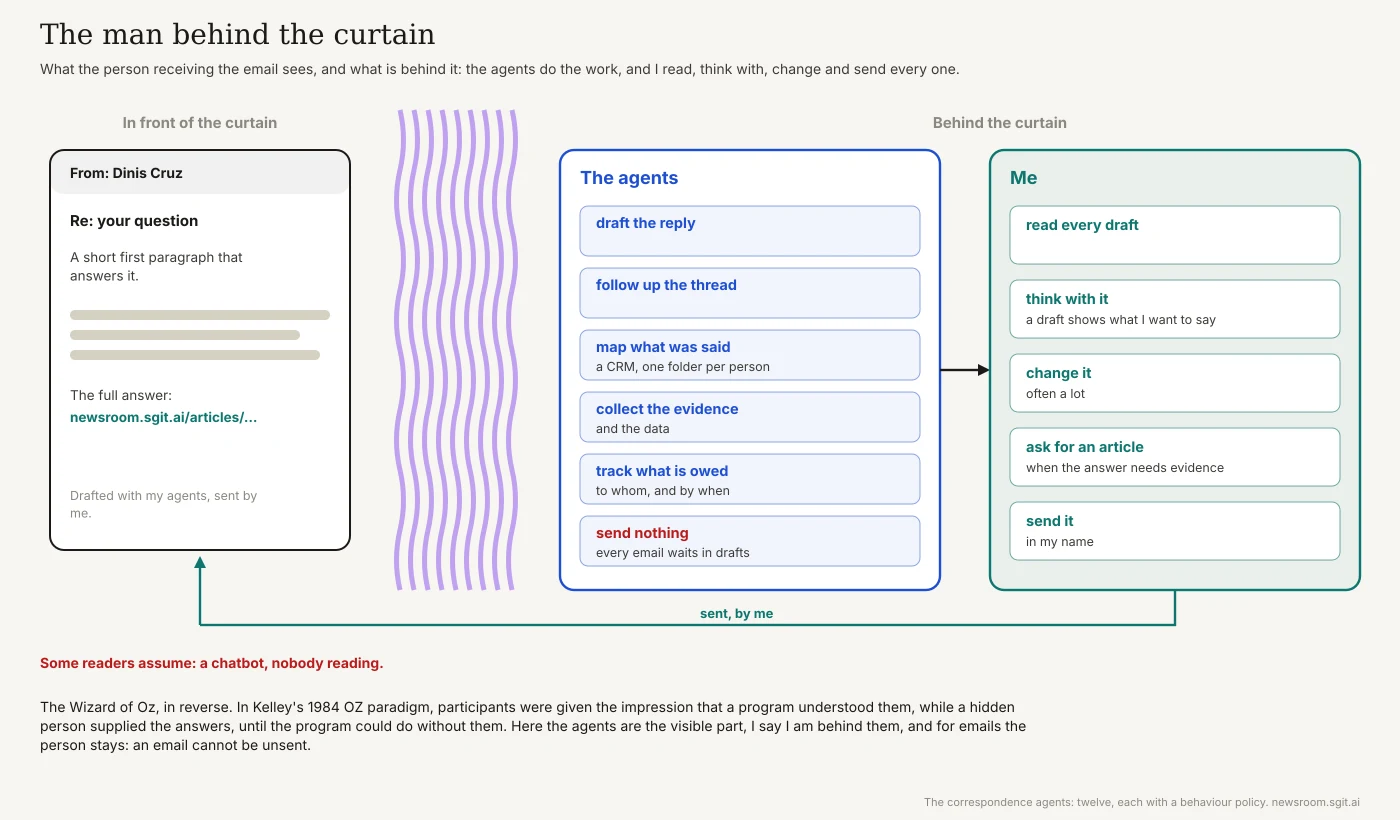
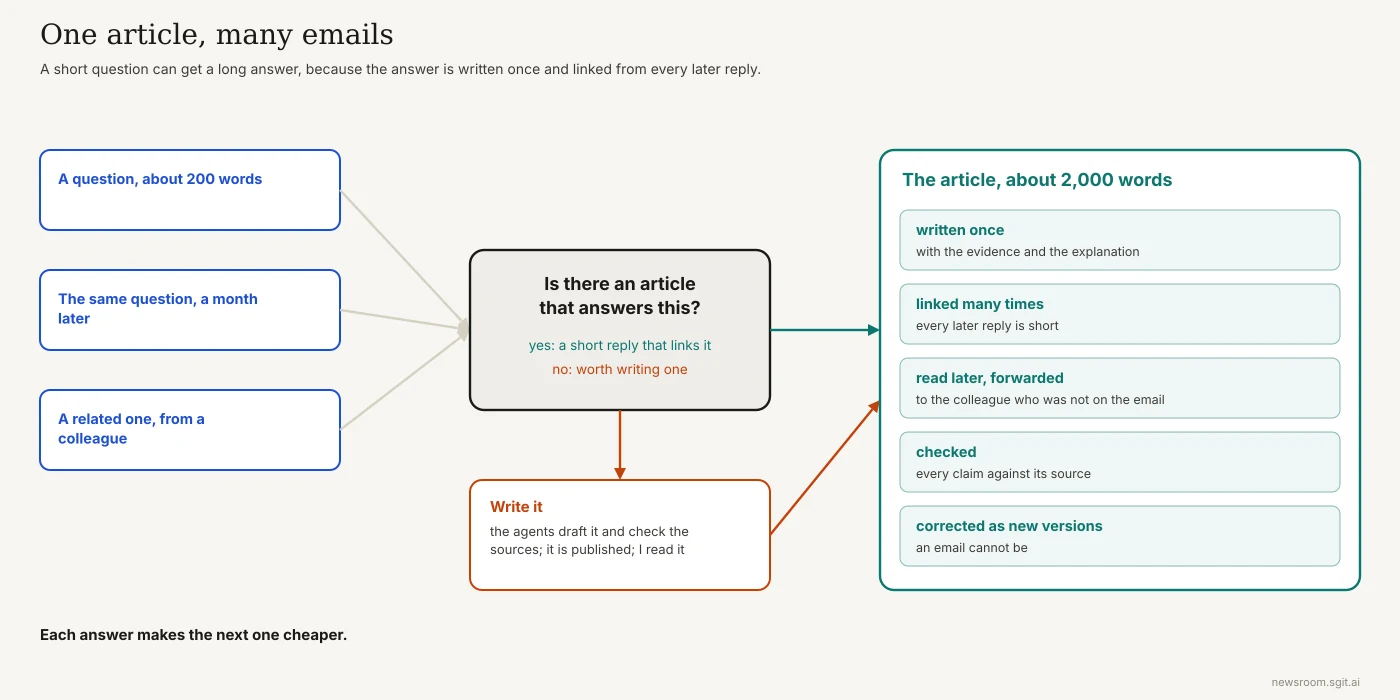
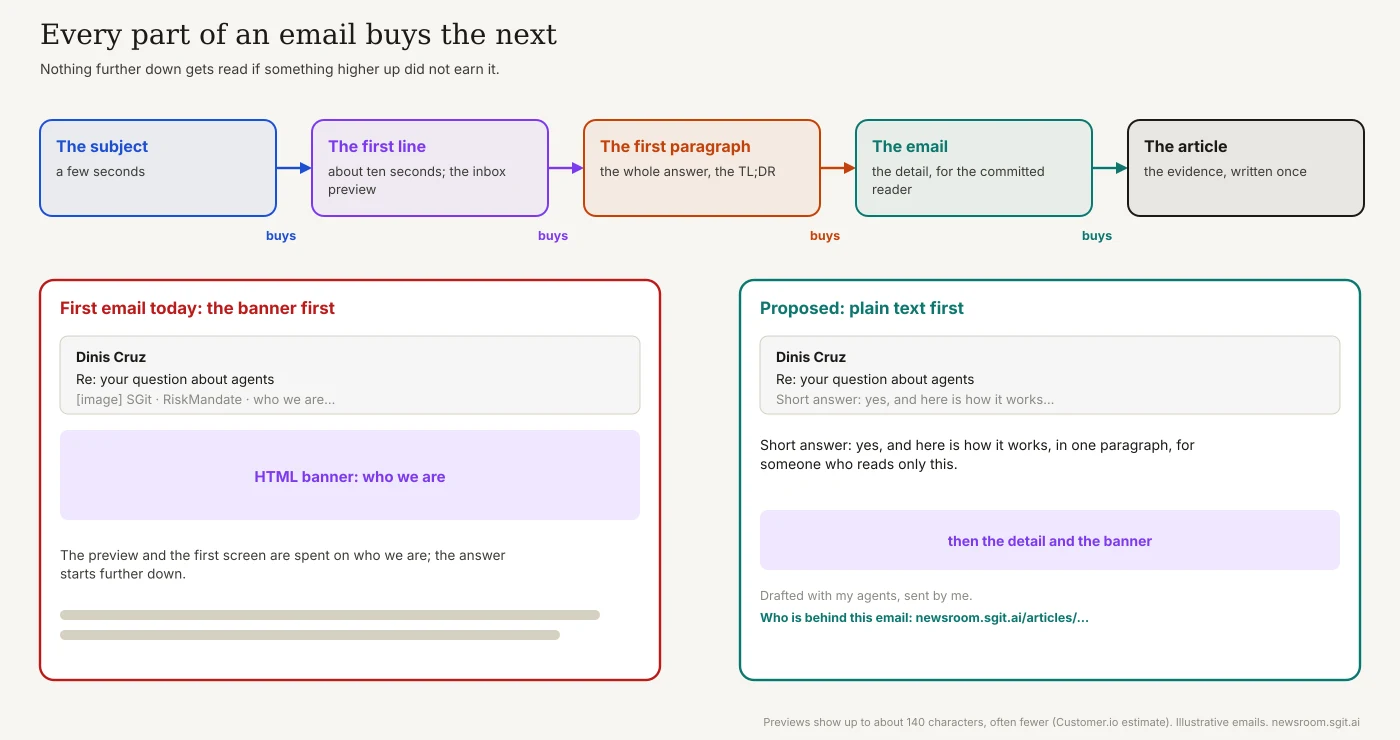
The man behind the curtain 3 figures

The article on newsroom.sgit.ai →
In front of the curtain, what the person receiving the email sees: one email, in my name. Behind it, two things. The agents: they draft the reply, follow up the thread, map what was said in a CRM, collect the evidence and keep track of what is owed. And me: I read every draft, use it to think, chang
diagram
One article, many emails. On the left, emails arriving with questions, a few hundred words each. In the middle, the test: is there an article that answers this? If yes, the reply is short and links it. If no, the agents write one and check it against its sources, it is published, I read it, and the
infographic
Every part of an email buys the next. The subject buys the first line, which buys the first paragraph, which buys the email, which buys the article. Below, the same first email two ways: starting with a banner, where the inbox preview shows the banner's text; and starting with a plain paragraph that
infographic
For a startup, the most important question is whether they miss it 2 figures

The article on newsroom.sgit.ai →
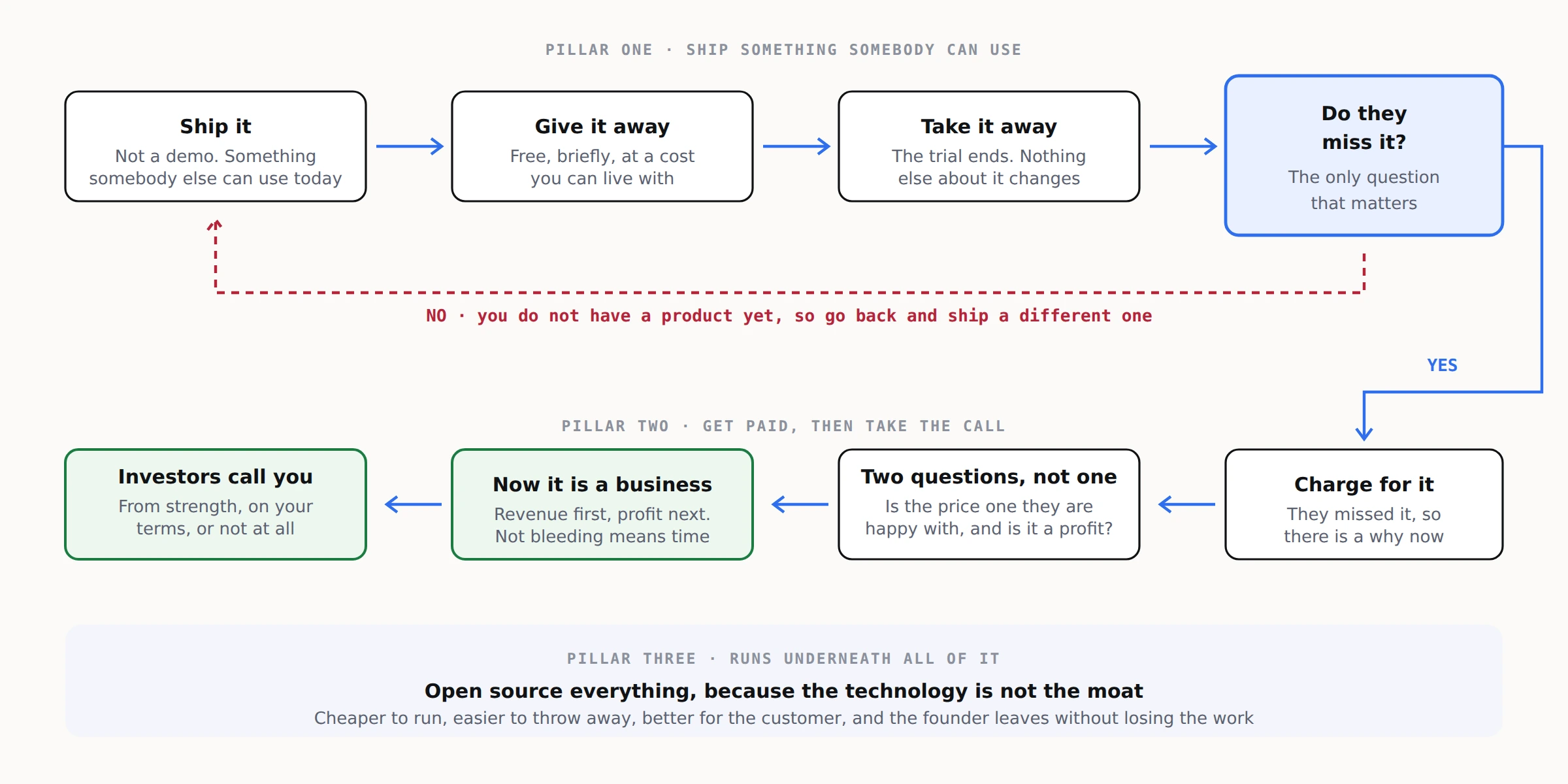
The loop. Ship something usable, give it away briefly, take it away, and find out whether anybody misses it. A no sends you back to the start with better information. A yes is the only thing that earns the right to charge, and charging at a profit is the only thing that earns the right to choose you
other · behind 3 proposals
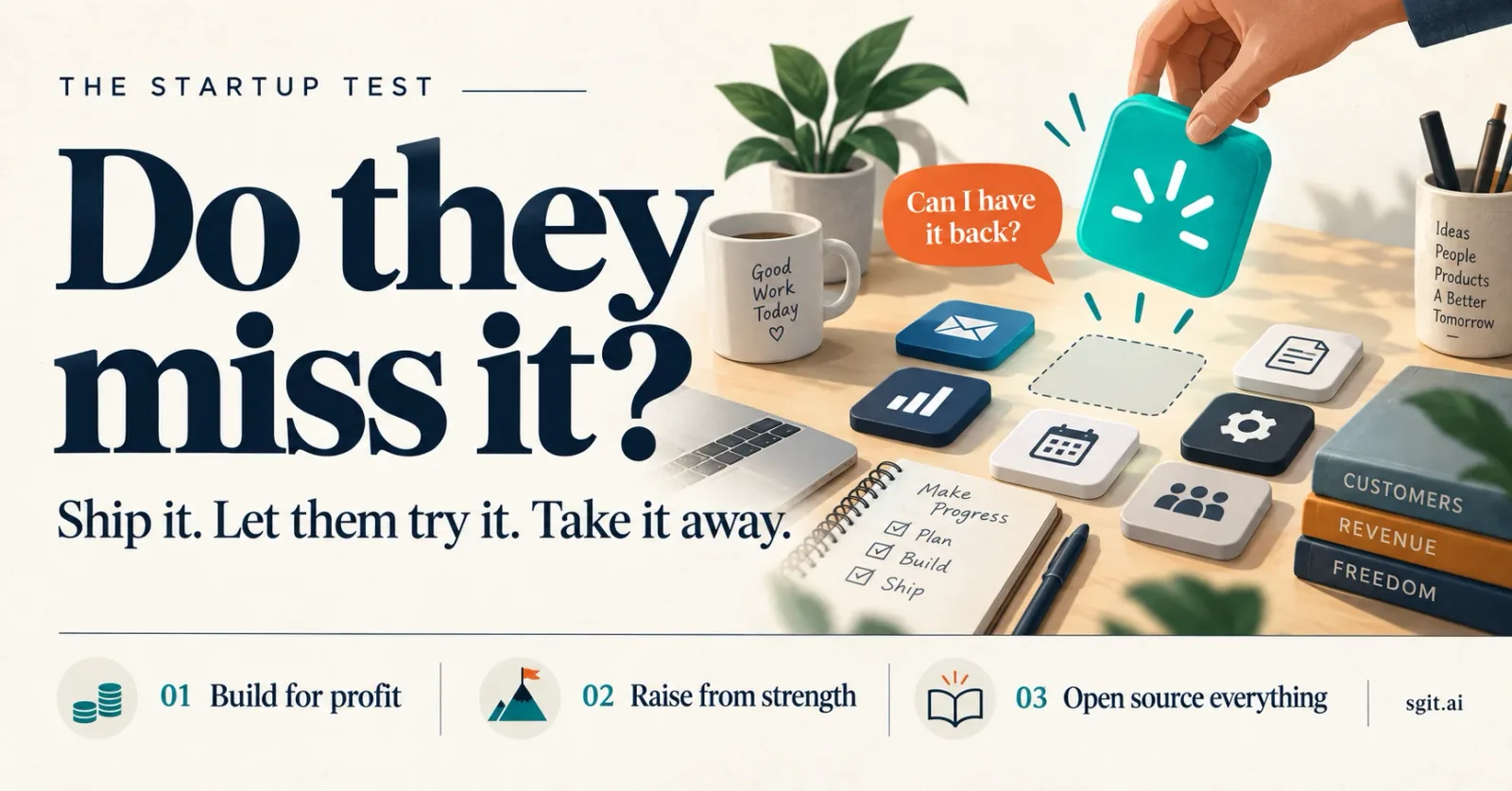
The startup test. Ship it, let them try it, take it away, and see whether anybody asks for it back.
hero · behind 3 proposals
The value of constraints 2 figures

The article on newsroom.sgit.ai →
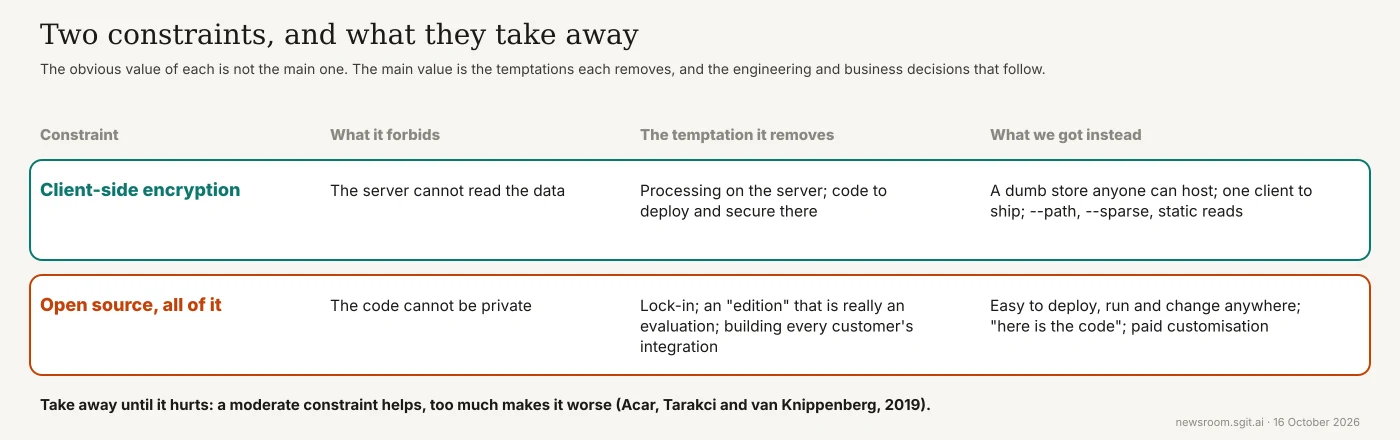
Two constraints and what they take away: client-side encryption forbids the server from reading the data and removes the temptation to process there; open source, all of it, forbids private code and removes lock-in, the evaluation edition and building every customer's integration.
infographic
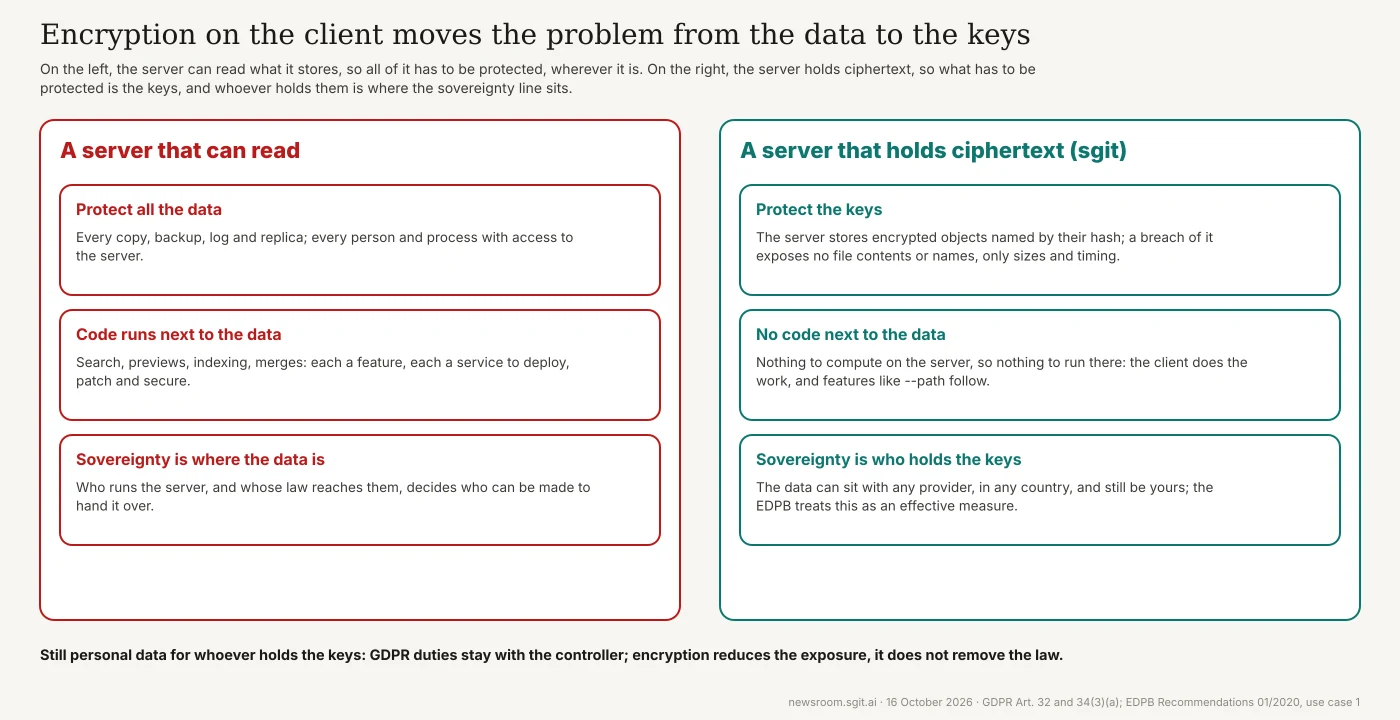
Encryption on the client moves the problem from the data to the keys: a server that can read has to protect all the data, runs code next to it, and puts the sovereignty line where the data is; a server that holds ciphertext needs the keys protected, runs no code next to the data, and puts the line a
infographic
Two years in, the opposite 1 figure

The article on newsroom.sgit.ai →
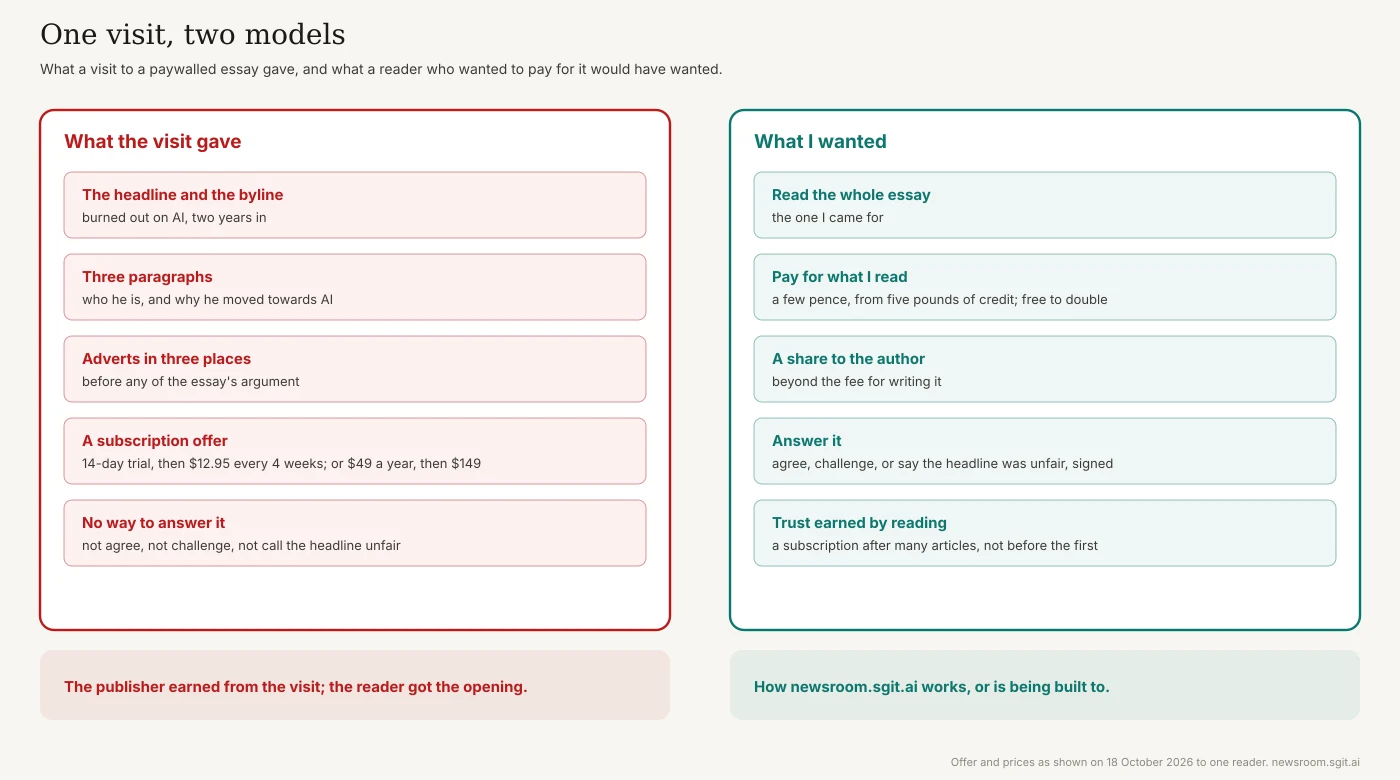
One visit, two models. On the left, what the visit to the essay gave: the headline, the byline, three paragraphs and adverts in three places, then a box offering a 14-day trial that renews at $12.95 every four weeks, or $49 for a year that renews at $149. On the right, what Dinis wanted: read the es
infographic · behind 1 proposal
What can your agent reach? RiskMandate and the Agent Behaviour Policy, explained for the person who has to decide 2 figures

The article on newsroom.sgit.ai →
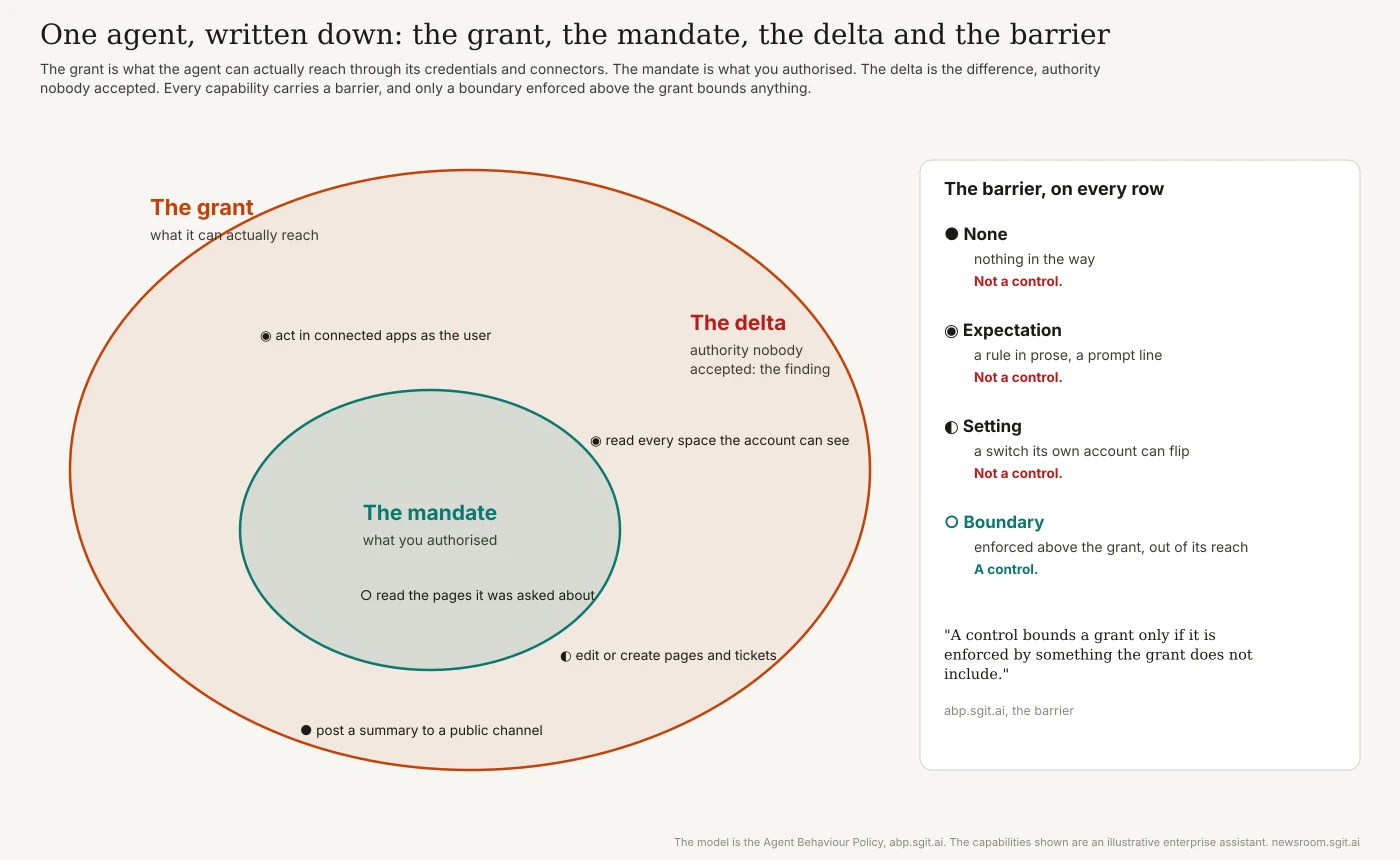
One agent, three sets. The grant is everything the agent can actually reach through its credentials and connectors; the mandate is what the organisation authorised it to do; the delta is the difference, the authority nobody accepted. Each capability in the grant carries a barrier: nothing in the way
infographic · behind 2 proposals
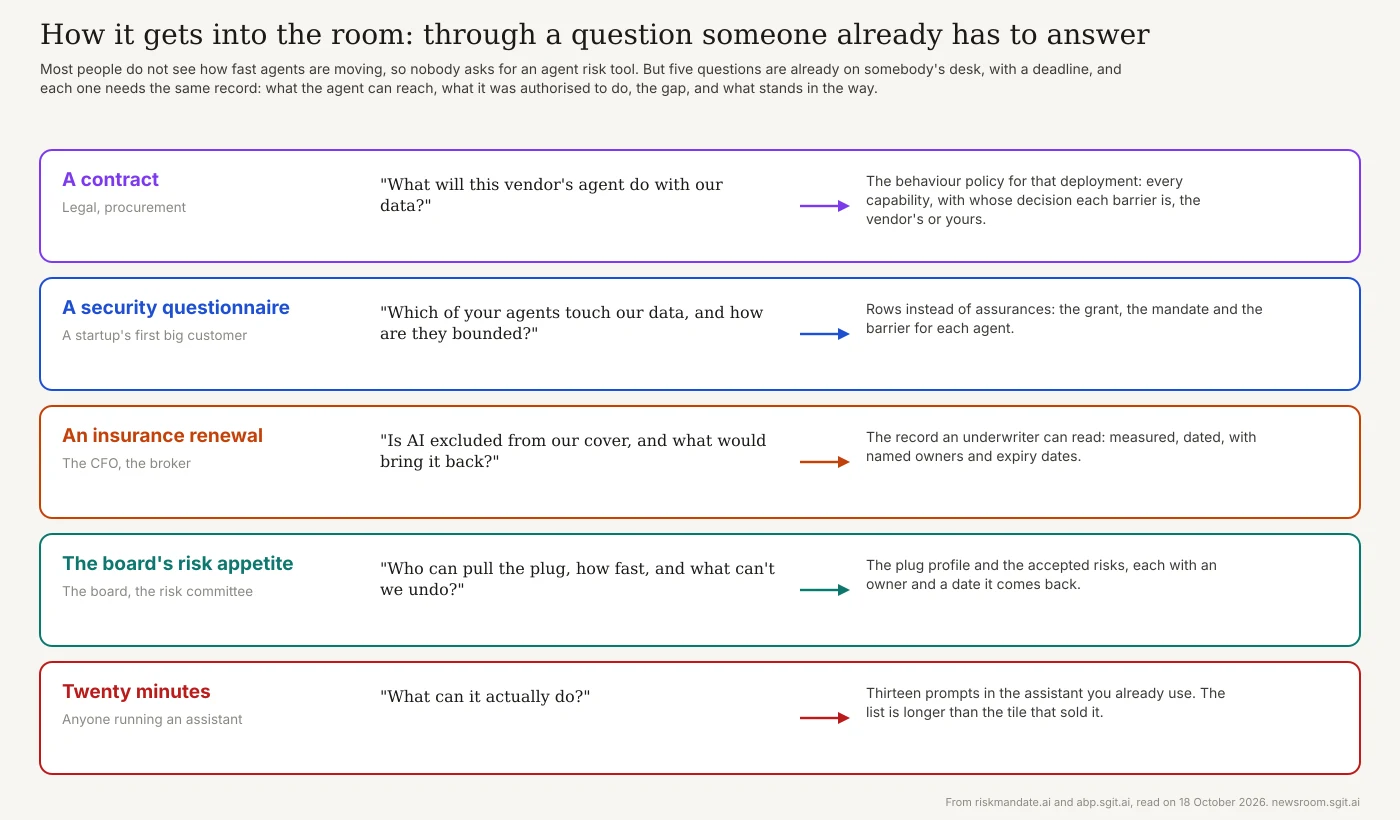
Five ways into the room, each a question someone already has to answer: a contract, where legal and procurement ask what the vendor's agent will do with the data; a security questionnaire, where a customer asks which agents touch their data; an insurance renewal, where the question is whether AI is
infographic · behind 2 proposals
Git for things you cannot put on GitHub 6 figures

The article on newsroom.sgit.ai →
sgit.ai, `pip install sgit-ai`. Pure Python, two runtime dependencies, Apache-2.0.
other · behind 3 proposals
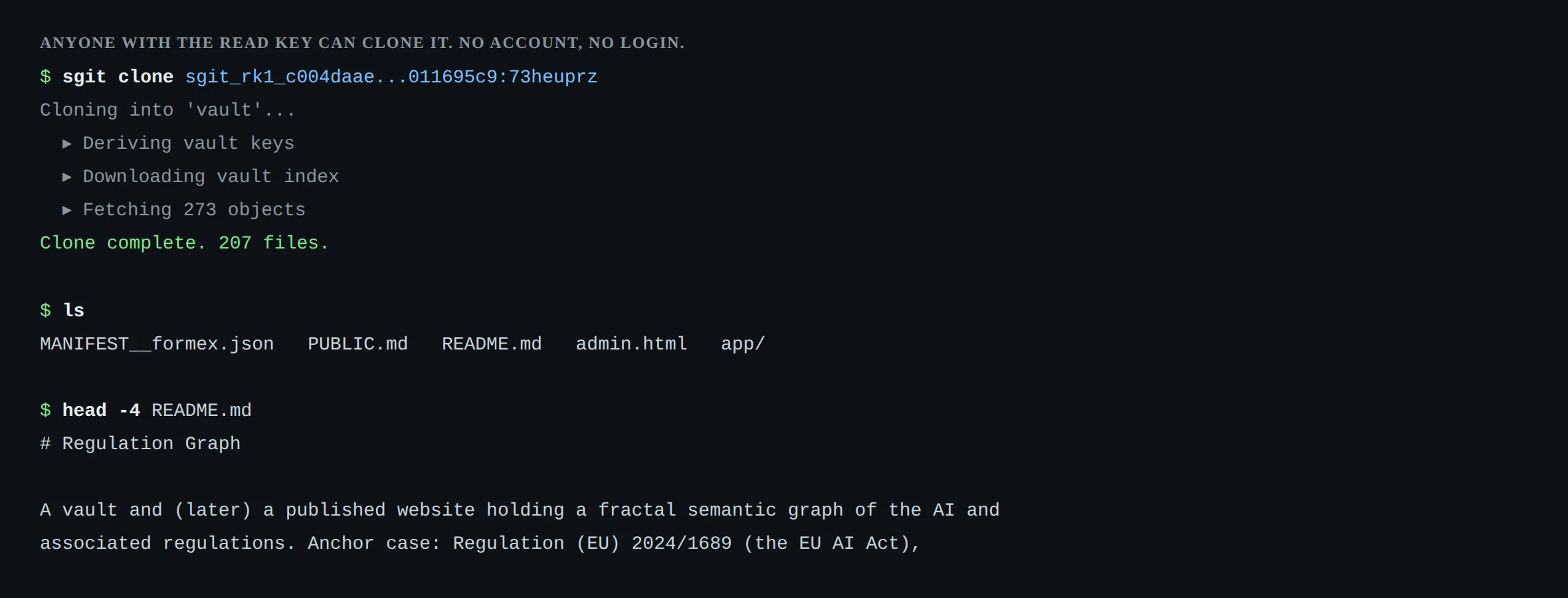
A real clone of the published EU AI Act vault. 273 objects, 207 files.
other · behind 3 proposals
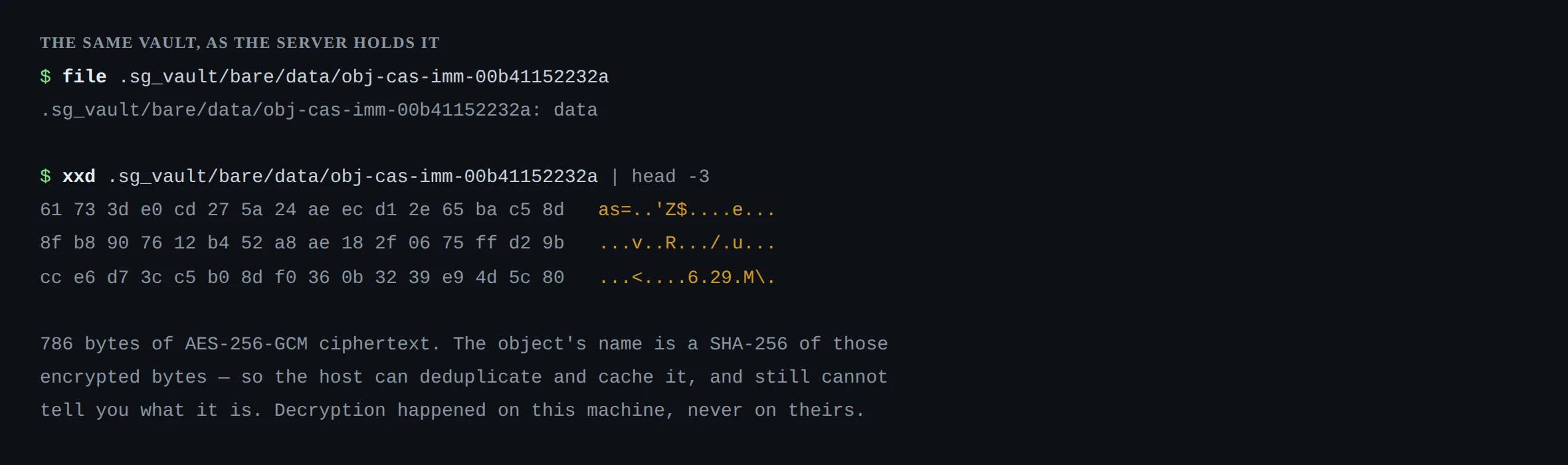
786 bytes of AES-256-GCM ciphertext. The object's name is a SHA-256 of the encrypted bytes.
other · behind 3 proposals
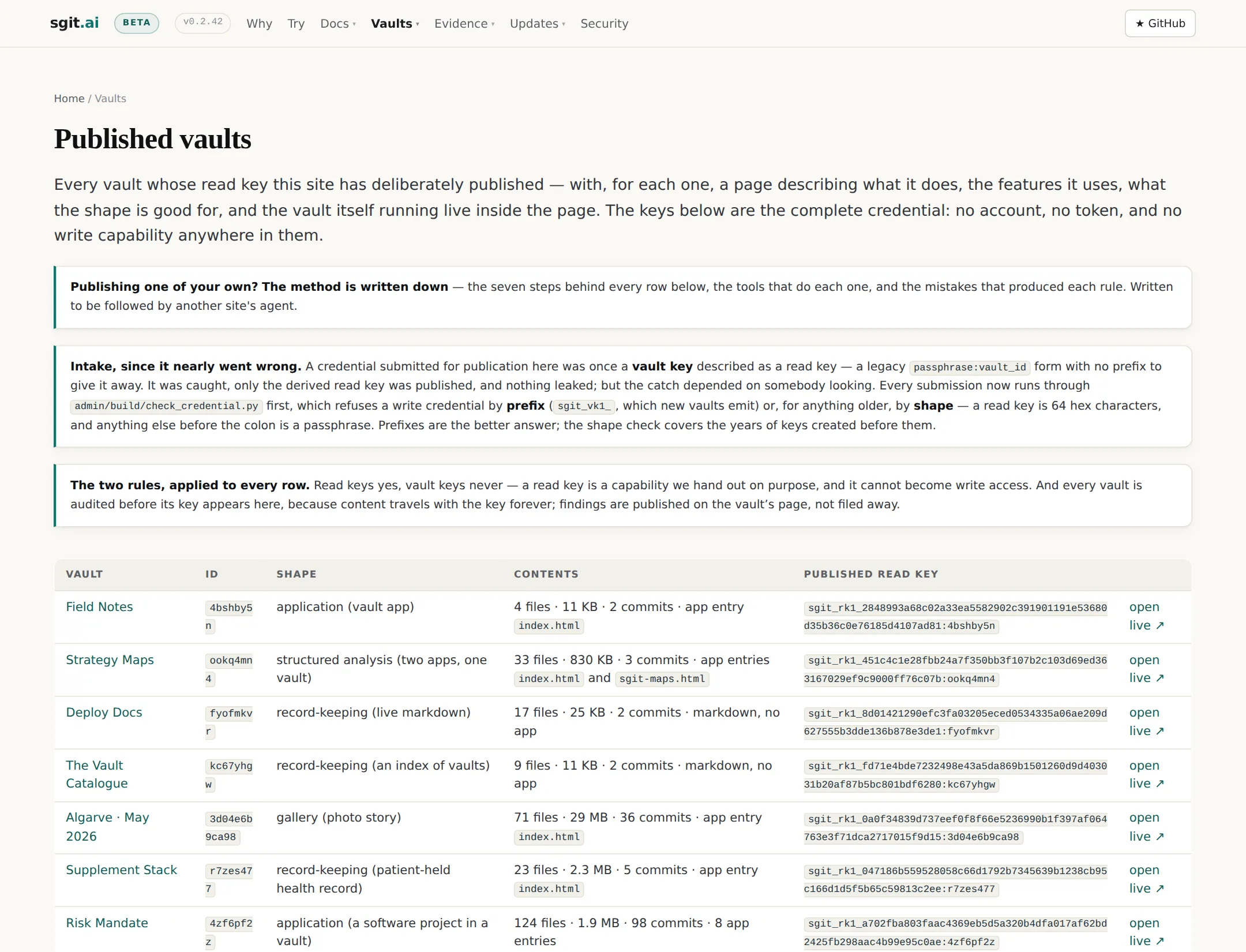
The published vaults. Each one carries its read key on the page.
other · behind 3 proposals
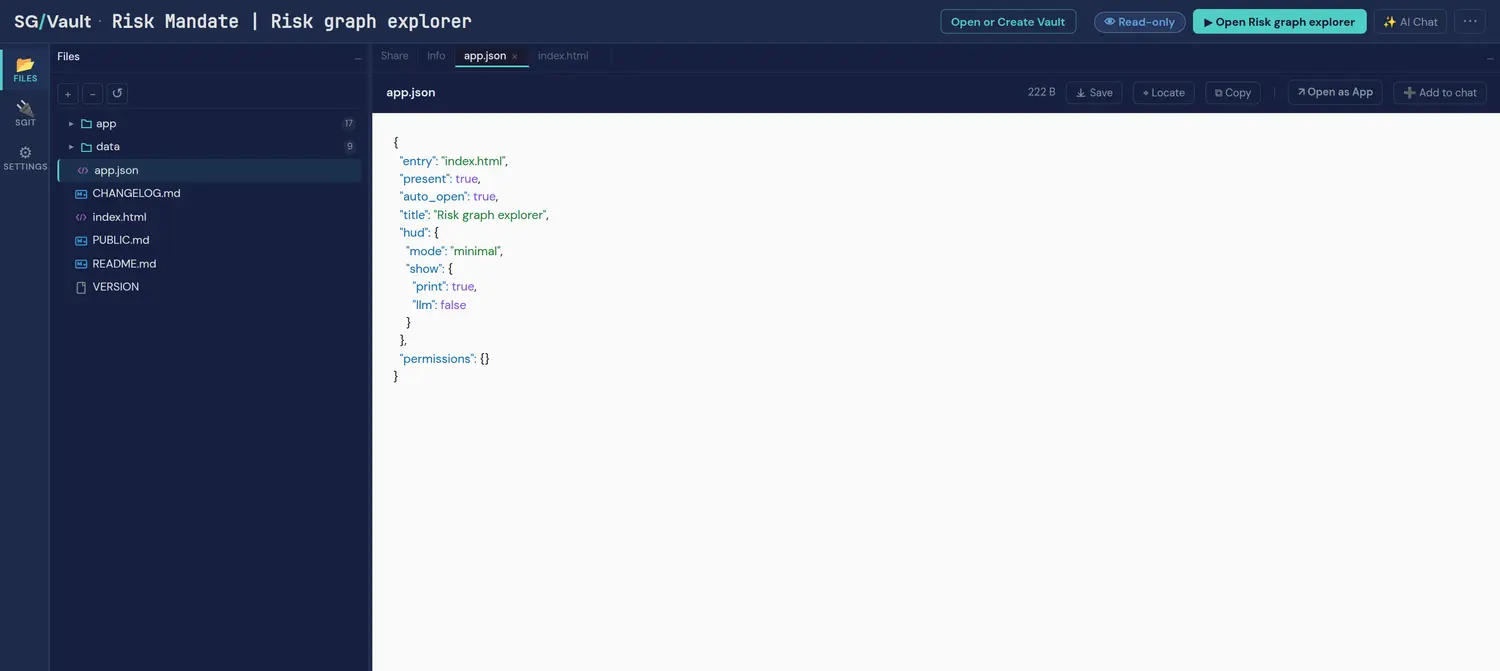
`"permissions": {}`, the app requests nothing, and is granted nothing.
other · behind 3 proposals
The network directory: start from the question you arrived with.
other · behind 3 proposals
Where the vault keys live 6 figures

The article on newsroom.sgit.ai →
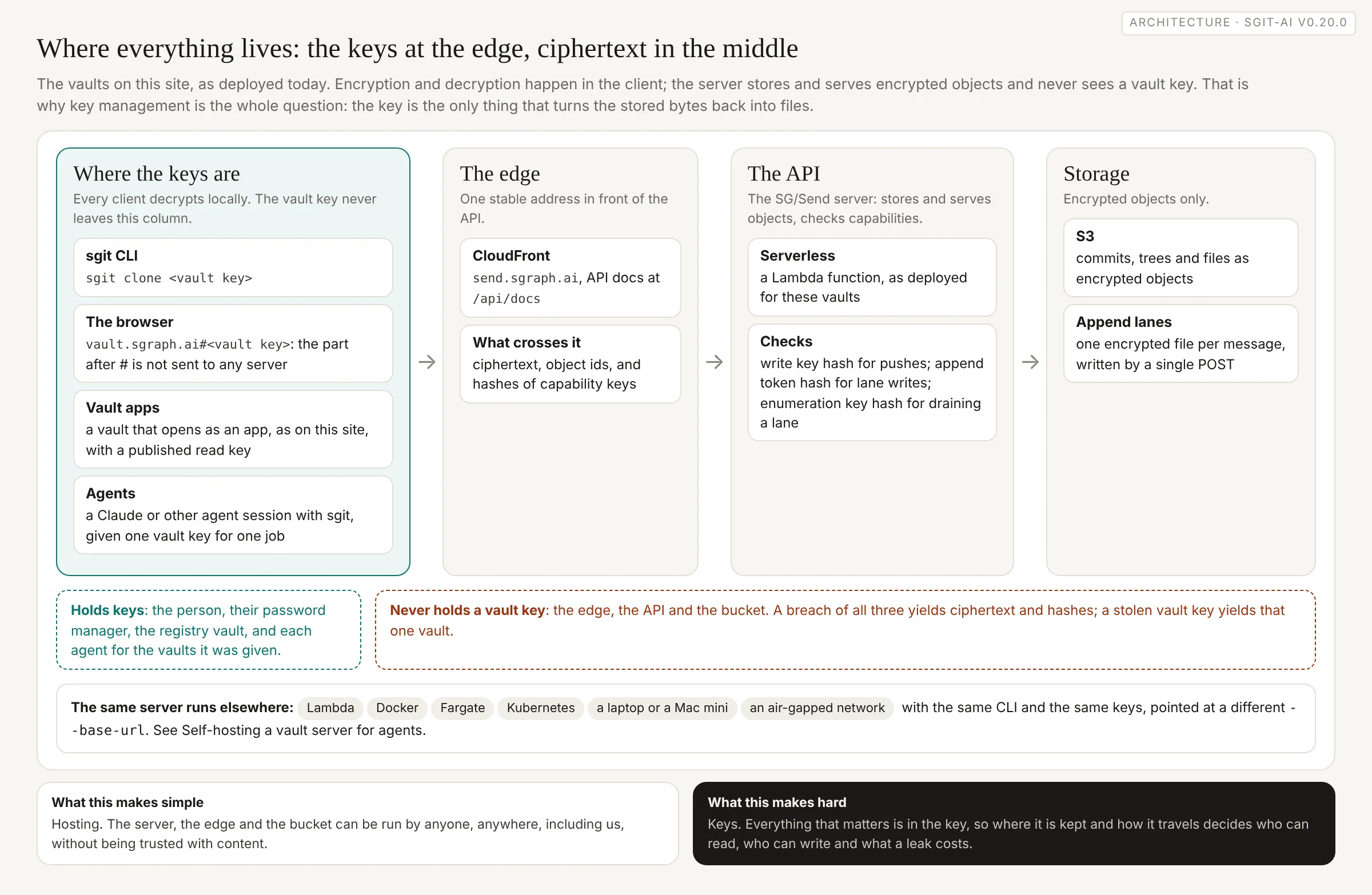
Where everything lives. Encryption and decryption happen in the client; the edge, the API and the bucket only ever handle ciphertext and hashes of capability keys.
other · behind 1 proposal
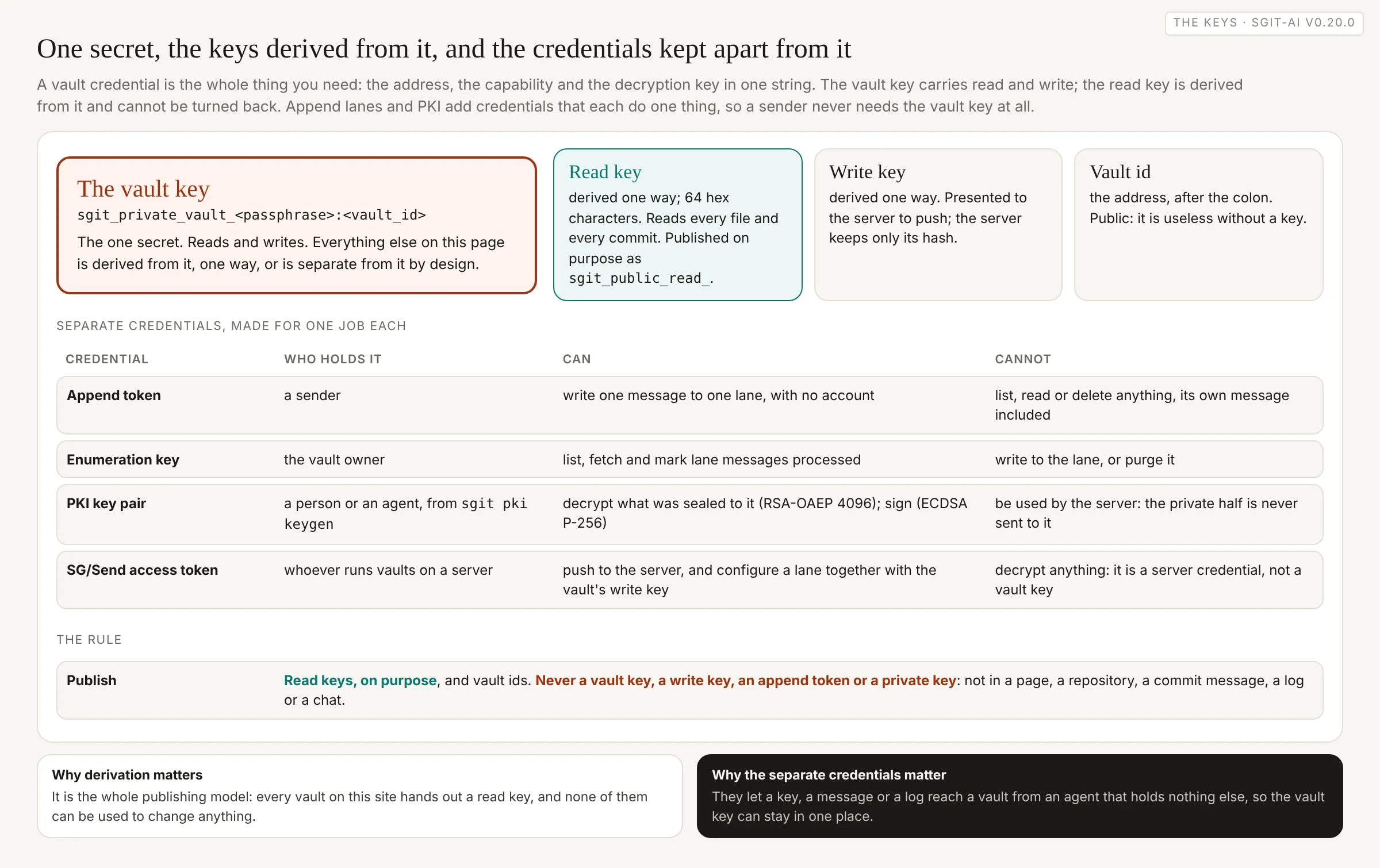
The vault key, the keys derived from it, and the separate credentials made for one job each. The full table, with the prefixes, is on the vault credentials page.
other · behind 1 proposal
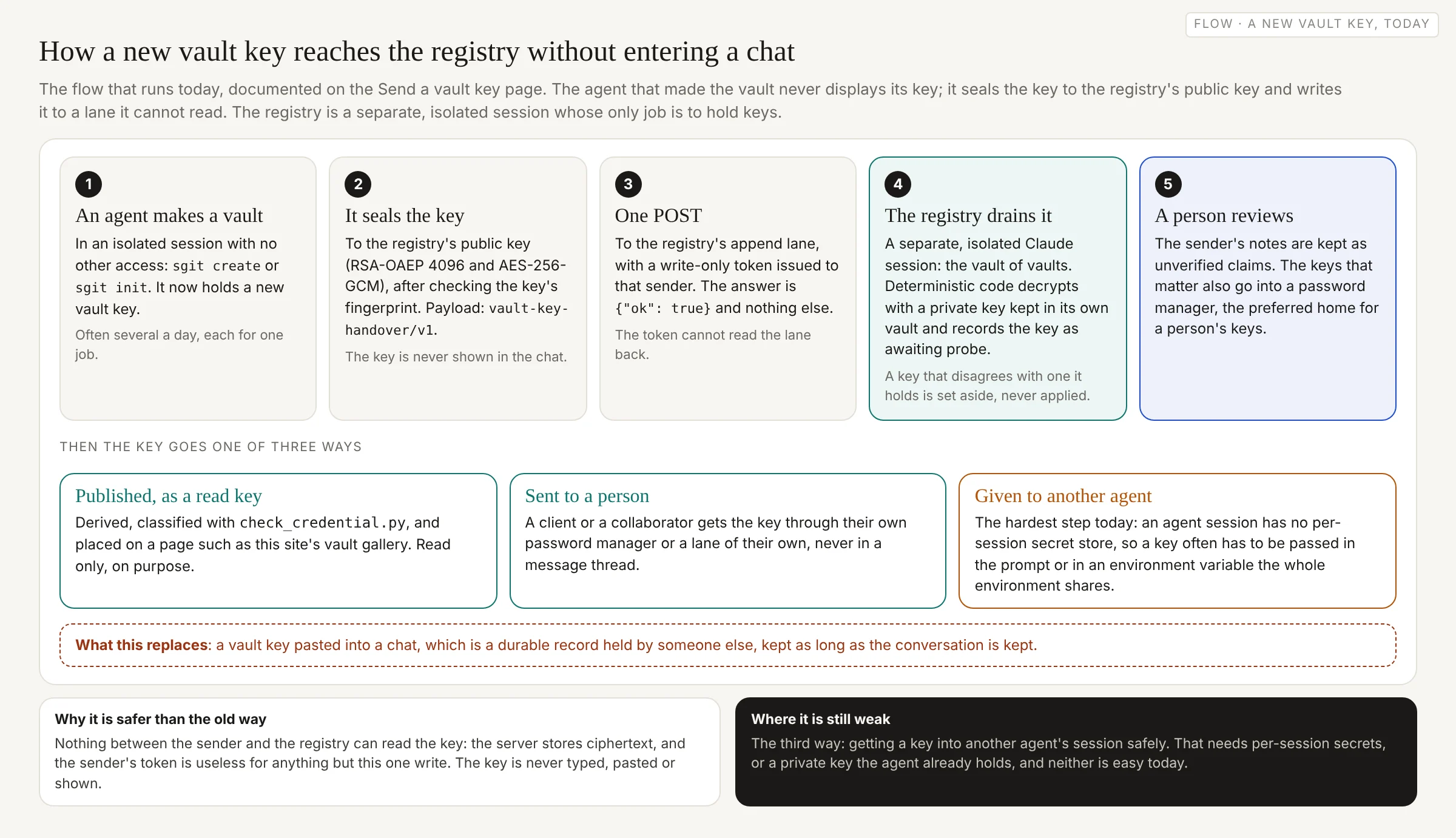
How a new vault key reaches the registry without entering a chat. The flow is documented, for the agent that has to follow it, on the Send a vault key page.
other · behind 1 proposal
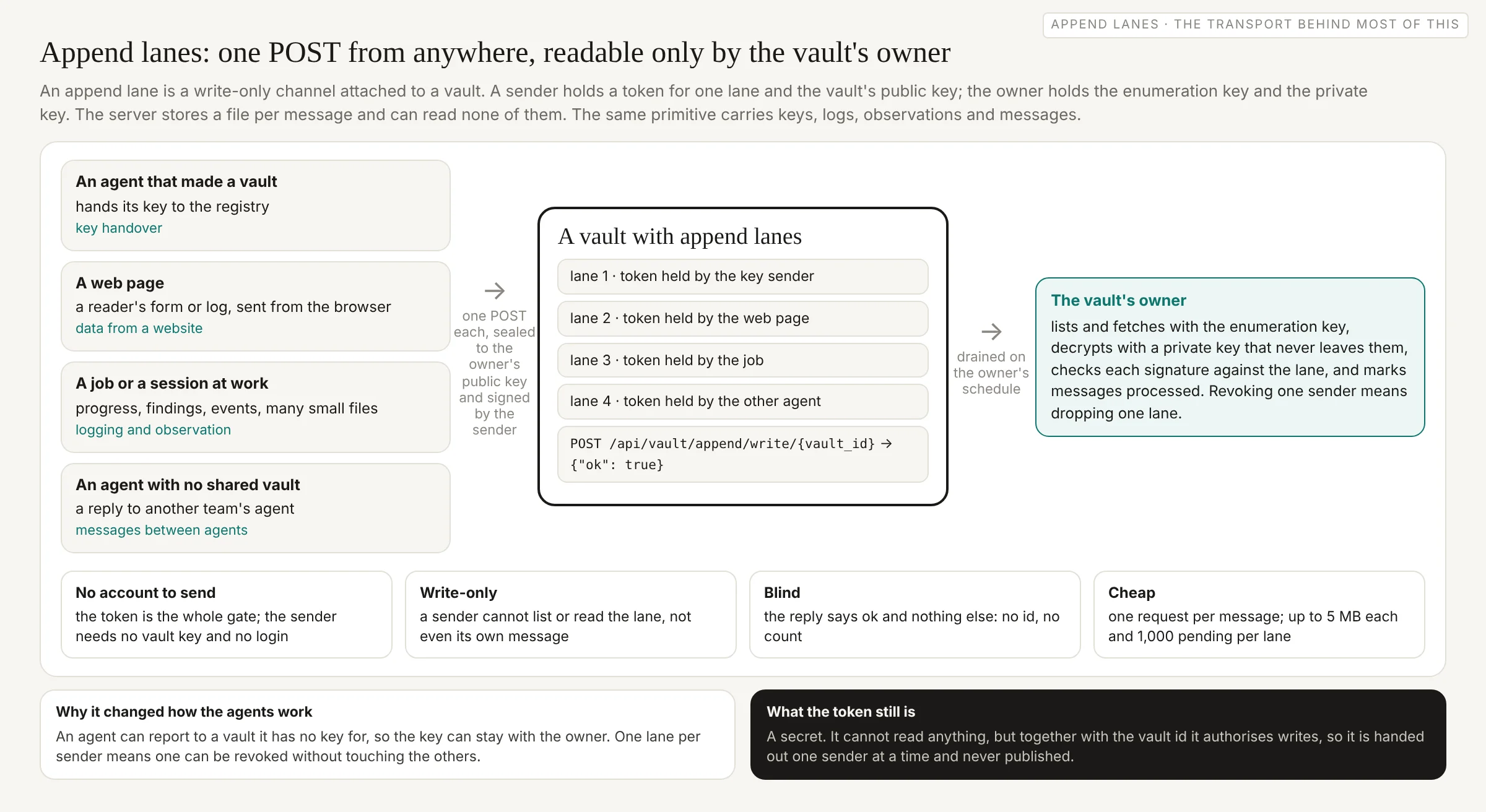
Append lanes: one POST from anywhere, readable only by the vault's owner. One lane per sender, so one can be revoked without touching the others.
other · behind 1 proposal
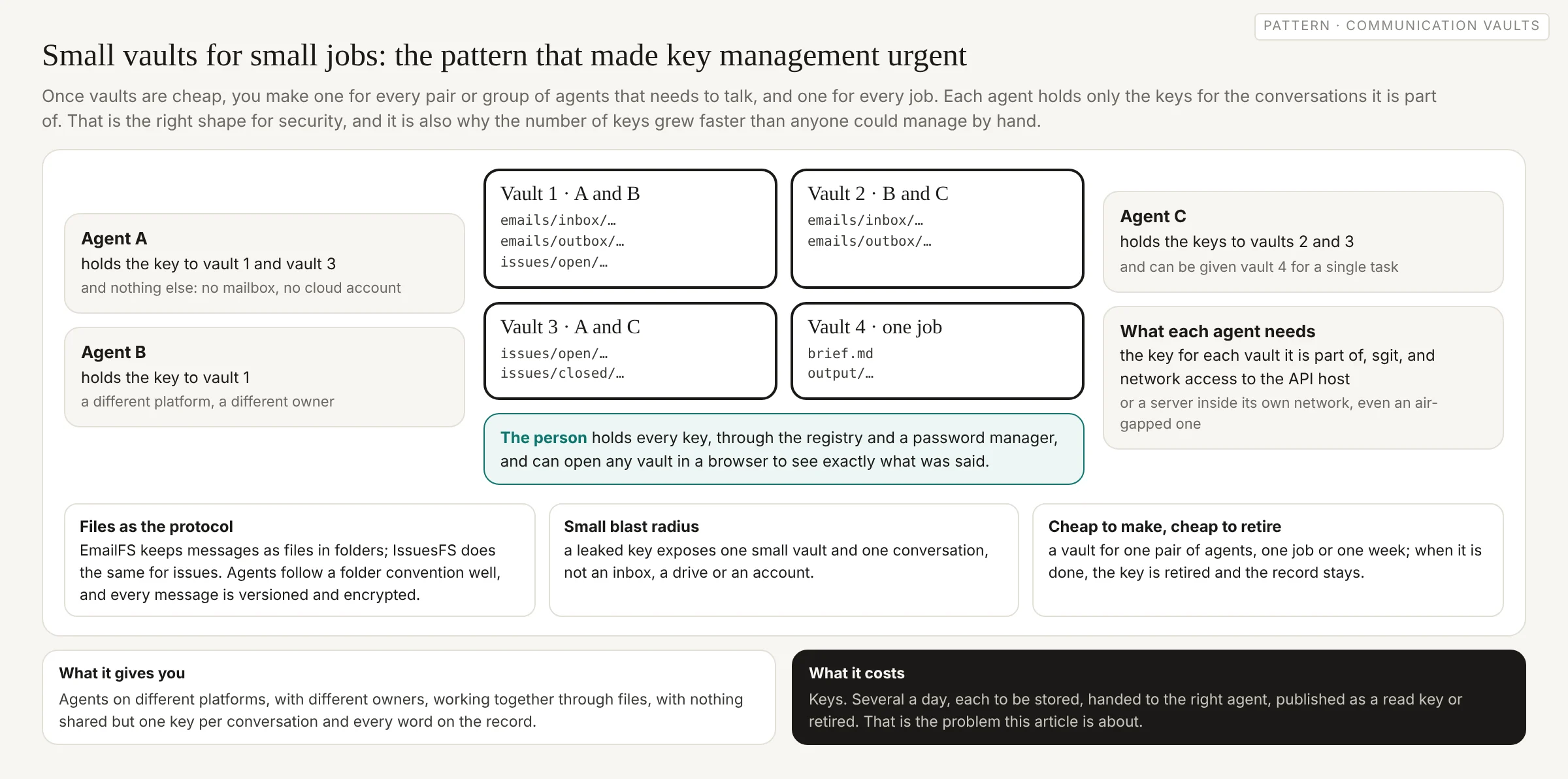
Communication vaults: one per pair or group of agents, and one per job. Each agent holds only the keys for the conversations it is part of.
other · behind 1 proposal
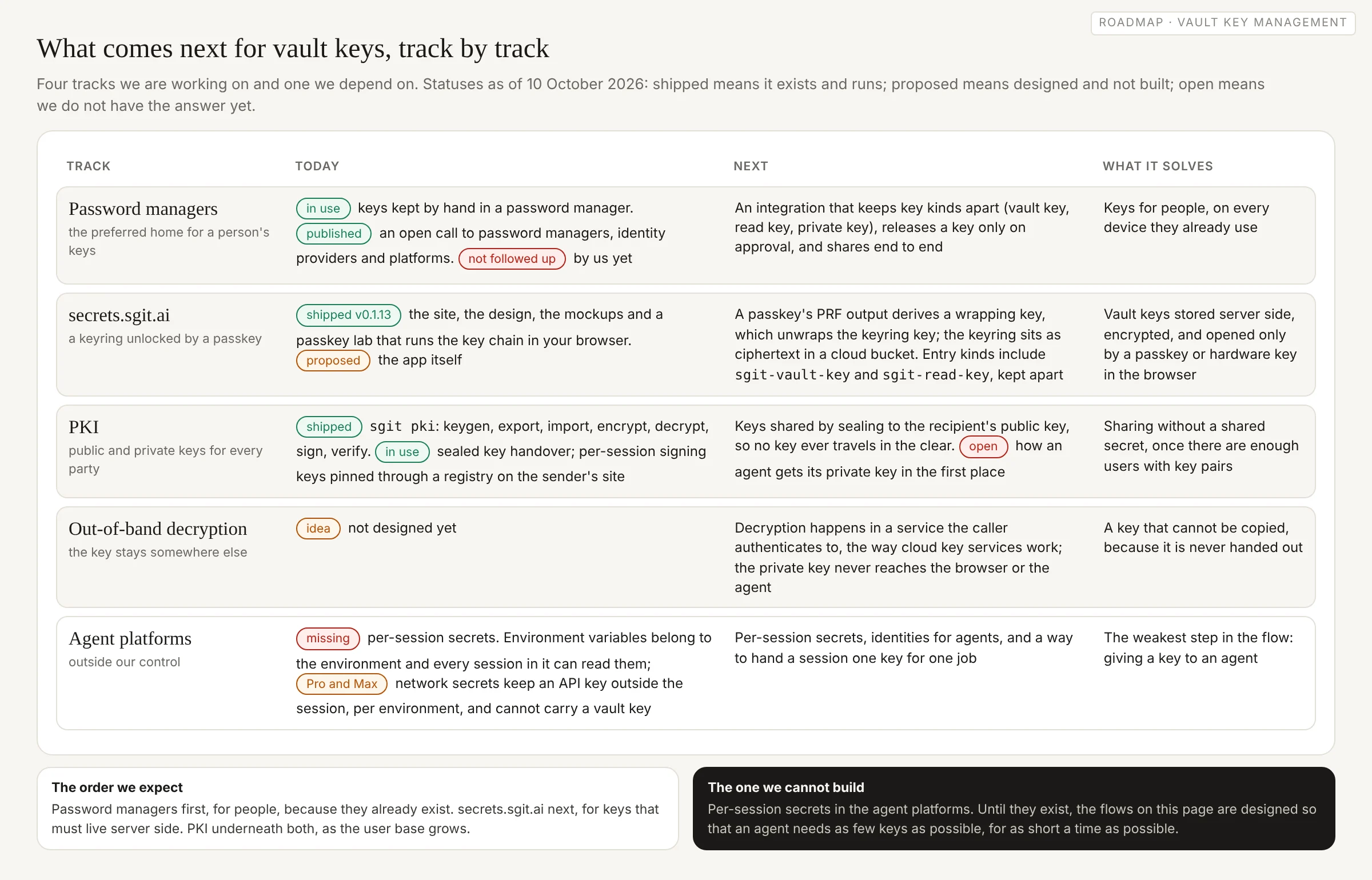
The four tracks we are working on, and the one we depend on. Statuses as of 10 October 2026.
other · behind 1 proposal
Who are you protecting against? Draw the security line where the attacker is, not above it 5 figures

The article on newsroom.sgit.ai →
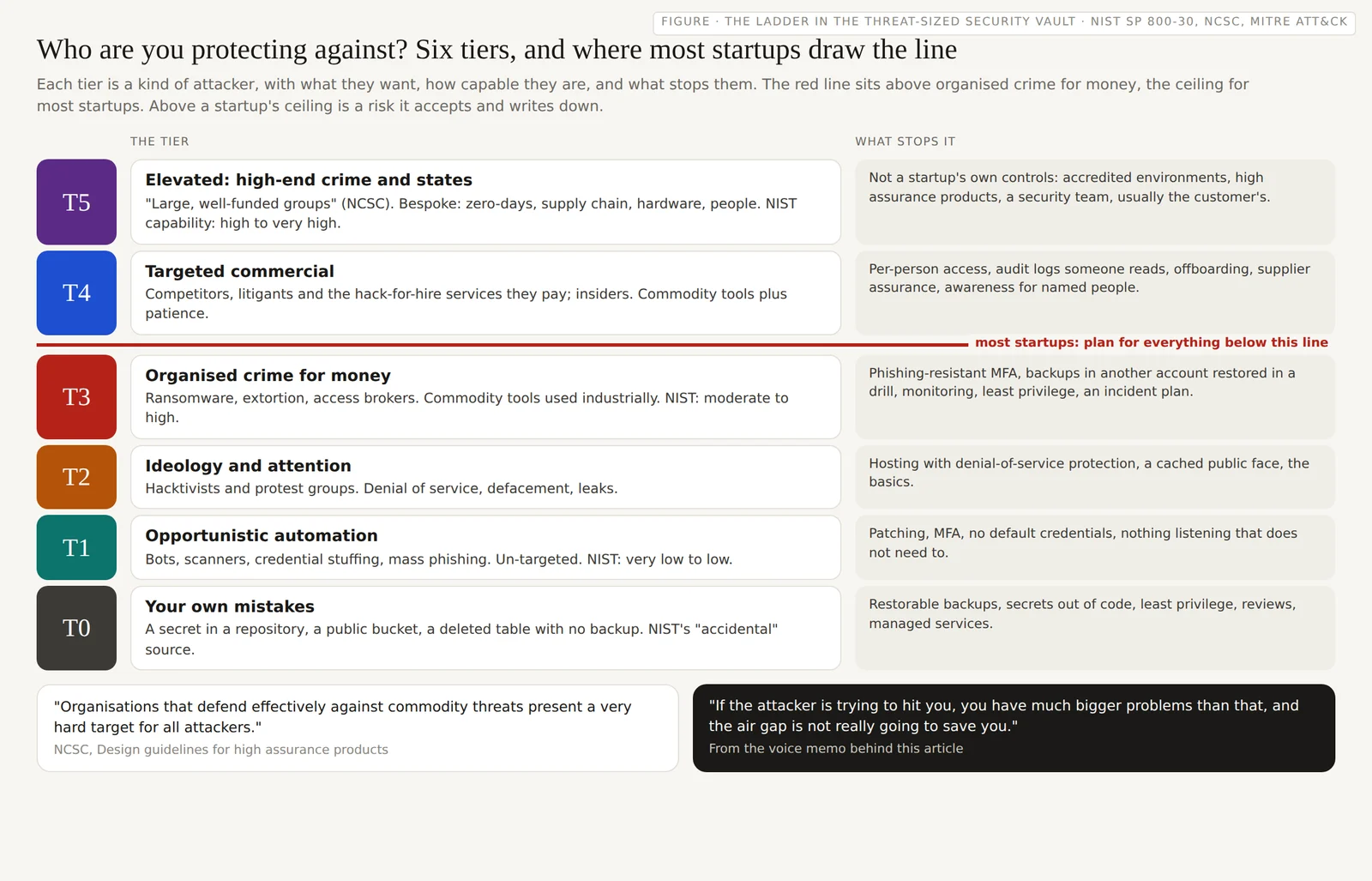
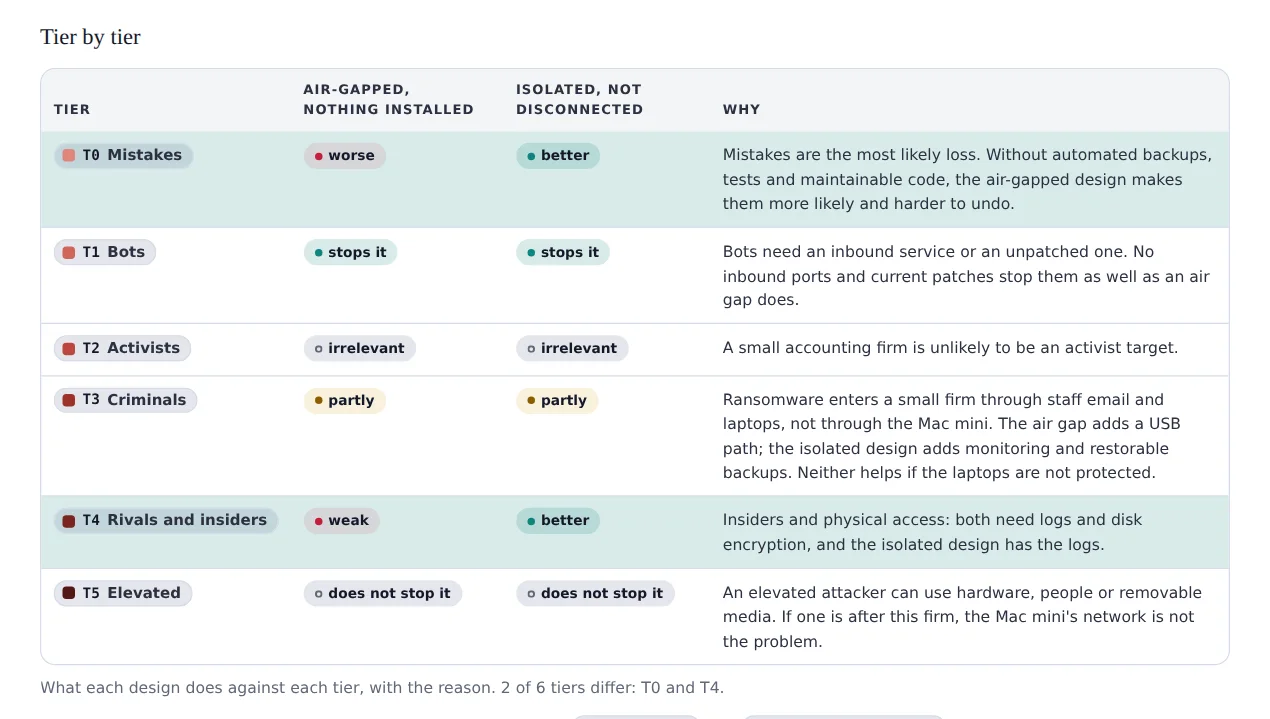
Six tiers of attacker, from your own mistakes to elevated threats, with what stops each. Most startups plan for everything up to organised crime for money, and write down what they accept above it.
other
The vault's comparison: the air-gapped, nothing-installed design against an isolated-not-disconnected one, tier by tier. The air gap stops the bots, which no inbound ports and patches also stop; adds a USB path; and gives up backups, monitoring and tooling that would catch the most likely losses.
other
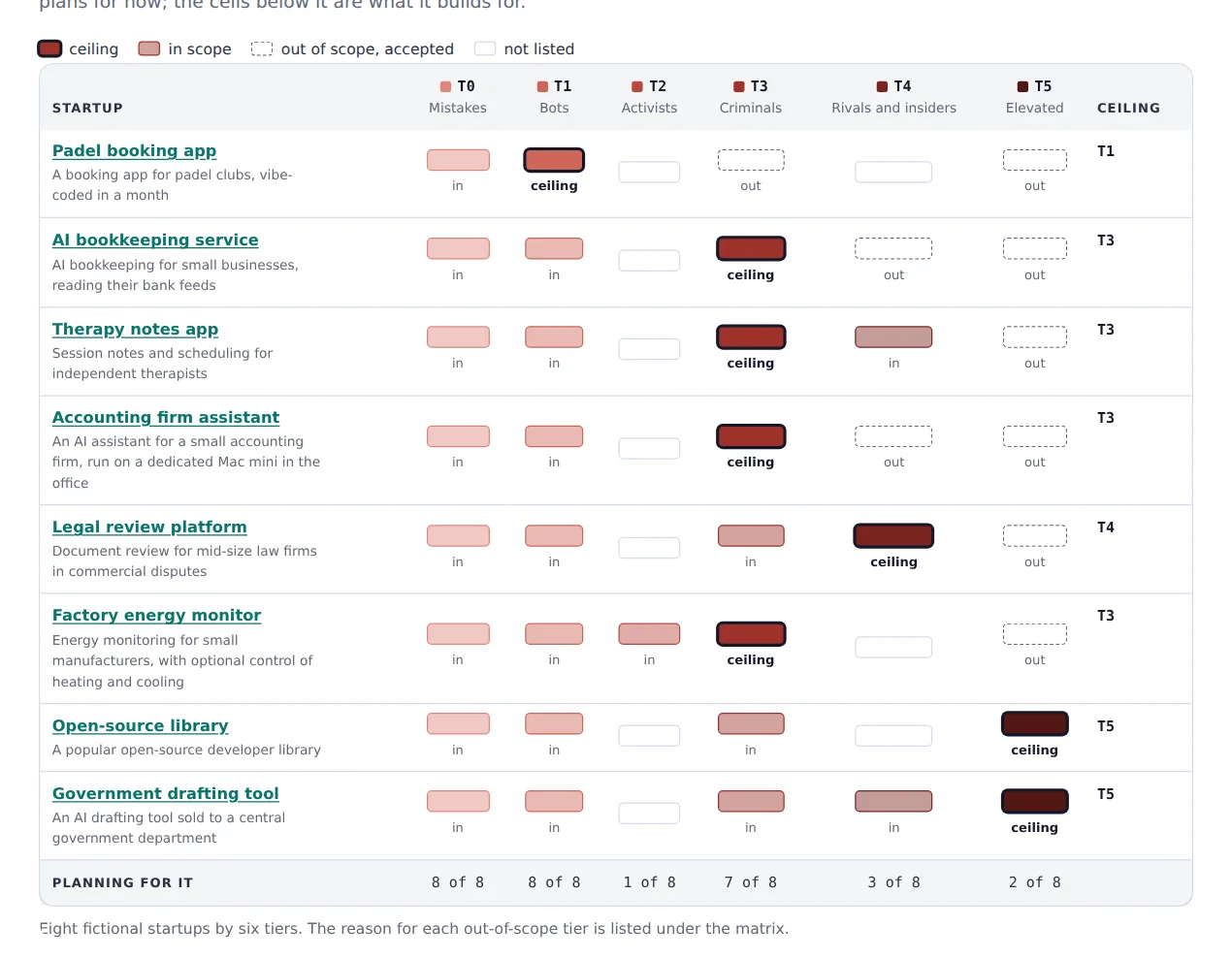
The vault's compare view: eight fictional startups against the six tiers, the tiers in scope filled and each ceiling marked.
other
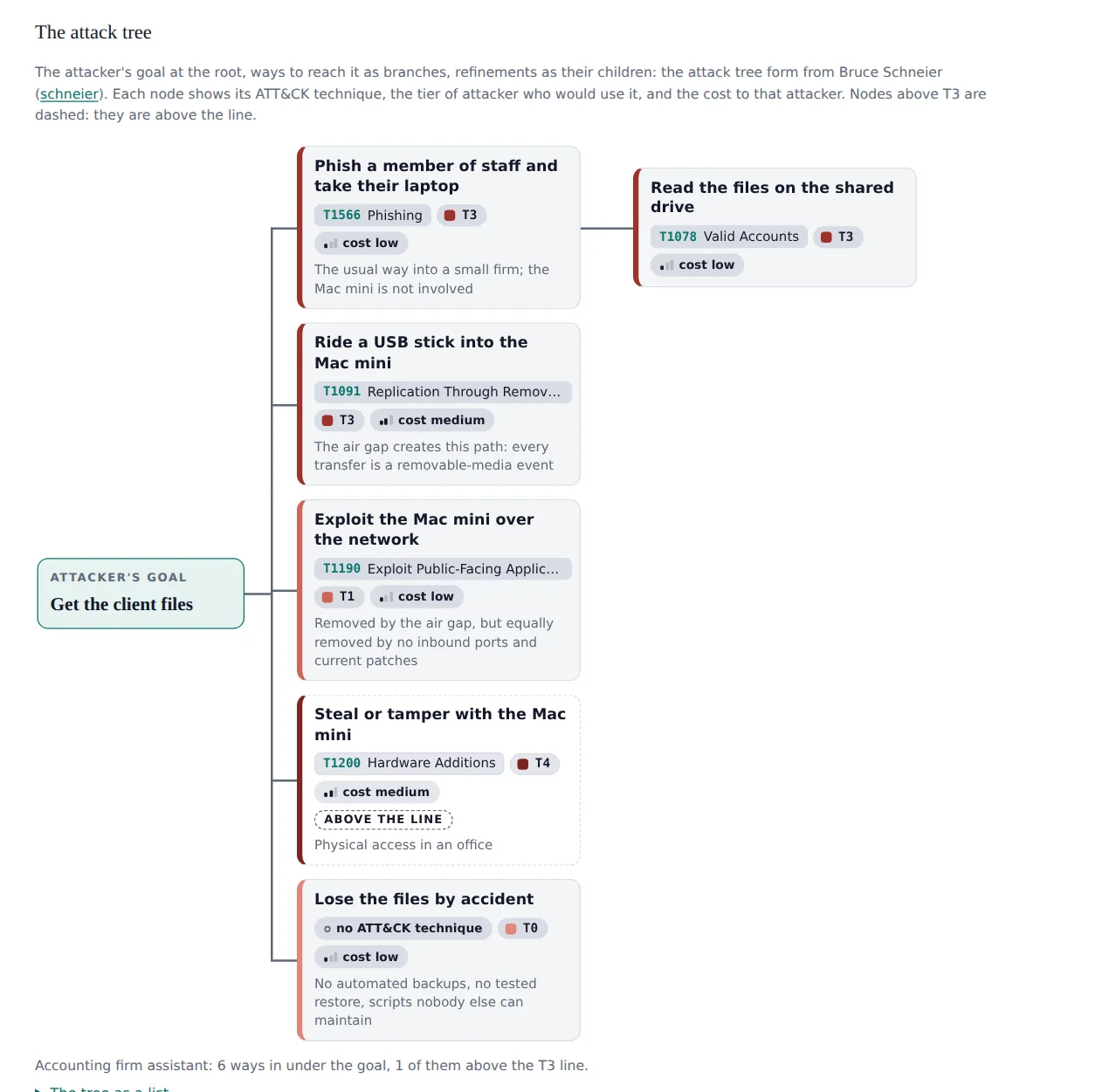
One scenario in full: the accounting firm assistant's assets, its attack tree with an ATT&CK technique on every branch, and the line, with what must be done, what should, what is over the line and why, and the under-engineering to avoid.
other
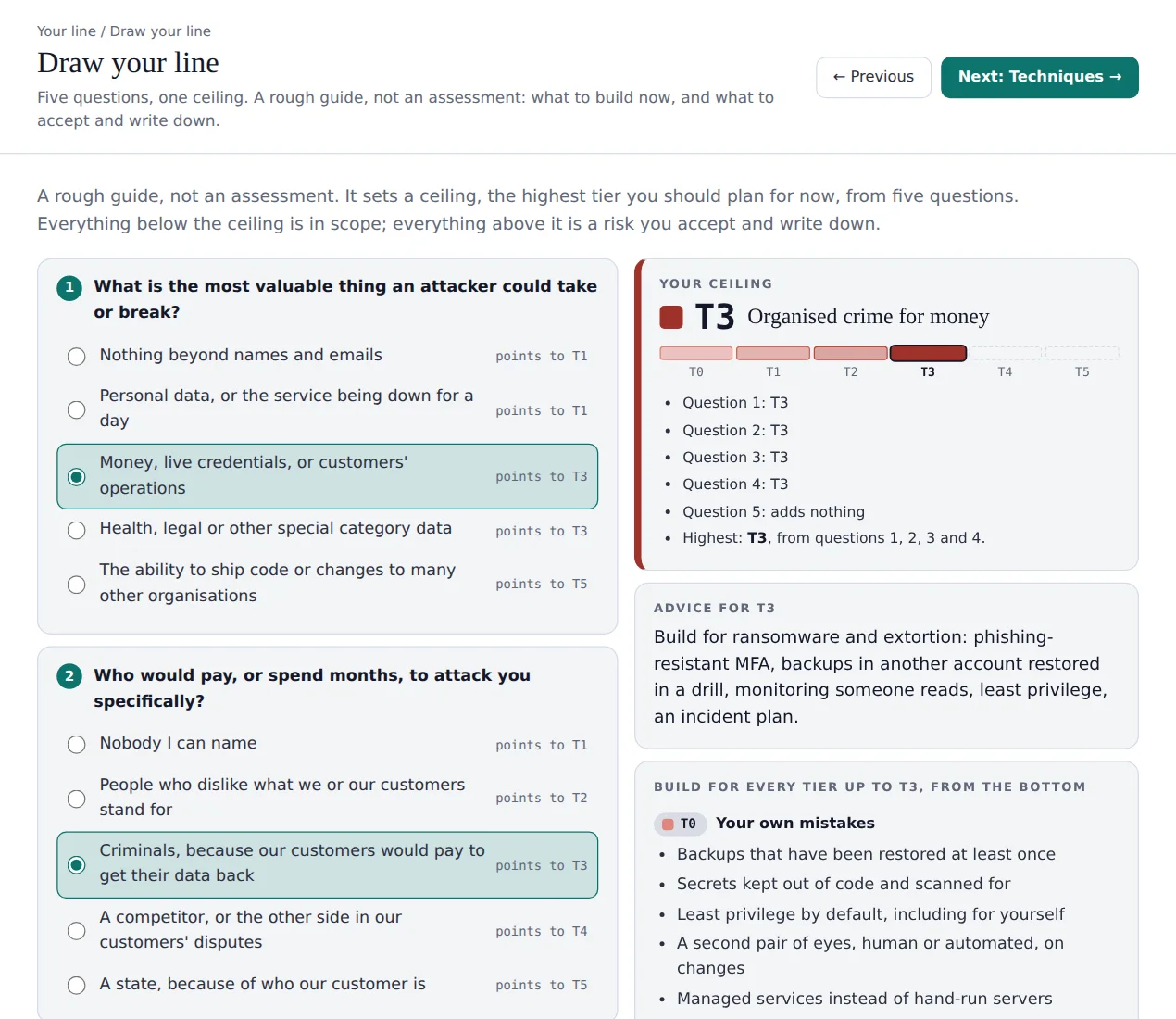
The questionnaire: five questions about what you hold, who would pay to attack you, who you sell to, how far one breach reaches and what your customers use today, and the ceiling they point to, with the controls for every tier up to it.
other
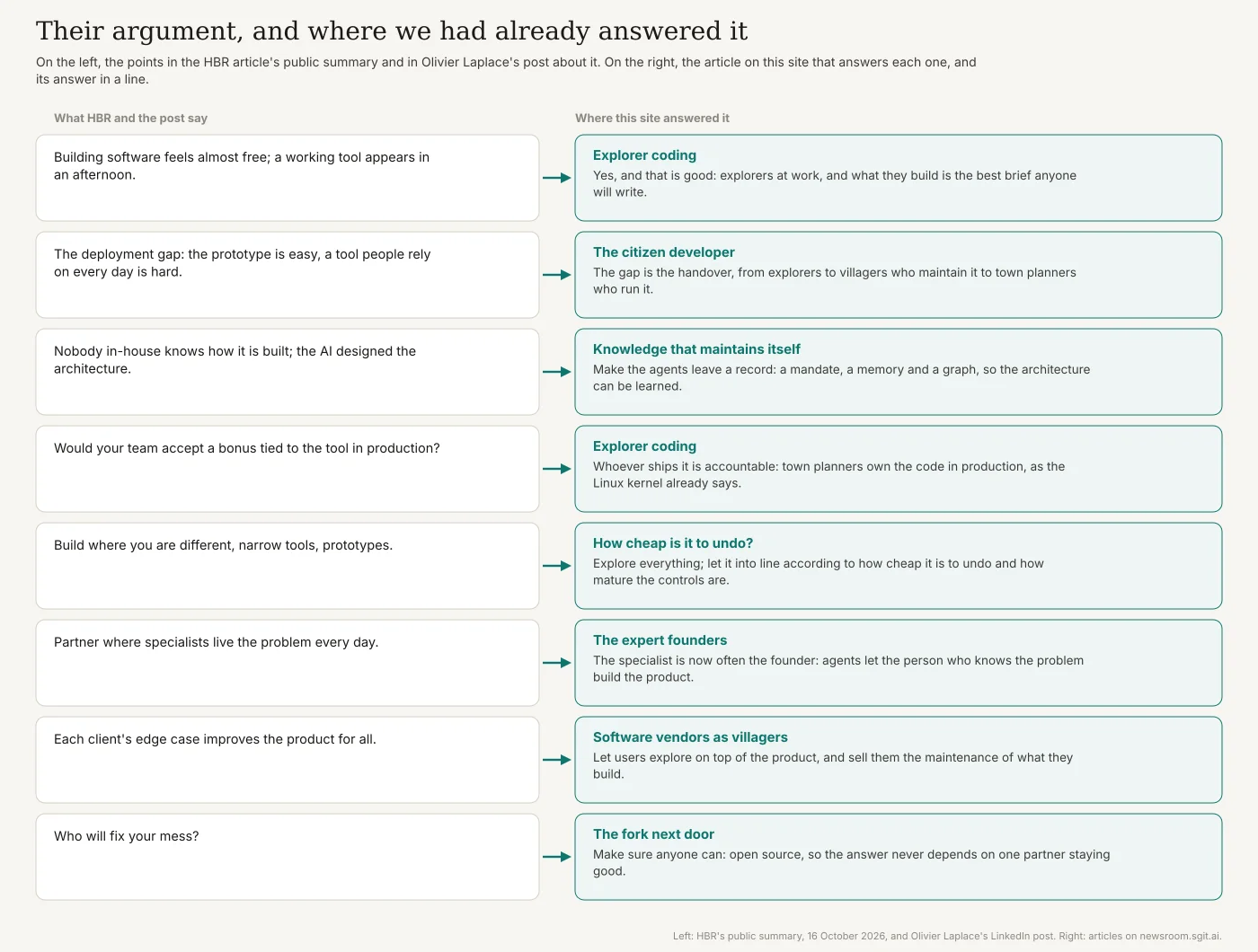
Who will fix your mess? An answer to HBR's "deployment gap" from what this site has already published 10 figures

The article on newsroom.sgit.ai →
The points in the HBR article's public summary and in Olivier Laplace's post, on the left, and the article on this site that answers each one, on the right: explorer coding, the citizen developer, knowledge that maintains itself, how cheap it is to undo, the expert founders, software vendors as vill
infographic · behind 2 proposals
Explorer coding and the handover that makes it last: explorers build by talking to an agent, and what they build is the brief; villagers maintain it, with policies, data handling and tests; town planners own the code in production. From Explorer coding.
diagram · behind 3 proposals
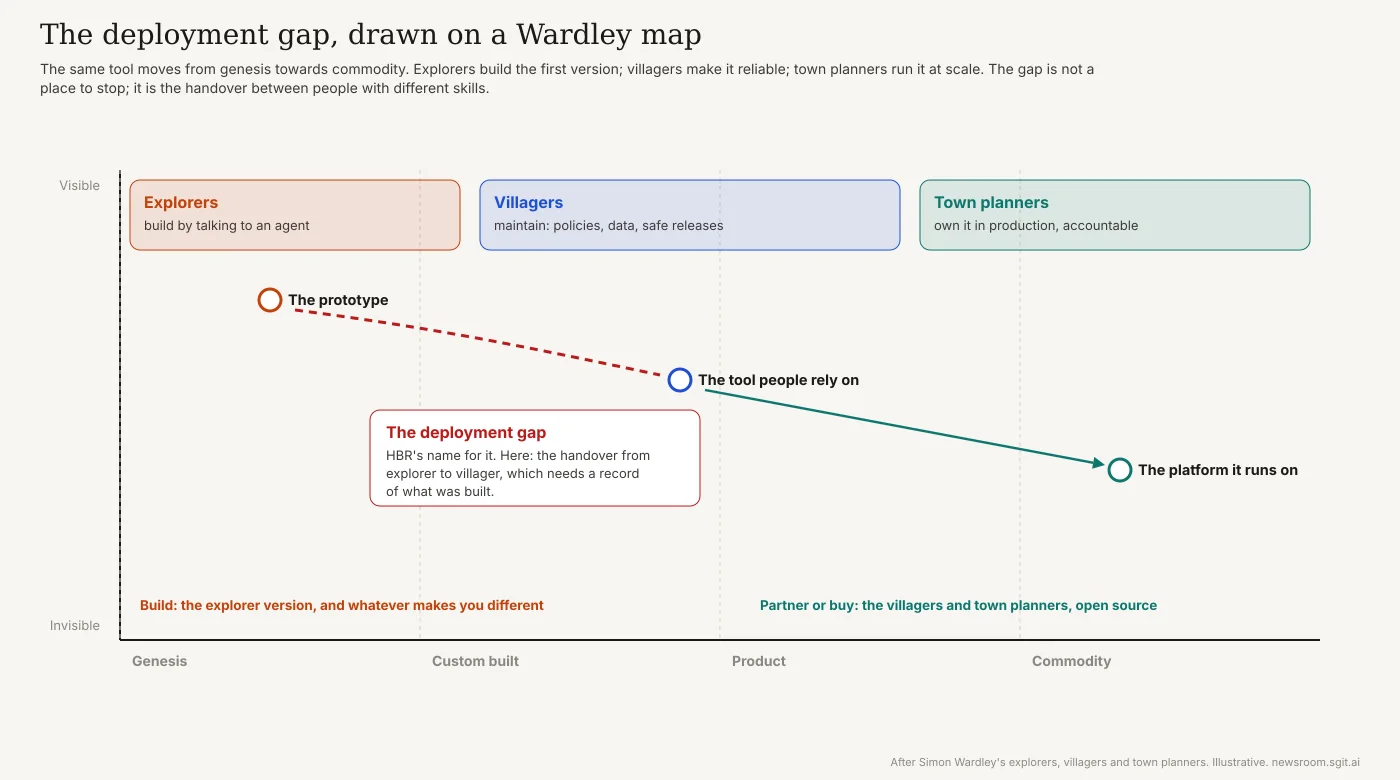
The deployment gap on a Wardley map: the prototype in genesis, built by explorers; the tool people rely on, made reliable by villagers; the platform it runs on, owned by town planners. The gap is the handover from explorer to villager.
diagram · behind 2 proposals
From the spreadsheet to the town planners: the citizen developer's path, from what people built with what they controlled, to the application they need, to the villagers and town planners who make it last. From The citizen developer.
diagram · behind 3 proposals
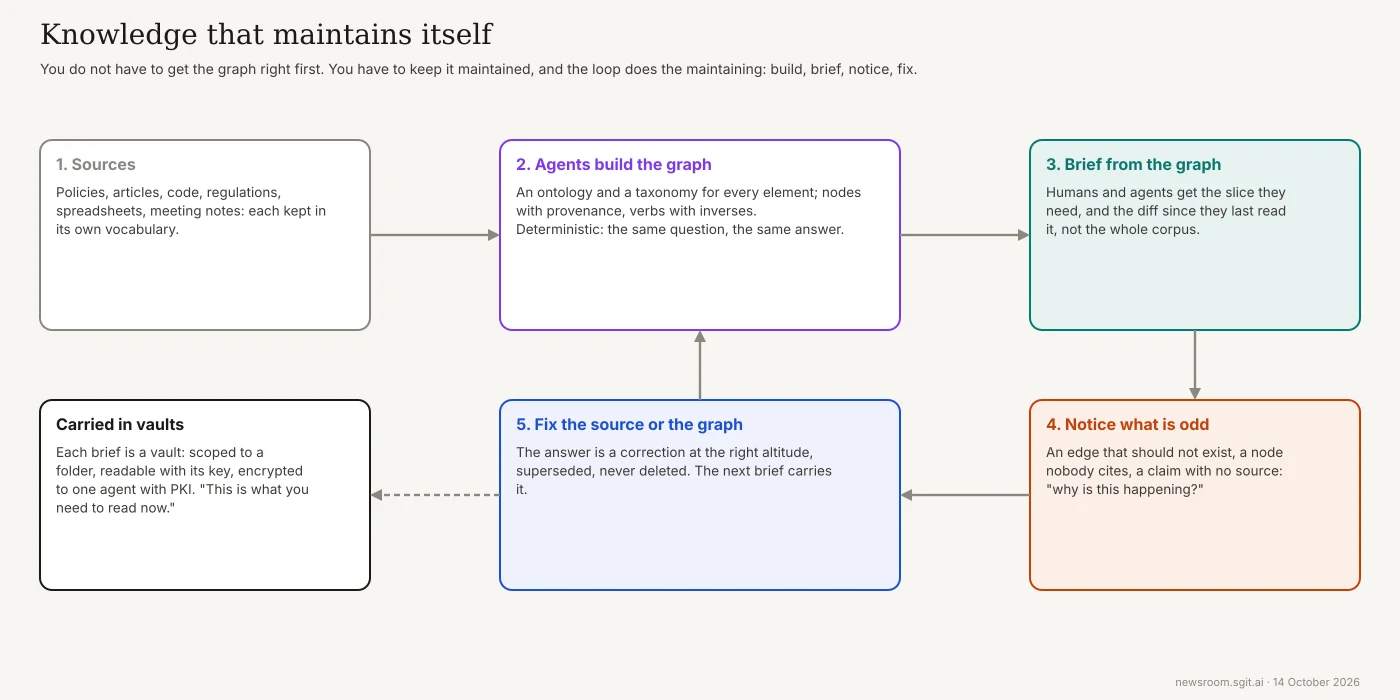
Knowledge that maintains itself: sources kept in their own vocabularies, agents that keep a semantic graph of them up to date, and people and agents briefed from the graph. From Knowledge that maintains itself.
diagram · behind 2 proposals
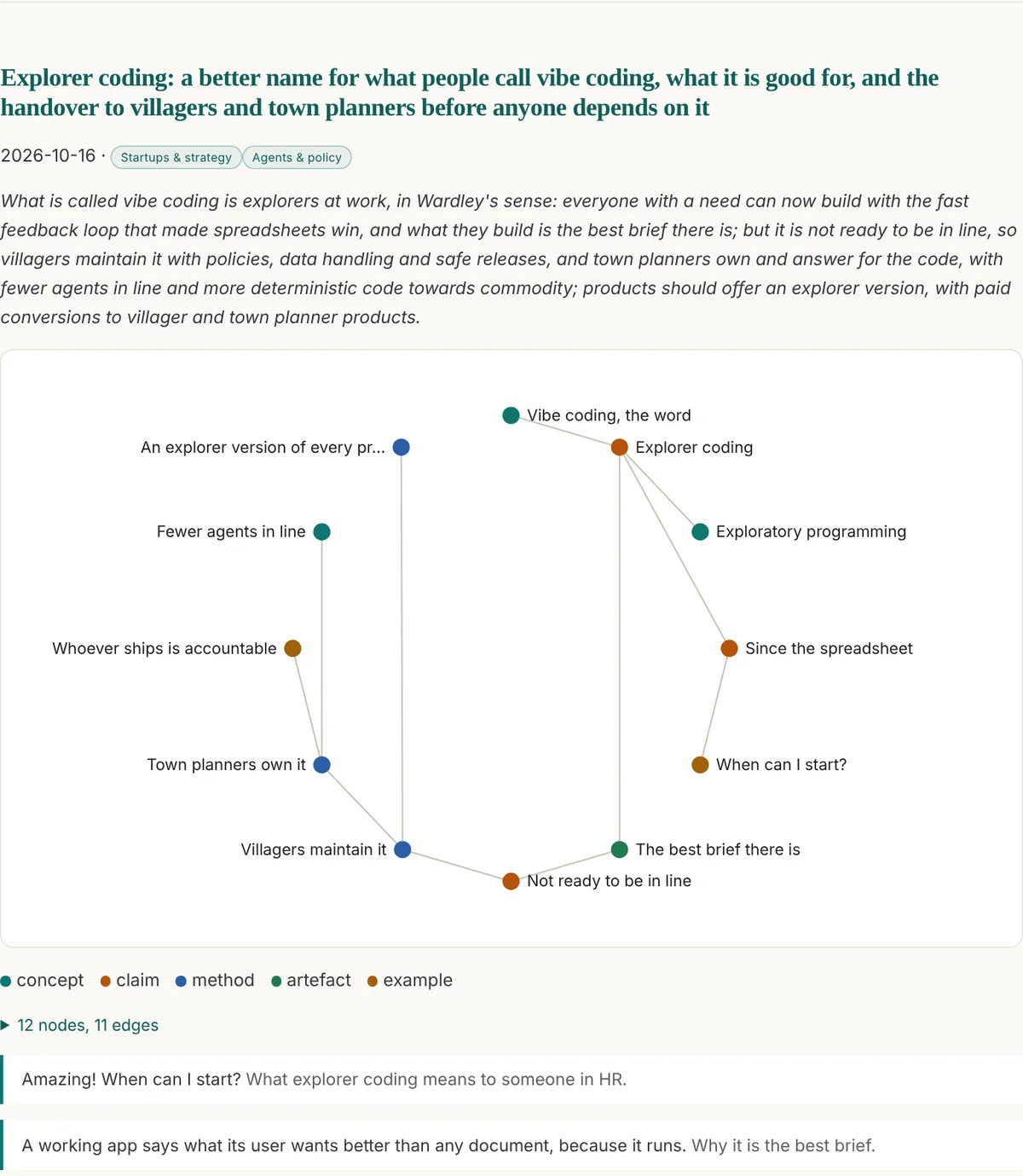
One article as a graph, as this site publishes it for every article: Explorer coding's twelve nodes, from "vibe coding, the word" to "town planners own it", with the edges between them and the quotes that carry them. A screenshot of the graphs page on newsroom.sgit.ai.
infographic · behind 2 proposals
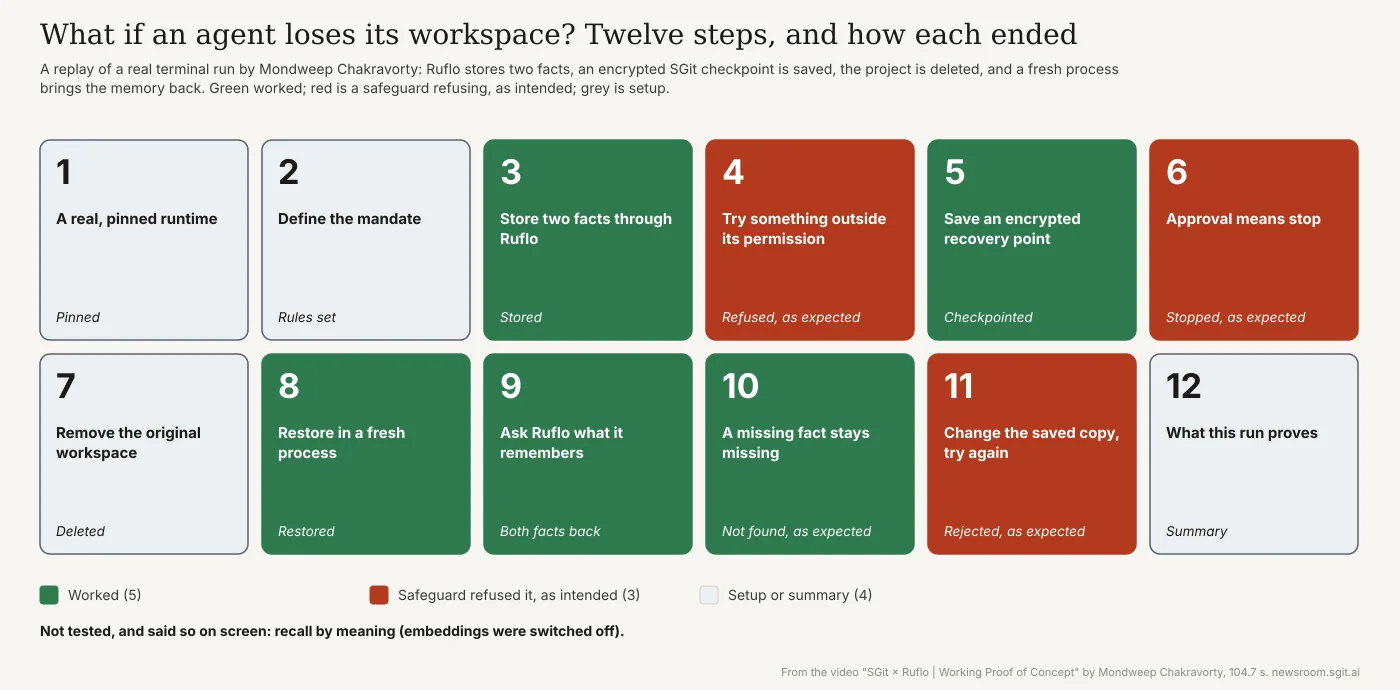
A prototype that is ready for the villagers: Mondweep Chakravorty's SGit × Ruflo run, twelve steps, five worked, three safeguards refused as intended, recall by meaning marked as not tested. From What if an agent loses its workspace?
infographic · behind 2 proposals
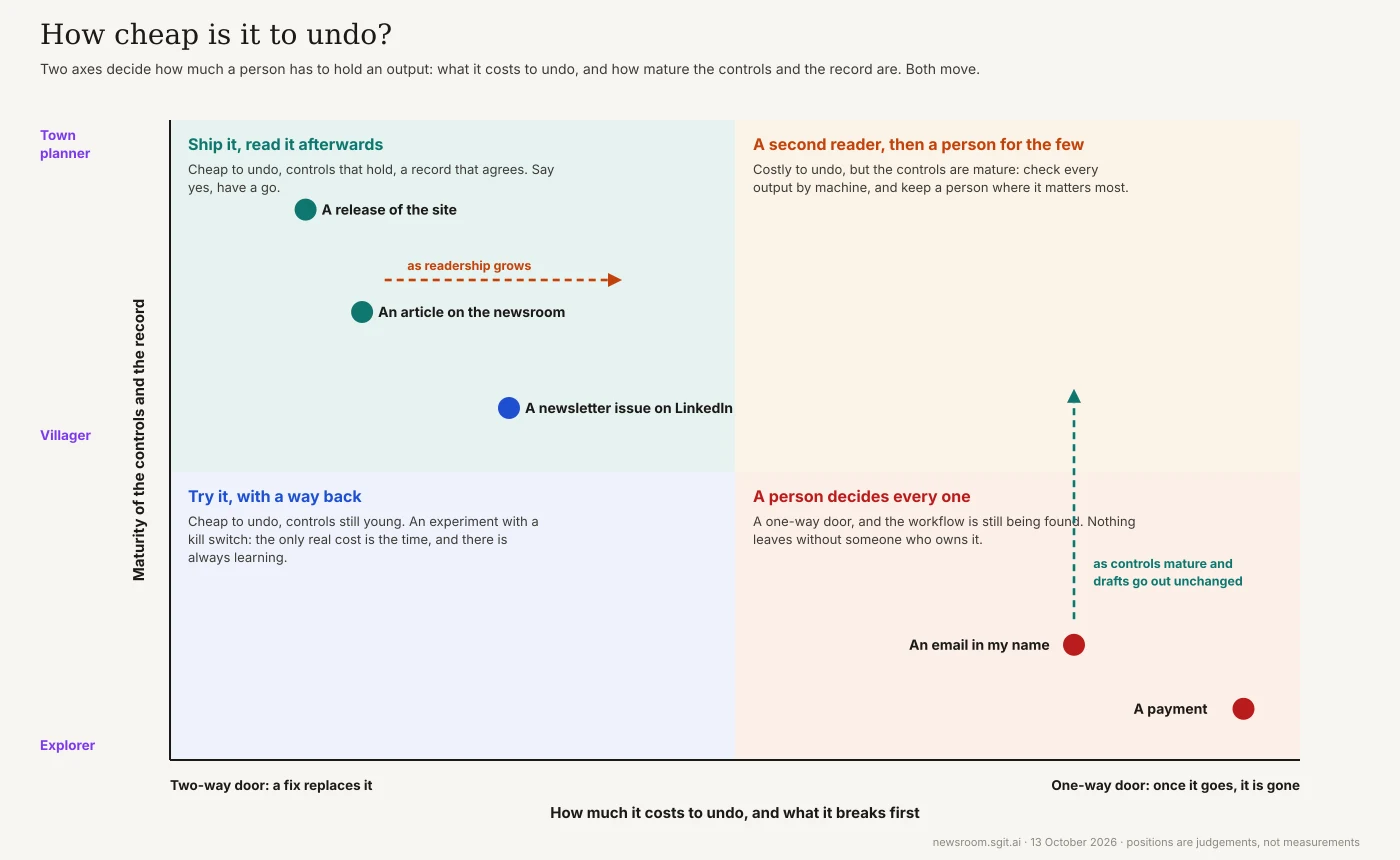
The spectrum: across, how much it costs to undo, from a two-way door to a one-way door; up, how mature the controls and the record are, from explorer to town planner. Where an output sits decides how much a person needs to be in the loop. From How cheap is it to undo?
infographic · behind 2 proposals
Two playbooks: the outsider who finds a gap, raises first and hires the experts; and the expert who lives the problem and builds it with agents. From The expert founders.
infographic · behind 5 proposals
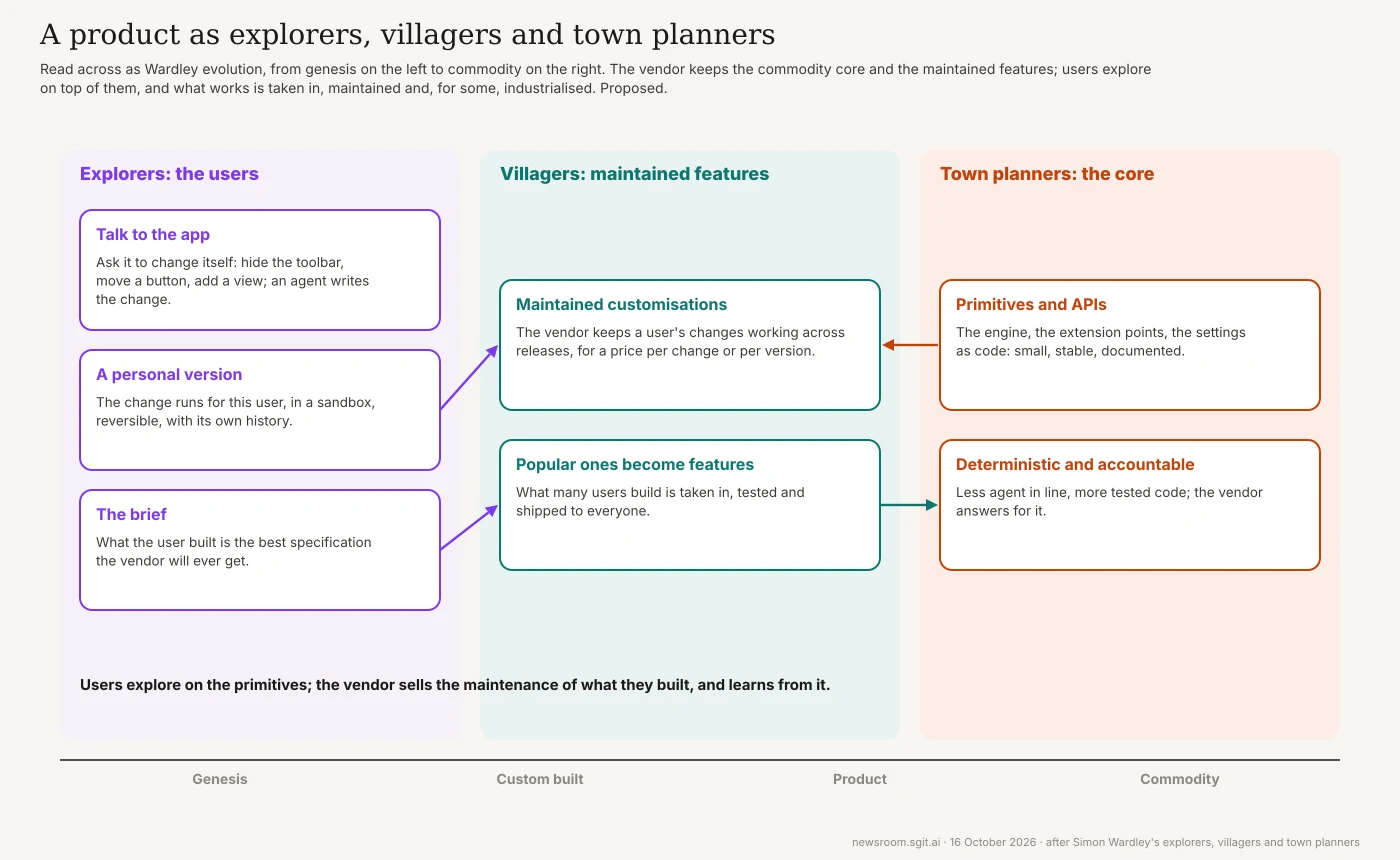
A product as explorers, villagers and town planners: users explore on top, talking to the app and writing the best brief the vendor will get; the vendor maintains the customisations, and runs the platform. From Software vendors should become villagers and town planners.
diagram · behind 2 proposals
Your own newsroom 2 figures

The article on newsroom.sgit.ai →
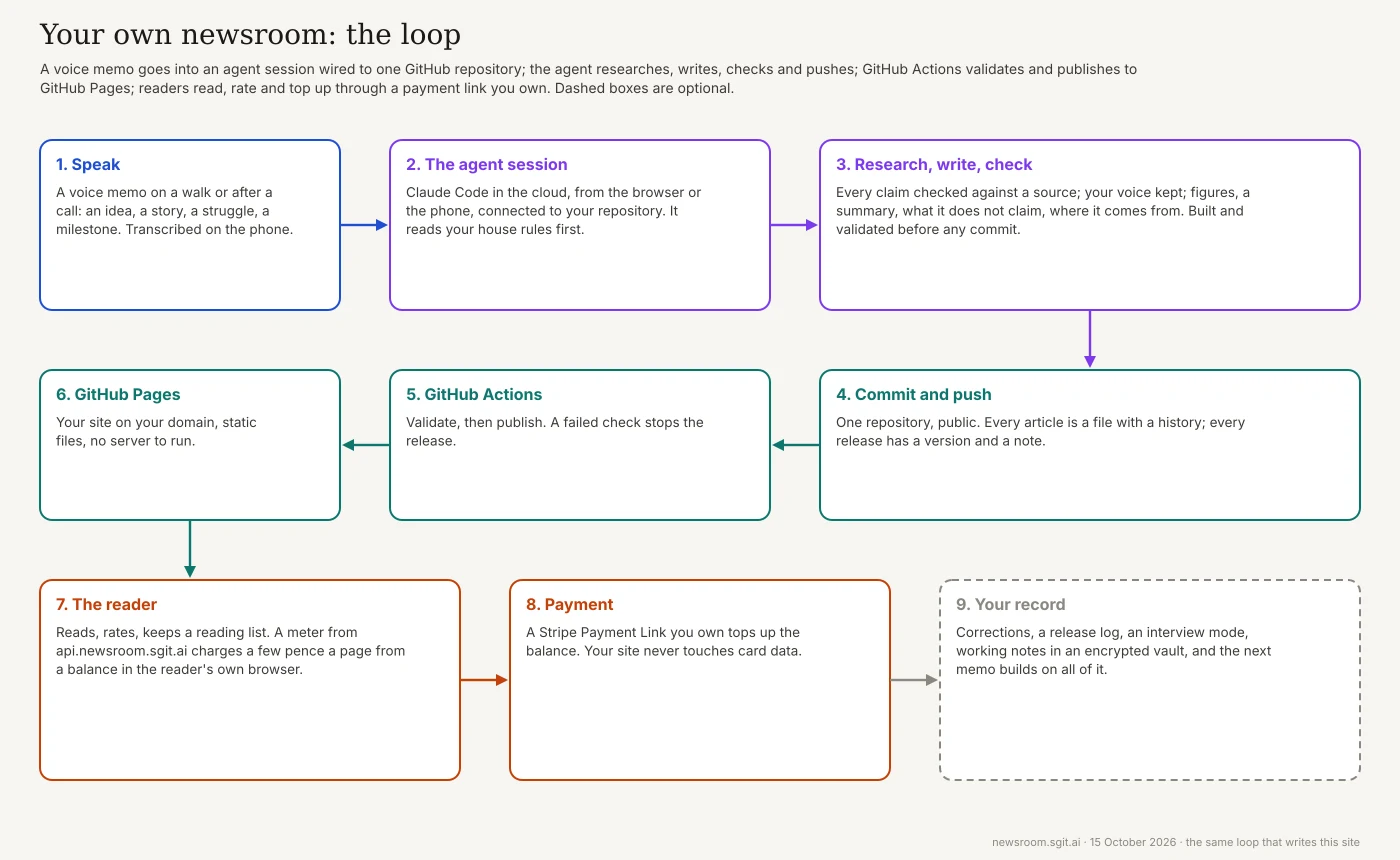
The loop: speak a memo; an agent session connected to one repository researches, writes and checks it; it commits and pushes; GitHub Actions validates and publishes to GitHub Pages; readers read, rate and top up through a payment link you own; and the record grows.
diagram · behind 2 proposals
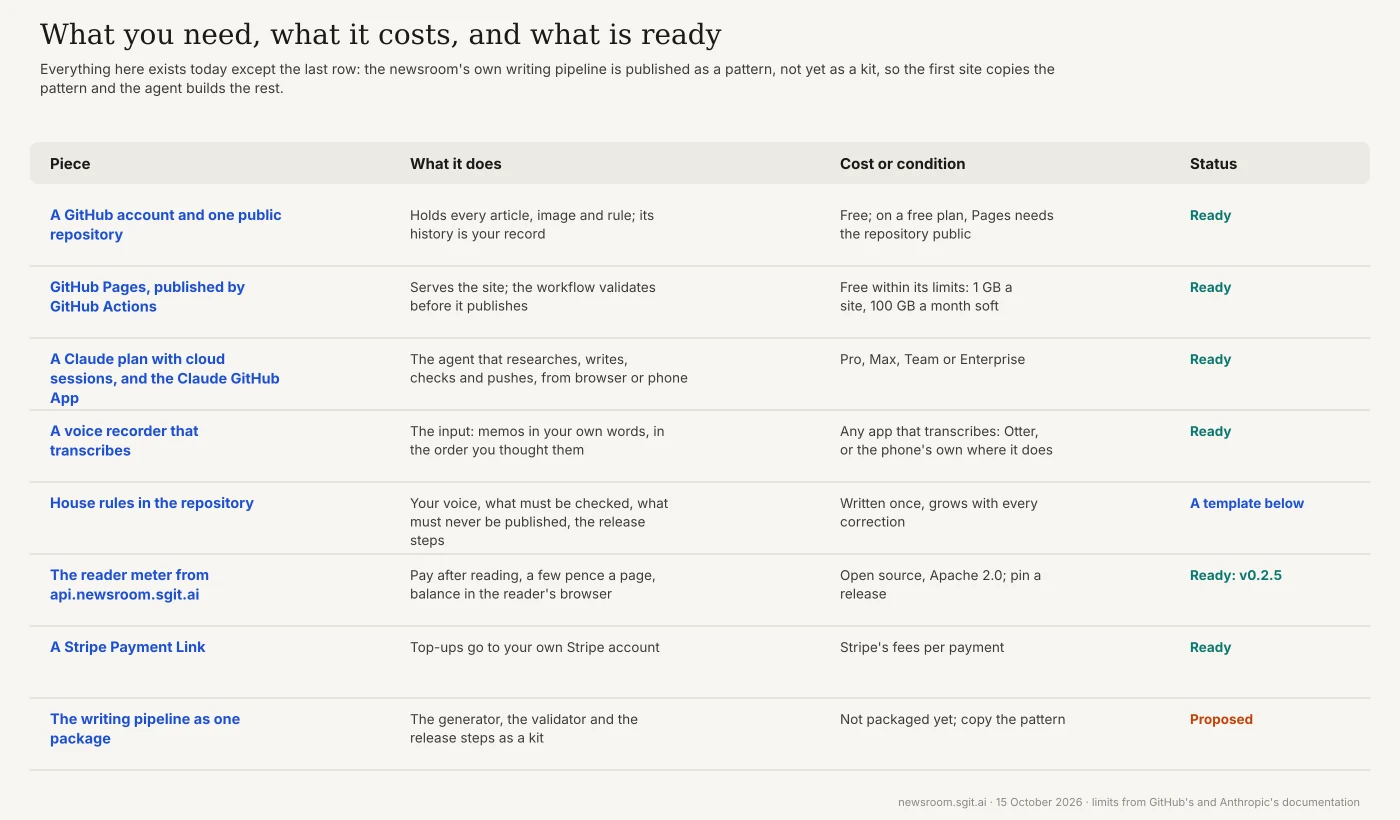
What you need, what it costs, and what is ready: a public GitHub repository, GitHub Pages published by GitHub Actions, a Claude plan with cloud sessions and the Claude GitHub App, a recorder that transcribes, house rules, the reader meter from api.newsroom.sgit.ai, a Stripe Payment Link; the writing
infographic · behind 2 proposals

The storyboards

Panels drawn by assets/storyboard.js from data, some of which are already infographics: evidence cards (a pinned quote or a bar chart), spectrums and graphs. A proposal that is a sequence of scenes with people is a storyboard, not an infographic, and is left to them.

Data: admin/content/infographics/v1-figures.json and newsroom.json, catalogued on 2026-10-19 from the newsroom's graphs.json.