gen-z-developers.sgit.ai → RC2 on paper
RC2 on paper: every page, every note
Dinis is reading the printed release candidate 2 with a pen. Each batch of photographs is a record and an article; this page puts them together: 19 pages, 143 notes, 13 themes, mapped to the chapter each page is in. Every note has its own address (#n52), the photograph it is on, its words as written and what they mean.
The pages
Each card opens the photograph with the notes boxed, numbered and typed.
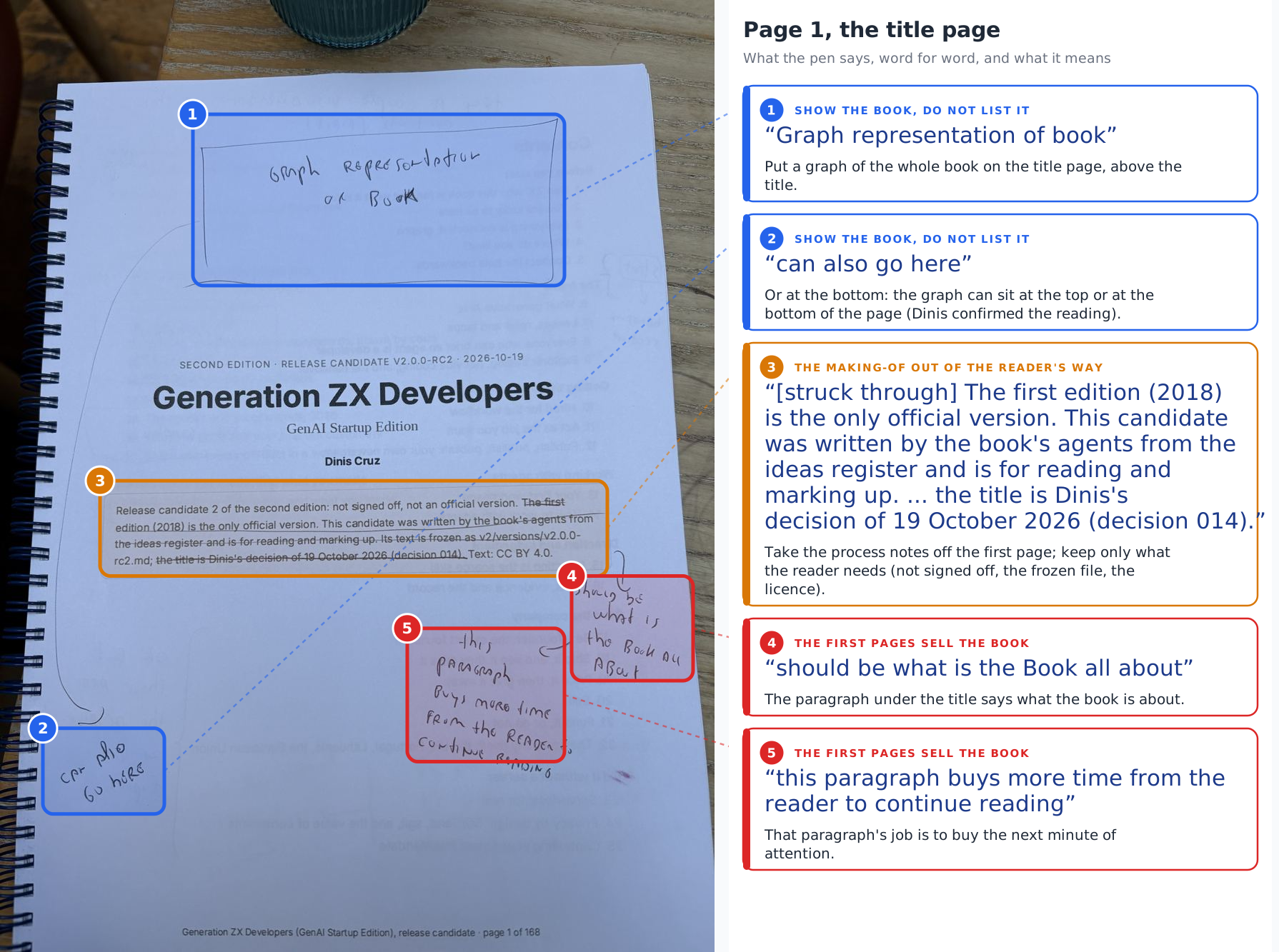 Page 1Front matternotes 1 to 5 · part 1
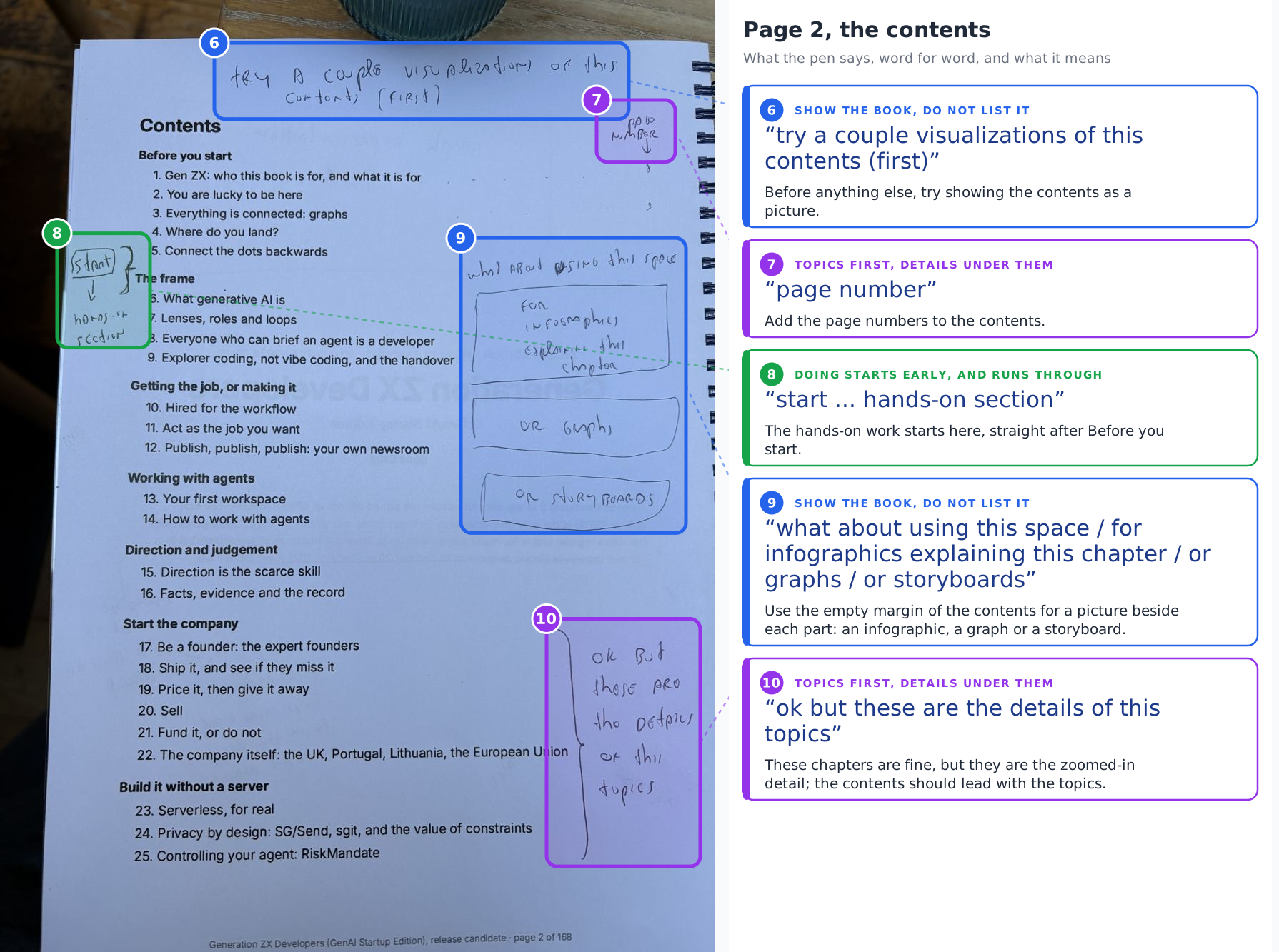 Page 2Front matternotes 6 to 10 · part 1
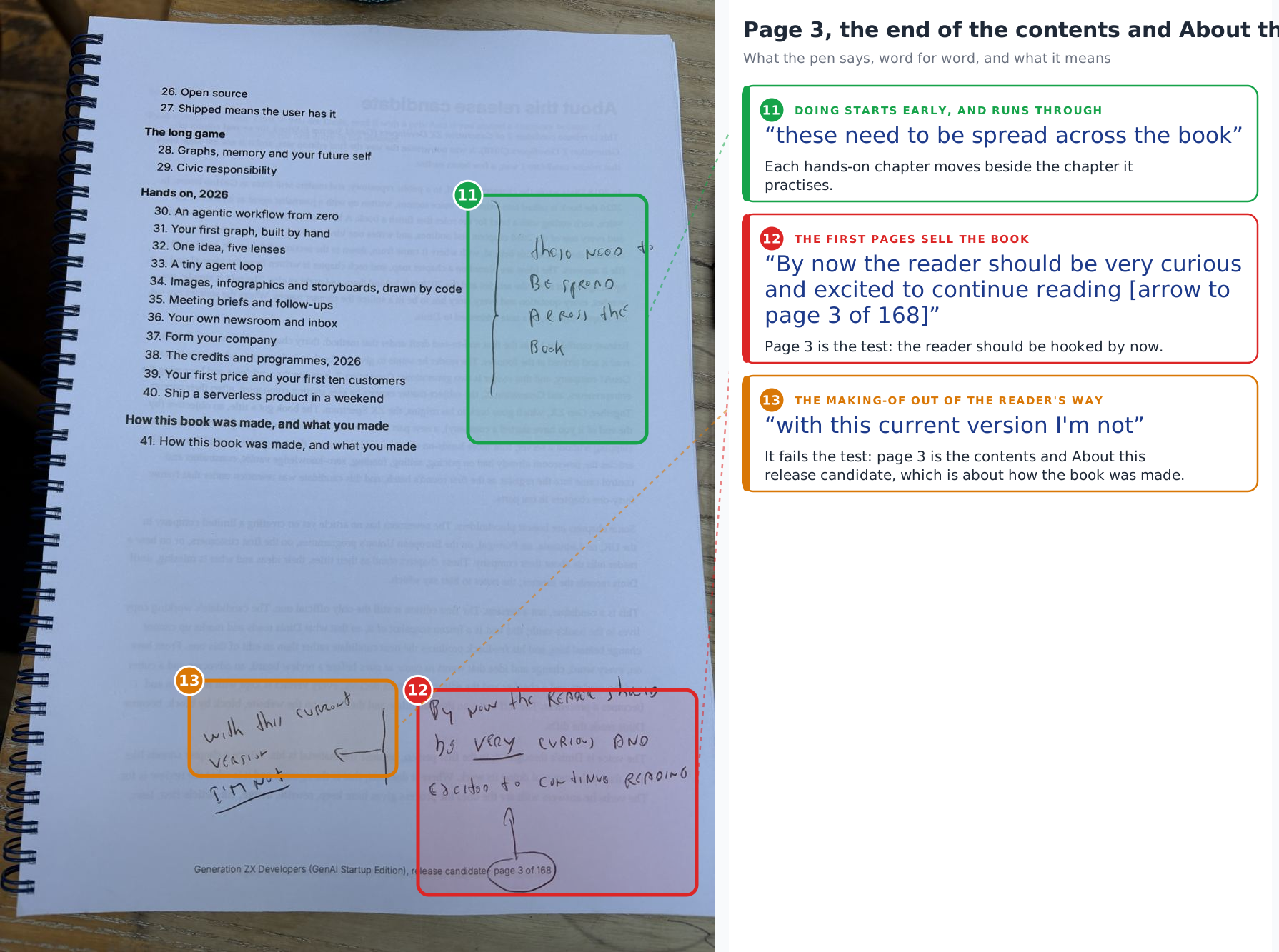 Page 3Front matternotes 11 to 13 · part 1
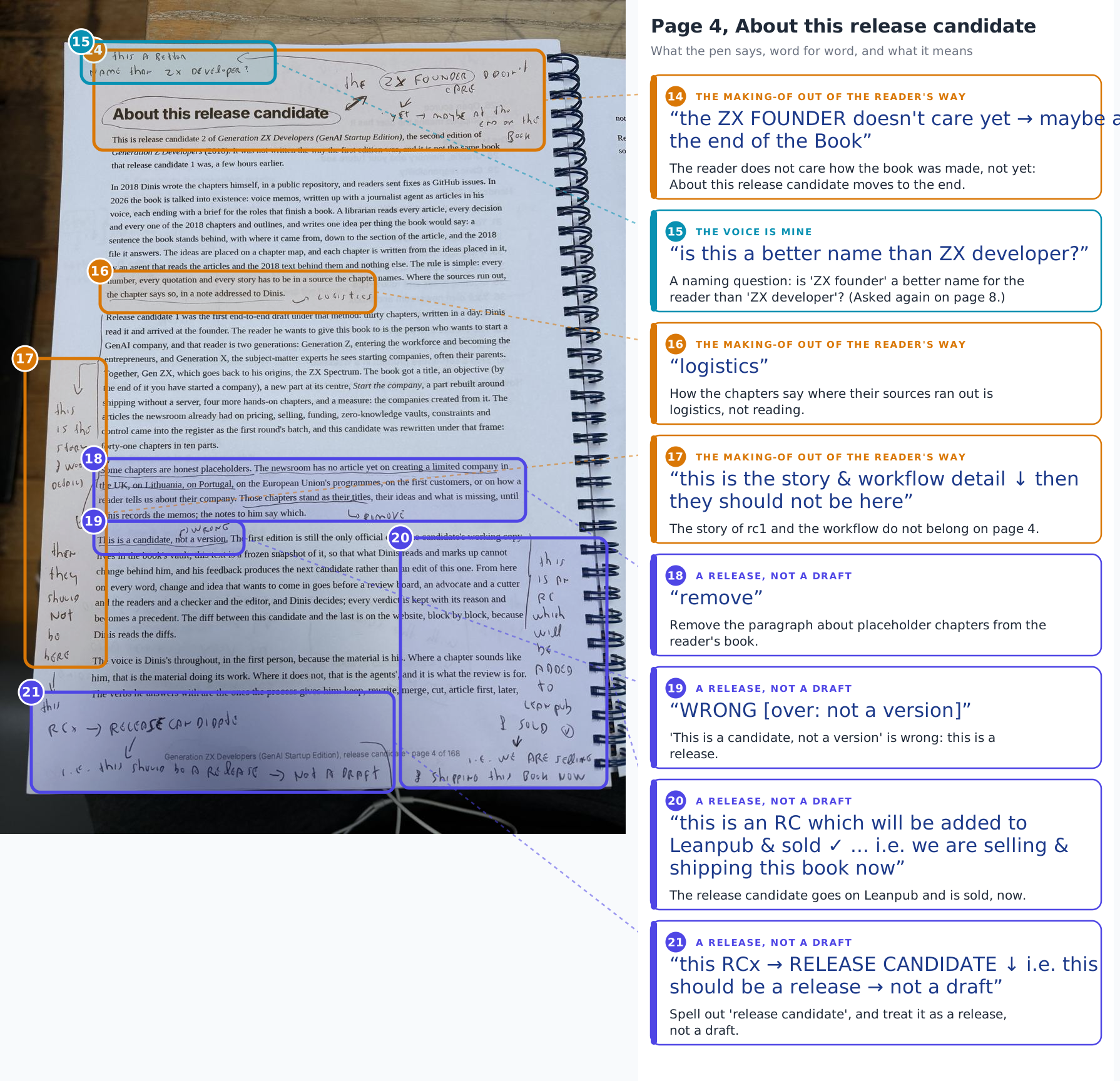 Page 4Front matternotes 14 to 21 · part 2
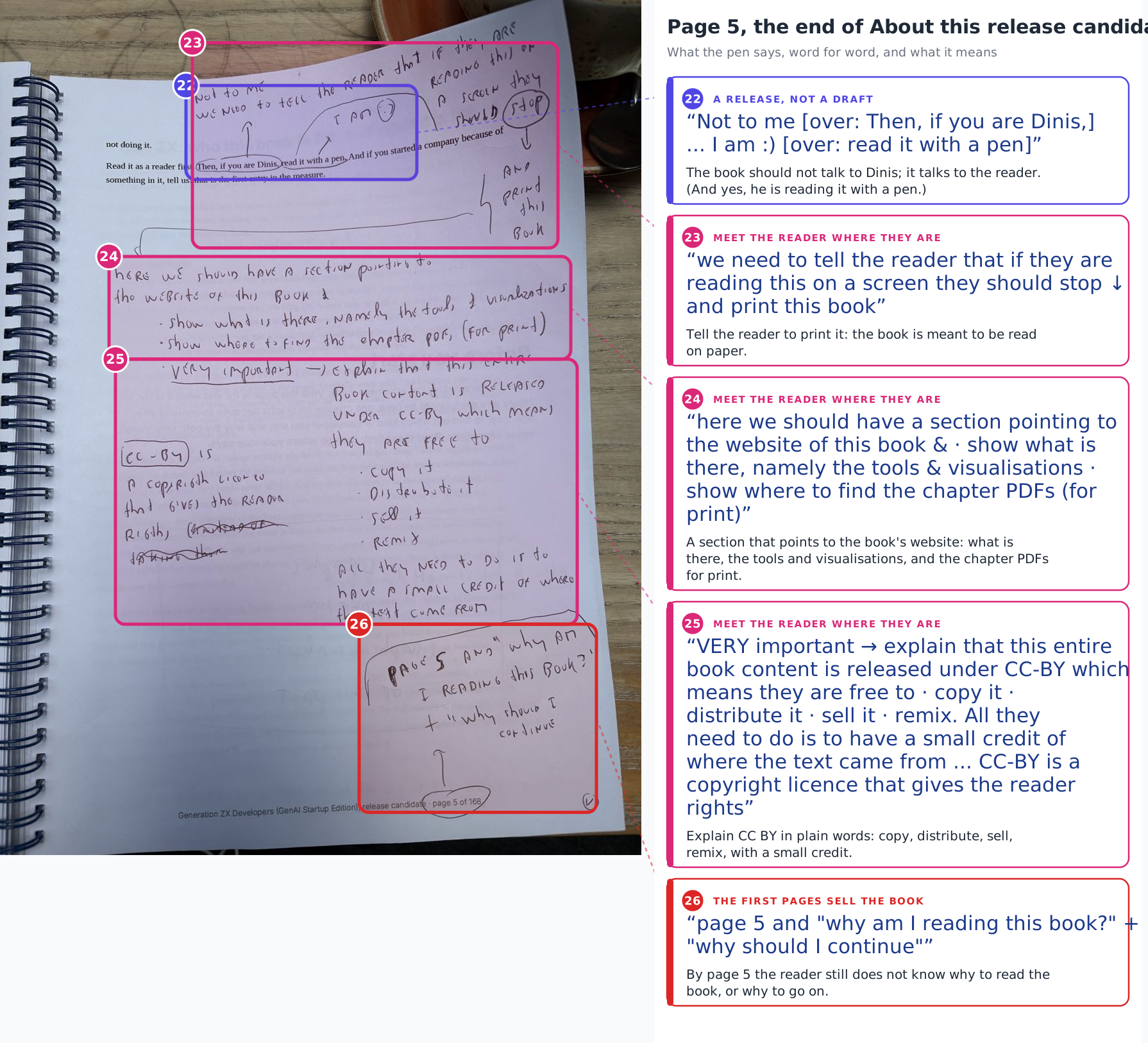 Page 5Front matternotes 22 to 26 · part 2
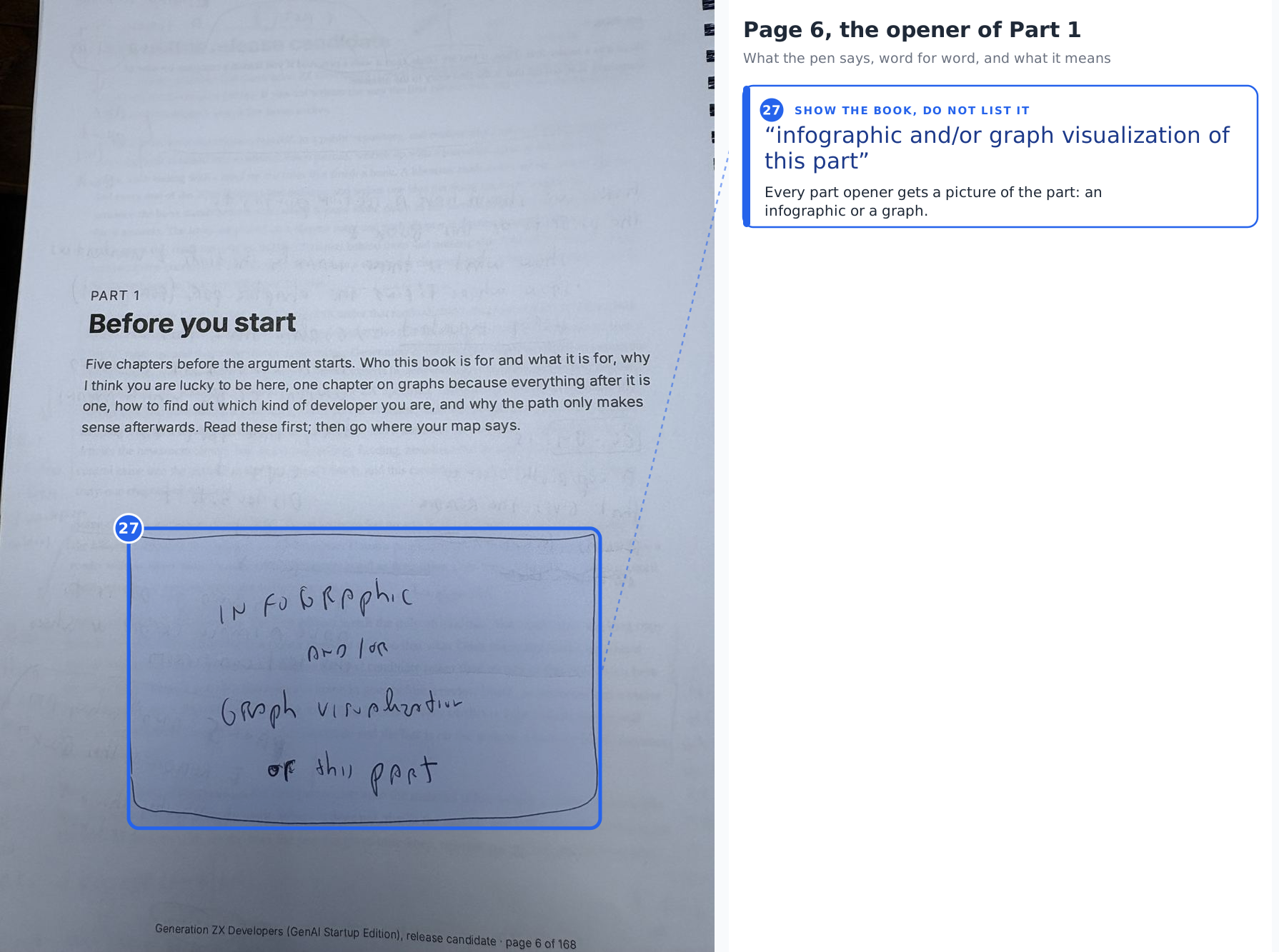 Page 6Front matternote 27 · part 2
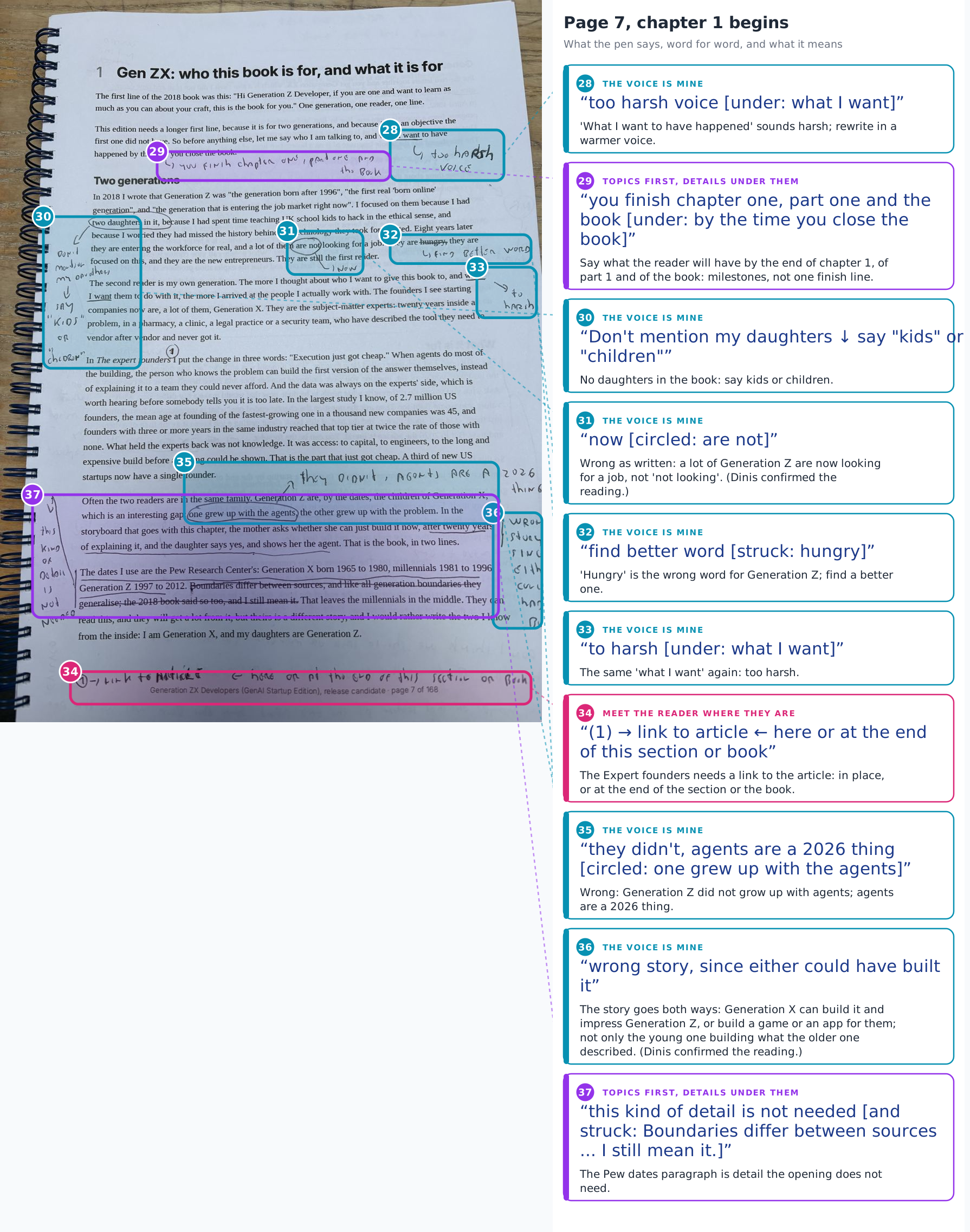 Page 71. Gen ZX: who this book is for, and what it is fornotes 28 to 37 · part 2
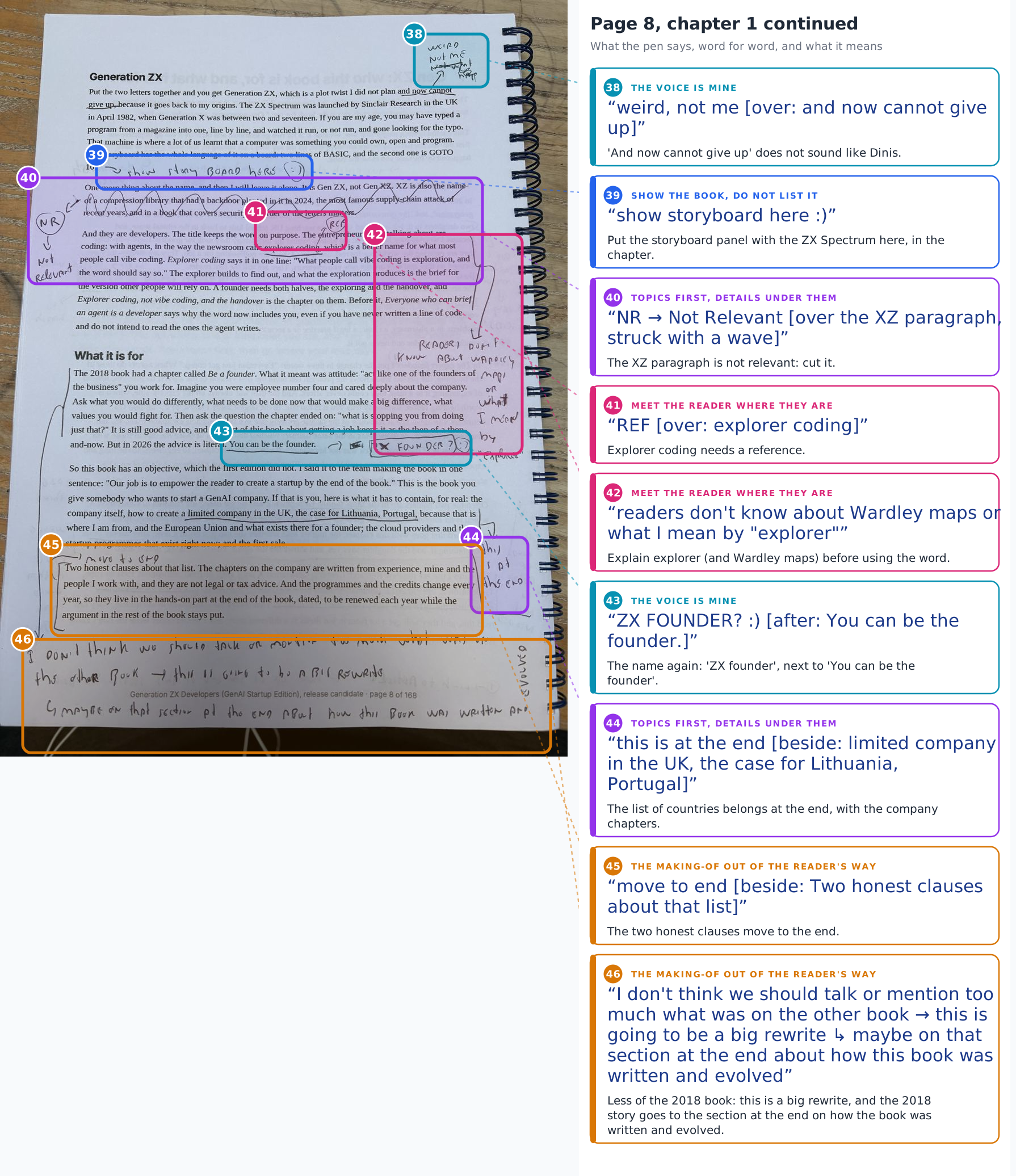 Page 81. Gen ZX: who this book is for, and what it is fornotes 38 to 46 · part 2
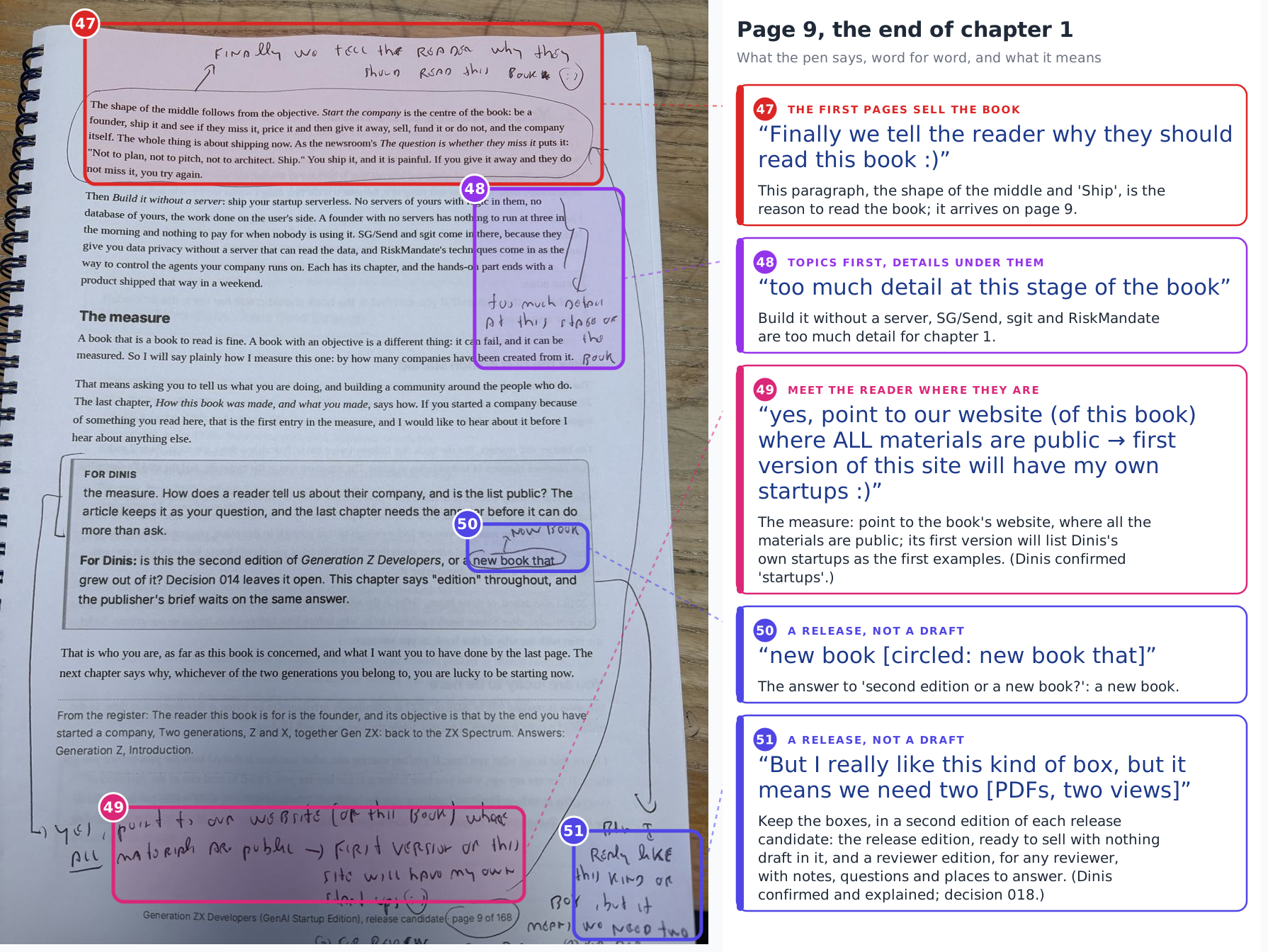 Page 91. Gen ZX: who this book is for, and what it is fornotes 47 to 51 · part 2
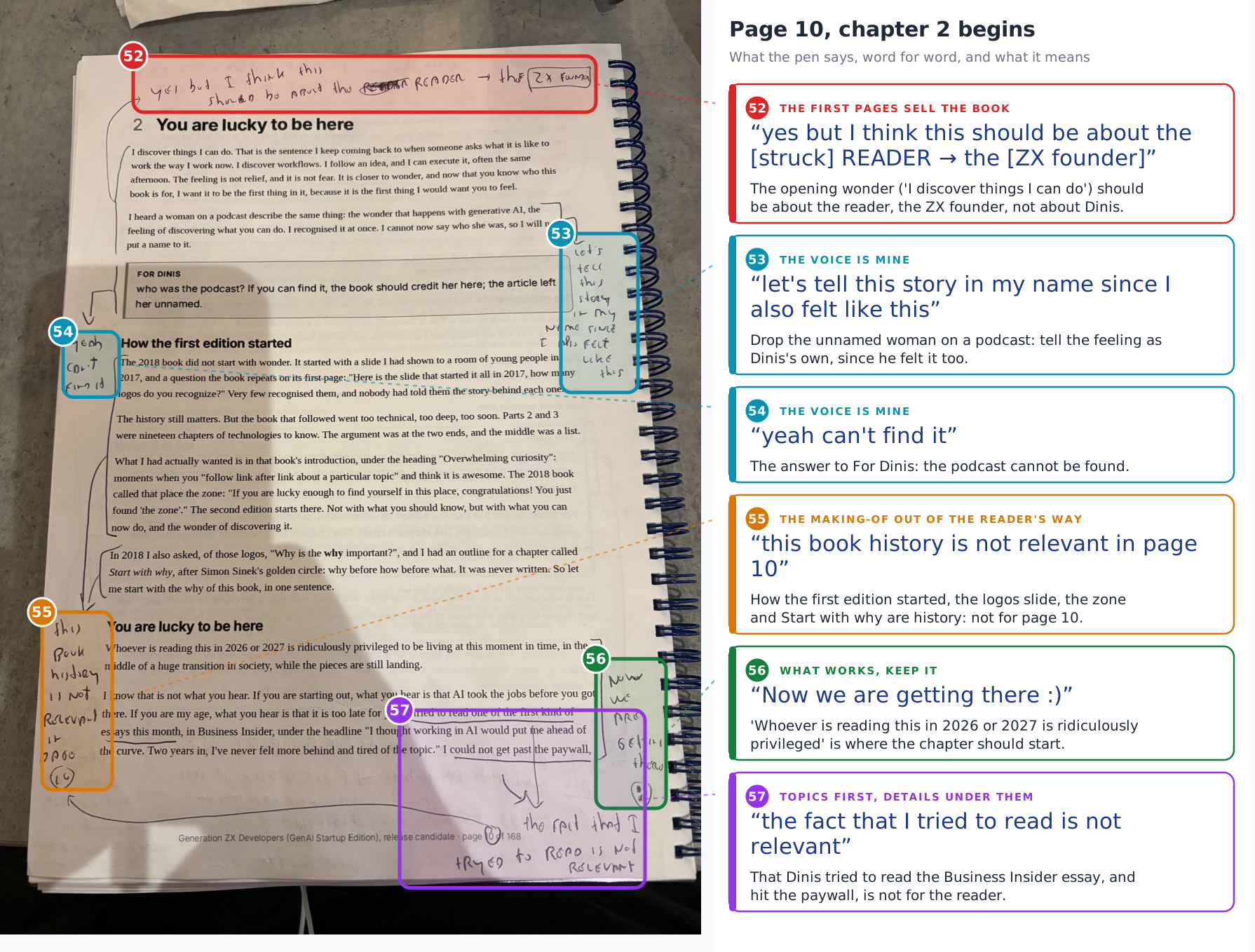 Page 102. You are lucky to be herenotes 52 to 57 · part 3
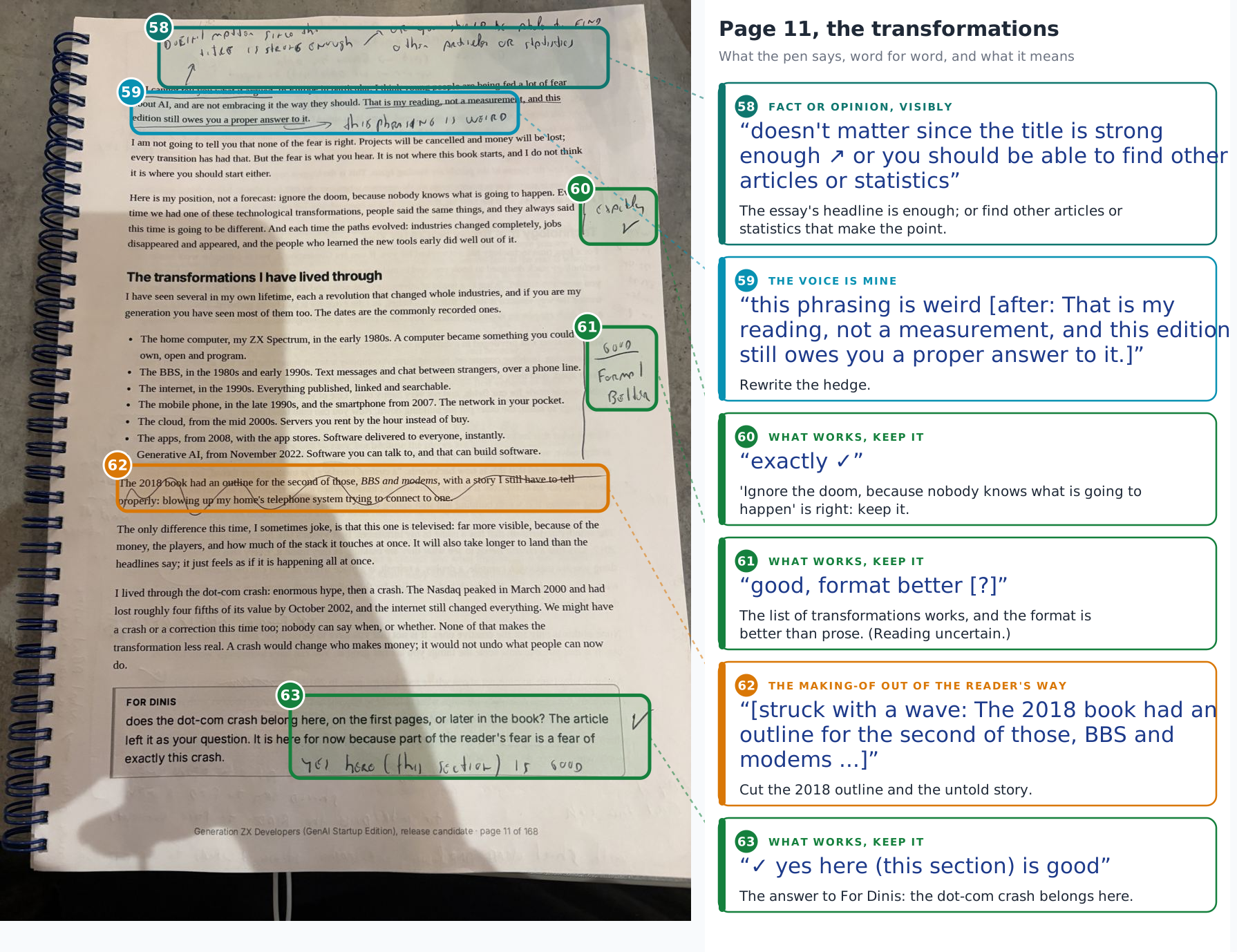 Page 112. You are lucky to be herenotes 58 to 63 · part 3
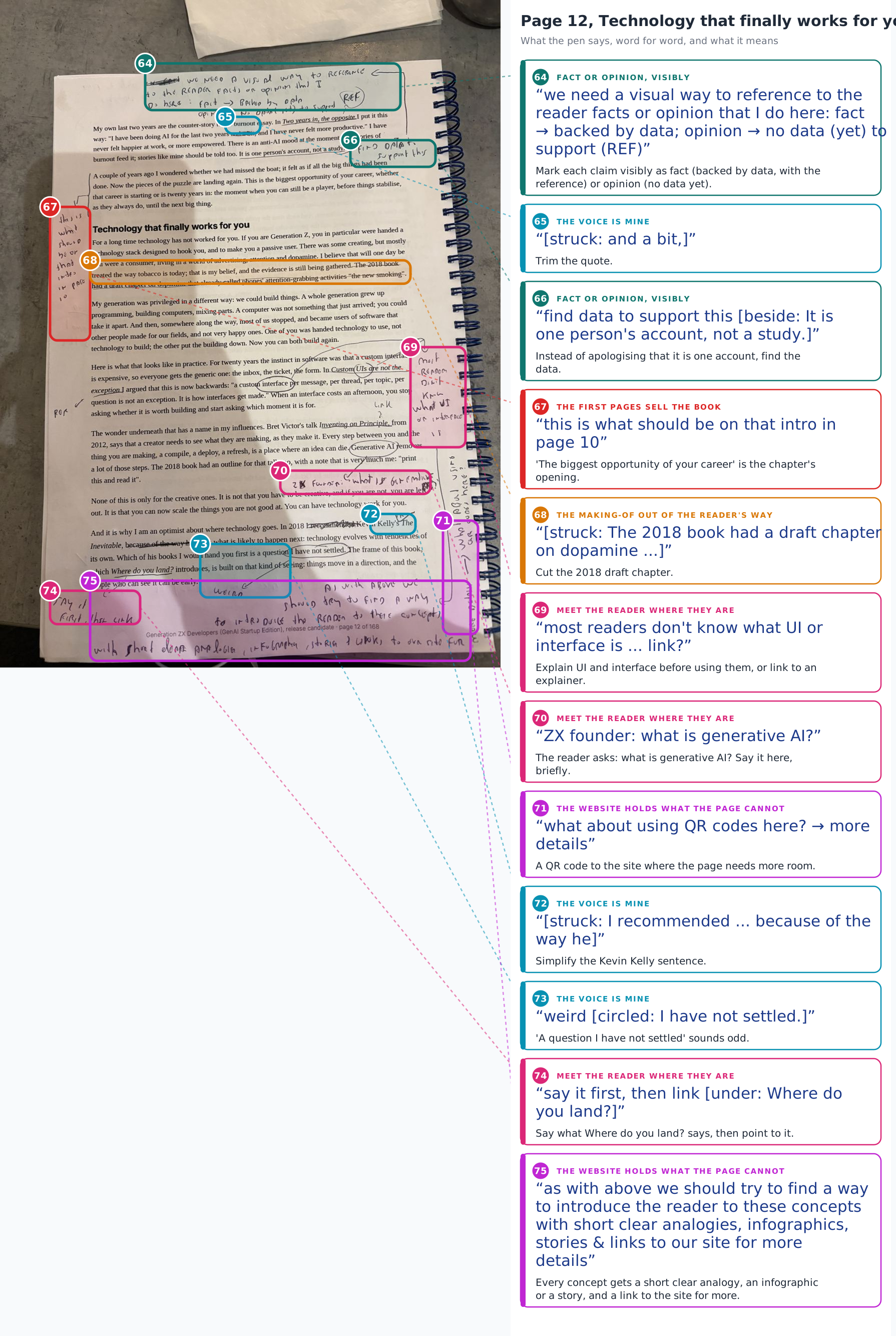 Page 122. You are lucky to be herenotes 64 to 75 · part 3
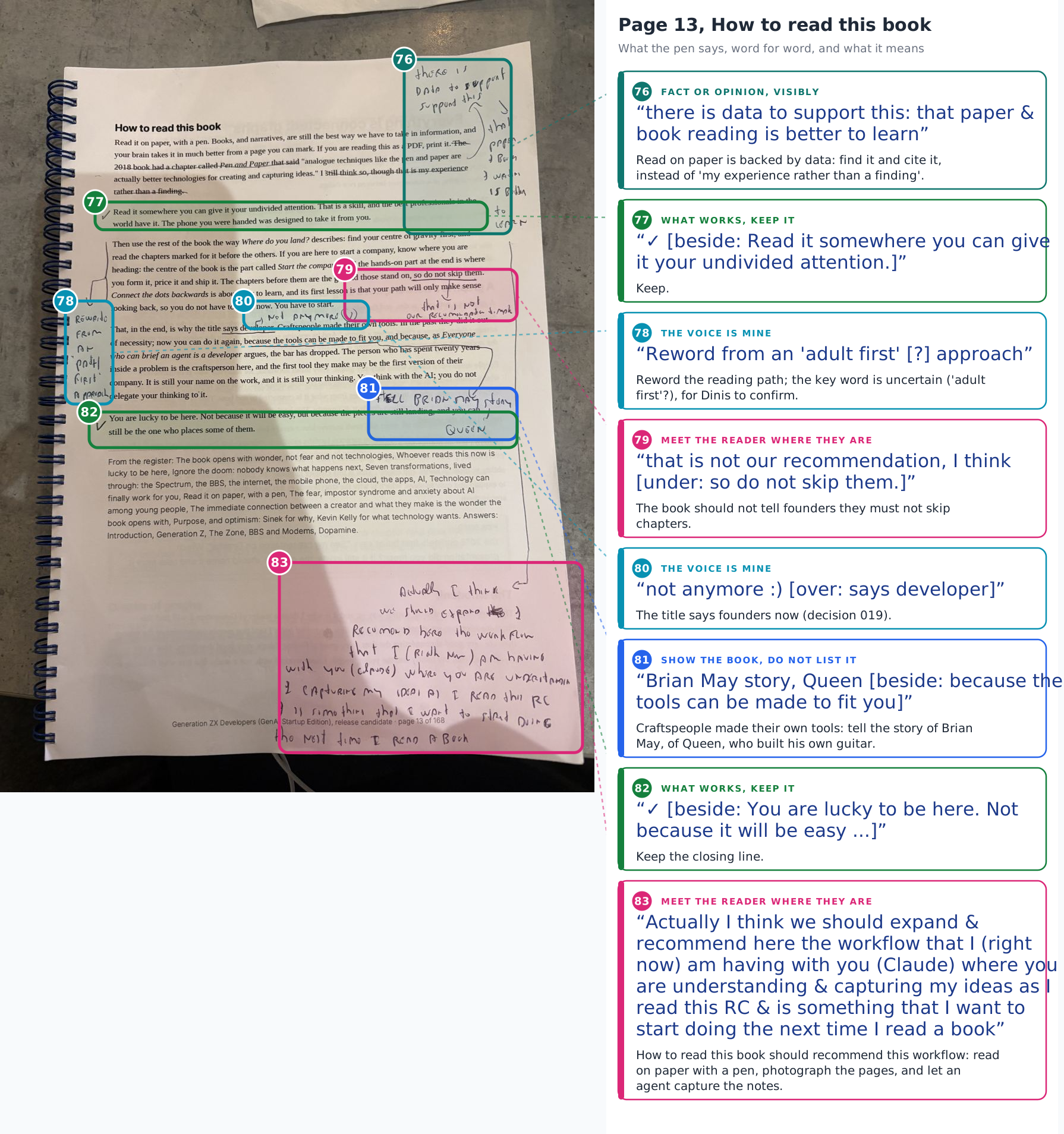 Page 132. You are lucky to be herenotes 76 to 83 · part 3
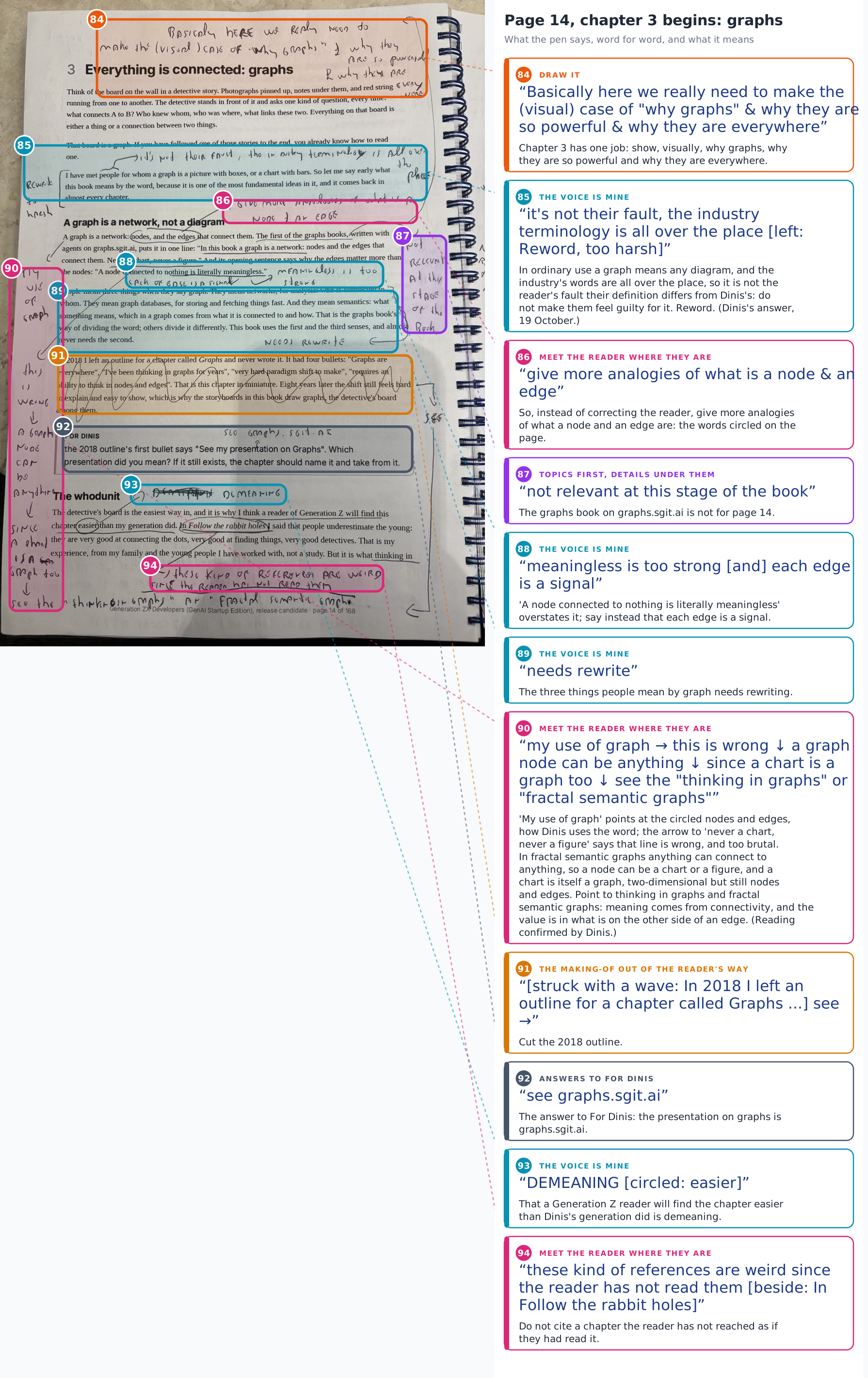 Page 143. Everything is connected: graphsnotes 84 to 94 · part 4
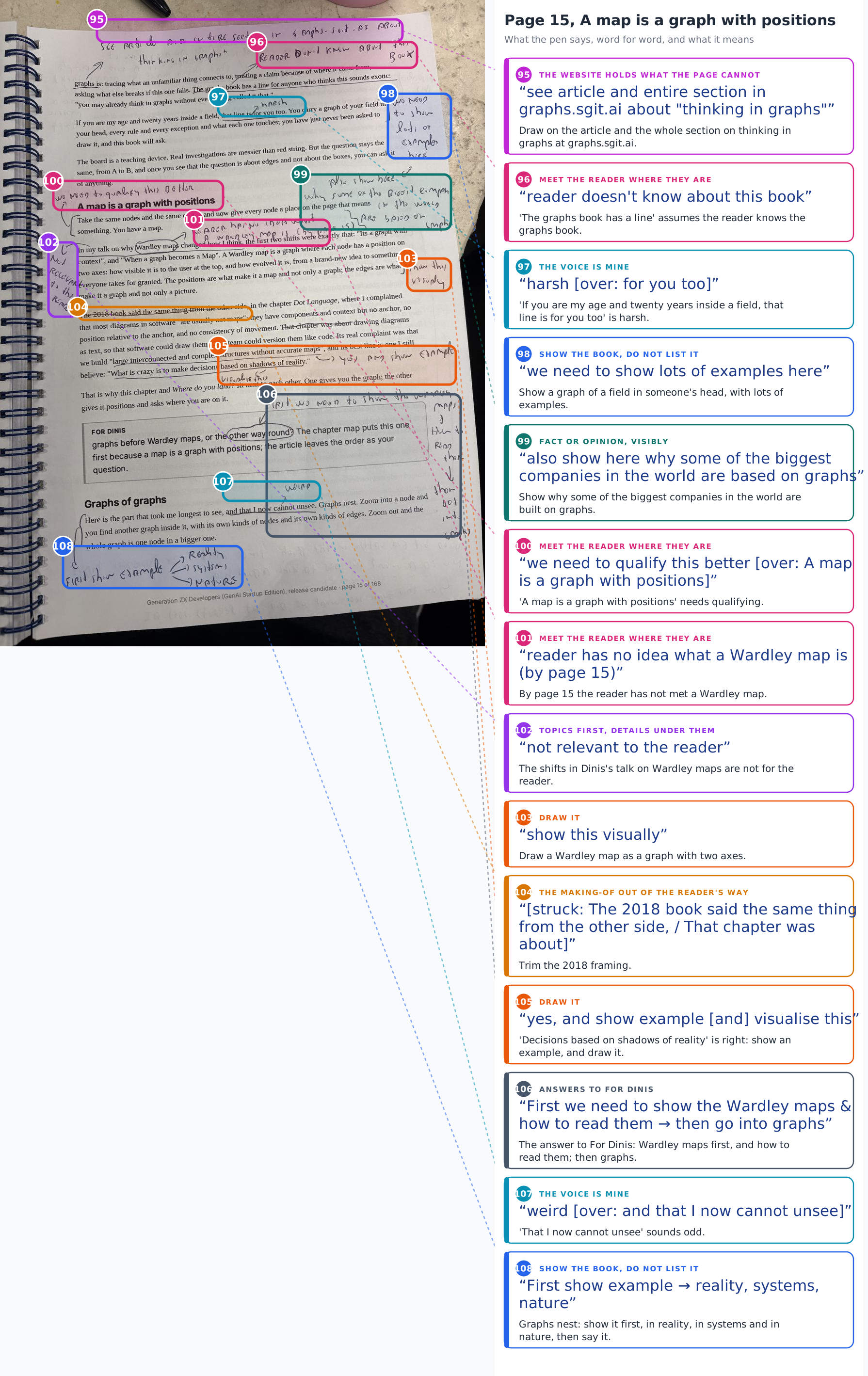 Page 153. Everything is connected: graphsnotes 95 to 108 · part 4
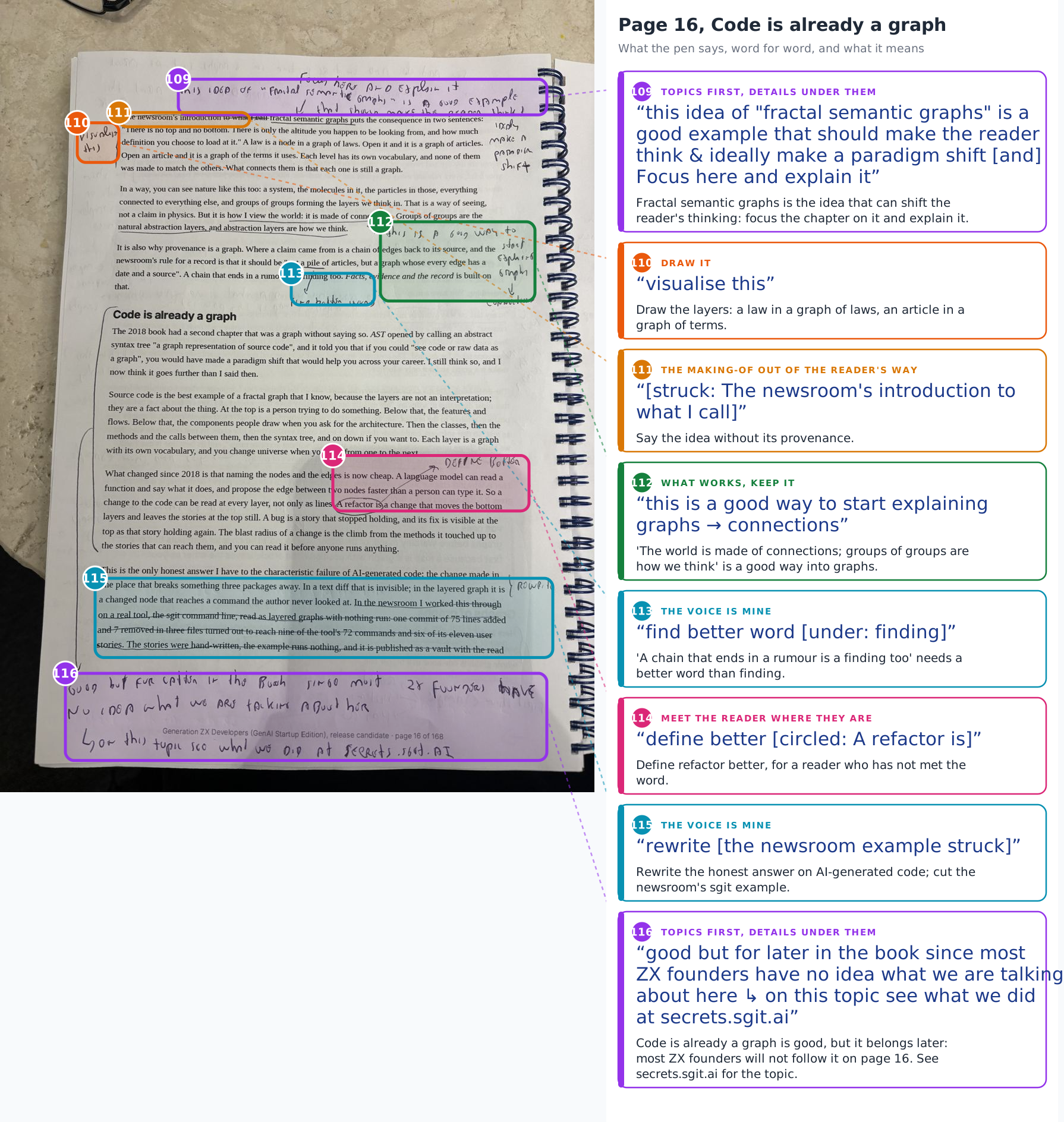 Page 163. Everything is connected: graphsnotes 109 to 116 · part 4
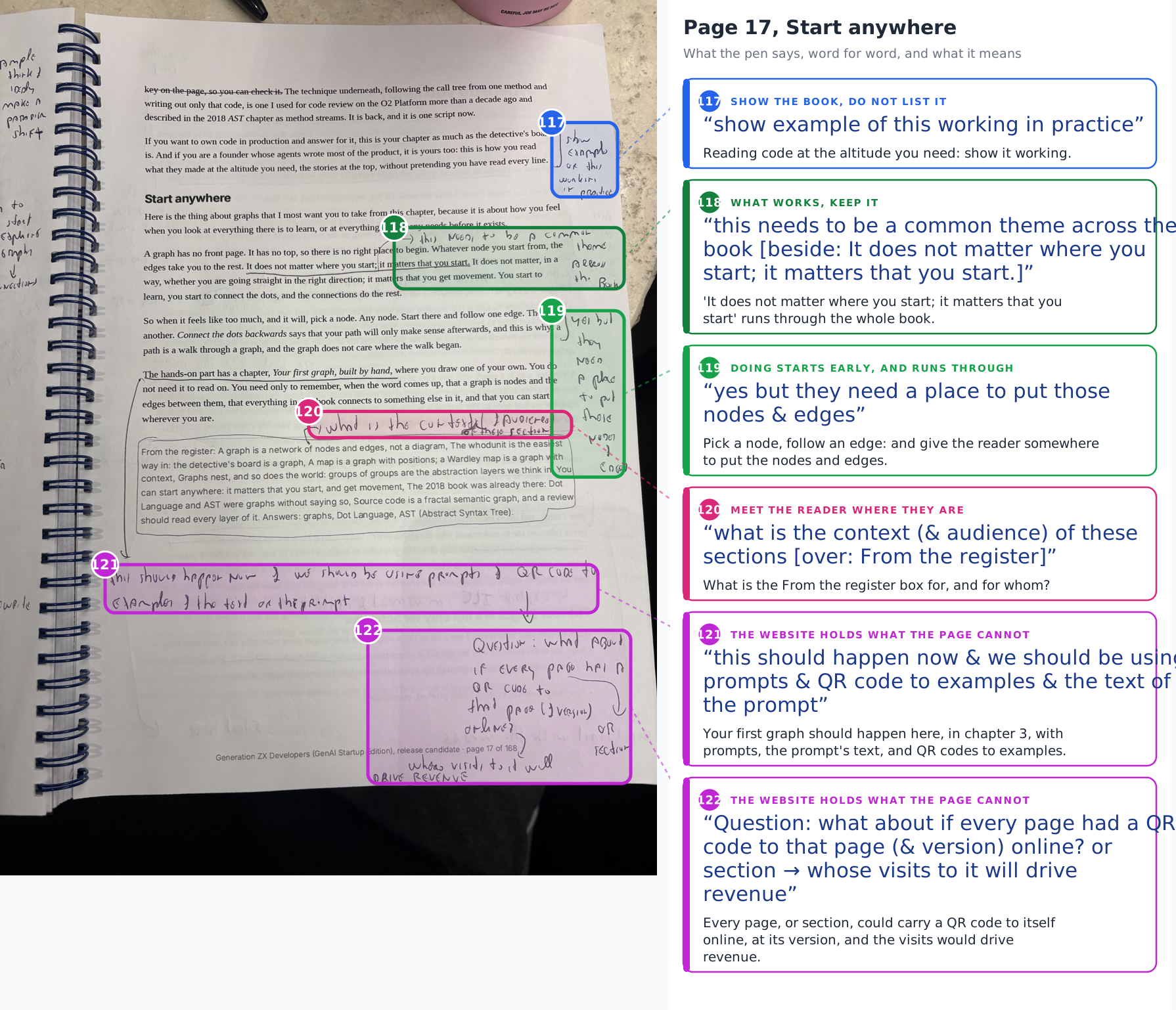 Page 173. Everything is connected: graphsnotes 117 to 122 · part 4
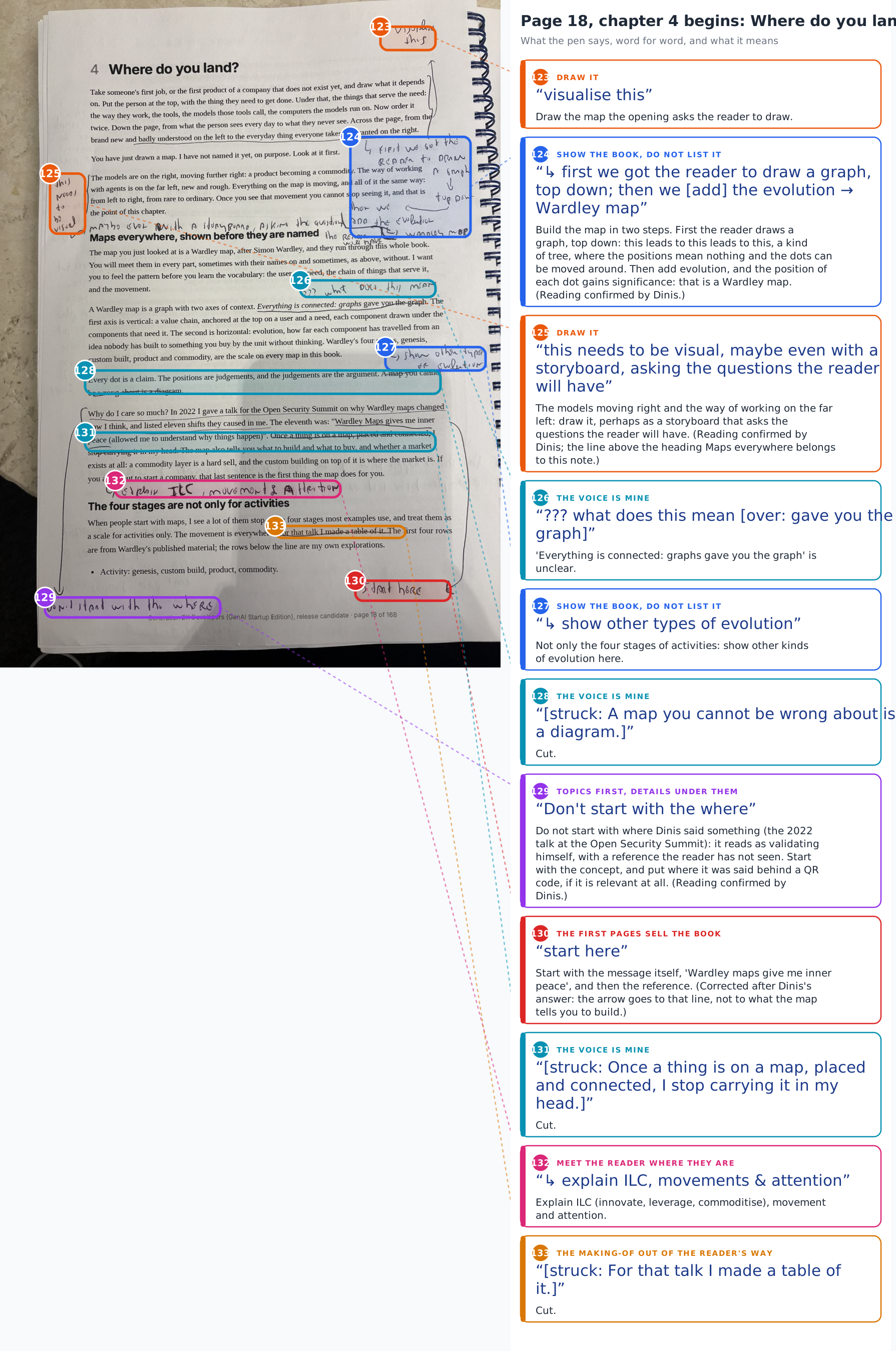 Page 184. Where do you land?notes 123 to 133 · part 4
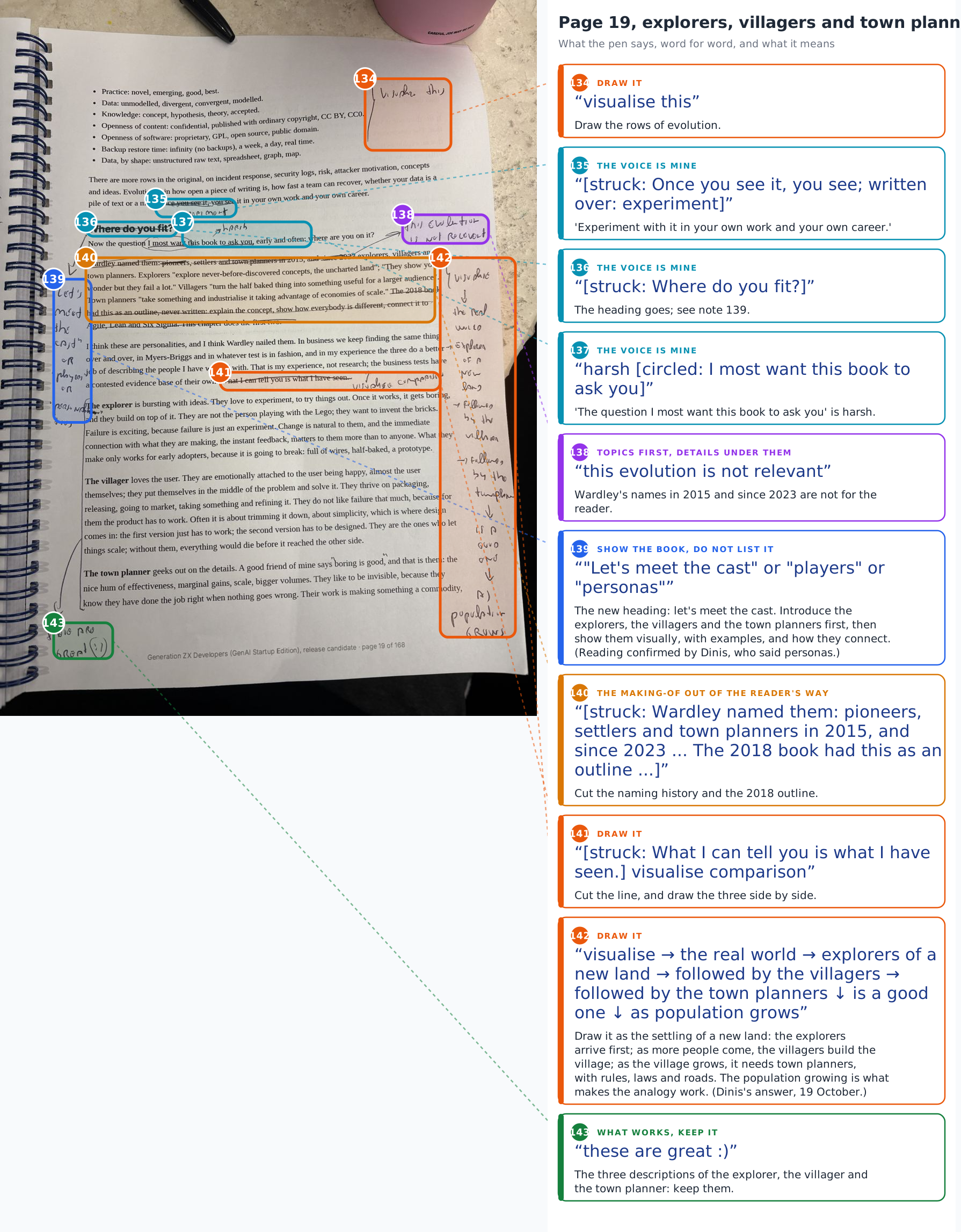 Page 194. Where do you land?notes 134 to 143 · part 4
Chapters by theme
| Chapter | Notes | |||||||||||||
|---|---|---|---|---|---|---|---|---|---|---|---|---|---|---|
| Front matter | 4 | 5 | 2 | 2 | 5 | 1 | 3 | 5 | 27 | |||||
| 1. Gen ZX: who this book is for, and what it is for | 1 | 1 | 5 | 2 | 9 | 4 | 2 | 24 | ||||||
| 2. You are lucky to be here | 2 | 1 | 1 | 3 | 8 | 5 | 4 | 2 | 6 | 32 | ||||
| 3. Everything is connected: graphs | 3 | 1 | 4 | 3 | 8 | 8 | 1 | 3 | 2 | 2 | 4 | 39 | ||
| 4. Where do you land? | 1 | 3 | 2 | 2 | 6 | 1 | 1 | 5 | 21 |
- The first pages sell the book (8): The opening is about the reader, and the reason to read comes first (Zoom in, not discover).
- Show the book, do not list it (13): A story or a picture where an argument would do less.
- Doing starts early, and runs through (3): A manual, not a journey: you learn by doing, so you start doing early (Zoom in, not discover).
- Topics first, details under them (14): Detail the point does not need is cut (Zoom in, not discover).
- The making-of out of the reader's way (15): The 2018 book and its outlines go to the section at the end.
- The voice is mine (32): Lines that sound odd, hedged or not like Dinis are rewritten.
- Meet the reader where they are (21): Explain a term before using it, with a short analogy, and say it first, then link.
- A release, not a draft (7): The release candidate is shipped and sold; it should read as a book, not as a working document.
- Fact or opinion, visibly (5): The reader can see which claims are backed by data and which are Dinis's opinion, and the data is found (Follow the rabbit holes).
- The website holds what the page cannot (5): Where the book needs more room, a QR code sends the reader to the site: the source, the explainer, the visualisation.
- What works, keep it (9): The ticks: what the pen approves is kept, and the format it likes is used again.
- Answers to For Dinis (2): Where the candidate asked Dinis a question in a For Dinis box, the pen answers it, and the next candidate acts on the answer.
- Draw it (9): Where an idea is a shape (a graph, a map, an evolution, a comparison), the book draws it instead of describing it.
Every note
Theme
Chapter
143 shown
| # | Page | Theme | Written | What it means | |
|---|---|---|---|---|---|
| 1 | p. 1 Front matter | Show the book, do not list it | Graph representation of book | Put a graph of the whole book on the title page, above the title. | article |
| 2 | p. 1 Front matter | Show the book, do not list it | can also go here | Or at the bottom: the graph can sit at the top or at the bottom of the page (Dinis confirmed the reading). | article |
| 3 | p. 1 Front matter | The making-of out of the reader's way | [struck through] The first edition (2018) is the only official version. This candidate was written by the book's agents from the ideas register and is for reading and marking up. ... the title is Dinis's decision of 19 October 2026 (decision 014). | Take the process notes off the first page; keep only what the reader needs (not signed off, the frozen file, the licence). | article |
| 4 | p. 1 Front matter | The first pages sell the book | should be what is the Book all about | The paragraph under the title says what the book is about. | article |
| 5 | p. 1 Front matter | The first pages sell the book | this paragraph buys more time from the reader to continue reading | That paragraph's job is to buy the next minute of attention. | article |
| 6 | p. 2 Front matter | Show the book, do not list it | try a couple visualizations of this contents (first) | Before anything else, try showing the contents as a picture. | article |
| 7 | p. 2 Front matter | Topics first, details under them | page number | Add the page numbers to the contents. | article |
| 8 | p. 2 Front matter | Doing starts early, and runs through | start ... hands-on section | The hands-on work starts here, straight after Before you start. | article |
| 9 | p. 2 Front matter | Show the book, do not list it | what about using this space / for infographics explaining this chapter / or graphs / or storyboards | Use the empty margin of the contents for a picture beside each part: an infographic, a graph or a storyboard. | article |
| 10 | p. 2 Front matter | Topics first, details under them | ok but these are the details of this topics | These chapters are fine, but they are the zoomed-in detail; the contents should lead with the topics. | article |
| 11 | p. 3 Front matter | Doing starts early, and runs through | these need to be spread across the book | Each hands-on chapter moves beside the chapter it practises. | article |
| 12 | p. 3 Front matter | The first pages sell the book | By now the reader should be very curious and excited to continue reading [arrow to page 3 of 168] | Page 3 is the test: the reader should be hooked by now. | article |
| 13 | p. 3 Front matter | The making-of out of the reader's way | with this current version I'm not | It fails the test: page 3 is the contents and About this release candidate, which is about how the book was made. | article |
| 14 | p. 4 Front matter | The making-of out of the reader's way | the ZX FOUNDER doesn't care yet → maybe at the end of the Book | The reader does not care how the book was made, not yet: About this release candidate moves to the end. | article |
| 15 | p. 4 Front matter | The voice is mine | is this a better name than ZX developer? | A naming question: is 'ZX founder' a better name for the reader than 'ZX developer'? (Asked again on page 8.) | article |
| 16 | p. 4 Front matter | The making-of out of the reader's way | logistics | How the chapters say where their sources ran out is logistics, not reading. | article |
| 17 | p. 4 Front matter | The making-of out of the reader's way | this is the story & workflow detail ↓ then they should not be here | The story of rc1 and the workflow do not belong on page 4. | article |
| 18 | p. 4 Front matter | A release, not a draft | remove | Remove the paragraph about placeholder chapters from the reader's book. | article |
| 19 | p. 4 Front matter | A release, not a draft | WRONG [over: not a version] | 'This is a candidate, not a version' is wrong: this is a release. | article |
| 20 | p. 4 Front matter | A release, not a draft | this is an RC which will be added to Leanpub & sold ✓ ... i.e. we are selling & shipping this book now | The release candidate goes on Leanpub and is sold, now. | article |
| 21 | p. 4 Front matter | A release, not a draft | this RCx → RELEASE CANDIDATE ↓ i.e. this should be a release → not a draft | Spell out 'release candidate', and treat it as a release, not a draft. | article |
| 22 | p. 5 Front matter | A release, not a draft | Not to me [over: Then, if you are Dinis,] ... I am :) [over: read it with a pen] | The book should not talk to Dinis; it talks to the reader. (And yes, he is reading it with a pen.) | article |
| 23 | p. 5 Front matter | Meet the reader where they are | we need to tell the reader that if they are reading this on a screen they should stop ↓ and print this book | Tell the reader to print it: the book is meant to be read on paper. | article |
| 24 | p. 5 Front matter | Meet the reader where they are | here we should have a section pointing to the website of this book & · show what is there, namely the tools & visualisations · show where to find the chapter PDFs (for print) | A section that points to the book's website: what is there, the tools and visualisations, and the chapter PDFs for print. | article |
| 25 | p. 5 Front matter | Meet the reader where they are | VERY important → explain that this entire book content is released under CC-BY which means they are free to · copy it · distribute it · sell it · remix. All they need to do is to have a small credit of where the text came from ... CC-BY is a copyright licence that gives the reader rights | Explain CC BY in plain words: copy, distribute, sell, remix, with a small credit. | article |
| 26 | p. 5 Front matter | The first pages sell the book | page 5 and "why am I reading this book?" + "why should I continue" | By page 5 the reader still does not know why to read the book, or why to go on. | article |
| 27 | p. 6 Front matter | Show the book, do not list it | infographic and/or graph visualization of this part | Every part opener gets a picture of the part: an infographic or a graph. | article |
| 28 | p. 7 1. Gen ZX: who this book is for, and what it is for | The voice is mine | too harsh voice [under: what I want] | 'What I want to have happened' sounds harsh; rewrite in a warmer voice. | article |
| 29 | p. 7 1. Gen ZX: who this book is for, and what it is for | Topics first, details under them | you finish chapter one, part one and the book [under: by the time you close the book] | Say what the reader will have by the end of chapter 1, of part 1 and of the book: milestones, not one finish line. | article |
| 30 | p. 7 1. Gen ZX: who this book is for, and what it is for | The voice is mine | Don't mention my daughters ↓ say "kids" or "children" | No daughters in the book: say kids or children. | article |
| 31 | p. 7 1. Gen ZX: who this book is for, and what it is for | The voice is mine | now [circled: are not] | Wrong as written: a lot of Generation Z are now looking for a job, not 'not looking'. (Dinis confirmed the reading.) | article |
| 32 | p. 7 1. Gen ZX: who this book is for, and what it is for | The voice is mine | find better word [struck: hungry] | 'Hungry' is the wrong word for Generation Z; find a better one. | article |
| 33 | p. 7 1. Gen ZX: who this book is for, and what it is for | The voice is mine | to harsh [under: what I want] | The same 'what I want' again: too harsh. | article |
| 34 | p. 7 1. Gen ZX: who this book is for, and what it is for | Meet the reader where they are | (1) → link to article ← here or at the end of this section or book | The Expert founders needs a link to the article: in place, or at the end of the section or the book. | article |
| 35 | p. 7 1. Gen ZX: who this book is for, and what it is for | The voice is mine | they didn't, agents are a 2026 thing [circled: one grew up with the agents] | Wrong: Generation Z did not grow up with agents; agents are a 2026 thing. | article |
| 36 | p. 7 1. Gen ZX: who this book is for, and what it is for | The voice is mine | wrong story, since either could have built it | The story goes both ways: Generation X can build it and impress Generation Z, or build a game or an app for them; not only the young one building what the older one described. (Dinis confirmed the reading.) | article |
| 37 | p. 7 1. Gen ZX: who this book is for, and what it is for | Topics first, details under them | this kind of detail is not needed [and struck: Boundaries differ between sources ... I still mean it.] | The Pew dates paragraph is detail the opening does not need. | article |
| 38 | p. 8 1. Gen ZX: who this book is for, and what it is for | The voice is mine | weird, not me [over: and now cannot give up] | 'And now cannot give up' does not sound like Dinis. | article |
| 39 | p. 8 1. Gen ZX: who this book is for, and what it is for | Show the book, do not list it | show storyboard here :) | Put the storyboard panel with the ZX Spectrum here, in the chapter. | article |
| 40 | p. 8 1. Gen ZX: who this book is for, and what it is for | Topics first, details under them | NR → Not Relevant [over the XZ paragraph, struck with a wave] | The XZ paragraph is not relevant: cut it. | article |
| 41 | p. 8 1. Gen ZX: who this book is for, and what it is for | Meet the reader where they are | REF [over: explorer coding] | Explorer coding needs a reference. | article |
| 42 | p. 8 1. Gen ZX: who this book is for, and what it is for | Meet the reader where they are | readers don't know about Wardley maps or what I mean by "explorer" | Explain explorer (and Wardley maps) before using the word. | article |
| 43 | p. 8 1. Gen ZX: who this book is for, and what it is for | The voice is mine | ZX FOUNDER? :) [after: You can be the founder.] | The name again: 'ZX founder', next to 'You can be the founder'. | article |
| 44 | p. 8 1. Gen ZX: who this book is for, and what it is for | Topics first, details under them | this is at the end [beside: limited company in the UK, the case for Lithuania, Portugal] | The list of countries belongs at the end, with the company chapters. | article |
| 45 | p. 8 1. Gen ZX: who this book is for, and what it is for | The making-of out of the reader's way | move to end [beside: Two honest clauses about that list] | The two honest clauses move to the end. | article |
| 46 | p. 8 1. Gen ZX: who this book is for, and what it is for | The making-of out of the reader's way | I don't think we should talk or mention too much what was on the other book → this is going to be a big rewrite ↳ maybe on that section at the end about how this book was written and evolved | Less of the 2018 book: this is a big rewrite, and the 2018 story goes to the section at the end on how the book was written and evolved. | article |
| 47 | p. 9 1. Gen ZX: who this book is for, and what it is for | The first pages sell the book | Finally we tell the reader why they should read this book :) | This paragraph, the shape of the middle and 'Ship', is the reason to read the book; it arrives on page 9. | article |
| 48 | p. 9 1. Gen ZX: who this book is for, and what it is for | Topics first, details under them | too much detail at this stage of the book | Build it without a server, SG/Send, sgit and RiskMandate are too much detail for chapter 1. | article |
| 49 | p. 9 1. Gen ZX: who this book is for, and what it is for | Meet the reader where they are | yes, point to our website (of this book) where ALL materials are public → first version of this site will have my own startups :) | The measure: point to the book's website, where all the materials are public; its first version will list Dinis's own startups as the first examples. (Dinis confirmed 'startups'.) | article |
| 50 | p. 9 1. Gen ZX: who this book is for, and what it is for | A release, not a draft | new book [circled: new book that] | The answer to 'second edition or a new book?': a new book. | article |
| 51 | p. 9 1. Gen ZX: who this book is for, and what it is for | A release, not a draft | But I really like this kind of box, but it means we need two [PDFs, two views] | Keep the boxes, in a second edition of each release candidate: the release edition, ready to sell with nothing draft in it, and a reviewer edition, for any reviewer, with notes, questions and places to answer. (Dinis confirmed and explained; decision 018.) | article |
| 52 | p. 10 2. You are lucky to be here | The first pages sell the book | yes but I think this should be about the [struck] READER → the [ZX founder] | The opening wonder ('I discover things I can do') should be about the reader, the ZX founder, not about Dinis. | article |
| 53 | p. 10 2. You are lucky to be here | The voice is mine | let's tell this story in my name since I also felt like this | Drop the unnamed woman on a podcast: tell the feeling as Dinis's own, since he felt it too. | article |
| 54 | p. 10 2. You are lucky to be here | The voice is mine | yeah can't find it | The answer to For Dinis: the podcast cannot be found. | article |
| 55 | p. 10 2. You are lucky to be here | The making-of out of the reader's way | this book history is not relevant in page 10 | How the first edition started, the logos slide, the zone and Start with why are history: not for page 10. | article |
| 56 | p. 10 2. You are lucky to be here | What works, keep it | Now we are getting there :) | 'Whoever is reading this in 2026 or 2027 is ridiculously privileged' is where the chapter should start. | article |
| 57 | p. 10 2. You are lucky to be here | Topics first, details under them | the fact that I tried to read is not relevant | That Dinis tried to read the Business Insider essay, and hit the paywall, is not for the reader. | article |
| 58 | p. 11 2. You are lucky to be here | Fact or opinion, visibly | doesn't matter since the title is strong enough ↗ or you should be able to find other articles or statistics | The essay's headline is enough; or find other articles or statistics that make the point. | article |
| 59 | p. 11 2. You are lucky to be here | The voice is mine | this phrasing is weird [after: That is my reading, not a measurement, and this edition still owes you a proper answer to it.] | Rewrite the hedge. | article |
| 60 | p. 11 2. You are lucky to be here | What works, keep it | exactly ✓ | 'Ignore the doom, because nobody knows what is going to happen' is right: keep it. | article |
| 61 | p. 11 2. You are lucky to be here | What works, keep it | good, format better [?] | The list of transformations works, and the format is better than prose. (Reading uncertain.) | article |
| 62 | p. 11 2. You are lucky to be here | The making-of out of the reader's way | [struck with a wave: The 2018 book had an outline for the second of those, BBS and modems ...] | Cut the 2018 outline and the untold story. | article |
| 63 | p. 11 2. You are lucky to be here | What works, keep it | ✓ yes here (this section) is good | The answer to For Dinis: the dot-com crash belongs here. | article |
| 64 | p. 12 2. You are lucky to be here | Fact or opinion, visibly | we need a visual way to reference to the reader facts or opinion that I do here: fact → backed by data; opinion → no data (yet) to support (REF) | Mark each claim visibly as fact (backed by data, with the reference) or opinion (no data yet). | article |
| 65 | p. 12 2. You are lucky to be here | The voice is mine | [struck: and a bit,] | Trim the quote. | article |
| 66 | p. 12 2. You are lucky to be here | Fact or opinion, visibly | find data to support this [beside: It is one person's account, not a study.] | Instead of apologising that it is one account, find the data. | article |
| 67 | p. 12 2. You are lucky to be here | The first pages sell the book | this is what should be on that intro in page 10 | 'The biggest opportunity of your career' is the chapter's opening. | article |
| 68 | p. 12 2. You are lucky to be here | The making-of out of the reader's way | [struck: The 2018 book had a draft chapter on dopamine ...] | Cut the 2018 draft chapter. | article |
| 69 | p. 12 2. You are lucky to be here | Meet the reader where they are | most readers don't know what UI or interface is ... link? | Explain UI and interface before using them, or link to an explainer. | article |
| 70 | p. 12 2. You are lucky to be here | Meet the reader where they are | ZX founder: what is generative AI? | The reader asks: what is generative AI? Say it here, briefly. | article |
| 71 | p. 12 2. You are lucky to be here | The website holds what the page cannot | what about using QR codes here? → more details | A QR code to the site where the page needs more room. | article |
| 72 | p. 12 2. You are lucky to be here | The voice is mine | [struck: I recommended ... because of the way he] | Simplify the Kevin Kelly sentence. | article |
| 73 | p. 12 2. You are lucky to be here | The voice is mine | weird [circled: I have not settled.] | 'A question I have not settled' sounds odd. | article |
| 74 | p. 12 2. You are lucky to be here | Meet the reader where they are | say it first, then link [under: Where do you land?] | Say what Where do you land? says, then point to it. | article |
| 75 | p. 12 2. You are lucky to be here | The website holds what the page cannot | as with above we should try to find a way to introduce the reader to these concepts with short clear analogies, infographics, stories & links to our site for more details | Every concept gets a short clear analogy, an infographic or a story, and a link to the site for more. | article |
| 76 | p. 13 2. You are lucky to be here | Fact or opinion, visibly | there is data to support this: that paper & book reading is better to learn | Read on paper is backed by data: find it and cite it, instead of 'my experience rather than a finding'. | article |
| 77 | p. 13 2. You are lucky to be here | What works, keep it | ✓ [beside: Read it somewhere you can give it your undivided attention.] | Keep. | article |
| 78 | p. 13 2. You are lucky to be here | The voice is mine | Reword from an 'adult first' [?] approach | Reword the reading path; the key word is uncertain ('adult first'?), for Dinis to confirm. | article |
| 79 | p. 13 2. You are lucky to be here | Meet the reader where they are | that is not our recommendation, I think [under: so do not skip them.] | The book should not tell founders they must not skip chapters. | article |
| 80 | p. 13 2. You are lucky to be here | The voice is mine | not anymore :) [over: says developer] | The title says founders now (decision 019). | article |
| 81 | p. 13 2. You are lucky to be here | Show the book, do not list it | Brian May story, Queen [beside: because the tools can be made to fit you] | Craftspeople made their own tools: tell the story of Brian May, of Queen, who built his own guitar. | article |
| 82 | p. 13 2. You are lucky to be here | What works, keep it | ✓ [beside: You are lucky to be here. Not because it will be easy ...] | Keep the closing line. | article |
| 83 | p. 13 2. You are lucky to be here | Meet the reader where they are | Actually I think we should expand & recommend here the workflow that I (right now) am having with you (Claude) where you are understanding & capturing my ideas as I read this RC & is something that I want to start doing the next time I read a book | How to read this book should recommend this workflow: read on paper with a pen, photograph the pages, and let an agent capture the notes. | article |
| 84 | p. 14 3. Everything is connected: graphs | Draw it | Basically here we really need to make the (visual) case of "why graphs" & why they are so powerful & why they are everywhere | Chapter 3 has one job: show, visually, why graphs, why they are so powerful and why they are everywhere. | article |
| 85 | p. 14 3. Everything is connected: graphs | The voice is mine | it's not their fault, the industry terminology is all over the place [left: Reword, too harsh] | In ordinary use a graph means any diagram, and the industry's words are all over the place, so it is not the reader's fault their definition differs from Dinis's: do not make them feel guilty for it. Reword. (Dinis's answer, 19 October.) | article |
| 86 | p. 14 3. Everything is connected: graphs | Meet the reader where they are | give more analogies of what is a node & an edge | So, instead of correcting the reader, give more analogies of what a node and an edge are: the words circled on the page. | article |
| 87 | p. 14 3. Everything is connected: graphs | Topics first, details under them | not relevant at this stage of the book | The graphs book on graphs.sgit.ai is not for page 14. | article |
| 88 | p. 14 3. Everything is connected: graphs | The voice is mine | meaningless is too strong [and] each edge is a signal | 'A node connected to nothing is literally meaningless' overstates it; say instead that each edge is a signal. | article |
| 89 | p. 14 3. Everything is connected: graphs | The voice is mine | needs rewrite | The three things people mean by graph needs rewriting. | article |
| 90 | p. 14 3. Everything is connected: graphs | Meet the reader where they are | my use of graph → this is wrong ↓ a graph node can be anything ↓ since a chart is a graph too ↓ see the "thinking in graphs" or "fractal semantic graphs" | 'My use of graph' points at the circled nodes and edges, how Dinis uses the word; the arrow to 'never a chart, never a figure' says that line is wrong, and too brutal. In fractal semantic graphs anything can connect to anything, so a node can be a chart or a figure, and a chart is itself a graph, two-dimensional but still nodes and edges. Point to thinking in graphs and fractal semantic graphs: meaning comes from connectivity, and the value is in what is on the other side of an edge. (Reading confirmed by Dinis.) | article |
| 91 | p. 14 3. Everything is connected: graphs | The making-of out of the reader's way | [struck with a wave: In 2018 I left an outline for a chapter called Graphs ...] see → | Cut the 2018 outline. | article |
| 92 | p. 14 3. Everything is connected: graphs | Answers to For Dinis | see graphs.sgit.ai | The answer to For Dinis: the presentation on graphs is graphs.sgit.ai. | article |
| 93 | p. 14 3. Everything is connected: graphs | The voice is mine | DEMEANING [circled: easier] | That a Generation Z reader will find the chapter easier than Dinis's generation did is demeaning. | article |
| 94 | p. 14 3. Everything is connected: graphs | Meet the reader where they are | these kind of references are weird since the reader has not read them [beside: In Follow the rabbit holes] | Do not cite a chapter the reader has not reached as if they had read it. | article |
| 95 | p. 15 3. Everything is connected: graphs | The website holds what the page cannot | see article and entire section in graphs.sgit.ai about "thinking in graphs" | Draw on the article and the whole section on thinking in graphs at graphs.sgit.ai. | article |
| 96 | p. 15 3. Everything is connected: graphs | Meet the reader where they are | reader doesn't know about this book | 'The graphs book has a line' assumes the reader knows the graphs book. | article |
| 97 | p. 15 3. Everything is connected: graphs | The voice is mine | harsh [over: for you too] | 'If you are my age and twenty years inside a field, that line is for you too' is harsh. | article |
| 98 | p. 15 3. Everything is connected: graphs | Show the book, do not list it | we need to show lots of examples here | Show a graph of a field in someone's head, with lots of examples. | article |
| 99 | p. 15 3. Everything is connected: graphs | Fact or opinion, visibly | also show here why some of the biggest companies in the world are based on graphs | Show why some of the biggest companies in the world are built on graphs. | article |
| 100 | p. 15 3. Everything is connected: graphs | Meet the reader where they are | we need to qualify this better [over: A map is a graph with positions] | 'A map is a graph with positions' needs qualifying. | article |
| 101 | p. 15 3. Everything is connected: graphs | Meet the reader where they are | reader has no idea what a Wardley map is (by page 15) | By page 15 the reader has not met a Wardley map. | article |
| 102 | p. 15 3. Everything is connected: graphs | Topics first, details under them | not relevant to the reader | The shifts in Dinis's talk on Wardley maps are not for the reader. | article |
| 103 | p. 15 3. Everything is connected: graphs | Draw it | show this visually | Draw a Wardley map as a graph with two axes. | article |
| 104 | p. 15 3. Everything is connected: graphs | The making-of out of the reader's way | [struck: The 2018 book said the same thing from the other side, / That chapter was about] | Trim the 2018 framing. | article |
| 105 | p. 15 3. Everything is connected: graphs | Draw it | yes, and show example [and] visualise this | 'Decisions based on shadows of reality' is right: show an example, and draw it. | article |
| 106 | p. 15 3. Everything is connected: graphs | Answers to For Dinis | First we need to show the Wardley maps & how to read them → then go into graphs | The answer to For Dinis: Wardley maps first, and how to read them; then graphs. | article |
| 107 | p. 15 3. Everything is connected: graphs | The voice is mine | weird [over: and that I now cannot unsee] | 'That I now cannot unsee' sounds odd. | article |
| 108 | p. 15 3. Everything is connected: graphs | Show the book, do not list it | First show example → reality, systems, nature | Graphs nest: show it first, in reality, in systems and in nature, then say it. | article |
| 109 | p. 16 3. Everything is connected: graphs | Topics first, details under them | this idea of "fractal semantic graphs" is a good example that should make the reader think & ideally make a paradigm shift [and] Focus here and explain it | Fractal semantic graphs is the idea that can shift the reader's thinking: focus the chapter on it and explain it. | article |
| 110 | p. 16 3. Everything is connected: graphs | Draw it | visualise this | Draw the layers: a law in a graph of laws, an article in a graph of terms. | article |
| 111 | p. 16 3. Everything is connected: graphs | The making-of out of the reader's way | [struck: The newsroom's introduction to what I call] | Say the idea without its provenance. | article |
| 112 | p. 16 3. Everything is connected: graphs | What works, keep it | this is a good way to start explaining graphs → connections | 'The world is made of connections; groups of groups are how we think' is a good way into graphs. | article |
| 113 | p. 16 3. Everything is connected: graphs | The voice is mine | find better word [under: finding] | 'A chain that ends in a rumour is a finding too' needs a better word than finding. | article |
| 114 | p. 16 3. Everything is connected: graphs | Meet the reader where they are | define better [circled: A refactor is] | Define refactor better, for a reader who has not met the word. | article |
| 115 | p. 16 3. Everything is connected: graphs | The voice is mine | rewrite [the newsroom example struck] | Rewrite the honest answer on AI-generated code; cut the newsroom's sgit example. | article |
| 116 | p. 16 3. Everything is connected: graphs | Topics first, details under them | good but for later in the book since most ZX founders have no idea what we are talking about here ↳ on this topic see what we did at secrets.sgit.ai | Code is already a graph is good, but it belongs later: most ZX founders will not follow it on page 16. See secrets.sgit.ai for the topic. | article |
| 117 | p. 17 3. Everything is connected: graphs | Show the book, do not list it | show example of this working in practice | Reading code at the altitude you need: show it working. | article |
| 118 | p. 17 3. Everything is connected: graphs | What works, keep it | this needs to be a common theme across the book [beside: It does not matter where you start; it matters that you start.] | 'It does not matter where you start; it matters that you start' runs through the whole book. | article |
| 119 | p. 17 3. Everything is connected: graphs | Doing starts early, and runs through | yes but they need a place to put those nodes & edges | Pick a node, follow an edge: and give the reader somewhere to put the nodes and edges. | article |
| 120 | p. 17 3. Everything is connected: graphs | Meet the reader where they are | what is the context (& audience) of these sections [over: From the register] | What is the From the register box for, and for whom? | article |
| 121 | p. 17 3. Everything is connected: graphs | The website holds what the page cannot | this should happen now & we should be using prompts & QR code to examples & the text of the prompt | Your first graph should happen here, in chapter 3, with prompts, the prompt's text, and QR codes to examples. | article |
| 122 | p. 17 3. Everything is connected: graphs | The website holds what the page cannot | Question: what about if every page had a QR code to that page (& version) online? or section → whose visits to it will drive revenue | Every page, or section, could carry a QR code to itself online, at its version, and the visits would drive revenue. | article |
| 123 | p. 18 4. Where do you land? | Draw it | visualise this | Draw the map the opening asks the reader to draw. | article |
| 124 | p. 18 4. Where do you land? | Show the book, do not list it | ↳ first we got the reader to draw a graph, top down; then we [add] the evolution → Wardley map | Build the map in two steps. First the reader draws a graph, top down: this leads to this leads to this, a kind of tree, where the positions mean nothing and the dots can be moved around. Then add evolution, and the position of each dot gains significance: that is a Wardley map. (Reading confirmed by Dinis.) | article |
| 125 | p. 18 4. Where do you land? | Draw it | this needs to be visual, maybe even with a storyboard, asking the questions the reader will have | The models moving right and the way of working on the far left: draw it, perhaps as a storyboard that asks the questions the reader will have. (Reading confirmed by Dinis; the line above the heading Maps everywhere belongs to this note.) | article |
| 126 | p. 18 4. Where do you land? | The voice is mine | ??? what does this mean [over: gave you the graph] | 'Everything is connected: graphs gave you the graph' is unclear. | article |
| 127 | p. 18 4. Where do you land? | Show the book, do not list it | ↳ show other types of evolution | Not only the four stages of activities: show other kinds of evolution here. | article |
| 128 | p. 18 4. Where do you land? | The voice is mine | [struck: A map you cannot be wrong about is a diagram.] | Cut. | article |
| 129 | p. 18 4. Where do you land? | Topics first, details under them | Don't start with the where | Do not start with where Dinis said something (the 2022 talk at the Open Security Summit): it reads as validating himself, with a reference the reader has not seen. Start with the concept, and put where it was said behind a QR code, if it is relevant at all. (Reading confirmed by Dinis.) | article |
| 130 | p. 18 4. Where do you land? | The first pages sell the book | start here | Start with the message itself, 'Wardley maps give me inner peace', and then the reference. (Corrected after Dinis's answer: the arrow goes to that line, not to what the map tells you to build.) | article |
| 131 | p. 18 4. Where do you land? | The voice is mine | [struck: Once a thing is on a map, placed and connected, I stop carrying it in my head.] | Cut. | article |
| 132 | p. 18 4. Where do you land? | Meet the reader where they are | ↳ explain ILC, movements & attention | Explain ILC (innovate, leverage, commoditise), movement and attention. | article |
| 133 | p. 18 4. Where do you land? | The making-of out of the reader's way | [struck: For that talk I made a table of it.] | Cut. | article |
| 134 | p. 19 4. Where do you land? | Draw it | visualise this | Draw the rows of evolution. | article |
| 135 | p. 19 4. Where do you land? | The voice is mine | [struck: Once you see it, you see; written over: experiment] | 'Experiment with it in your own work and your own career.' | article |
| 136 | p. 19 4. Where do you land? | The voice is mine | [struck: Where do you fit?] | The heading goes; see note 139. | article |
| 137 | p. 19 4. Where do you land? | The voice is mine | harsh [circled: I most want this book to ask you] | 'The question I most want this book to ask you' is harsh. | article |
| 138 | p. 19 4. Where do you land? | Topics first, details under them | this evolution is not relevant | Wardley's names in 2015 and since 2023 are not for the reader. | article |
| 139 | p. 19 4. Where do you land? | Show the book, do not list it | "Let's meet the cast" or "players" or "personas" | The new heading: let's meet the cast. Introduce the explorers, the villagers and the town planners first, then show them visually, with examples, and how they connect. (Reading confirmed by Dinis, who said personas.) | article |
| 140 | p. 19 4. Where do you land? | The making-of out of the reader's way | [struck: Wardley named them: pioneers, settlers and town planners in 2015, and since 2023 ... The 2018 book had this as an outline ...] | Cut the naming history and the 2018 outline. | article |
| 141 | p. 19 4. Where do you land? | Draw it | [struck: What I can tell you is what I have seen.] visualise comparison | Cut the line, and draw the three side by side. | article |
| 142 | p. 19 4. Where do you land? | Draw it | visualise → the real world → explorers of a new land → followed by the villagers → followed by the town planners ↓ is a good one ↓ as population grows | Draw it as the settling of a new land: the explorers arrive first; as more people come, the villagers build the village; as the village grows, it needs town planners, with rules, laws and roads. The population growing is what makes the analogy work. (Dinis's answer, 19 October.) | article |
| 143 | p. 19 4. Where do you land? | What works, keep it | these are great :) | The three descriptions of the explorer, the villager and the town planner: keep them. | article |
Source: admin/content/reviews/paper/rc2-*.json, drawn by admin/build/paper_reviews.py; the same notes as data in notes.json. The articles: part 1 · part 2 · part 3 · part 4.