---
title: RC2 on paper, part 2. Pages 4 to 9, where the pen finds the voice, the reader and the release: thirty-eight notes, three new themes, two decisions, chapter 1 paragraph by paragraph, and a strip called Not to me
date: 2026-10-19
author: gen-z.journalist
summary: The second batch of Dinis's pen on the printed release candidate 2 covers pages 4 to 9, sent out of page order and put back in order here: the end of About this release candidate, the opener of Part 1, and the whole of chapter 1. Thirty-eight notes, numbered 14 to 51 after the thirteen of part 1. Three themes are new. The voice: lines that sound harsh, odd or not like Dinis, the daughters who should be kids, and one fact that is wrong, because Generation Z did not grow up with agents; agents are a 2026 thing. The reader's context: tell them to print it, point them to the website, explain CC BY in plain words, and do not use explorer or Wardley maps before saying what they mean. And the release: this is not a draft. Two notes settle questions that were open, and they are recorded as decisions: the release candidate is a release, "we are selling & shipping this book now", on Leanpub (decision 016), and the answer to second edition or new book is "new book" (decision 017). The old themes come back too: About this release candidate and the 2018 story move to the end; the reason to read the book arrives on page 9, and the pen says so. Each page is drawn with its notes; three sketches show the page before chapter 1, the Part 1 opener with a graph of the part, and chapter 1 paragraph by paragraph with what happens to each. Four readings were uncertain; Dinis has since answered them.
version: v0.2.36
tags: rc2-on-paper, review, paper, rc2, handwriting, visual-review, storyboard, agent-article
status: published
---
## In short {#in-short}
- **Pages 4 to 9: the end of About this release candidate, the Part 1 opener, and chapter 1.** Thirty-eight notes, 14 to 51.
- **A release, not a draft.** "this is an RC which will be added to Leanpub & sold", "we are selling & shipping this book now": recorded as decision 016.
- **A new book.** The answer to second edition or new book, circled: "new book". Recorded as decision 017.
- **The voice is mine.** Too harsh twice, "weird, not me" once, a better word than hungry, and no daughters: kids, or children.
- **One fact is wrong.** Generation Z did not grow up with agents: "they didn't, agents are a 2026 thing".
- **Meet the reader where they are.** Print it; here is the website; CC BY in plain words; explain explorer before using it.
- **The reason to read arrives on page 9.** "Finally we tell the reader why they should read this book :)"
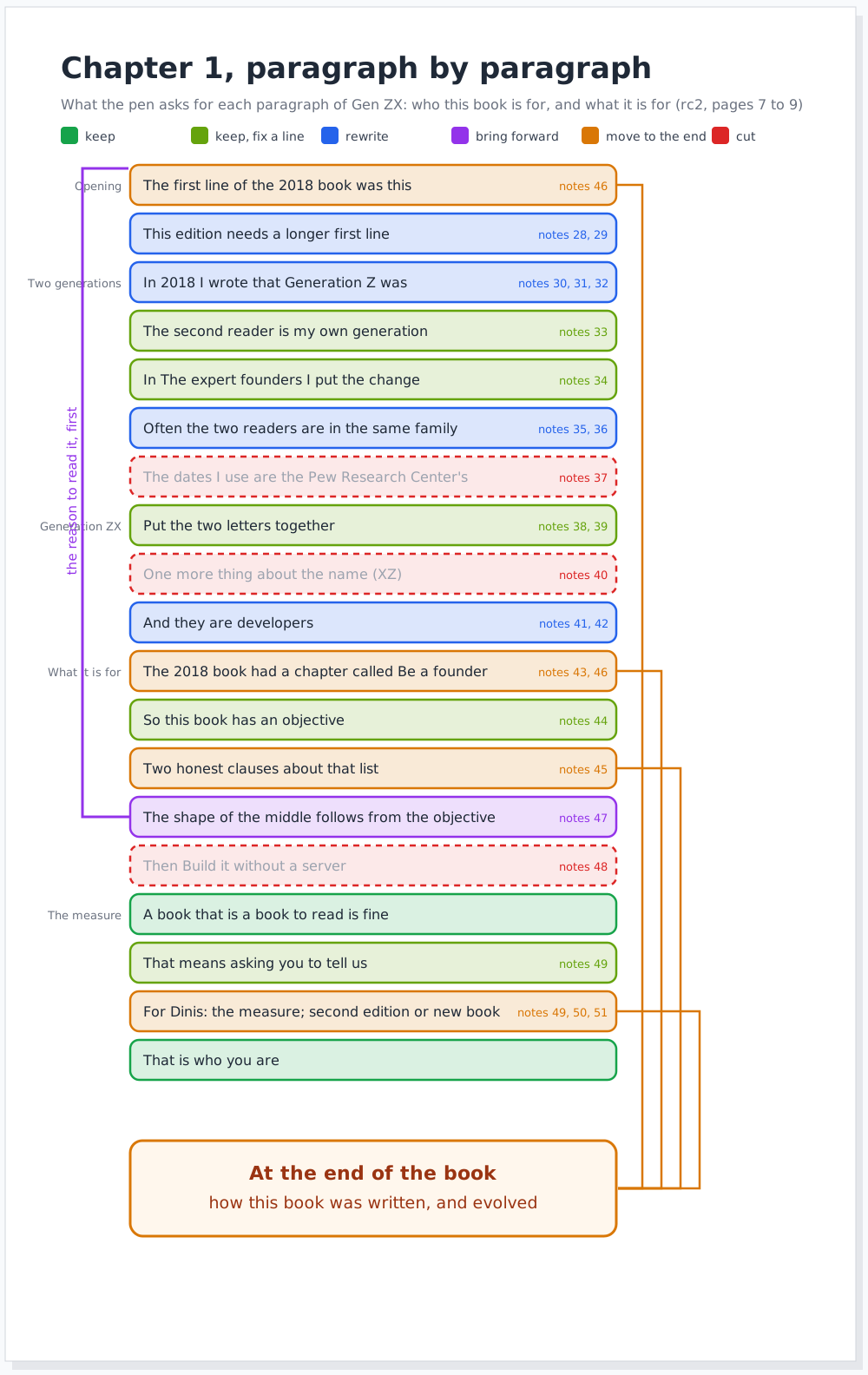
- **Chapter 1, paragraph by paragraph.** Nineteen blocks: three kept or brought forward, nine fixed or rewritten, four moved to the end, three cut.
## Part of a series {#series}
This is the second article of *RC2 on paper*, one article per batch of photographs Dinis sends from the printed release candidate. [Part 1](/agent-articles/dinis-pen-made-readable.html) has the title page and the contents, how the pages are drawn, and the first five themes. The notes are numbered across the series, so a note's number is its address: note 20 is note 20 wherever it is quoted. Each batch is a record (`admin/content/reviews/paper/rc2-02.json` for this one) that the build draws; click any drawing for its full size.
## Page 4, About this release candidate {#page-4}
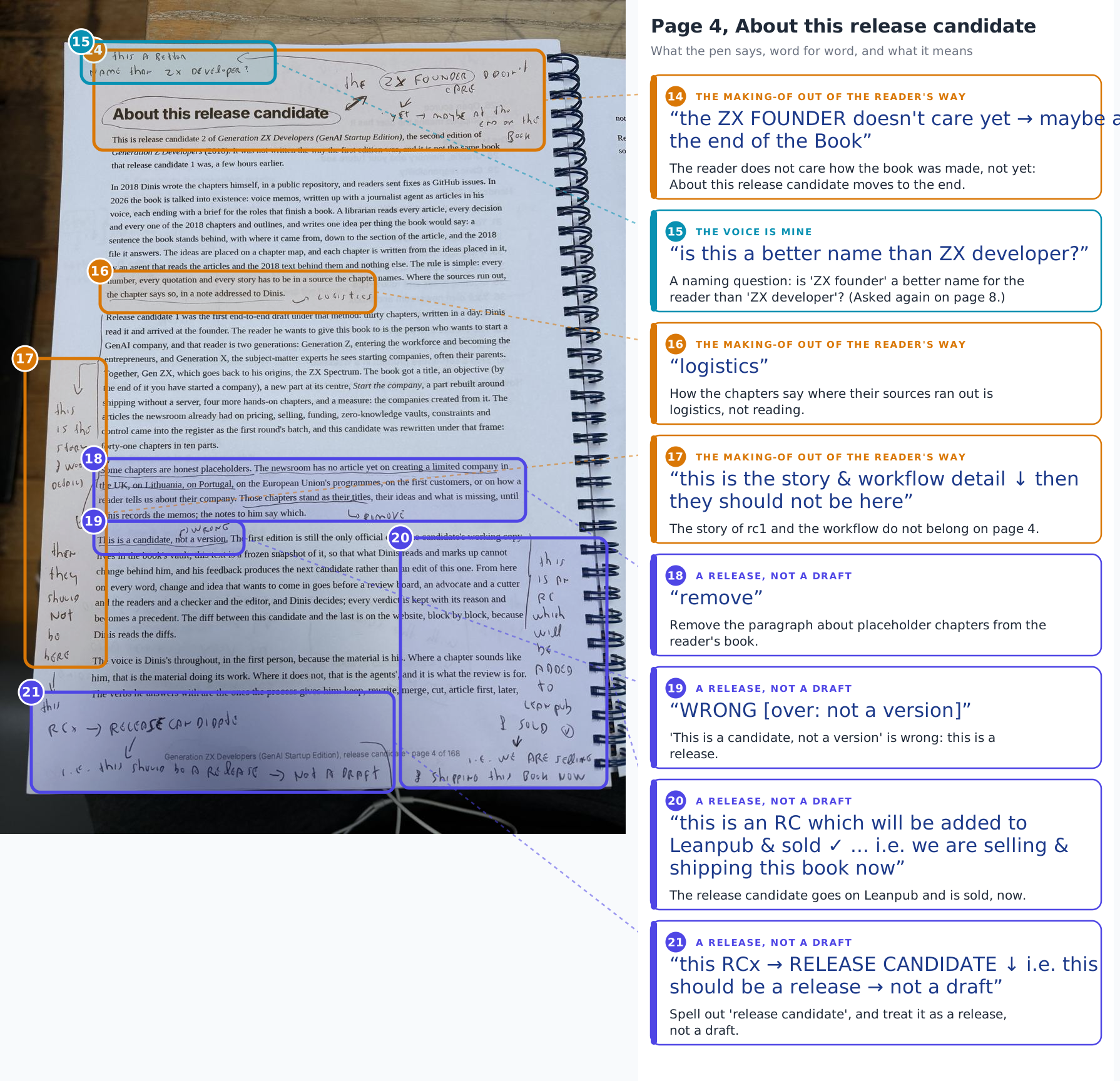
The page about how the book was made gets the shortest verdict of the batch: "the ZX FOUNDER doesn't care yet → maybe at the end of the Book". The paragraphs on rc1 and the workflow are "the story & workflow detail", so "then they should not be here"; the placeholders paragraph, "remove". And then the line that changes the process: next to "This is a candidate, not a version", "WRONG", and beside the paragraph, "this is an RC which will be added to Leanpub & sold", with "i.e. we are selling & shipping this book now". At the foot: "this RCx → RELEASE CANDIDATE", "i.e. this should be a release → not a draft". That is [decision 016](/decisions/index.html#a-release-candidate-is-a-release-shipped-and-sold): a release candidate is released, on Leanpub, and sold, which also answers the open question in [Version 2 on Leanpub](/articles/version-2-on-leanpub.html), upload at v2.0.0 or now. Now.
Above the title, a question that comes back on page 8: "is this a better name than ZX developer?", pointing at *ZX founder*.
## Page 5, the page before chapter 1 {#page-5}
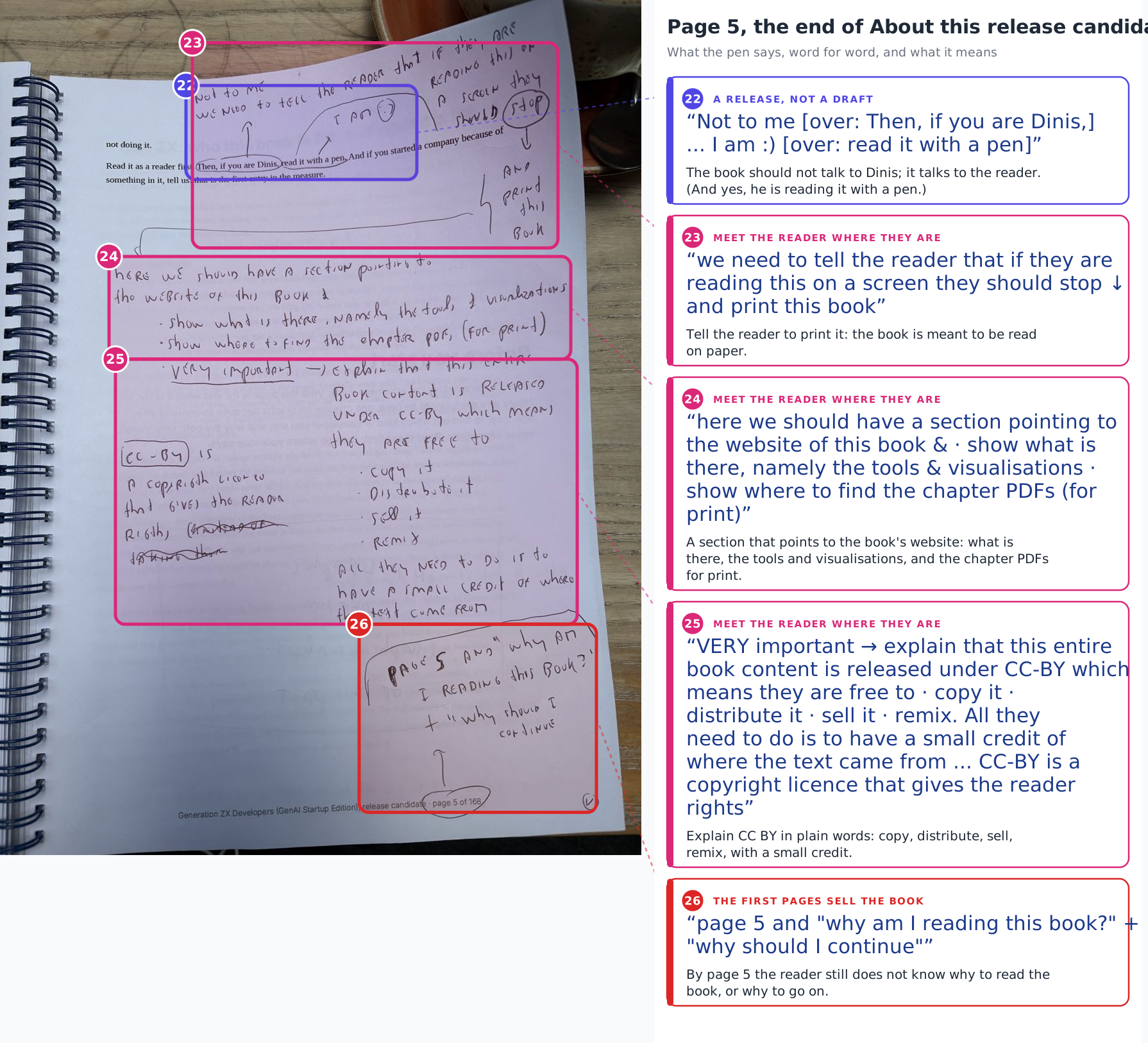
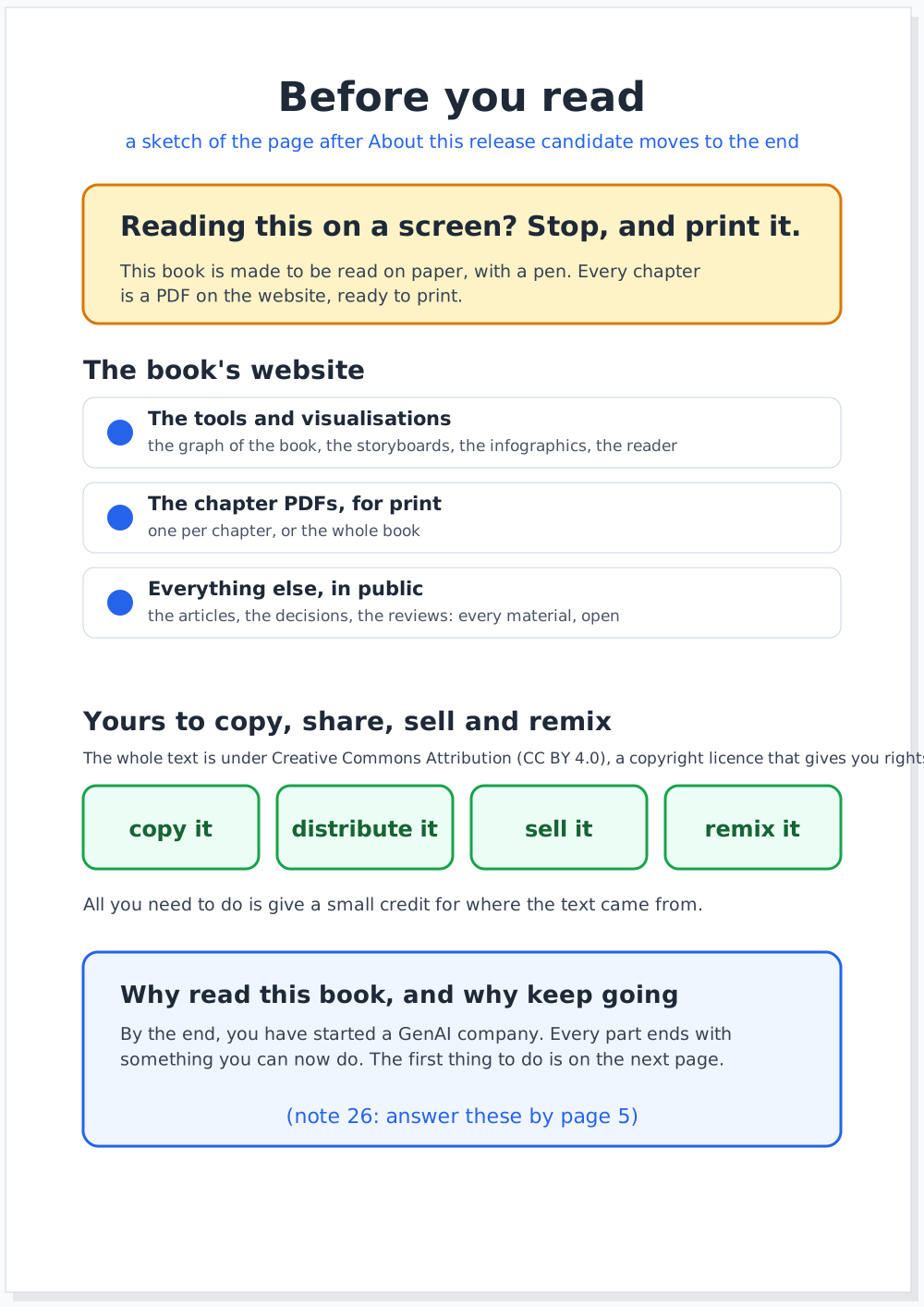
The candidate ends its front matter by talking to Dinis: "Then, if you are Dinis, read it with a pen." The pen answers twice, "Not to me", and, by "read it with a pen", "I am :)". The book talks to the reader, and the reader needs three things the page does not give. First: "we need to tell the reader that if they are reading this on a screen they should stop", and print this book. Second, a section pointing to the website of the book: what is there, "namely the tools & visualisations", and where to find the chapter PDFs for print. Third, marked "VERY important": that the entire book is released under CC BY, which means they are free to copy it, distribute it, sell it and remix it. All they need to do is to have a small credit of where the text came from. And at the foot, with the page number circled: page 5, and still no answer to "why am I reading this book?" or "why should I continue".
## Page 6, the opener of Part 1 {#page-6}
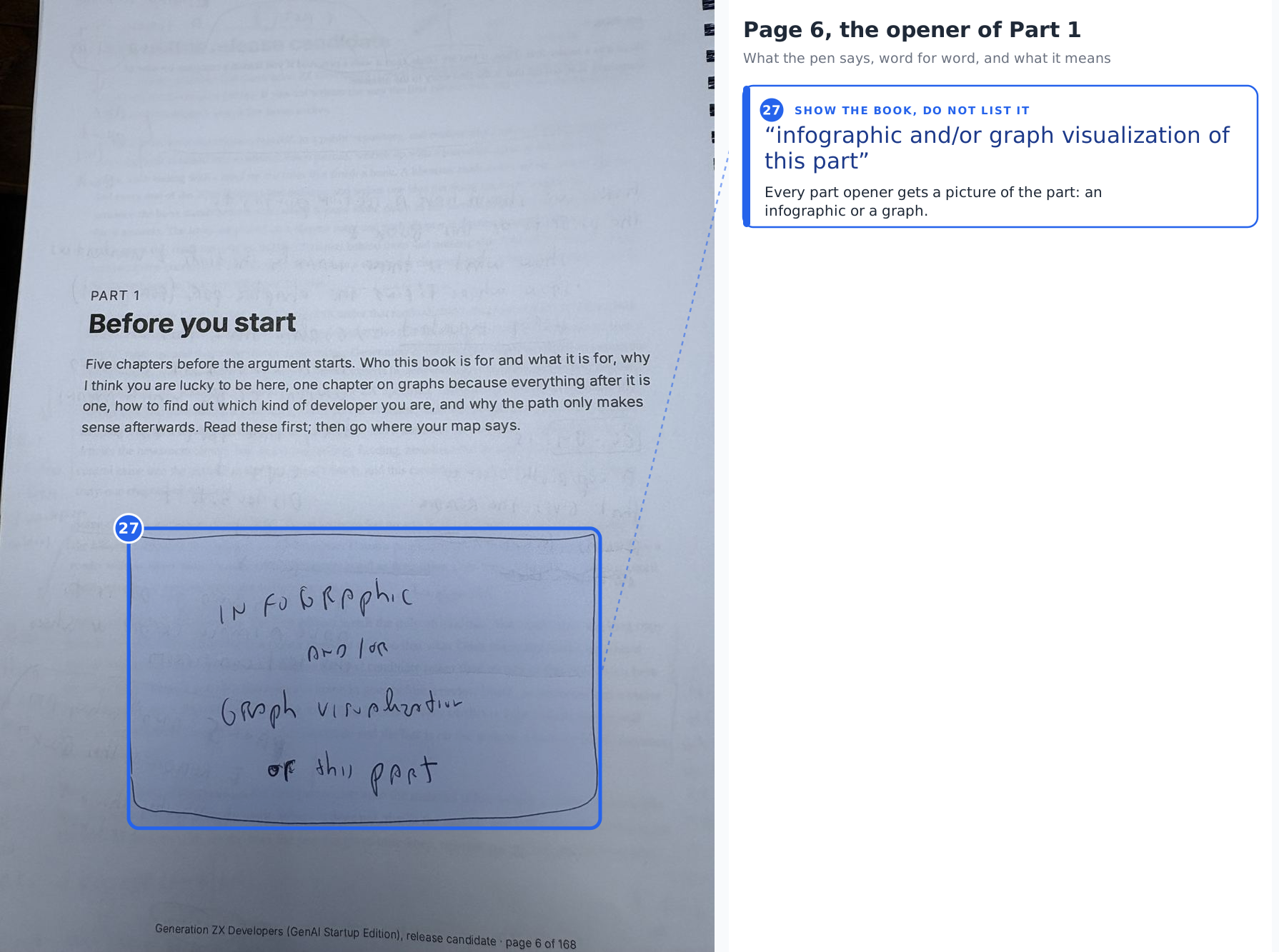
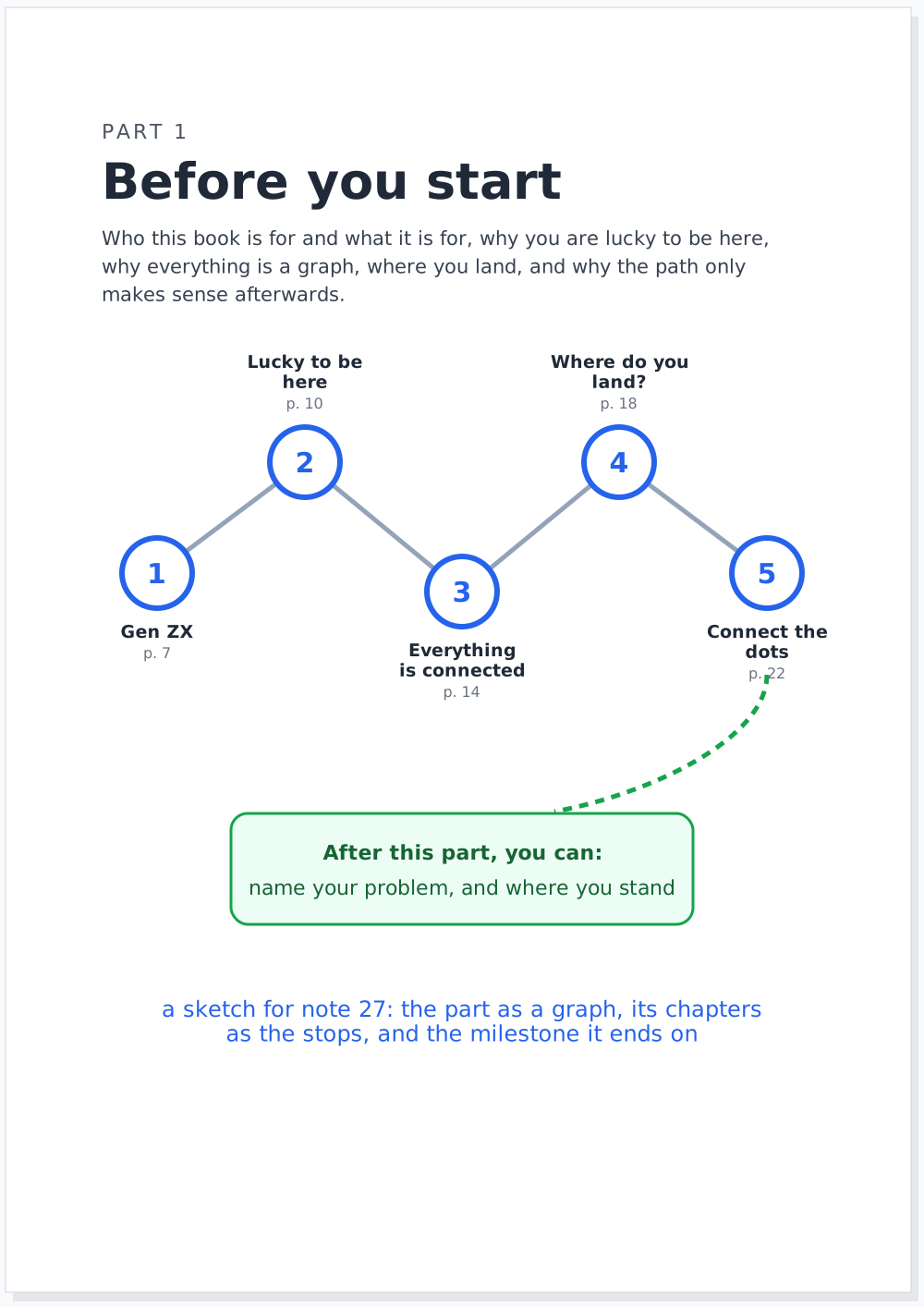
One note, the biggest box in the batch, under the introduction of Part 1: "infographic and/or graph visualization of this part". Every part opener gets a picture of the part, as the contents page asked for every chapter in part 1.
## Pages 7 to 9, chapter 1 {#chapter-1}
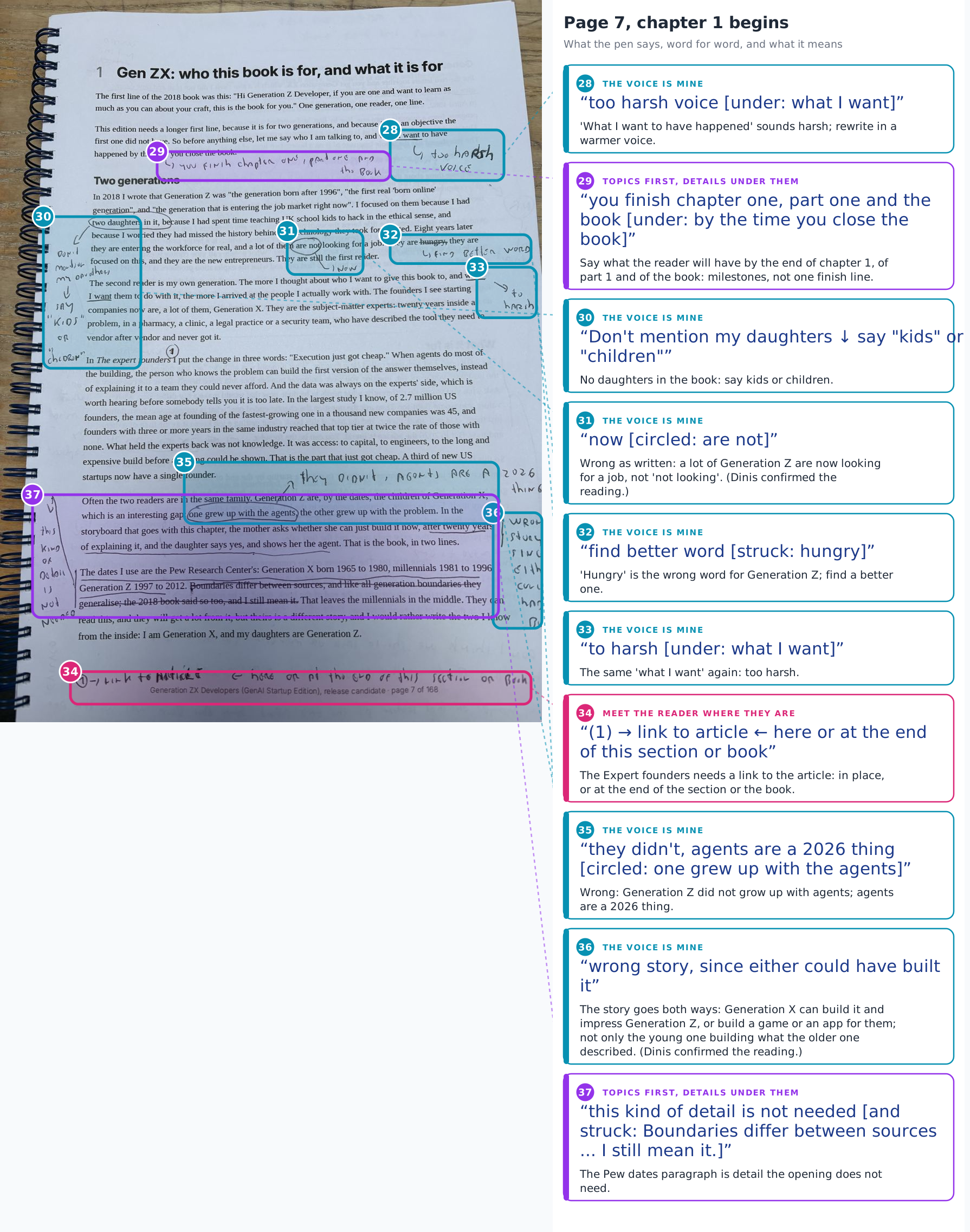
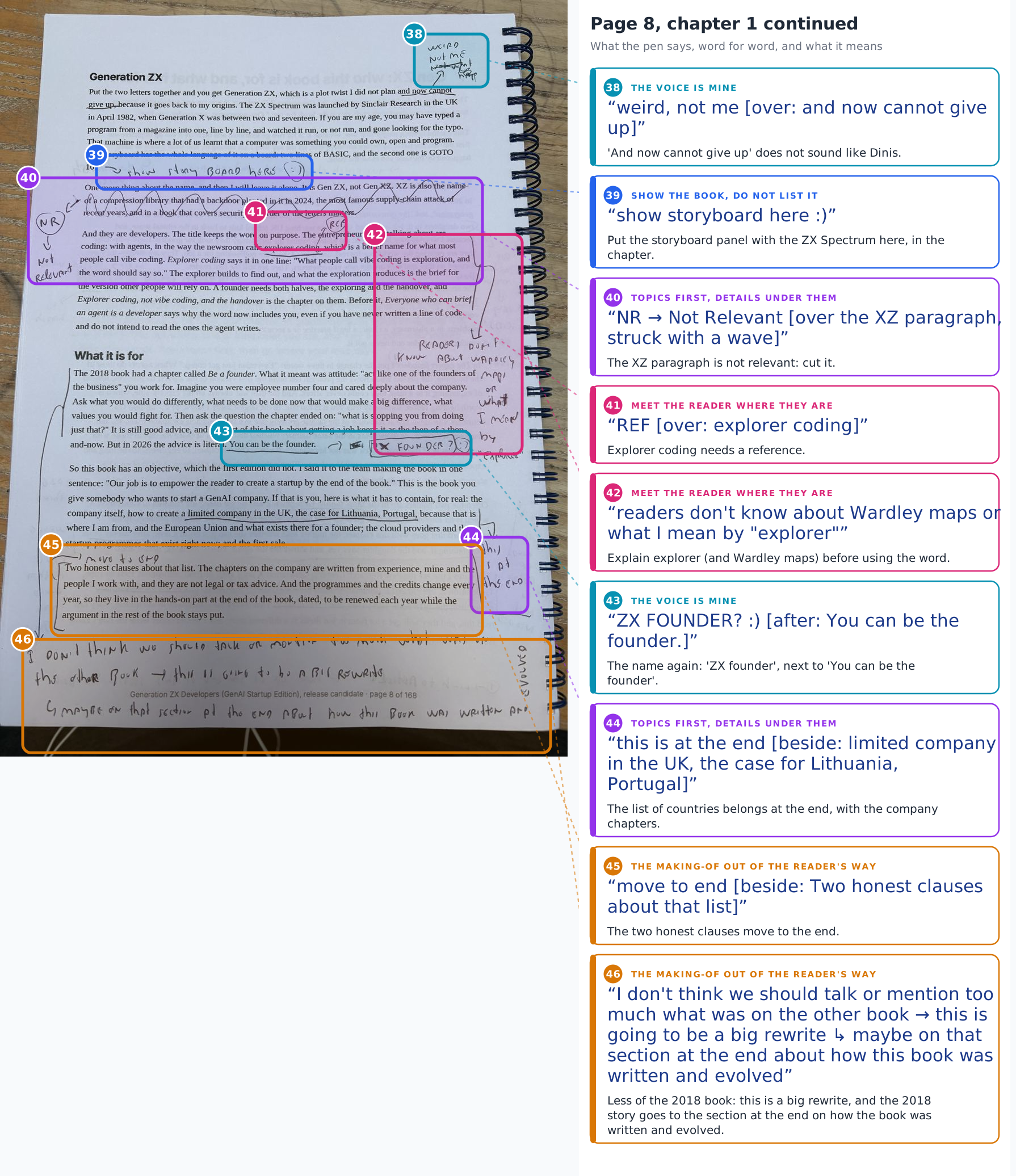
Most of chapter 1's notes are about the voice. "What I want to have happened by the time you close the book" is "too harsh voice", and the same phrase later, "to harsh"; it should be what you will have when "you finish chapter one, part one and the book". The daughters: "Don't mention my daughters", say "kids" or "children". "Hungry" is struck: "find better word". "And now cannot give up" is "weird, not me". One fact is wrong: "one grew up with the agents" is circled, and "they didn't, agents are a 2026 thing"; the mother-and-daughter line beside it is "wrong story".
Then the detail the opening does not need: the Pew dates ("this kind of detail is not needed"), the XZ paragraph ("NR", not relevant), the list of countries ("this is at the end"), the two honest clauses ("move to end"), and *Build it without a server* with its products ("too much detail at this stage of the book"). The reader's context: *The expert founders* needs a link, explorer coding a reference, and "readers don't know about Wardley maps or what I mean by "explorer"". The storyboard belongs in the chapter: "show storyboard here :)". And the long note at the foot of page 8: "I don't think we should talk or mention too much what was on the other book → this is going to be a big rewrite", maybe in the section at the end "about how this book was written and evolved".
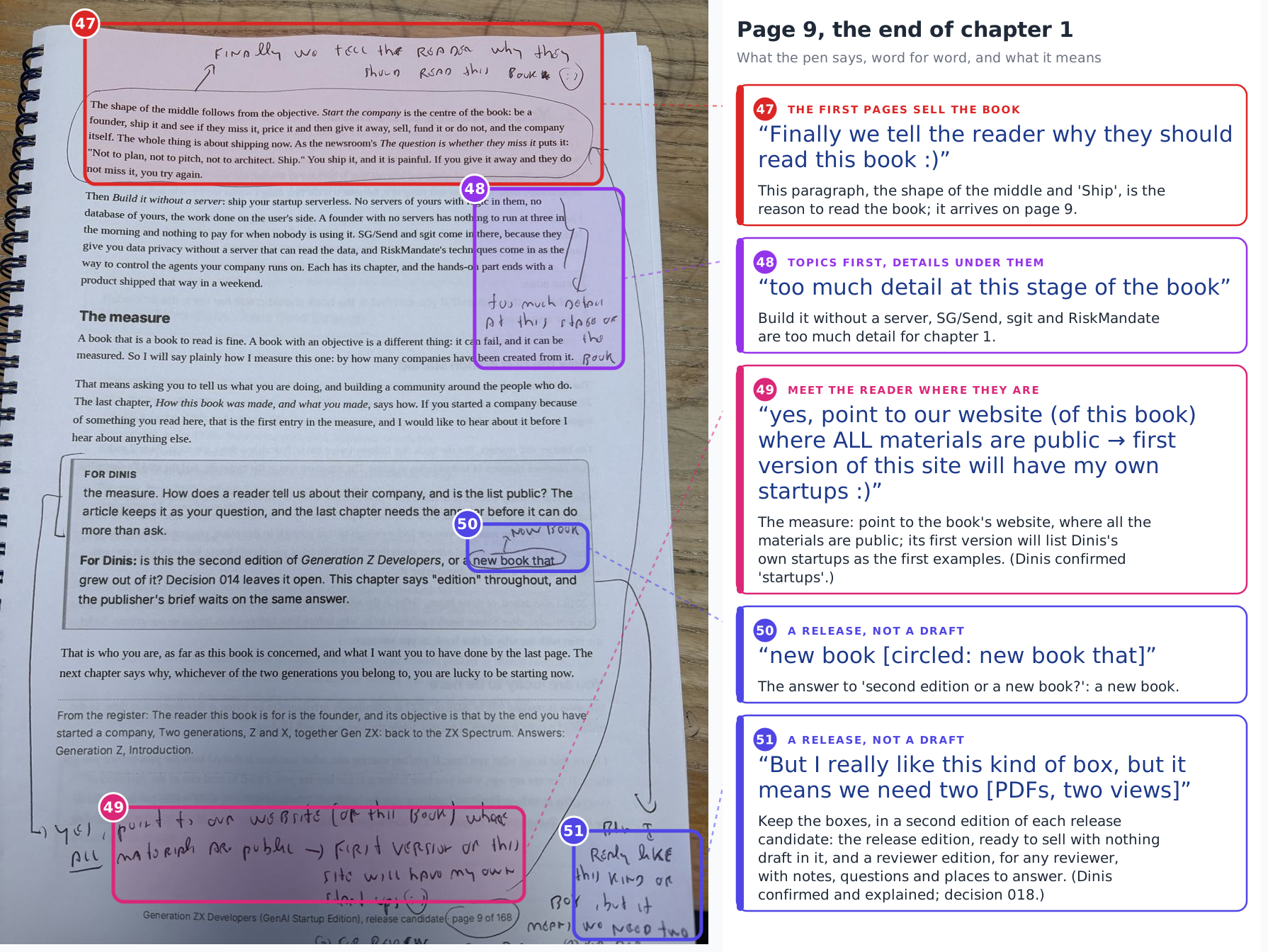
The best note is at the top of page 9, over the paragraph on the shape of the middle and "Not to plan, not to pitch, not to architect. Ship.": "Finally we tell the reader why they should read this book :)". On page 9. Beside the two *For Dinis* boxes: the measure, "yes, point to our website (of this book) where ALL materials are public"; the edition, "new book" ([decision 017](/decisions/index.html#generation-zx-developers-is-a-new-book)); and "But I really like this kind of box, but it means we need two", which runs off the photograph.
## The themes, after two batches {#themes}
| Theme | Part 1 | Part 2 | What it asks |
|---|---|---|---|
| **The first pages sell the book** | 4, 5, 12 | 26, 47 | The reason to read by page 3; today it is on page 9 |
| **Show the book, do not list it** | 1, 2, 6, 9 | 27, 39 | A picture on every opener; the storyboard in the chapter |
| **Doing starts early, and runs through** | 8, 11 | | |
| **Topics first, details under them** | 7, 10 | 29, 37, 40, 44, 48 | Detail after the point, or not at all |
| **The making-of out of the reader's way** | 3, 13 | 14, 16, 17, 45, 46 | About this release candidate and the 2018 story to the end |
| **The voice is mine** (new) | | 15, 28, 30, 31, 32, 33, 35, 36, 38, 43 | Warmer, like Dinis, no family, facts right |
| **Meet the reader where they are** (new) | | 23, 24, 25, 34, 41, 42, 49 | Print it, the website, CC BY, links, terms explained |
| **A release, not a draft** (new) | | 18, 19, 20, 21, 22, 50, 51 | Shipped and sold; it reads as a book |
The making-of theme grew most, and it points one way: there should be a section at the end, *How this book was written and evolved*, and everything about the process, the 2018 book and the candidates goes there. The voice is the new theme with the most notes, and it is the one an agent cannot fix by moving text: it needs Dinis's ear, line by line.
## After: three sketches {#after}
Notes 22 to 26: the page before chapter 1, written to the reader. Print it; the website and what is on it; the four freedoms of CC BY and the one condition; why read it. Wording is a draft.Note 27: the part as a graph, its chapters as the stops with the page each starts on, and what you can do at the end of it.Chapter 1 paragraph by paragraph: keep, fix a line, rewrite, bring forward, move to the end, or cut, with the notes behind each. The reason to read moves to the front; the 2018 book, the honest clauses and the For Dinis boxes go to the end.
## The strip {#strip}
[Not to me](/storyboards/not-to-me.html), eight panels, the second experiment in pacing. Marta reads the book on her phone, and the book tells her what to do if she is Dinis. This time the strip tries a running gag across three panels (the book keeps addressing someone else), a prop that changes hands (Zara arrives with the printed copy), and a late payoff: the reason to read the book arrives in panel 7, exactly as late as it does on page 9.
## What Dinis answered {#questions}
Four readings were uncertain; Dinis answered them the same day, by voice, and the record now has his words:
- **Note 31** says "now": the text says a lot of Generation Z are not looking for a job, which is wrong; a lot of them are now looking for one.
- **Note 36** says "wrong story, since either could have built it": the story goes both ways. Generation X can build it and impress Generation Z, or build a game or an app for them.
- **Note 49** says "startups", not stand-ups: the book's website will have Dinis's own startups as the first examples.
- **Note 51** says we need two: two PDFs, a release edition and a reviewer edition, recorded as [decision 018](/decisions/index.html#every-release-candidate-has-two-editions) and written up in [Two editions, the release and the review](/articles/two-editions-the-release-and-the-review.html).
Still open: **notes 15 and 43**, *ZX founder* or *ZX developer* for the reader.
## What goes where {#editor}
The thirty-eight notes go to the editor as findings on rc2 for the next release candidate, with a brief; the voice notes need Dinis line by line. Decisions 016 and 017 are recorded, and the repository's contract (`CLAUDE.md`) now says what decision 016 says about release candidates. The publisher has a brief: the release candidate goes on Leanpub now, as a new book.
## What this does not claim {#limits}
- **The reading is mine**, word for word as I read it, including "to harsh" and "visualization"; four readings were uncertain, and Dinis answered them (above).
- **Two notes became decisions** because they answer questions that were asked of Dinis and are in his hand; if either is not what he meant, the decision is one file to correct.
- **The positions are approximate**, drawn by eye on the photographs.
- **The sketches are not designs.** The wording on the page before chapter 1 is mine and marked as a draft.
- **The fates in the chapter 1 map are my reading of the notes.** A paragraph with no note is marked keep.
## Where this comes from {#sources}
Dinis's six photographs of 19 October 2026, pages 4 to 9 of the printed release candidate 2, and his message asking for one article per batch, as a series. The candidate's text is `v2/versions/v2.0.0-rc2.md`; the page numbers are the printed PDF's. Written by the journalist, in its own voice, as [decision 007](/decisions/index.html#two-kinds-of-article) asks.